Disclosure: airfryerkitchensupply.com is reader-supported. When you buy through links on our site, we may earn an affiliate commission at no extra cost to you.
Where to buy
Apartment charcoal grilling lives or dies on permission — most multi-unit buildings prohibit it — so this guide opens every relevant section with that reality and then serves the readers who can grill with charcoal: ground-floor patios, townhouses, and the minority of buildings that allow it. Every pick was confirmed as a current Amazon listing through a Amazon listing data verification pass before earning a link. The short version: the Weber Smokey Joe is the best apartment charcoal grill for most permitted situations, the AKORN Jr. is the best insulated option, and the Lodge Sportsman’s Pro is the choice for sear-obsessed cooks for two. Check the current price on Amazon for each pick, and verify your lease and fire code before lighting anything — this guide explains how.
- Weber Smokey Joe Portable Charcoal Grill, 14-Inch (Best Overall Apartment Charcoal Grill): Check the current price on Amazon
- Weber Jumbo Joe Charcoal Grill, 18-Inch (Best for Two-to-Three People): Check the current price on Amazon
- Char-Griller AKORN Jr. Portable Kamado Charcoal Grill (Best Insulated / Low-Smoke Potential): Check the current price on Amazon
- Cuisinart 14-Inch Portable Charcoal Grill (CCG-190RB) (Best Budget Apartment Charcoal): Check the current price on Amazon
- Lodge Sportsman’s Pro Cast Iron Grill (Best for Searing (Ground Patios)): Check the current price on Amazon
- Weber Go-Anywhere Portable Charcoal Grill (Best Rectangular / Tabletop Format): Check the current price on Amazon
The best apartment charcoal grills share three traits that have nothing to do with cooking and everything to do with keeping the privilege: they are small, they contain their fire completely, and they produce a modest, manageable amount of smoke. Charcoal is the most restricted grilling fuel in multi-unit housing — banned outright in most apartment buildings by lease, code or both — so this guide is written for the readers whose situation permits it: ground-floor units with private patios, townhouses, duplexes, and buildings whose written rules allow small charcoal grills. If that is not verifiably you, the honest recommendation is this site’s electric apartment picks, and this guide says so up front rather than after you have bought a grill you cannot light.
Within the permitted world, charcoal at apartment scale is a delight. A small kettle or kamado burns a handful of charcoal, cooks for one to three people with real fire flavor, contains its ash in a lidded vessel, and stores in a corner or closet. The picks here were chosen on apartment criteria first — footprint, smoke volume, ash containment, lid security, storability — and cooking quality second, though you will notice the winners are also simply excellent small grills: Weber’s kettles, Char-Griller’s insulated kamado, Lodge’s cast-iron classic and Cuisinart’s budget portable are the small charcoal aristocracy by any measure.
Smoke management is the social contract that keeps apartment charcoal legal in practice. A small grill burning a small, hot, clean fire produces a fraction of the smoke of a big grill smoldering a large load — technique is therefore part of the product, and this guide’s how-to section teaches the low-smoke routine explicitly: fully lit charcoal, lid discipline, lean menus on weeknights, and ash handled like the regulated waste it is. Buy the right small grill, run it considerately, and apartment charcoal is sustainable. Buy big or burn dirty, and you will lose the privilege for yourself and probably your building.
In this guide
Quick Picks
Six small charcoal grills for permitted apartment patios and balconies: two Weber kettles, an insulated kamado, a cast-iron hibachi, a rectangular traveler and a budget portable — all sized for one to three people.
- Weber Smokey Joe Portable Charcoal Grill, 14-Inch — Best Overall Apartment Charcoal Grill. A 14-inch enameled kettle whose lid locks on for carrying — small fire, contained ash, real damper control, and a footprint that disappears into a closet. — check price on Amazon
- Weber Jumbo Joe Charcoal Grill, 18-Inch — Best for Two-to-Three People. The Smokey Joe’s formula at 18 inches: locking lid, enameled kettle, and enough grate for two to three people — the step-up when the 14 feels tight. — check price on Amazon
- Char-Griller AKORN Jr. Portable Kamado Charcoal Grill — Best Insulated / Low-Smoke Potential. A triple-wall insulated steel kamado at 155 square inches with cast-iron grates — burns the least charcoal per cook, and with it, makes the least smoke. — check price on Amazon
- Cuisinart 14-Inch Portable Charcoal Grill (CCG-190RB) — Best Budget Apartment Charcoal. A 14-inch portable with dual vents, three lid locks and a 196-square-inch total figure in Cuisinart’s listing — the budget route into contained apartment charcoal. — check price on Amazon
- Lodge Sportsman’s Pro Cast Iron Grill — Best for Searing (Ground Patios). A solid cast-iron hibachi-format grill, 9 × 16.75 inches, with dual vents — skillet-grade searing for two, on the smallest footprint in this guide. — check price on Amazon
- Weber Go-Anywhere Portable Charcoal Grill — Best Rectangular / Tabletop Format. Weber’s rectangular traveler: folding legs that lock the lid for carrying, a two-piece grate, and a shape that packs and stores like a briefcase. — check price on Amazon
How These Picks Were Chosen
Candidates were screened on apartment fitness before cooking merit: the grill had to cook for one to three people, contain its fire under a lid, manage ash without scattering, and store in apartment-scale space. Large kettles and barrels were excluded regardless of quality — a 22-inch kettle is a fine grill and a poor apartment neighbor. Survivors were verified against Amazon’s catalog on this site, and ranked on the balance of containment, smoke behavior, cooking quality and value.
One deliberate inclusion needs explaining: the Lodge Sportsman’s Pro is an open hibachi-style grill rather than a lidded kettle, included because its tiny footprint, skillet-grade searing and complete fuel containment in a cast-iron body make it a legitimate apartment option for ground-level patios — with the explicit caveat that its open design demands the most supervision and the most distance discipline of any pick here. Conversely, several competent small charcoal grills were excluded for open, lids-off designs with poor ash containment. Permission language in this article is general guidance; your lease and local code are the law of your balcony.
The 6 Best Apartment Charcoal Grills
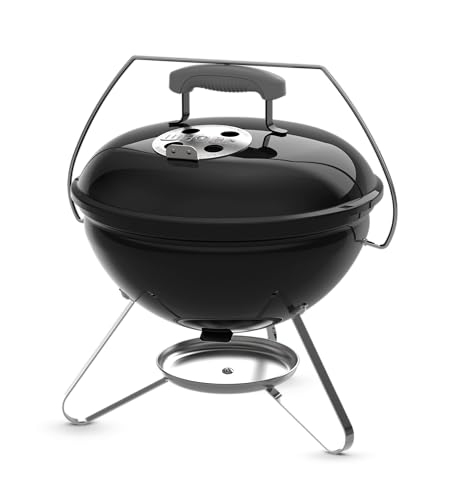
Weber Smokey Joe Portable Charcoal Grill, 14-Inch — Best Overall Apartment Charcoal Grill
The Smokey Joe is the apartment charcoal benchmark because every one of its traits answers an apartment problem. The 14-inch bowl burns a small chimney of charcoal — a modest fire with modest smoke. The Tuck-N-Carry lid lock clamps the lid, grate and ash into one contained package you can carry and store without spills. The porcelain enamel shrugs off balcony weather, and the dampers give genuine two-zone control in miniature for steaks, burgers, skewers and vegetables for one or two people. It suits permitted balconies, small patios and anyone whose grill must live in a closet between cooks.
Strengths
- Locking lid contains ash and makes storage spill-proof
- Small, efficient fire — the lowest smoke volume of the kettle picks
- Full Weber enamel durability and parts support in miniature
Trade-offs
- Cooks for one to two — guests mean waves, honestly stated
- No enclosed ash catcher like the big kettles; empty it carefully
- Charcoal permission required — banned in many buildings
| Spec | Detail |
|---|---|
| Size | 14-inch kettle |
| Carry/storage | Tuck-N-Carry lid lock |
| Construction | Porcelain-enameled steel |
| Fuel | Charcoal, small loads |
Containment is the Smokey Joe’s apartment superpower. A balcony grill gets moved constantly — out for cooking, back for storage, aside for space — and every move is an ash-spill opportunity that the locking lid simply eliminates. The same lock makes it the only pick here you can store on a closet shelf with complete confidence. As a cooker it is a true kettle: bank the coals for two zones, park the lid vent over the food, and it roasts a small chicken piece load or sears two steaks with the same technique as its 22-inch sibling, just scaled to a couple’s dinner.
Its discipline requirements are size-related, not quality-related: plan menus for two, light a small chimney rather than a full one (less smoke, less waste), and let ash cool fully before the careful empty into a metal container. Owners in permitted buildings consistently find it the grill that never causes a problem — and in apartment grilling, that is the highest praise there is.
Best for: permitted balconies and small patios cooking for one or two / Not suited for: families, hosts, or any building where charcoal is prohibited
Check on Amazon — check the current price on Amazon before you decide, because grill pricing moves with the season.

Weber Jumbo Joe Charcoal Grill, 18-Inch — Best for Two-to-Three People
The Jumbo Joe answers the Smokey Joe’s one limitation — capacity — while keeping its apartment virtues. The 18-inch grate cooks for two to three with genuine working room: four to six burgers with space to move them, a spatchcocked small chicken over a two-zone fire, or a full skewer session. The Tuck-N-Carry lock still clamps everything for storage, and the enamel construction still shrugs off weather. It suits couples who cook for a friend regularly, small ground-floor patios, and apartment cooks who found the 14-inch a wave-cooking exercise once too often.
Strengths
- 18-inch grate: real two-zone room for two to three people
- Locking lid storage, same as the Smokey Joe
- Still a small, efficient fire by apartment standards
Trade-offs
- Bigger fire and more smoke than the 14-inch — technique matters
- Footprint and storage size grow accordingly
- Charcoal permission required, as with every pick here
| Spec | Detail |
|---|---|
| Size | 18-inch kettle |
| Carry/storage | Tuck-N-Carry lid lock |
| Construction | Porcelain-enameled steel |
| Audience | 2–3 people |
Eighteen inches is the diameter where kettle technique fully unlocks: the indirect zone fits actual food, the direct zone sears with room to spare, and the fire is still small enough for apartment smoke manners. In practice the Jumbo Joe is the pick for couples who grill like they mean it — weeknight steaks with a vegetable side cooked simultaneously, weekend chicken pieces without waves. The locking lid keeps the storage story identical to its smaller sibling, and Weber’s parts support covers its grates and dampers indefinitely.
Choose between the two kettles by honest headcount and storage: the 14 for strict one-to-two and the tightest closets, the 18 for two-to-three and any regular guest. Either way you are inside the most proven design in charcoal, sized to apartment reality — which is why Weber takes the top two slots in this guide without apology.
Best for: couples and small patios cooking for two to three / Not suited for: strict solo cooks with minimal storage — take the Smokey Joe
Check on Amazon — check the current price on Amazon before you decide, because grill pricing moves with the season.

Char-Griller AKORN Jr. Portable Kamado Charcoal Grill — Best Insulated / Low-Smoke Potential
Insulation is an apartment feature, and the AKORN Jr. is its proof. Because its triple-wall steel body wastes almost no heat, it cooks a meal on a remarkably small load of lump charcoal — and small, hot, efficient fires are clean fires, producing the least smoke of any pick in this guide once lit. The same insulation holds a low smoking temperature for a small shoulder or runs hot for a cast-iron-grate sear, and the locking lid contains everything for patio storage. It suits permitted patio cooks for one to three who want the widest cooking range from the smallest fuel footprint.
Strengths
- Most fuel-efficient pick: smallest charcoal load, least smoke per cook
- Widest temperature range here — low smoking to high searing
- Locking lid, insulated steel body, cast-iron grates
Trade-offs
- 155 sq. in. is a firm capacity ceiling
- Heavier than the kettles for its size — it lives where you place it
- Lighting still produces a smoke burst; time it considerately
| Spec | Detail |
|---|---|
| Cooking area | 155 sq. in. |
| Construction | Triple-wall insulated steel |
| Grates | Cast iron |
| Fuel | Charcoal, preferably lump |
The Jr.’s apartment case rests on combustion quality. An insulated kamado brings its small fuel load to temperature quickly and then sips air to hold it, which means the long, smoldering, smoky phase that annoys neighbors is compressed into the lighting minutes. Run with lump charcoal — which lights cleaner than briquettes — and a chimney started at a considerate hour, it is the most neighbor-compatible charcoal cooking in this guide. As a cooker it is also the most versatile: ribs for two at lunch, steaks at searing heat for dinner, from one small steel egg.
Its costs are capacity and commitment: 155 square inches is 155 square inches, and kamado cooking asks you to learn vent control rather than spread-and-forget grilling. For the apartment cook who treats charcoal as a craft and whose building permits it, those are features disguised as costs. For a beginner who wants the simplest possible start, the Smokey Joe is the gentler teacher.
Best for: permitted patios wanting minimum smoke and maximum range for one to three / Not suited for: beginners wanting the simplest kettle learning curve
Check on Amazon — check the current price on Amazon before you decide, because grill pricing moves with the season.

Cuisinart 14-Inch Portable Charcoal Grill (CCG-190RB) — Best Budget Apartment Charcoal
The Cuisinart CCG-190RB is the budget answer to the Smokey Joe, built on the same apartment logic: a lidded 14-inch bowl, lid locks (three of them) for contained carrying and storage, and a dual-vent system for fire control. Its listing cites 196 square inches, and its chrome-plated grate and enameled firebox keep the price tier low while the format stays right. It suits budget buyers in permitted buildings, first-time charcoal cooks testing whether balcony grilling suits their life, and campers who want a grill that double-duties at home and away.
Strengths
- Budget tier with the right apartment format: lid, locks, vents
- Three lid locks make transport and storage genuinely secure
- Dual vents give more fire control than most budget portables
Trade-offs
- Chrome-plated grate and lighter build trail Weber’s enamel durability
- Parts support is thinner than Weber’s ecosystem
- Same one-to-two-person capacity ceiling as the Smokey Joe
| Spec | Detail |
|---|---|
| Size | 14-inch portable |
| Vents | Dual air vent system |
| Carry | 3 lid locks, one-handed carrying (listing) |
| Grate | Chrome-plated |
Budget portables usually cut the containment features that make apartment charcoal workable; the Cuisinart’s merit is that it does not. The locking lid keeps ash where it belongs between patio and closet, the dual vents let a beginner actually steer a fire, and the whole package is light and small enough to store without negotiation. Cooking performance is honest budget-kettle performance — good burgers, dogs and skewers, with two-zone cooking possible in miniature — and for a first apartment grill, format correctness matters more than the last degree of sear.
The durability gap to Weber is real and stated plainly: plated grates and lighter steel will show age sooner, and if charcoal becomes a weekly ritual you will likely upgrade to a Weber within a few years. As a first, inexpensive, correctly-shaped step into permitted apartment charcoal, though, it is exactly right — and it remains a fine camping grill even after the upgrade.
Best for: budget buyers and first-timers in permitted buildings / Not suited for: buy-once shoppers — Weber’s enamel is the long game
Check on Amazon — check the current price on Amazon before you decide, because grill pricing moves with the season.

Lodge Sportsman’s Pro Cast Iron Grill — Best for Searing (Ground Patios)
The Sportsman’s Pro is the specialist: a heavy cast-iron grill whose cooking surface behaves like the world’s best skillet, because it essentially is one. For a ground-floor patio cook for one or two who prizes crust — steaks, chops, smash-style burgers, charred vegetables — nothing else here sears like seasoned cast iron heated over charcoal. Its footprint is the smallest in the guide, it contains its small charcoal load in an iron body, and it will outlive every other pick. The caveats are structural: it is an open grill without a lid, so it demands constant supervision, generous distance from anything combustible, and it is a ground-patio tool, not a wooden-balcony one.
Strengths
- Unmatched searing: massive cast-iron grate over charcoal
- Smallest footprint here; indestructible construction
- Dual vents and draft door give surprising fire control
Trade-offs
- Open design: no lid — most supervision and distance discipline required
- No roasting or smoking; it is a direct-heat specialist
- Heavy for its size, and cast iron needs seasoning care
| Spec | Detail |
|---|---|
| Surface | 9 × 16.75 inches |
| Construction | Cast iron body and grate |
| Features | Removable grate, dual air vents, draft door |
| Format | Open hibachi-style, ground use |
Sear quality is a function of stored heat, and the Lodge’s iron grate stores more heat per inch than anything else in this guide: food lands and the surface temperature holds, building crust instead of steaming. For the apartment cook whose menu is a great steak for two rather than a varied cookout, that single virtue can outweigh every missing feature. The dual vents and draft door give more control than hibachis historically offer, letting you bank the fire’s intensity up or down across a cook. And its permanence is a genuine apartment virtue — a grill you buy once and store in a cabinet for decades.
Respect its terms and it is a jewel: use it on a non-combustible ground surface, never on a wooden deck or balcony floor, never unattended, and with clear space around it. Buildings or situations that cannot offer those terms should choose a lidded kettle instead — the Smokey Joe contains its fire for exactly those environments. Matched correctly, the Lodge is the pick owners keep for life.
Best for: ground-patio sear specialists cooking for one or two / Not suited for: wooden balconies, unattended cooking, or anyone needing a lid
Check on Amazon — check the current price on Amazon before you decide, because grill pricing moves with the season.

Weber Go-Anywhere Portable Charcoal Grill — Best Rectangular / Tabletop Format
The Go-Anywhere’s rectangle is its apartment argument. Round kettles store awkwardly; this grill’s legs pivot to lock the lid shut and the whole unit packs into a flat, briefcase-like package that slides into a closet, under a bed or onto a shelf — the storage geometry apartment dwellers actually have. On a sturdy heat-safe table or stand it cooks for one to two with Weber’s usual damper control and enamel durability, and its rectangular grate suits skewers, asparagus and long vegetables better than a small round grate does. It suits storage-critical apartments in permitted buildings and cooks who also take their grill traveling.
Strengths
- Briefcase pack-down: the best storage shape in this guide
- Legs lock the lid for contained, spill-free carrying
- Rectangular grate suits skewers and long foods; enamel build
Trade-offs
- Tabletop format needs a genuinely heat-safe, stable surface
- Capacity is one to two people, like the Smokey Joe
- Rectangular two-zone fires take a cook or two to learn
| Spec | Detail |
|---|---|
| Format | Rectangular portable, folding locking legs |
| Grate | 2-piece cooking grate (listing) |
| Construction | Porcelain-enameled steel |
| Storage | Flat briefcase profile |
Storage is the silent killer of apartment grilling — a grill that lives in the way gets sold or abandoned — and the Go-Anywhere is engineered around that fact more completely than any pick here. Folded, it is a flat case; the locking legs mean it travels from closet to patio with its ash and grate contained, and its light weight makes the trip trivial. As a cooker it is a proper small Weber: the rectangular fire bed takes a two-zone layout along its length, the lid supports roasting small items, and the two-piece grate simplifies adding charcoal and cleaning.
Its tabletop nature is the discipline: it must sit on something that laughs at heat — a metal stand, a stone or concrete surface — never a plastic table or a wooden railing shelf. Ground patios and sturdy metal patio tables suit it perfectly. If your apartment life involves moving the grill for every cook and storing it invisibly after, this is your pick; if it will live assembled on a patio, a kettle’s ergonomics edge it out.
Best for: storage-critical apartments and traveling cooks in permitted buildings / Not suited for: setups without a heat-safe surface to place it on
Check on Amazon — check the current price on Amazon before you decide, because grill pricing moves with the season.
Comparison Table
Apartment fitness first: containment, footprint and smoke decide this table, with capacity honestly capped at one to three people across the board.
| Pick | Badge | Key spec | Best for | Amazon |
|---|---|---|---|---|
| Weber Smokey Joe Portable Charcoal Grill, 14-Inch | Best Overall Apartment Charcoal Grill | 14-inch, locking lid, contained ash | permitted balconies and small patios cooking for one or two | Check price |
| Weber Jumbo Joe Charcoal Grill, 18-Inch | Best for Two-to-Three People | 18-inch, locking lid, two-zone capable | couples and small patios cooking for two to three | Check price |
| Char-Griller AKORN Jr. Portable Kamado Charcoal Grill | Best Insulated / Low-Smoke Potential | Insulated kamado, 155 sq. in. | permitted patios wanting minimum smoke and maximum range for one to three | Check price |
| Cuisinart 14-Inch Portable Charcoal Grill (CCG-190RB) | Best Budget Apartment Charcoal | 14-inch budget portable, locking lid | budget buyers and first-timers in permitted buildings | Check price |
| Lodge Sportsman’s Pro Cast Iron Grill | Best for Searing (Ground Patios) | All cast iron, open hibachi format | ground-patio sear specialists cooking for one or two | Check price |
| Weber Go-Anywhere Portable Charcoal Grill | Best Rectangular / Tabletop Format | Rectangular, briefcase storage, locking legs | storage-critical apartments and traveling cooks in permitted buildings | Check price |
How to Choose an Apartment Charcoal Grill (After You Check Permission)
Permission is step zero, and this guide will not let you skip it: read your lease for charcoal, open-flame and balcony clauses; check your city’s fire code, which in many jurisdictions bans charcoal on multi-unit balconies outright; and ask your landlord or association in writing when documents are unclear. If charcoal is prohibited — the common case — stop here and buy an electric grill from this site’s apartment barbecue guide; a great grill you cannot light is worth nothing. If charcoal is permitted, note the conditions (distance from the building, patio type, ash rules) and buy inside them.
Then choose on containment and scale. The apartment-correct grill is lidded, locks or latches for storage, and cooks for your real headcount — one to two for the 14-inch picks, two to three for the 18-inch Jumbo Joe and the kamado. Prefer enamel or insulated steel construction, which handle balcony weather and small efficient fires best. Think through the full life cycle before buying: where it stores, where the chimney lights, where ash cools for 48 hours in a metal container, and how grease is contained above the neighbor’s patio. A grill whose life cycle fits your space will be used weekly; one that fights your space will be used twice.
Low-Smoke Charcoal Technique for Apartments
Charcoal smoke is worst when fuel is lighting and when fat hits a smoldering fire — and both are manageable. Light with a chimney and let the coals ash over completely before cooking: fully lit charcoal burns hot and comparatively clean, while food over half-lit coals sits in the smokiest phase of the fire. Use lump charcoal for cleaner lighting and less ash volume, and size the load to the meal — the small grills in this guide need a fraction of a big kettle’s fuel, and excess charcoal is excess smoke with no benefit. Keep the lid on and vents set rather than wide open; a controlled fire is a cleaner fire.
Manage the cook itself like a neighbor. Fatty, flare-prone menus produce the most smoke and smell; on weeknights or still evenings, favor leaner items — steaks, chops, chicken pieces with skin managed, skewers, vegetables — and save the bacon-wrapped marathon for a breezy weekend afternoon. Position the grill for the day’s airflow, as far from open windows (yours and theirs) as the patio allows, and consider a small fan to move air outward. Finally, close the dampers when you finish: the fire dies, the smoke ends, and the remaining charcoal is reusable — economy and courtesy in the same gesture.
Ash, Grease and Storage: The Apartment Charcoal Rulebook
Ash is a regulated substance in apartment life, practically speaking. Charcoal ash must cool completely — 48 hours is the safe standard — in a metal container with a lid, set on a non-combustible surface, before it goes into the trash; never into a plastic bin, a dumpster with fresh coals suspected, or a building chute. The lidded, locking designs in this guide help by keeping ash contained in the grill while it cools, but the metal-can step is still yours to perform. Grease follows the same logic: a drip tray or mat under the grill, drippings disposed of sealed in household trash, and nothing poured over a railing, ever — the fastest way to end a building’s charcoal tolerance is a grease incident on the patio below.
Storage closes the loop. Apartment charcoal grills live in closets, storage cages and patio corners; choose the pick whose stored shape fits yours — the Go-Anywhere’s briefcase, the kettles’ locked packages, the kamado’s resident corner. Store charcoal itself dry and sealed, in modest quantities, away from the grill’s heat, and keep lighter cubes or a chimney as your only lighting system — never lighter fluid, whose smell, flare risk and neighbor impact disqualify it in multi-unit life. Run this rulebook and apartment charcoal is a sustainable privilege; skip it and the building will eventually make the decision for everyone.
How to Run a Clean, Low-Smoke Charcoal Session on a Small Patio
This routine is written for the picks in this guide and for the neighbors who make apartment charcoal possible.
- Verify the moment: check wind direction and strength, confirm your grill’s position gives maximum distance from open windows and railings, and set the drip mat and metal ash container before any charcoal moves.
- Light small and clean: fill the chimney only to the meal’s need — a half chimney serves most one-to-two-person cooks on these grills — using a cube starter, never fluid, and let the coals ash over fully before pouring them out.
- Arrange the fire for the menu: bank coals to one side for a two-zone setup on the kettles and Go-Anywhere, or spread a thin even layer for direct-only sessions on the Lodge; place a small drip pan under fatty items on the indirect side.
- Cook lid-on with vents set, opening the lid in short, purposeful intervals; every unnecessary lid lift is a puff of smoke and a temperature swing your small fire must recover from.
- Finish and close down: move food off, close all dampers to starve the fire, and leave the lidded grill undisturbed while it cools — the contained designs in this guide make this step clean and safe.
- Handle the remains on schedule: after full cooling (48 hours for ash), transfer ash to the metal container and then to household trash per your building’s rules, brush the grate, wipe grease from the drip zone, and store the grill in its locked, contained state.
One habit upgrades every session: tell the neighbors. A quick word — or the occasional shared plate — converts your grill from a smell they endure into a feature of the building they enjoy. Apartment charcoal survives on that goodwill as surely as on enamel and steel.
Charcoal Choice and Fire Size for Small-Space Cooking
Fuel choice matters more at apartment scale than anywhere else in charcoal cooking, because your fire is small and close to other people’s homes. Lump charcoal is the apartment default recommended throughout this guide: it lights faster and cleaner than briquettes, produces less ash to dispose of, contains no fillers or binders to smell during ignition, and its irregular pieces suit the small, hot fires these grills run. Briquettes have one genuine virtue — uniform, predictable burn time — which matters for long smokes that apartment grills rarely attempt; for the 30-to-60-minute sessions that define apartment charcoal, lump wins on smoke, ash and storage alike. Buy it in modest bags that stay dry and sealed; a giant sack aging in a damp storage cage serves nobody.
Fire size is the second discipline. The small grills in this guide reach cooking temperature on a half chimney or less, and oversizing the load is the beginner’s signature error: too much charcoal makes too much smoke, too much heat for a small grate, and a long, smoldering tail after the food is done. Build the fire for the meal — a single layer over half the grate for a two-zone cook for two, a modest full layer for direct-only sessions — and let the grill’s dampers, not the fuel pile, set the temperature. You will use less charcoal per cook than you expect, produce a fraction of the smoke, and find the fire easier to shut down completely, which in an apartment is a safety feature as much as an economy.
Finally, treat ignition as part of the menu planning. A chimney started when neighbors’ windows are closed or the breeze is favorable, allowed to ash over fully before the food goes on, compresses your smoke footprint into a few considerate minutes. Electric chimney alternatives and cube starters keep the process clean; fluid never belongs in it. These are small disciplines, but they compound: the apartment charcoal cook who masters fuel, fire size and ignition timing produces less total smoke in a season than a careless big-grill owner produces in a single afternoon — and keeps the building’s permission, and goodwill, intact while doing it.
Common Buying Mistakes
Assuming charcoal is allowed because nobody has complained yet. Absence of complaints is not permission. Most leases and many fire codes ban balcony charcoal outright; verify in writing before the first cook, not after the first fine.
Lighting with lighter fluid. Fluid flares, stinks, flavors food and announces itself to the entire building. A chimney with a cube starter is cleaner, safer and more considerate in every direction.
Cooking over half-lit charcoal. The lighting phase is the smokiest. Food added early tastes of it and neighbors wear it. Wait for fully ashed-over coals — ten extra minutes that define apartment charcoal manners.
Dumping ash too soon. Charcoal holds heat for many hours invisibly. Ash goes to a lidded metal container for 48 hours before trash — the single most important fire-safety rule in this article.
Buying a full-size kettle for an apartment. A 22-inch grill burns a bigger, smokier fire, stores badly and overwhelms small menus. Apartment charcoal is a small-grill discipline; the picks here are sized to it deliberately.
Learning Charcoal on a Small Grill: A Beginner’s First Month
Small apartment grills are quietly the best teachers in charcoal, because their fires are small enough to correct and their lessons arrive quickly. Spend the first month on a short curriculum: week one, direct grilling only — burgers and skewers over a single-layer fire — learning how the dampers change the heat. Week two, add the two-zone fire and cook chicken pieces, moving them between zones and discovering why the technique exists. Week three, cook a thick steak with a reverse sear, indirect first and direct at the end, and notice what the lid and vents do across a longer cook. By week four you will be running the grill the way this guide’s low-smoke routine assumes — fully lit coals, lid discipline, damper control — without thinking about it.
Keep a simple log for that month: fuel amount, vent settings, what cooked and how it came out. Small fires forgive, but they also vary with wind and weather more than big ones, and your own notes become the manual no manufacturer can write for your patio. Beginners who do this discover the apartment charcoal secret — that constraint is a curriculum. A small grill, a small fire and close neighbors teach clean, controlled charcoal cooking faster than any large grill in an empty field, and the skill transfers upward forever if you ever graduate to a bigger kettle.
Finally, a word about graduating. Many apartment charcoal cooks eventually move to a house with a yard, and the small grill bought for the balcony turns out to be the purchase that keeps giving: the Smokey Joe becomes the camping grill, the AKORN Jr. the weeknight quick-fire option beside a big kettle, the Lodge a permanent searing station. Nothing in this guide is a compromise to be discarded at the next address — each pick is a complete, durable small grill whose apartment virtues (containment, efficiency, small fires) remain virtues anywhere. Buy the best small grill your current rules allow, learn it properly, and it will follow your cooking life for years, whatever size your patio becomes.
That is the real promise of apartment charcoal done right: not a lesser version of grilling, but its most disciplined and portable form — one that starts on a balcony and never has to be left behind.
Final Recommendation
For most permitted apartment situations, buy the Weber Smokey Joe: contained, tiny, durable and genuinely good. Step up to the Jumbo Joe for two-to-three-person cooking, choose the AKORN Jr. for the least smoke and widest range, the Cuisinart CCG-190RB on a budget, the Lodge Sportsman’s Pro for ground-patio searing, and the Go-Anywhere when storage shape rules your life. Every one of them assumes you have verified permission — do that first, in writing.
Run charcoal the apartment way — small loads, fully lit, lid down, ash respected — and a small grill on a small patio delivers the full charcoal experience at a scale your building and neighbors can live with. Check price on Amazon for the pick that fits your headcount and storage, and light your first considerate fire this weekend.
Weber Smokey Joe Portable Charcoal Grill, 14-Inch · Weber Jumbo Joe Charcoal Grill, 18-Inch · Char-Griller AKORN Jr. Portable Kamado Charcoal Grill
Best Apartment Barbecue Grills Best Portable Charcoal Grills Best Kamado Grills Best Kettle Grills Best Charcoal Grills Best Electric Grills
Frequently Asked Questions
Are charcoal grills allowed in apartments?
Usually not. Most leases and many municipal fire codes prohibit charcoal on apartment balconies because of fire risk. Ground-floor private patios and some townhouse situations are the common exceptions. Always verify your lease and local code in writing before buying or lighting.
What is the smallest good charcoal grill for an apartment?
The 14-inch class: the Weber Smokey Joe and Cuisinart CCG-190RB cook for one to two, store in a closet with their lids locked, and burn the small, manageable fires apartment life requires.
How do I reduce charcoal smoke on a balcony?
Use a small load of lump charcoal, light it in a chimney and wait until it is fully ashed over, cook with the lid on and vents set, favor leaner menus on still evenings, and close the dampers the moment you finish. Fully lit, controlled fires smoke a fraction as much as smoldering ones.
How long must charcoal ash cool before disposal?
Forty-eight hours is the safe standard, in a lidded metal container on a non-combustible surface. Charcoal can hold ignition-capable heat invisibly for many hours; never put ash in plastic bins or building chutes.
Is a kamado good for an apartment?
Where charcoal is permitted, yes — the insulated AKORN Jr. burns the least fuel per cook, which means the least smoke, and it covers smoking and searing in one small footprint. It is heavier than the kettles and stays where you place it.
What if my building bans charcoal?
Then the correct apartment grill is electric — see this site’s apartment barbecue guide, where the Weber Lumin Compact leads the picks. Electric grills are permitted almost everywhere and modern models sear genuinely well; do not risk a lease over charcoal.


