Disclosure: airfryerkitchensupply.com is reader-supported. When you buy through links on our site, we may earn an affiliate commission at no extra cost to you.
Where to buy
Apartment grilling starts with a rule check, not a product check — so this guide leads with the grills that are legal almost everywhere (electric), then covers the gas and charcoal picks for the balconies and patios where they are allowed. Every pick was confirmed as a current Amazon listing through a Amazon listing data verification pass before earning a link. The short version: the Weber Lumin Compact is the best apartment barbecue grill for most people, the Cuisinart CEG-115 is the budget electric to get, and the Weber Q 1200N is the best small gas grill where propane is permitted. Check the current price on Amazon for each, and check your lease and local fire code before any flame grill enters the cart — the guide explains exactly what to check.
- Weber Lumin Compact Portable Electric Grill (Best Overall Apartment Grill): Check the current price on Amazon
- Cuisinart 2-in-1 Portable Outdoor Electric Grill (CEG-115) (Best Budget Electric): Check the current price on Amazon
- Char-Broil Patio Bistro TRU-Infrared Electric Grill (Best Electric for Balcony Traditionalists): Check the current price on Amazon
- Weber Q 1200N Portable Propane Gas Grill (Best Small Gas (Where Allowed)): Check the current price on Amazon
- Cuisinart Grillster Portable Gas Grill (CGG-059A) (Best Tiny Tabletop Gas): Check the current price on Amazon
- Char-Griller AKORN Jr. Portable Kamado Charcoal Grill (Best Charcoal (Where Allowed)): Check the current price on Amazon
The best apartment barbecue grills are decided by your building before they are decided by your taste. Many leases, condo rules and municipal fire codes prohibit open-flame grills — charcoal entirely, and gas within a certain distance of combustible structures or on covered balconies — while electric grills are permitted almost everywhere because they have no open flame and no fuel storage. That is why this guide is organized the way your decision actually works: electric picks first, because they are the only category every apartment dweller can buy with confidence, then the best small gas and charcoal options for readers whose buildings and codes allow them.
Within those constraints, apartment grilling is better than it used to be. Modern electric grills genuinely sear — the picks here reach proper grilling temperatures rather than the lukewarm steaming of old indoor models — and compact gas grills like the Weber Q series were practically designed for balconies: small footprints, tidy grease systems and lids that contain the cooking. What apartment grills cannot do is volume: every pick here cooks for one to four people, and this guide says so plainly rather than dressing a two-person grill in party language. Buy for your actual headcount and your actual rules, and balcony grilling is a genuine pleasure rather than a lease violation with good sear marks.
A word on smoke, because it decides neighbor relations: charcoal smokes most, gas less, electric least — and electric smoke is mostly food vapor rather than fuel smoke. If your balcony sits below another balcony, that ordering matters as much as any regulation. The reviews below rate each pick’s smoke and footprint honestly, and the guide sections walk through the rule checks — lease, building policy, fire code, insurance — in the order to make them. Start there if you have not checked yet; the picks will still be here, and they are ranked so that the universally safe choices come first.
In this guide
Quick Picks
Six apartment grills in permission order: two electrics anyone can run, two compact gas grills for propane-friendly buildings, and two charcoal options for the patios and buildings that allow them.
- Weber Lumin Compact Portable Electric Grill — Best Overall Apartment Grill. Weber’s purpose-built electric for small spaces: high-heat searing from a standard outlet, a compact footprint and a lid design made for balconies — no flame, no fuel, no lease drama. — check price on Amazon
- Cuisinart 2-in-1 Portable Outdoor Electric Grill (CEG-115) — Best Budget Electric. Electric grilling to a listed 550°F, usable on its stand or as a tabletop — the flexible, budget-friendly route onto the balcony. — check price on Amazon
- Char-Broil Patio Bistro TRU-Infrared Electric Grill — Best Electric for Balcony Traditionalists. A kettle-style electric with TRU-Infrared cooking — it looks and cooks like a classic patio grill, stands on its own legs, and plugs into the wall. — check price on Amazon
- Weber Q 1200N Portable Propane Gas Grill — Best Small Gas (Where Allowed). A cast-aluminum, single-burner gas grill with porcelain-enameled cast-iron grates and electronic ignition — the balcony gas benchmark, where your building allows propane. — check price on Amazon
- Cuisinart Grillster Portable Gas Grill (CGG-059A) — Best Tiny Tabletop Gas. 146 square inches, 8,000 BTU reaching a listed 600°F, 13 pounds — a briefcase-class gas grill for the smallest balconies and one-to-two-person cooking. — check price on Amazon
- Char-Griller AKORN Jr. Portable Kamado Charcoal Grill — Best Charcoal (Where Allowed). A 155-square-inch insulated steel kamado with cast-iron grates and a locking lid — real charcoal grilling and smoking in the smallest serious footprint, for charcoal-permitted patios. — check price on Amazon
How These Picks Were Chosen
Selection began with the permission matrix rather than performance: each candidate was classed as electric (near-universally allowed), gas (allowed in many but not all buildings, often with distance and tank-size rules), or charcoal (the most restricted). Within each class, picks were screened for apartment-specific traits — footprint, smoke output, grease containment, lid design and storage — before raw grilling performance. Every finalist was then verified against Amazon’s catalog on this site; unverifiable models were dropped.
Two screening judgments deserve stating. First, no full-size grills appear here even where a large patio might fit one, because this search serves apartment dwellers and the storage, smoke and rule exposure of big grills work against them. Second, indoor-only countertop grills were excluded except where a model is genuinely designed for outdoor balcony use with a stand option — the CEG-115 qualifies on exactly that basis. Local rules vary enormously, and nothing in this guide overrides your lease or fire code; the article’s job is to make sure you buy the best grill inside the rules that apply to you.
The 6 Best Apartment Barbecue Grills

Weber Lumin Compact Portable Electric Grill — Best Overall Apartment Grill
The Lumin Compact is what happens when a serious grill maker designs for apartments on purpose. It plugs into a standard outlet, heats to genuine searing temperatures, and packs the functions apartment cooks actually need — grill, smoke, steam and warm modes in Weber’s design — into a footprint that lives happily on a small balcony and stores in a closet. The porcelain-enameled cast-iron grates deliver real sear marks, and the whole unit is light enough to move for cleaning or storage. It suits apartment and condo cooks who want barbecue flavor without a single conversation with their landlord.
Strengths
- Electric: permitted in virtually every apartment and condo situation
- Reaches true searing heat — not a lukewarm indoor-grill compromise
- Compact, light and closet-storable; cast-iron grates for real marks
Trade-offs
- Needs an outdoor-rated outlet within cord reach
- Cooking capacity is one-to-four people, honestly stated
- Premium tier among electrics (check price on Amazon)
| Spec | Detail |
|---|---|
| Power | Electric, standard outlet |
| Grates | Porcelain-enameled cast iron |
| Format | Compact portable, small-space design |
| Fuel storage | None — a decisive apartment advantage |
The Lumin’s engineering targets the two historic failures of electric grills: weak heat and anemic searing. Its element and grate mass are sized to hold temperature when food lands, so burgers brown and chicken skin renders instead of steaming in their own juices — the difference between an electric grill and an electric disappointment. The multi-function design (Weber builds in smoke, steam and warming capability) suits apartment cooking’s reality, where the balcony grill often doubles as the second oven for small kitchens. Cleanup is apartment-appropriate too: a contained grease path and parts that come to the sink rather than a hose-down in a yard you do not have.
Its constraints are the honest electric ones: you need power at the balcony, capacity is modest, and there is no charcoal flavor because there is no charcoal. For the overwhelming majority of apartment dwellers, that trade is not close — this is the grill you are actually allowed to use, nightly, for years. When a product is both the best in its class and the only class your building permits, the recommendation writes itself.
Best for: apartment and condo cooks who want real grilling with zero rule risk / Not suited for: hosts cooking for five-plus, or purists who require live-fire flavor
Check on Amazon — check the current price on Amazon before you decide, because grill pricing moves with the season.

Cuisinart 2-in-1 Portable Outdoor Electric Grill (CEG-115) — Best Budget Electric
The CEG-115’s 2-in-1 design is its apartment genius: run it on the included stand for a freestanding balcony grill, or lift the grill off and use it as a tabletop unit on a sturdy outdoor table or even indoors by a window for winter cooks. Its listing cites grilling up to 550°F from a wall outlet, which is proper searing territory, and the footprint stays modest either way. It suits budget-conscious apartment cooks, renters who move often (the whole system packs down), and anyone whose balcony layout changes with the seasons.
Strengths
- Stand or tabletop use — adapts to any balcony layout
- Listed 550°F capability: real searing from an outlet
- Budget tier positioning among credible electrics
Trade-offs
- Build feel is lighter than the Weber Lumin’s
- Tabletop mode needs a genuinely heat-safe, stable surface
- Capacity suits one to three people best
| Spec | Detail |
|---|---|
| Power | Electric, wall outlet |
| Max temp | 550°F (verified listing figure) |
| Format | 2-in-1: stand or tabletop |
| Fuel storage | None |
Convertibility sounds like a gimmick until you live with apartment geometry: a stand grill for the balcony’s corner in summer, a tabletop unit when the balcony is crowded with plants or a bike, an indoor option when the weather closes in. The CEG-115 handles all three without a second purchase, and its heat output — 550°F at the top end — puts it in the small class of electrics that sear rather than simmer. Temperature control is a simple dial, cleanup centers on a removable grate and drip management, and the whole package stores flat-ish in a closet, which renters will appreciate at moving time.
Against the Lumin, you trade build refinement and Weber’s ecosystem for price and flexibility — a rational trade for many renters. Against flame grills, you trade flavor complexity for universal permission. As the budget electric anchor of this guide, it is the pick that gets the most apartment cooks grilling soonest, which is its own kind of best.
Best for: renters and budget buyers wanting flexible electric grilling anywhere / Not suited for: buyers wanting premium build heft or four-person capacity
Check on Amazon — check the current price on Amazon before you decide, because grill pricing moves with the season.
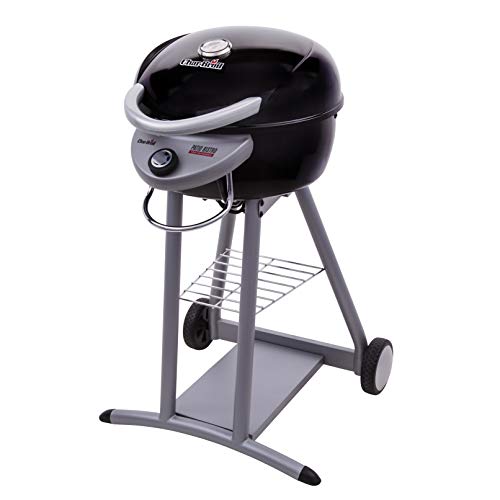
Char-Broil Patio Bistro TRU-Infrared Electric Grill — Best Electric for Balcony Traditionalists
The Patio Bistro is for apartment cooks who want the ritual and form of a traditional grill — a lidded kettle on legs with a proper grate — without flame or fuel. Char-Broil’s TRU-Infrared system puts an emitter between the electric element and the food, spreading heat evenly, limiting flare-ups and producing results closer to gas-grill character than bare-element electrics. It stands freestanding like a small patio grill, which suits balconies with floor space but no suitable table. It suits traditionalists in flame-restricted buildings and anyone cooking for two to three.
Strengths
- Traditional lidded-grill form with infrared evenness
- Freestanding — no table or stand purchase needed
- Electric permission profile with gas-like cooking manners
Trade-offs
- Freestanding format takes balcony floor space permanently
- Infrared emitter needs regular cleaning, like its gas cousins
- Capacity is small-party only
| Spec | Detail |
|---|---|
| Power | Electric |
| System | TRU-Infrared emitter design |
| Format | Freestanding kettle-style grill |
| Fuel storage | None |
Form matters to how a grill gets used: the Patio Bistro’s standing, lidded format invites the full grilling ritual — preheat, zones by placement, lid-down roasting — in a way tabletops do not, and its infrared system backs the ritual with even heat and calm behavior under fatty foods. For balcony cooks transitioning from a beloved gas grill left behind at a house, this is the least culture shock per dollar in the electric class. The emitter plate asks the usual infrared discipline: keep it brushed and clear, and it rewards you with consistency.
Choose it over the Lumin when you have the floor space and want a resident grill rather than a portable; choose the Lumin when storage and multi-function flexibility matter more. Both keep you legal and fed; the Bistro simply does it in the silhouette of the grills you already know.
Best for: balcony traditionalists in flame-restricted buildings with floor space / Not suited for: closet-storage situations or tabletop-only balconies
Check on Amazon — check the current price on Amazon before you decide, because grill pricing moves with the season.

Weber Q 1200N Portable Propane Gas Grill — Best Small Gas (Where Allowed)
Where gas is permitted — and you must verify that first — the Q 1200N is the apartment gas grill to beat. Its cast-aluminum body will not rust on an exposed balcony, the porcelain-enameled cast-iron grates sear like a full-size grill’s, and the single 10,000 BTU burner is honestly matched to its compact grate. Electronic ignition, a tidy removable grease pan and folding side tables complete a design that has been refined for small spaces for years. It suits couples and small families in gas-friendly buildings who want real flame grilling in the smallest credible footprint.
Strengths
- Cast-aluminum body: balcony-proof against rust
- Cast-iron grates deliver full-size searing in a compact grill
- Small canister fuel keeps tank storage minimal and tidy
Trade-offs
- Gas rules apply: verify lease, code and tank-size limits before buying
- Single burner — no true two-zone cooking
- Premium tier among small gas grills
| Spec | Detail |
|---|---|
| Output | 10,000 BTU, 1 burner |
| Body | Cast aluminum |
| Grates | Porcelain-enameled cast iron |
| Ignition | Electronic |
The Q’s apartment virtues are practical ones. Small 1 lb canisters mean no 20 lb tank storage problem — a genuine rule and space issue in many buildings — while an optional hose opens the full-tank route where allowed. The grease system is enclosed and removable, which matters enormously on a balcony where drips land on a neighbor’s patio rather than your lawn. Heat performance punches above the single-burner label because the cast-iron grate mass evens the fire’s footprint; steaks, burgers and vegetables cook with real conviction, and the lid’s height handles thicker cuts better than most compact rivals.
The permission homework is non-negotiable and this guide repeats it deliberately: many buildings that allow electric prohibit gas on balconies outright, and fire codes in numerous jurisdictions restrict propane grill use near combustible construction. Where the Q is allowed, it is the best small gas grill here by a clear margin. Where it is not, no amount of quality makes it a good idea — buy the Lumin and grill tonight instead of arguing with a lease.
Best for: gas-permitted balconies wanting real flame in a compact, rust-proof grill / Not suited for: any building with propane restrictions — verify before purchase
Check on Amazon — check the current price on Amazon before you decide, because grill pricing moves with the season.

Cuisinart Grillster Portable Gas Grill (CGG-059A) — Best Tiny Tabletop Gas
The Grillster is the minimalist’s gas grill: 13 pounds, a briefcase profile, a single burner that its listing credits with 600°F capability, and a dishwasher-safe grate that makes apartment cleanup genuinely easy. Its 146 square inches cook for one or two — a couple of steaks, four burgers, a skewer session — and then it stores in a closet or under a bed, which no standing grill can claim. It suits solo cooks and couples in gas-permitted buildings whose balconies are measured in inches and whose storage is a closet shelf.
Strengths
- 13 lbs and briefcase-sized: stores anywhere, carries anywhere
- Listed 600°F top end — serious searing heat for its class
- Dishwasher-safe grate suits sink-only apartment cleanup
Trade-offs
- 146 sq. in. is strictly one-to-two-person capacity
- Gas permission rules apply in full
- Tabletop use demands a heat-safe surface and clearance discipline
| Spec | Detail |
|---|---|
| Cooking area | 146 sq. in. |
| Output | 8,000 BTU, up to 600°F (listing figures) |
| Weight | 13 lbs |
| Extras | Dishwasher-safe grate, push-button ignition |
Small grills usually fail on heat; the Grillster’s listed 600°F ceiling is its headline because it means this tiny box genuinely sears — the burner-to-grate ratio is high precisely because the grate is small. For its intended menu — a steak for one, burgers for two, a few skewers and vegetables — it performs with an intensity that larger, weaker grills envy. The apartment logistics are equally considered: canister fuel, a locking lid for carry, and a grate that goes in the dishwasher remove the three frictions (fuel storage, transport, cleanup) that kill small-space grilling habits.
Its limit is written in its dimensions, and this guide will not soften it: the Grillster cannot host. Two guests become a wave-cooking exercise, and a family should look at the Q or the electrics instead. As a personal grill for the smallest spaces, though, it is close to perfectly judged — the gas counterpart to the Smokey Joe’s charcoal minimalism.
Best for: solo cooks and couples with tiny balconies and closet storage / Not suited for: families or anyone who hosts, even occasionally
Check on Amazon — check the current price on Amazon before you decide, because grill pricing moves with the season.

Char-Griller AKORN Jr. Portable Kamado Charcoal Grill — Best Charcoal (Where Allowed)
Where charcoal is allowed — some townhouse patios, ground-floor units and permissive buildings — the AKORN Jr. is the apartment charcoal pick because insulation is a neighbor feature as much as a cooking one. Its triple-wall steel body burns a small charcoal load efficiently, holds smoking and searing temperatures across a wide range, and its locking lid and compact 155-square-inch footprint suit small patios. Cast-iron grates deliver the sear. It suits charcoal devotees in permitted spaces who cook for one to three and want one small grill that both smokes a small shoulder and sears a steak.
Strengths
- Insulated steel kamado: efficient, wide temperature range, small fuel loads
- Locking lid and compact footprint suit small patios
- Cast-iron grates; genuine smoking capability at apartment scale
Trade-offs
- Charcoal is the most restricted fuel — verify rules before anything else
- 155 sq. in. caps capacity at one to three people
- Kamado weight is substantial for its size; ash management is manual
| Spec | Detail |
|---|---|
| Cooking area | 155 sq. in. |
| Construction | Triple-wall insulated steel |
| Grates | Cast iron |
| Fuel | Charcoal |
The Jr. earns its place on efficiency: insulation means a modest handful of lump charcoal does the work, which means less smoke volume over a cook than an open kettle burning more fuel — a real consideration with neighbors above and beside you. Temperature range is the other apartment-relevant virtue: one small grill that holds a low smoking temperature for a small pork shoulder on Saturday and runs hot for weeknight steaks replaces two appliances a small home cannot store. The steel body shrugs off the knocks of patio life that threaten ceramic kamados.
The permission warning is strongest for this pick, and the guide states it without dilution: charcoal is banned in most multi-unit settings, full stop, and ash disposal adds a second rule layer (cold ash, metal container, never the chute). Where it is allowed, the AKORN Jr. is a delight. Where it is not, it is a violation with excellent insulation. Check first; the electric picks above exist precisely for the majority case.
Best for: charcoal-permitted small patios wanting smoke and sear in one small grill / Not suited for: any multi-unit building with charcoal restrictions — most of them
Check on Amazon — check the current price on Amazon before you decide, because grill pricing moves with the season.
Comparison Table
Read this table permission-first: the Fuel column decides whether a pick is even available to you, and only then do size and features matter.
| Pick | Badge | Key spec | Best for | Amazon |
|---|---|---|---|---|
| Weber Lumin Compact Portable Electric Grill | Best Overall Apartment Grill | Electric, compact, cast-iron grates | apartment and condo cooks who want real grilling with zero rule risk | Check price |
| Cuisinart 2-in-1 Portable Outdoor Electric Grill (CEG-115) | Best Budget Electric | Electric 550°F, stand/tabletop convertible | renters and budget buyers wanting flexible electric grilling anywhere | Check price |
| Char-Broil Patio Bistro TRU-Infrared Electric Grill | Best Electric for Balcony Traditionalists | Electric infrared, freestanding | balcony traditionalists in flame-restricted buildings with floor space | Check price |
| Weber Q 1200N Portable Propane Gas Grill | Best Small Gas (Where Allowed) | 10,000 BTU, cast aluminum, compact gas | gas-permitted balconies wanting real flame in a compact, rust-proof grill | Check price |
| Cuisinart Grillster Portable Gas Grill (CGG-059A) | Best Tiny Tabletop Gas | 146 sq. in., 13 lbs, 600°F listed | solo cooks and couples with tiny balconies and closet storage | Check price |
| Char-Griller AKORN Jr. Portable Kamado Charcoal Grill | Best Charcoal (Where Allowed) | 155 sq. in. insulated kamado | charcoal-permitted small patios wanting smoke and sear in one small grill | Check price |
How to Choose an Apartment Barbecue Grill: The Rule Checks Come First
Check in this order, because each layer can veto the ones below. First, your lease or condo declaration: look for ‘grill’, ‘barbecue’, ‘open flame’, ‘propane’ and ‘balcony’ clauses, and ask the landlord or association in writing if the documents are silent — an email answer is your protection later. Second, your municipal fire code: many jurisdictions prohibit charcoal entirely on multi-unit balconies and restrict gas grills by distance from the building, balcony covering and tank size; your local fire department’s website usually states it plainly. Third, the building’s practical rules: some properties allow electric only as a house policy regardless of code. Fourth, insurance reality: a grill used against code or lease can complicate any claim, which is a reason beyond fines to comply.
With permission established, choose by footprint and storage. Measure the balcony’s usable corner, account for the clearance any flame grill needs from railings, walls and the neighbor’s airspace, and decide where the grill lives in winter — a closet-storable electric or a 13-pound tabletop gas grill solves storage that a freestanding unit cannot. Then choose by headcount with the honest capacities in this guide: one to two (Grillster, AKORN Jr.), two to three (CEG-115, Patio Bistro), up to four (Lumin, Q 1200N). Apartment grilling fails socially when smoke and smell overwhelm the neighbors, so prefer lidded cooking, leaner menus on weeknights, and a small fan angled outward on still evenings — courtesy is a feature no manufacturer sells.
Electric vs. Gas vs. Charcoal in an Apartment: An Honest Comparison
Electric wins on permission, storage and smoke, and modern electrics have closed most of the cooking gap: the picks here sear at temperatures that produce genuine barbecue character on burgers, steaks, chicken and vegetables. What electric cannot reproduce is combustion flavor — there is no wood or charcoal note — and it tethers you to an outlet. For most apartment dwellers, most of the time, those are acceptable trades for a grill that is legal, light and closet-friendly. Electric is also the only category whose running cost and cleanup are trivially small: no fuel runs, no ash, and parts that fit in a sink.
Gas adds real flame behavior, instant heat and independence from outlets, at the cost of the strictest rule-checking after charcoal: tank size limits, storage rules and distance requirements are common, and canister-based small grills like the Q and Grillster exist partly to fit inside those rules. Charcoal adds the fullest flavor and the widest temperature craft, and pays with the most smoke, the most restrictions, ash disposal duties and the longest startup. The apartment answer is therefore personal but structured: default to electric unless your building clearly permits more, choose gas when you want flame and can store fuel legally, and choose charcoal only where it is unambiguously allowed and your neighbors are genuinely unbothered.
Small-Space Grilling Technique: Big Results from Small Grills
Small grills reward technique that big grills forgive. Preheat fully — compact grills have less thermal mass, and a complete soak of the grate is what stands between searing and steaming. Cook in a single layer with space between pieces; overcrowding a small grate drops its temperature and steams the load, so two quick waves beat one crowded round every time. Keep the lid down and treat it as part of the oven: on a balcony this also contains smoke and directs it up rather than across to the neighbors. Choose the menu to the medium — thinner cuts, skewers, burgers, butterflied chicken and vegetables all suit small grates better than a giant bone-in roast.
Manage the apartment-specific details like a professional. A drip tray or mat under the grill protects the balcony floor and the neighbor below from grease — the fastest route to a grill ban is a grease stain on someone else’s patio. Keep a spray bottle and a small extinguisher rated for grease within reach, never leave a balcony grill unattended (a rule with legal force in many codes), and let charcoal ash cool for a full 48 hours in a metal container before disposal. Clean while the grill is warm and the residue is easy: apartment grills that stay clean stay welcome, and a welcome grill gets used for years.
How to Set Up a Balcony Grill Station That Keeps Everyone Happy
A good apartment setup is half equipment, half diplomacy. This arrangement works for every pick in this guide.
- Confirm permission in writing before the grill arrives: lease clause checked, building policy asked, fire code read. Screenshot or save the answers with your lease paperwork.
- Choose the grill’s home corner: maximum distance from doors, windows and the railing, on a stable, heat-safe surface, with the lid’s swing and the cook’s standing room both accounted for.
- Protect the floor: a grill mat or metal tray under the unit catches the drips that cause neighbor complaints and deposit problems, and defines the station visually.
- Stage the kit in one small bin: tongs, spatula, brush matched to your grate, spray bottle, instant-read thermometer and a lidded metal container for ash or used foil — everything within reach so the balcony door is not swinging all cook long.
- Plan smoke like a neighbor: cook smellier, fattier menus when windows around you are closed or the breeze carries smoke away from the building, keep the lid down, and consider a small outward fan on still days.
- Close down completely: burn off and brush the grate, empty grease into a sealed container for the trash (never the sink or the railing planter), confirm fuel is off and stored per your building’s rules, and let charcoal ash sit 48 hours in metal before disposal.
The diplomacy dividend is real: the neighbor who occasionally receives a plate of what they have been smelling rarely complains about smelling it. Apartment grilling is a long game played at close quarters, and the cooks who keep their grills for years are the ones whose buildings and neighbors are on their side.
Apartment Grilling, Season by Season
Spring is when apartment grilling is won or lost, because it is when rules get enforced and habits get set. Re-read your lease before the first cook of the year — buildings change policies, and last year’s tolerance is not this year’s permission. Inspect the grill after storage: electric elements and cords for damage, gas connections and hoses for cracks, charcoal vessels for rust at the ash line. Set the station up once, properly — mat down, bin stocked, extinguisher placed — rather than improvising it at every cook, because improvisation is where drips, clutter and complaints come from. A deliberate spring setup is the difference between a grill that integrates into apartment life and one that becomes a recurring negotiation.
Summer is the high season and the high-risk season simultaneously: windows are open, neighbors are on their balconies, and smoke travels into living rooms. This is when the low-smoke disciplines in this guide earn their keep — lidded cooking, leaner weeknight menus, fattier feasts saved for breezy afternoons, and the grill positioned for the day’s airflow. It is also when capacity gets tested by guests; resist the urge to solve a four-person problem with a bigger flame grill your building has not approved, and instead cook in the waves these compact grills handle well, using the warming and holding tricks in the reviews. Autumn rewards the apartment griller with the year’s best conditions — cool air, closed windows, and charcoal-permitted patios at their most pleasant — and winter separates the stored electrics, which grill on the mildest day in minutes, from everything else.
Across all four seasons, the apartment grills that survive are the ones whose owners treat the building as part of the equipment. Rules checked, station tidy, smoke managed, grease contained, neighbors considered — that operating system, more than any single product, is what ‘best apartment grill’ actually means. The picks in this guide were chosen to make that system easy: small footprints, contained grease, closet storage and, in the electric leaders, zero permission risk. Pair any of them with the seasonal habits above and balcony grilling becomes a permanent feature of your home rather than a summer experiment.
Common Buying Mistakes
Buying a charcoal grill before checking the rules. Charcoal is prohibited in most multi-unit housing. The purchase is easy to make and impossible to use legally; check the lease and fire code first, and default to electric when in doubt.
Storing a big propane tank against building rules. Many codes and leases limit tank size or ban balcony storage entirely. Small-canister grills exist for this reason; a 20 lb tank in violation is a fine and a safety issue, not a convenience.
Ignoring the neighbors below. Grease drips and smoke fall and drift downward. A grill mat, lidded cooking and menu awareness prevent the complaints that get grills banned for the whole building.
Overcrowding a small grate. Packed food on a compact grill steams instead of searing and smokes more while doing it. Cook in waves — the second wave takes four minutes and tastes like grilling.
Leaving ash or grease ‘for later’. In a small space, residue is a smell, pest and fire problem within days. Apartment grills need same-day cleanup; fortunately every pick here is sized to make that a five-minute job.
What Apartment Grilling Costs to Run
The running economics of apartment grilling favor the small formats across the board. Electric picks draw household power at ordinary appliance rates and ask for nothing else — no fuel trips, no tank exchanges, no charcoal bags — which makes them the cheapest grills in this guide to operate as well as the easiest to permit. Small-canister gas costs more per cook than a full tank but buys the storage and rule compliance that apartment life demands, and the Q and Grillster sip fuel at rates that make canisters a reasonable long-term choice rather than a stopgap. Charcoal at apartment scale burns a half chimney per session, so even quality lump charcoal amounts to a modest seasonal line item.
The costs to plan around are the consumables and the courtesies: replacement grates and elements over the years for electrics, igniters and hoses eventually for gas, ash containers and covers for everything. None of these figures changes the rankings in this guide, but together they make a point worth stating in an apartment context — the expensive apartment grill is the one bought twice because the first one violated the lease, annoyed the building or outgrew its storage corner. Buy the permitted, storable pick once, and apartment grilling is among the cheapest forms of cooking equipment you will ever own.
One final apartment consideration belongs in every buyer’s checklist: the exit. Renters move, and a grill that cannot move with you becomes a listing, a gift or a curb item. The picks in this guide were chosen partly for their second lives — electrics that pack into a box, a 13-pound gas grill that rides in any car, kettles and a kamado that a new patio will welcome. Before buying, picture the grill in a moving truck and in your next home’s outdoor space; if it fits both pictures, it is an apartment grill in the full sense. That long view is what turns a seasonal purchase into a decade of balcony dinners, across addresses, buildings and rulebooks.
And when you do move, leave the balcony better than you found it: mat lifted, floor checked, grease points cleaned. The deposit you protect is your own, and the reputation you leave is the one the next grilling tenant inherits.
Final Recommendation
For most apartment dwellers the answer is the Weber Lumin Compact: legal everywhere, genuinely hot, and sized and weighted for real apartment life. Budget buyers and layout-jugglers should take the Cuisinart CEG-115, traditionalists with floor space the Char-Broil Patio Bistro. Where gas is verified as allowed, the Weber Q 1200N is the small gas grill to own and the Cuisinart Grillster the tiny one; where charcoal is genuinely permitted, the AKORN Jr. brings real smoke craft to a small patio.
Do the permission homework first — it takes an email and ten minutes on a fire-code page — then buy the best grill inside your rules and check price on Amazon for the exact model. Apartment grilling done this way is not a compromise at all: it is dinner, outside, any night you want it, with your lease and your neighbors intact.
Weber Lumin Compact Portable Electric Grill · Cuisinart 2-in-1 Portable Outdoor Electric Grill (CEG-115) · Char-Broil Patio Bistro TRU-Infrared Electric Grill
Best Apartment Charcoal Grills Best Electric Grills Best Portable Gas Grills Best Small Gas Grills Best Kamado Grills Best Grills For Small Spaces
Frequently Asked Questions
Are electric grills allowed in apartments?
In the vast majority of cases, yes — electric grills have no open flame and no fuel storage, so most leases and fire codes that ban charcoal and restrict gas still permit them. Always confirm your own lease and building policy, but electric is the default-safe category.
Can I use a propane grill on my apartment balcony?
Sometimes. It depends on your lease, your building’s policy and your local fire code, which may restrict tank size, distance from the building and covered balconies. Verify all three in writing before buying — the Weber Q 1200N’s small-canister format fits the most rule sets.
What size grill is right for an apartment?
One that cooks for your actual household: compact electrics and the Q serve two to four, and the smallest picks serve one to two. Apartment grills are not party equipment; wave cooking handles the occasional guest better than an oversized grill handles storage.
How do I keep grill smoke from bothering neighbors?
Cook with the lid down, favor electric or gas over charcoal where smoke matters, avoid very fatty flare-up menus on still evenings, position the grill away from open windows, and use a small fan to direct smoke outward. A drip mat below prevents the other classic complaint.
Can an electric grill really sear a steak?
Modern ones can. The picks in this guide reach listed temperatures up to 550°F with grate mass designed to hold heat when food lands — enough for genuine sear marks and browning, though without combustion flavor.
Where do I store an apartment grill in winter?
Electrics and the Grillster store in a closet or under a bed; the Q and AKORN Jr. fit a balcony corner under a cover. Never store propane tanks indoors or against your building’s rules — fuel storage is the detail most often regulated.


