Disclosure: airfryerkitchensupply.com is reader-supported. When you buy through links on our site, we may earn an affiliate commission at no extra cost to you.
The best back spud toilets serve a specific piece of plumbing architecture, so this guide starts with the definition that decides everything. A spud is the inlet fitting where a flushometer valve connects to the bowl. On a back spud (rear spud) toilet, that connection sits at the back of the bowl, hidden against the wall; on a top spud model it sits on top, exposed. Back spud bowls are overwhelmingly wall-hung commercial fixtures — restrooms in offices, schools, clinics and public buildings — paired with a separate flushometer valve that the buyer usually sources alongside. If your project has a tank, this category is not yours; if it has a carrier in the wall and a flushometer rough-in, nothing else will fit.
Honesty about the market shapes the shortlist. Amazon’s verified listings in this niche are bowl listings — TOTO and Kohler commercial bowls with the spud location stated in their own titles — rather than complete toilet-and-valve packages. Five picks below are verified bowls with rear or back spud connections stated in their Amazon titles; the sixth slot covers the flushometer valve pairing in prose, because the verified valve listings on Amazon skew to top-spud models and inventing a rear-spud valve ASIN would violate this program’s verification rule. Every linked pick was confirmed.
Finally, a note for the home reader who arrived here from a search engine detour: despite the word ‘toilet’ in every title, nothing in this guide can be installed in a house without commercial plumbing work. The residential equivalents — wall-hung toilets with concealed cisterns — are a different product family covered elsewhere in this program, and confusing the two families at order time is an expensive education.
Where to buy
The confirmed bowls in this guide are sold through Amazon, where you can check the current price on Amazon for each model, confirm spud position, mounting and flush volume on the listing, and arrange freight-appropriate delivery of commercial ceramic. Start with these confirmed options:
- TOTO CT708UVG Wall-Mounted Flushometer Bowl with Back Spud and CEFIONTECT — Best Overall: Check the current price on Amazon
- TOTO CT708UV Wall-Mounted Flushometer Bowl with Back Spud — Best TOTO Value: Check the current price on Amazon
- Kohler Kingston K-4323 Toilet Bowl with Rear Spud — Best 1.28 GPF Rear Spud: Check the current price on Amazon
- Kohler Kingston Ultra 84323 Wall-Mounted Rear Spud Bowl — Best Wall-Mounted Kohler: Check the current price on Amazon
- American Standard Afwall Millennium Elongated Bowl with EverClean — Best EverClean Wall-Hung Bowl: Check the current price on Amazon
- The Matching Rear-Spud Flushometer Valve (Bowl-and-Valve Pairing) — Best Complete-System Approach: sold through plumbing-supply channels rather than a verified Amazon listing, so it is covered in prose below with no purchase link.
These are bowls. Each needs a compatible flushometer valve (and, for wall-hung models, a carrier) sourced to match the spud position and flush volume — the pairing section below explains how, and the one unlinked pick in this guide covers it in full.
In this guide
Quick Picks
- Best Overall: TOTO CT708UVG Wall-Mounted Flushometer Bowl with Back Spud and CEFIONTECT — The reference back spud bowl — TOTO commercial engineering with the low-maintenance glaze — Check price on Amazon
- Best TOTO Value: TOTO CT708UV Wall-Mounted Flushometer Bowl with Back Spud — The same back spud platform as the flagship, without the CEFIONTECT glaze premium — Check price on Amazon
- Best 1.28 GPF Rear Spud: Kohler Kingston K-4323 Toilet Bowl with Rear Spud — Kohler’s rear spud entry at the 1.28 GPF volume many existing buildings are plumbed for — Check price on Amazon
- Best Wall-Mounted Kohler: Kohler Kingston Ultra 84323 Wall-Mounted Rear Spud Bowl — Kohler’s wall-mounted rear spud bowl for carrier-based commercial restrooms — Check price on Amazon
- Best EverClean Wall-Hung Bowl: American Standard Afwall Millennium Elongated Bowl with EverClean — The Afwall name is commercial wall-hung heritage — with a spud-configuration check required before ordering — Check price on Amazon
- Best Complete-System Approach: The Matching Rear-Spud Flushometer Valve (Bowl-and-Valve Pairing) — A back spud bowl is half a toilet — this is how to buy the other half correctly
How These Picks Were Chosen
Verification in this niche had to be stricter than usual, so the rule was mechanical: a bowl earned a link only if its own listed Amazon title states the spud position — ‘Back Spud’ or ‘Rear Spud’ — in words. Models whose titles said top spud were excluded even when they were excellent commercial bowls, and models whose titles were silent on spud position were either excluded or, in one clearly flagged case, included with an explicit instruction to confirm the configuration on the manufacturer’s spec sheet before ordering.
Beyond the spud test, picks were ranked on the commercial buyer’s real criteria: flush volume options for current codes (1.0 and 1.28 GPF dominate), glaze technology that reduces cleaning labor, wall-hung versus floor-mount format, and the depth of the manufacturer’s commercial parts ecosystem. In commercial restrooms the purchase price is the small number; the decade-long costs are cleaning time, clog callouts and parts availability, and the ranking reflects that arithmetic.
One structural note: complete back-spud toilet-and-valve combinations are rarely sold as a single Amazon listing, because commercial buyers specify bowl and valve separately. This guide follows that professional reality rather than forcing a consumer framing onto it.
A note on geography and code: this guide reflects North American commercial practice, where flushometer bowls, carrier systems and the volumes discussed are standard. Other markets use different concealed-cistern systems almost exclusively; a back spud specification outside North America should be re-verified against local product lines and plumbing codes before any of these models are imported into a project.
It is worth stating the obvious once, because procurement processes obscure it: in this category the cheapest compliant bowl-and-valve pairing, installed correctly and documented properly, will outperform the most expensive pairing installed carelessly. Specification discipline is the product. The rankings above assume it; your project should too.
The 6 Best Back Spud Toilets

TOTO CT708UVG Wall-Mounted Flushometer Bowl with Back Spud and CEFIONTECT — Best Overall
The TOTO CT708UVG is the benchmark back spud bowl: a wall-mounted elongated flushometer bowl at 1.0 GPF with the spud at the back and TOTO’s CEFIONTECT glaze baked into the ceramic. It suits commercial restrooms specifying wall-hung fixtures — offices, healthcare, hospitality, education — where cleaning labor is a budgeted line and water codes favor low volumes. It is a bowl only: budget the carrier and a 1.0 GPF rear-spud flushometer alongside it. Facilities wanting a floor-mount format should look at the Kohler picks below.
Strengths
- Back spud connection stated in the verified title — the defining requirement, confirmed
- CEFIONTECT glaze resists waste adhesion, cutting cleaning time across hundreds of weekly uses
- 1.0 GPF volume suits the strictest current commercial water codes
Trade-offs
- Bowl only — carrier and flushometer valve are separate purchases
- 1.0 GPF demands a correctly matched valve; underpowered pairings flush poorly
- Wall-hung install requires carrier framing inside the wall
| Specification | Detail |
|---|---|
| Mounting | Wall-mounted |
| Spud | Back spud (per Amazon title) |
| Flush volume | 1.0 GPF |
| Glaze | CEFIONTECT |
| Bowl | Elongated |
In commercial specification, glaze is not a luxury feature — it is a labor contract. A bowl that sheds waste cleanly at 1.0 gallons gets wiped and left; a bowl that streaks gets scrubbed, re-flushed and revisited, multiplied by every restroom in the building every day. CEFIONTECT is TOTO’s answer to that arithmetic, and pairing it with the low 1.0 GPF volume only works because the bowl’s flush geometry was designed around both. Specify this bowl with a quality 1.0 GPF rear-spud valve and the restroom’s maintenance profile improves measurably, which is the most any bowl can honestly promise.
The wall-hung format compounds the labor saving: no base, no floor seal to fail, and a mop passes underneath in one motion. For facilities managers comparing lifetime cost against floor-mount alternatives, the carrier investment is repaid by cleaning minutes — the currency commercial restrooms actually trade in.
Order discipline: confirm the carrier’s stud and weight specification against your wall construction before the bowl ships, and photograph the in-wall work before closing. Commercial projects fail on sequencing more often than on product choice.
Best for: Wall-hung commercial restrooms prioritizing cleaning labor and water codes / Not suited for: Floor-mount projects, or buyers expecting a complete toilet in the box
Check the current price on Amazon

TOTO CT708UV Wall-Mounted Flushometer Bowl with Back Spud — Best TOTO Value
The CT708UV is the CT708UVG’s sibling with the glaze deleted: same wall-mounted elongated back spud platform at 1.0 GPF, standard ceramic finish. It suits facilities where the specification is driven by first cost — multi-restroom fit-outs where the per-bowl difference multiplies across dozens of units — or buildings whose cleaning regime is already intensive for other reasons, making the glaze’s labor saving less decisive. It is not the pick for low-staffed facilities where every scrubbing minute counts; there the G model’s glaze earns its premium back.
Strengths
- Verified back spud, wall-mounted, 1.0 GPF — the core specification intact
- Lower first cost across multi-unit orders than the glazed version
- TOTO commercial parts and documentation ecosystem fully applies
Trade-offs
- Standard glaze needs more cleaning effort to stay presentable at low flush volumes
- Same separate carrier and valve purchases as every bowl here
- Savings shrink if cleaning labor is priced honestly over the fixture’s life
| Specification | Detail |
|---|---|
| Mounting | Wall-mounted |
| Spud | Back spud (per Amazon title) |
| Flush volume | 1.0 GPF |
| Bowl | Elongated |
This is the honest value play in the TOTO line: identical hydraulics and mounting, with the difference confined to surface technology. The decision rule is simple — estimate your cleaning reality. A school with a dedicated custodial team on a fixed route absorbs the standard glaze without noticing. A small clinic where the receptionist also cleans the restroom will feel every extra scrub, every day, for years, and should buy the glaze. Neither answer is wrong; mismatching the bowl to the building is the only error available here.
Multi-unit buyers should also weigh consistency: mixing glazed and unglazed bowls across one building’s restrooms creates two cleaning profiles and endless ‘why does this one look worse’ conversations. Standardize on one sibling or the other per building, and let the per-building cleaning model make the call.
As with its sibling, the valve pairing decides performance: a genuine 1.0 GPF rear-spud flushometer, correctly adjusted, is not optional equipment but half the product.
Best for: Multi-unit fit-outs with strong existing cleaning regimes / Not suited for: Low-staffed facilities where cleaning minutes are the scarce resource
Check the current price on Amazon

Kohler Kingston K-4323 Toilet Bowl with Rear Spud — Best 1.28 GPF Rear Spud
The Kohler Kingston K-4323 serves the large installed base of commercial buildings whose flushometer infrastructure is set up for 1.28 GPF: a rear spud bowl from Kohler’s long-running Kingston commercial family. It suits renovation projects replacing bowls on existing carriers and valves, and facilities standardized on Kohler commercial parts. Buyers designing to the newest 1.0 GPF codes should take the TOTO picks; buyers matching an existing 1.28 GPF building will find this the path of least resistance — as always, confirm mounting configuration on the spec sheet for your exact installation.
Strengths
- Rear spud stated in the verified title — the category requirement, confirmed
- 1.28 GPF matches the valve inventory of a huge installed base
- Kingston is a mature commercial line with deep parts availability
Trade-offs
- 1.28 GPF does not meet the strictest 1.0 GPF specifications
- Bowl only — valve and any carrier work are separate
- Confirm wall-hung versus floor configuration against your rough-in before ordering
| Specification | Detail |
|---|---|
| Spud | Rear spud (per Amazon title) |
| Flush volume | 1.28 GPF |
| Model | K-4323-0 Kingston |
Renovation reality governs this pick’s value. In an existing building, the valve, carrier and supply are sunk costs arranged around a flush volume; replacing bowls at that same volume is a maintenance project, while changing volume converts it into a plumbing project with permits and wall work. The Kingston exists for the maintenance project — a known bowl, on a known spud, at the building’s existing volume, from a maker whose commercial catalog will stock its parts for the foreseeable future. That is unglamorous and exactly right.
Kohler’s commercial documentation is a genuine asset for facilities teams: spec sheets, parts diagrams and valve pairing charts are published and stable, which shortens every future repair conversation. In buildings maintained by rotating contractors, that documentation continuity is worth specifying deliberately.
When ordering for a multi-bowl replacement, buy one unit first and dry-fit it against an existing carrier and valve before releasing the full order — the cheapest insurance in commercial plumbing.
Best for: Renovations matching an existing 1.28 GPF flushometer building / Not suited for: New builds specifying 1.0 GPF, or anyone needing a complete fixture
Check the current price on Amazon
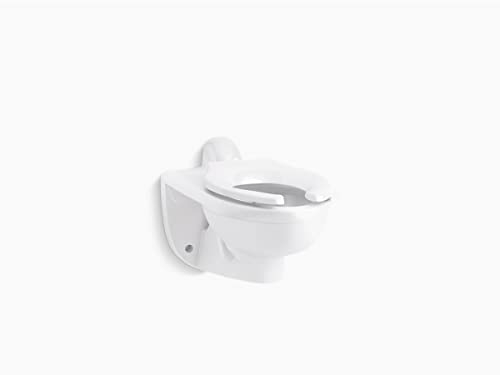
Kohler Kingston Ultra 84323 Wall-Mounted Rear Spud Bowl — Best Wall-Mounted Kohler
The Kingston Ultra 84323 is Kohler’s wall-mounted rear spud entry, built for carrier-based commercial restrooms in the brand’s current Ultra flushometer bowl line. It suits new commercial construction and gut renovations where the carrier is being set fresh and the design wants a floating bowl with Kohler behind it. Confirm the flush volume pairing for your valve on the manufacturer’s documentation, since the verified title emphasizes mounting and spud rather than volume. Projects standardized on TOTO will take the CT708 models; this is the Kohler-ecosystem equivalent decision.
Strengths
- Wall-mounted with rear spud — both requirements stated in the verified title
- Current Kingston Ultra line, with Kohler commercial support behind it
- Floating bowl format delivers the commercial cleaning advantages of wall-hung design
Trade-offs
- Flush volume not stated in the title — verify the exact GPF pairing before specifying valves
- Carrier required; bowl-only purchase like all wall-hung picks
- Brand ecosystem choice: parts and documentation follow Kohler, not TOTO
| Specification | Detail |
|---|---|
| Mounting | Wall-mounted |
| Spud | Rear spud (per Amazon title) |
| Line | Kingston Ultra |
Choosing between this and the TOTO bowls is less about the bowl than about the building’s ecosystem. Facilities teams stock parts, learn quirks and build contractor familiarity per brand; a Kohler-standardized building gains more from staying Kohler than from any single bowl’s specification edge. Within that logic the Kingston Ultra is the straightforward wall-hung rear spud answer: current line, correct spud, correct mounting, and a manufacturer whose commercial division answers the phone. Specify the valve volume deliberately and the system behaves as commercial systems should — invisibly.
Wall-hung bowls also future-proof the restroom floor: with no base footprint, flooring can be repaired or replaced around the fixture without disturbing it, a lifecycle detail that matters in buildings planning decades of service from one restroom build.
As with every pick here, photograph the carrier install and record the valve model in the building file at handover. The next decade’s maintenance team is a stakeholder in today’s purchase.
Best for: Kohler-standardized facilities building wall-hung restrooms / Not suited for: Buyers who have not confirmed the flush volume pairing for their valves
Check the current price on Amazon

American Standard Afwall Millennium Elongated Bowl with EverClean — Best EverClean Wall-Hung Bowl
The Afwall Millennium is American Standard’s wall-hung commercial bowl, with the brand’s EverClean antimicrobial surface and a wide 1.1–1.6 GPF working range. One verification note must be stated plainly, because this guide’s standard demands it: unlike the picks above, its verified Amazon title does not state the spud position. Afwall bowls are specified in back-spud commercial configurations, but you must confirm the exact spud configuration on the manufacturer’s spec sheet for this model before ordering — treat this pick as conditional on that check. Buyers unwilling to make the check should choose a title-verified pick above.
Strengths
- EverClean surface inhibits stain and odor-causing buildup — a cleaning-labor feature
- Wide 1.1–1.6 GPF range pairs with more existing valve inventories
- Afwall is one of the longest-running wall-hung commercial bowl families
Trade-offs
- Spud position NOT stated in the verified listing title — spec-sheet confirmation is mandatory before purchase
- Bowl only, like every pick here; carrier and valve separate
- Wide GPF range means the installed valve decides actual water use — set it deliberately
| Specification | Detail |
|---|---|
| Mounting | Wall-hung (Afwall line) |
| Flush range | 1.1–1.6 GPF (per Amazon title) |
| Surface | EverClean |
| Bowl | Elongated, bowl only |
Why include a pick with a verification caveat in a guide this strict? Because the Afwall line is genuinely central to North American commercial restrooms — omitting it would misrepresent the category — and because the honest treatment is available: state what the listing confirms (wall-hung format, EverClean, volume range, bowl-only sale) and state equally plainly what it does not (spud position in the title). A professional buyer confirms spud configuration on the spec sheet for every bowl anyway; this pick simply refuses to let you skip the step.
The wide volume range is the Afwall’s practical charm in renovation work: buildings mid-transition between valve generations can standardize the bowl and let each restroom’s valve set the volume. EverClean then does the same quiet labor-saving work as the glazed TOTO, through American Standard’s own surface technology.
If the spec sheet confirms the back spud configuration for your installation — as Afwall commercial specifications commonly provide — this becomes one of the safest long-term bowls in the guide on parts availability alone.
Best for: American Standard facilities doing renovation, after spec-sheet spud confirmation / Not suited for: Any buyer who will not verify spud configuration before ordering
Check the current price on Amazon
The Matching Rear-Spud Flushometer Valve (Bowl-and-Valve Pairing) — Best Complete-System Approach
Every bowl above is half a system. The other half — the flushometer valve — determines flush volume, reliability and service life, and in the back spud world it is bought separately, usually through plumbing supply channels where Sloan, Zurn and the bowl makers’ own rear-spud valve lines are stocked with specification support. This unlinked pick exists because the verified Amazon valve listings available to this guide are top-spud models; rather than mislabel one as a back spud pairing, the correct valve is described here so you can source it accurately.
Strengths
- Correct pairing preserves the bowl’s designed flush volume and performance
- Plumbing-supply sourcing brings spec-sheet support and commercial warranty handling
- Sensor (Selectronic-style) and manual rear-spud valves both exist — hygiene and budget options stay open
Trade-offs
- A second purchase from a second channel — no single-box convenience
- Valve must match spud position AND volume; a mismatch flushes badly or not at all
- Commercial valves assume commercial supply pressure and pipe sizing
Pairing rules are short and absolute. Spud position: rear, matching the bowl. Volume: exactly the bowl’s rating — 1.0 GPF bowls get 1.0 GPF valves, 1.28 bowls get 1.28 valves — because flushometer bowls are tuned hydraulically to their valve. Connection: confirm the spud coupling size and the valve’s rough-in dimensions against the carrier layout. Actuation: manual valves for budget and simplicity, sensor valves where hygiene codes or user experience demand them, with power (battery or hardwired) decided at specification time. Follow those four rules and any bowl in this guide performs as its maker intended.
A final professional habit: order the valve with the bowl, not after it, and dry-assemble one complete station — carrier, bowl, valve — before releasing a multi-restroom order. Commercial restroom projects are won on that single pilot installation more than on any catalog decision.
Best for: Every back spud project — this pairing step is not optional / Not suited for: Residential buyers, who should be reading the tank-toilet guides instead
The Matching Rear-Spud Flushometer Valve (Bowl-and-Valve Pairing) sits in the commercial tier of this category; because no verified Amazon listing matched it, treat this as a recommendation without a link and source it through the channel described above.
Comparison Table
| Pick | Badge | Key spec | Best for |
|---|---|---|---|
| TOTO CT708UVG Wall-Mounted Flushometer Bowl with Back Spud and CEFIONTECT (check price on Amazon) | Best Overall | Wall-mounted elongated bowl, back spud, 1.0 GPF, CEFIONTECT glaze | Wall-hung commercial restrooms prioritizing cleaning labor and water codes |
| TOTO CT708UV Wall-Mounted Flushometer Bowl with Back Spud (check price on Amazon) | Best TOTO Value | Wall-mounted elongated bowl, back spud, 1.0 GPF, standard glaze | Multi-unit fit-outs with strong existing cleaning regimes |
| Kohler Kingston K-4323 Toilet Bowl with Rear Spud (check price on Amazon) | Best 1.28 GPF Rear Spud | Rear spud bowl, 1.28 GPF, Kohler Kingston commercial line | Renovations matching an existing 1.28 GPF flushometer building |
| Kohler Kingston Ultra 84323 Wall-Mounted Rear Spud Bowl (check price on Amazon) | Best Wall-Mounted Kohler | Wall-mounted rear spud flushometer bowl, Kingston Ultra line | Kohler-standardized facilities building wall-hung restrooms |
| American Standard Afwall Millennium Elongated Bowl with EverClean (check price on Amazon) | Best EverClean Wall-Hung Bowl | Wall-hung elongated bowl only, EverClean surface, 1.1–1.6 GPF range | American Standard facilities doing renovation, after spec-sheet spud confirmation |
| The Matching Rear-Spud Flushometer Valve (Bowl-and-Valve Pairing) | Best Complete-System Approach | Rear-spud flushometer valve, matched GPF, sourced via plumbing supply | Every back spud project — this pairing step is not optional |
How to Choose a Back Spud Toilet: Spud, Volume, Mounting, Glaze
The specification order matters. First, spud position — back (rear) versus top — is dictated by the existing plumbing and carrier, and is not a preference: confirm it from the rough-in or the bowl being replaced, and buy only bowls whose documentation states it. Second, flush volume: match the building’s valve inventory or the governing code, with 1.0 GPF for the strictest new specifications and 1.28 GPF across the broad installed base. Third, mounting: wall-hung bowls need carriers and reward the project with superior cleaning; confirm carrier compatibility with the exact bowl. Fourth, surface: glazed or antimicrobial bowls repay their premium in cleaning labor, the dominant lifetime cost in commercial restrooms.
Notice what is not on that list: style, brand fashion and consumer features. Commercial bowl selection is an infrastructure decision with a decade-long shadow, and the facilities that get it right treat it as one — documented, standardized per building, and piloted before multi-unit orders. The picks above were ranked in exactly that spirit.
- Spud: back/rear confirmed in writing (title or spec sheet)
- Volume: matched to valves and code — 1.0 or 1.28 GPF
- Mounting: wall-hung carrier confirmed for the exact bowl
- Surface: glaze/EverClean where cleaning labor is scarce
- Valve: rear-spud, volume-matched, ordered with the bowl
Back Spud vs Top Spud: Why the Distinction Runs the Whole Project
A top spud bowl takes its flushometer connection from above, leaving the valve’s tailpiece visible over the bowl’s back rim — the classic exposed commercial look. A back spud bowl takes the connection horizontally at the rear, so the valve connects through or against the wall and the bowl’s top line stays clean. The two are not interchangeable: the spud is cast into the ceramic, the carrier and rough-in are arranged around it, and a mismatch is discovered at installation, in the wall, at the worst possible moment.
Back spud designs dominate modern wall-hung specification for practical reasons: the connection is protected inside the wall chase, the bowl presents a clean top surface that is faster to wipe down, and the finished restroom reads more contemporary. Top spud remains common in floor-mount and legacy installations. When replacing an existing bowl, the only safe method is to identify the old bowl’s spud from its model documentation — never from a photograph or a guess — and order its exact equivalent.
Flushometer Valves for Back Spud Bowls: Manual, Sensor and Volume Matching
The valve is the toilet’s engine, and three decisions define it. Actuation: manual diaphragm valves are the durable default; sensor valves add touch-free operation for hygiene-led specifications, at the cost of batteries or hardwired power and more service points. Volume: the valve’s rated GPF must equal the bowl’s — flushometer bowls are hydraulically tuned pairs, and a 1.6 GPF valve on a 1.0 GPF bowl (or the reverse) produces the splashy, weak or double-flushing behavior that gives low-flow commercial restrooms their bad reputation. Rough-in: the valve’s dimensions and the spud coupling must suit the carrier and wall depth, which is why bowl and valve are specified together on professional schedules.
Service planning belongs in the same conversation. Diaphragm kits are the wear item across all major valve lines and are cheap and standardized; a facilities team should stock the kit for whichever valve the building standardizes on, and record valve models in the building file at install. Sensor valves add a battery schedule. None of this is complicated — it is simply commercial plumbing’s normal discipline, and it is the difference between a restroom that runs for a decade and one that generates weekly work orders.
Specifying Back Spud Restrooms for Accessibility and Maintenance Crews
Commercial restrooms are used by everyone and maintained by someone specific, and good specification thinks about both. For users, wall-hung bowls at correct comfort or ADA heights — set at carrier installation, which is the one moment height is adjustable — serve the widest public, and sensor flushometer valves remove the grip-and-twist demand of manual handles in accessible stalls. Lever position, flush force and reach ranges are code matters that the design team must verify against local accessibility requirements; the bowl choice supports those requirements but does not satisfy them by itself.
For maintenance crews, the specification gifts that keep giving are standardization and access. One bowl model, one valve model, one diaphragm kit in the store room, carriers installed with genuine service access, and a building file with photographs of everything inside the walls. Crews inherit the consequences of specification for a decade; a bowl chosen for a marginal first-cost saving that doubles cleaning time or orphans its parts is the most expensive bowl in this guide regardless of its invoice. That is the lens the rankings above were built with, and it is the lens facilities teams should apply to their own shortlists.
Troubleshooting Back Spud Installations: Leaks, Weak Flushes and Double Flushes
Three symptoms account for nearly every back spud service call, and each has a disciplined diagnostic order. A weeping spud joint after installation is a gasket and alignment matter: the coupling between valve and bowl must seat squarely, and the fix is reseating with a fresh gasket — never overtightening against ceramic, which trades a leak for a cracked bowl. A weak flush on a new installation is a volume or supply matter: verify the valve’s rated and adjusted volume against the bowl first, then supply pressure and the vacuum breaker’s condition, before suspecting the bowl. A double flush or run-on is a valve matter — diaphragm wear or debris — and the diaphragm kit the building standardized on is the cure.
Notice what none of these diagnoses begins with: replacing the bowl. Ceramic bowls almost never fail hydraulically when correctly paired; the system around them — gaskets, valves, supply — is where faults live. Facilities teams that work the order above resolve most calls in one visit with parts from the store room. Teams that start by condemning fixtures generate the renovation budgets that make commercial restrooms look expensive. The specification choices in this guide — matched volumes, standard models, stocked kits — exist to keep your building in the first group.
How to Install a Wall-Hung Back Spud Toilet Bowl
This is professional work in most jurisdictions — commercial plumbing, in-wall carriers and pressurized flushometer supplies are not a DIY weekend — but every buyer and facilities manager should know the sequence their contractor is following.
- Set the carrier first: the in-wall frame is anchored to studs and floor per its template, at the finished bowl height the specification requires, with supply and waste roughed to the carrier’s points
- Pressure-test the supply and inspect the waste connection before any wall closing — the carrier stage is the last cheap moment to find a leak
- Close the wall and finish it, leaving the carrier’s mounting bolts and connection points accessible through the finished surface
- Mount the bowl onto the carrier bolts with the back spud aligned to the flush connection; level it and torque fixings evenly so the ceramic seats without stress points
- Connect the flushometer valve to the back spud with the correct coupling and gasket, and connect the valve to the supply with its vacuum breaker and shut-off as specified
- Set the valve’s flush volume adjustment to the bowl’s rating and test-flush repeatedly, checking the spud joint, carrier connections and supply for any weep
- Seal the bowl-to-wall joint appropriately, fit the seat, and record bowl model, valve model and carrier model in the building maintenance file
The photograph rule applies with full force: image every in-wall stage before closing. In ten years, that photo set will save a wall from being opened on a guess.
At handover, run one full maintenance rehearsal with the building’s own crew: locate the valve shut-off, open the flush plate access, identify the diaphragm kit the building will stock. A restroom whose first service call is a rehearsal rather than a discovery is a restroom that was specified properly.
Close the project by stocking the store room on day one: one diaphragm kit per valve model in the building, one spare seat per restroom bank, and the gasket assortment for the spud couplings used. A restroom commissioned with its spares already shelved starts its service life a full repair ahead of schedule.
Common Buying Mistakes
Ordering a top spud bowl for a back spud rough-in. The spud is cast into the ceramic; there is no adapter that forgives this. Confirm spud position from documentation — the old bowl’s model records or the carrier specification — before any order.
Mismatching valve and bowl volumes. A 1.0 GPF bowl on a 1.6 GPF valve wastes water and splashes; the reverse under-flushes and clogs. Volume equality is a specification rule, not a suggestion.
Buying the bowl and “sorting the valve later.” Bowl, carrier and valve are one system specified together. Late valve decisions discover rough-in conflicts after the wall is finished.
Skipping the spec sheet because the listing looked right. One pick in this very guide carries that warning on its badge. Commercial ceramics are specified from manufacturer documents, not marketplace titles — the listing starts the conversation, the spec sheet ends it.
Forgetting the building file. Bowl, valve and carrier models, plus install photos, belong in the maintenance record at handover. Buildings that skip this pay for the omission at the first repair.
Specifying designer finishes for commercial bowls. Back spud bowls are working infrastructure in white ceramic. Money spent on exotic finishes is money not spent on the glaze, valve quality and spare kits that determine the restroom’s decade.
Letting the pilot restroom be the unusual one. Pilot the most typical restroom in the building, not the easiest — a pilot that hides carrier or supply problems teaches the project nothing and scales the surprises instead of the solutions.
Final Recommendation
For new wall-hung commercial specification, the TOTO CT708UVG is the complete answer — verified back spud, 1.0 GPF, and the glaze that pays in cleaning labor — with the CT708UV as its first-cost sibling for strongly staffed facilities. Kohler-standardized buildings take the Kingston rear spud bowls, at 1.28 GPF for the installed base or in wall-mounted Ultra form for fresh carriers. The American Standard Afwall remains a legitimate renovation bowl on condition — stated on its badge — that the spud configuration is confirmed on the spec sheet first. And whichever bowl you specify, treat the unlinked sixth pick as part of the purchase: the rear-spud, volume-matched valve, ordered with the bowl, is what turns five ceramic bowls into working restrooms.
One last specification habit separates professional buyers from hopeful ones: every claim in the order — spud position, volume, carrier model, valve model — traceable to a manufacturer document on file. The bowls in this guide were chosen to make that habit easy to keep, and the buildings that keep it are the ones whose restrooms never make the news.
To compare the leading options side by side, start with TOTO CT708UVG Wall-Mounted Flushometer Bowl with Back Spud and CEFIONTECT, TOTO CT708UV Wall-Mounted Flushometer Bowl with Back Spud, Kohler Kingston K-4323 Toilet Bowl with Rear Spud — each listing confirms the current configuration and lets you check price on Amazon before you commit.
Keep researching within this category cluster: Best Automatic Toilets Best 1.28 Gpf Toilets Best Ada Compliant Toilets Best 1 Piece Toilets
Frequently Asked Questions
What is a back spud toilet?
A toilet bowl whose flushometer inlet — the spud — is located at the back of the bowl rather than on top. Back spud bowls are typically wall-hung commercial fixtures, connected through the wall to a separate flushometer valve.
Does a back spud toilet come with the flush valve?
Almost never. Bowls, carriers and valves are specified and sold separately in commercial plumbing. Budget all three, and match the valve’s spud position and flush volume to the bowl exactly.
Can I replace a top spud bowl with a back spud bowl?
Not as a like-for-like swap. The spud position is cast into the bowl and the carrier and rough-in are arranged around it. Changing spud position is a plumbing project involving the wall, not a bowl replacement.
What flush volumes do back spud toilets use?
Current commercial specifications center on 1.0 GPF and 1.28 GPF, with older buildings running higher volumes. The bowl and valve must share the same rating — check both before ordering either.
Are back spud toilets suitable for homes?
Practically no. They require flushometer supply plumbing, commercial carriers and commercial valves that residential plumbing does not provide. Homes wanting a wall-hung look should use residential wall-hung toilets with concealed tank carriers instead.
How do I confirm the spud position of a bowl I am replacing?
From the bowl’s model number and the manufacturer’s specification sheet — not from appearance. If records are missing, a plumber can identify the configuration from the existing valve connection during a site visit before any order is placed.
Why are most picks here bowls rather than complete toilets?
Because that is how the category is genuinely sold and verified. This guide links only listings whose own titles confirm the back spud specification, and those listings are bowls. The valve pairing is covered honestly in prose rather than attached to an unverified listing.
How long do commercial flushometer bowls last?
The ceramic bowl itself is a decades-long fixture; the wear items are the valve’s diaphragm kit, the seat and the carrier connections. Buildings that standardize models and stock the correct diaphragm kits routinely keep bowls in service far longer than the restroom finishes around them.
Do back spud bowls come in comfort or ADA heights?
Height on wall-hung bowls is set by the carrier installation, which is precisely the format’s accessibility advantage: the same bowl can be mounted at the height the specification and code require. Confirm the carrier’s adjustment range when specifying for accessible stalls.
What is a flushometer, and why do these bowls need one?
A flushometer is a commercial flush valve that meters pressurized line water directly into the bowl, replacing a tank. Back spud bowls are only the ceramic half of the system; the flushometer is the mechanism, which is why volume and spud matching between the two is this guide’s recurring rule.
Can a back spud bowl be converted to a tank toilet?
No. The bowl is cast for a flushometer connection and has no tank interface. A building changing from flushometer to tank systems is replacing fixtures and replumbing the supply — a renovation decision, not a conversion kit.
Where can I buy the matching rear-spud valve?
Through plumbing supply distributors and the bowl manufacturers’ commercial channels, where staff can confirm the exact valve for your bowl model and volume. Bring the bowl’s model number; that single detail turns the conversation from browsing into specifying.


