Disclosure: airfryerkitchensupply.com is reader-supported. When you buy through links on our site, we may earn an affiliate commission at no extra cost to you.
Where to buy
Every entry in this guide to the best and most reliable toilets is a verified Amazon listing, so you can check the current price on Amazon for the model that fits your household: the TOTO Drake 1.28 GPF for the benchmark all-rounder, the TOTO Drake 1.6 GPF for maximum clearing margin, the Kohler Highline 1.6 GPF for the classic gravity workhorse, the American Standard Champion PRO for clog resistance, the TOTO Entrada for TOTO engineering at a budget tier, and the Gerber Maxwell Crest for the plumber-channel value pick. Reliability is a parts story as much as a product story — before ordering, note the exact model number somewhere permanent, because that number is what every future seal, valve and seat will be bought by.
The best and most reliable toilets share a personality: they are boring in the best way. Simple gravity flush mechanisms with big valves and glazed trapways. Porcelain from manufacturers who have cast the same models for years. Internals that any plumber can service from the stock on the truck, and that any hardware store shelves when you would rather do it yourself. No electronics to fail, no proprietary cartridges to hunt, no surprises at year nine. This guide ranks the six toilets that best fit that description — the models tradespeople install in their own homes and landlords specify when callbacks cost money — and it explains what reliability actually consists of, so you can spot it in any showroom: mechanism simplicity, flush margin, parts depth and the manufacturer’s track record behind the specific model, not just the brand.
In this guide
Quick Picks
- Best Overall — TOTO Drake Two-Piece Elongated 1.28 GPF: the modern benchmark — proven flush engineering, glazed bowl, universal parts knowledge. Check the current price on Amazon.
- Best for Heavy Use — TOTO Drake Two-Piece Elongated 1.6 GPF: the same platform with more water per flush for demanding households and older drains. Check the current price on Amazon.
- Best Gravity Workhorse — Kohler Highline 1.6 GPF Two-Piece: Kohler’s long-running line with Class Five flushing and Comfort Height. Check the current price on Amazon.
- Best Clog Resistance — American Standard Champion PRO Elongated: the large-valve Champion platform for households with a plunger history. Check the current price on Amazon.
- Best Budget — TOTO Entrada Elongated: TOTO’s simpler, value-tier two-piece with the brand’s engineering discipline intact. Check the current price on Amazon.
- Best Plumber’s Value Pick — Gerber Maxwell Crest: the trade-channel favourite — straightforward, serviceable and specified by professionals. Check the current price on Amazon.
How These Picks Were Chosen
All six models were verified against live Amazon listings. Reliability was then scored on four evidence-based criteria rather than on reputation alone. First, mechanism: every pick is a gravity-flush toilet with conventional, widely understood internals — flappers or tower valves, standard fill valves — because gravity systems have the fewest failure modes and the cheapest fixes in the category. Second, flush margin: published MaP performance and oversized valves or trapways matter because a toilet working well within its capacity clogs rarely, and clogs are the failure owners actually experience. Third, model longevity and parts depth: lines that have been in production for years, with seals and valves stocked nationally, beat newer designs however clever. Fourth, manufacturer support: the brands here — TOTO, Kohler, American Standard and Gerber — maintain real parts pipelines and documentation for these specific models.
Two deliberate exclusions follow from those criteria. Smart toilets, however good, add electronics whose service life is shorter than porcelain’s and whose parts are model-specific; they belong in feature guides, not a reliability ranking. And ultra-budget no-name toilets fail the parts test by definition — a toilet whose flapper cannot be sourced in year six is not reliable at any purchase price. What remains is this list: six gravity toilets that a competent homeowner or any plumber can keep flushing for decades.
The 6 Best and Most Reliable Toilets

TOTO Drake Two-Piece Elongated 1.28 GPF — Best Overall
The Drake is the reliability benchmark because it combines modern flush engineering with total mechanical conventionality. TORNADO FLUSH rim jets and a CEFIONTECT-glazed bowl do the sophisticated work; underneath, it is a standard two-piece gravity toilet whose fill valve, flush valve and seals are understood by every plumber and stocked by every serious supplier. The platform has been in production long enough for its behaviour to be fully known — there are no surprises left in it — and its 1.28-gallon flush clears with margin rather than at the edge of its ability, which is precisely the condition that keeps a toilet clog-free across years of varied household use. Universal Height and an included SoftClose seat complete a specification that asks nothing unusual of anyone: installer, user or maintainer.
Strengths
- Proven platform with a decade-plus track record and no known systematic weaknesses.
- Flush performance with genuine margin at 1.28 GPF — reliable clearing without double-flushing.
- Standard internals and the deepest support network in the category.
Trade-offs
- Mid-to-premium pricing for the conventional class; budget buyers should look at the Entrada.
- Two-piece format carries the usual seam-cleaning chore.
- In older homes with rough drains, the 1.6-gallon sibling below may be the wiser reliability choice.
Reliability, properly understood, is what the Drake’s sales history demonstrates: the same model, bought by the million, serviced with commodity parts, still flushing. Notice what is absent from its story — no redesign drama, no discontinued cartridge, no generation of owners stranded by a changed fitting. When a plumber says “just get a Drake”, this boring completeness is what they mean, and for a main bathroom it is the strongest recommendation in this guide.
Best for: main bathrooms in modern homes wanting the proven, serviceable benchmark. Not suited for: the tightest budgets or feature-led smart bathrooms. Check the current price on Amazon.

TOTO Drake Two-Piece Elongated 1.6 GPF — Best for Heavy Use
The 1.6-gallon Drake is the same toilet with the margin turned up: more water per flush to carry waste further and clear heavier loads, in the identical proven body with the same glaze and support. Its reliability case is situational and strong — in older homes with cast-iron drains, in households whose usage is genuinely heavy, and in any installation where the cost of a clog is high (a single-bathroom home, a rental with response obligations), the extra flush volume is not waste, it is insurance bought in fractions of a gallon. Every other Drake virtue carries over unchanged, including the parts ecosystem, because the platform is shared.
Strengths
- Maximum clearing and carry margin in the proven Drake platform.
- The safer reliability choice for older, rougher drain lines.
- Identical parts and support ecosystem to the 1.28 model.
Trade-offs
- Uses more water than the 1.28 — the trade is explicit and should be made deliberately.
- May not suit jurisdictions or households with strict conservation targets.
- Same two-piece cleaning profile as its sibling.
The choice between the two Drakes is the cleanest decision in this guide: walk your drain line’s age and your household’s history, and pick the margin that matches. New PVC, no clog history — the 1.28. Cast iron, long runs, a plunger with a name — the 1.6. Either way you own the same porcelain, the same glaze and the same twenty-year support story, which is what platform buying is for.
Best for: heavy-use households, older plumbing and single-bathroom homes. Not suited for: strict water-conservation priorities. Check the current price on Amazon.

Kohler Highline 1.6 GPF Two-Piece Elongated — Best Gravity Workhorse
Kohler’s Highline line has been the other great American workhorse for decades, and this Comfort Height elongated 1.6 configuration is its classic form: Class Five flush technology — Kohler’s large-valve engineered system — in a two-piece body that any tradesperson in the country has installed. The verified listing is sold less seat, which is typical of the line’s trade configurations and worth knowing before the box arrives. The Highline’s reliability argument is longevity at scale: an enormous installed base, internals that stayed standard while fashion changed around them, and a dealer network that stocks its parts as a matter of routine.
Strengths
- Decades-long production run with a vast installed base and universal parts availability.
- Class Five flushing with 1.6-gallon margin suits older drains and heavy use.
- Comfort Height elongated is the configuration most households keep happily for decades.
Trade-offs
- Seat not included in this configuration — budget and order it with the toilet.
- 1.6 GPF is above the modern conservation standard.
- Traditional styling and a two-piece seam, as with all the workhorse class.
There is a particular kind of confidence that comes from a product your plumber has serviced five hundred times, and the Highline is its embodiment. Nothing about it is the newest; everything about it is known. For a buyer whose top priority is that the toilet never becomes a project — in a family home, a rental, a property managed from a distance — that knownness is the feature, and it justifies both the older flush volume and the separate seat purchase.
Best for: buyers who value the largest possible service network and a known quantity. Not suited for: water-bill-led purchases or design-led rooms. Check the current price on Amazon.

American Standard Champion PRO Two-Piece Elongated — Best Clog Resistance
Reliability has a second face: not just “does it keep working” but “does it keep working on the worst load of the year”. The Champion PRO is this guide’s answer to that face. Its platform is built around a large flush valve and wide trapway — the Champion design brief was clog resistance — at 1.28 GPF in an elongated, chair-height two-piece body. For households whose reliability complaints are not leaks or running tanks but the plunger ritual, this is the toilet that changes the story, while remaining a conventional gravity design with American Standard’s national parts support behind it.
Strengths
- The strongest clog resistance in the guide, from the large-valve Champion platform.
- Conventional gravity mechanism — the power comes from geometry, not complexity.
- American Standard parts availability matches Kohler’s and TOTO’s depth.
Trade-offs
- The Champion flush-valve seal is model-specific — keep its part number recorded.
- Two-piece seam and traditional profile, as with the workhorse class.
- Seat inclusion varies by configuration; confirm on the listing.
The honest boundary of the Champion’s promise is the drain line itself: no toilet out-flushes a collapsed pipe or a root-filled main, and a household whose clogs live beyond the trapway needs a plumber’s camera, not a new fixture. But where the blockage history is at the toilet — bulky loads, generous paper, a marginal old fixture — the Champion platform’s margin is exactly the reliability that matters, delivered without a single electronic component.
Best for: households with a genuine clog history at the fixture. Not suited for: drain-line problems beyond the toilet, which need a plumber first. Check the current price on Amazon.
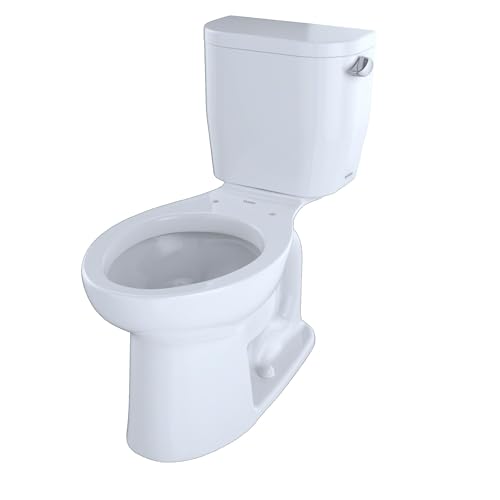
TOTO Entrada Two-Piece Elongated — Best Budget
The Entrada is TOTO’s value-tier two-piece, and its reliability story is inheritance: the same engineering discipline, glazing standards and quality control as the Drake, in a simpler specification at a lower tier — elongated bowl, Universal Height, 1.28 GPF, right-hand lever in this verified configuration. What you give up against the Drake is the flagship flush system’s margin and some finish refinement; what you keep is the part that matters for this guide — a conventional gravity toilet from the manufacturer with the category’s best support record, whose internals are standard and whose behaviour is documented by a large owner base.
Strengths
- TOTO engineering and support at the budget end of the reliable class.
- Standard gravity internals — cheap, universal servicing for decades.
- Elongated Universal Height comfort retained despite the tier.
Trade-offs
- Less flush margin than the Drake — heavy-use households should step up.
- Seat and finish specification are simpler; check the listing contents.
- Still a two-piece with a seam to clean.
The Entrada is the correct answer to a common question: how little can I spend without leaving the reliable class? Its existence in TOTO’s line is the point — a major manufacturer staking its support network on a value model rather than abandoning the tier to anonymous castings. For second bathrooms, rentals being upgraded responsibly, and first homes, it is the budget pick that will not become a false economy.
Best for: second bathrooms, rentals and budget renovations staying inside the proven class. Not suited for: heavy-use main bathrooms that need the Drake’s margin. Check the current price on Amazon.

Gerber Maxwell Crest Elongated Two-Piece — Best Plumber’s Value Pick
Gerber is the name homeowners know least and plumbers know well: a trade-focused manufacturer whose toilets are specified where callbacks are the specifier’s problem. The Maxwell Crest is its representative here — an elongated two-piece with a soft-close seat included in the verified listing, built around straightforward gravity internals and conservative engineering. Its reliability argument is the channel it sells through: products that survive in the trade channel do so because they install without drama and stay fixed, and Gerber’s parts support through plumbing suppliers is a professional ecosystem rather than a retail afterthought.
Strengths
- Trade-channel engineering: designed to install once and not generate callbacks.
- Soft-close seat included in this configuration — no separate order to forget.
- Conventional internals serviceable by any plumber, with pro-channel parts support.
Trade-offs
- Retail presence is thinner than the big three — you may order parts through suppliers rather than a local shelf.
- Specification details are plainer; this is a working toilet, not a design object.
- Less consumer review history to browse than the household-name rivals.
Consider the Maxwell Crest the guide’s nod to how professionals actually buy: not by brand fame but by failure rates they have personally observed. If your plumber suggests a Gerber, this listing is what they mean, and the suggestion itself is data. For a buyer comfortable ordering through the same channels the trade uses, it is a value pick with an unusually honest pedigree.
Best for: buyers guided by trade practice, landlords and property managers. Not suited for: buyers who want maximum retail shelf support in a small town. Check the current price on Amazon.
Comparison Table
| Pick | Badge | Key spec | Best for |
|---|---|---|---|
| TOTO Drake 1.28 | Best Overall | Two-piece, 1.28 GPF, TORNADO FLUSH, CEFIONTECT | Proven modern benchmark |
| TOTO Drake 1.6 | Best for Heavy Use | Two-piece, 1.6 GPF, same Drake platform | Margin for older drains |
| Kohler Highline 1.6 | Best Gravity Workhorse | Two-piece, 1.6 GPF, Class Five, Comfort Height | Largest service tradition |
| American Standard Champion PRO | Best Clog Resistance | Two-piece, 1.28 GPF, large-valve Champion platform | Clog-prone households |
| TOTO Entrada | Best Budget | Two-piece, 1.28 GPF, Universal Height | Value inside the proven class |
| Gerber Maxwell Crest | Best Plumber’s Value Pick | Two-piece elongated, soft-close seat included | Trade-channel reliability |
What Reliability Actually Consists Of
Strip the word down and a toilet can fail in only a handful of ways. It can leak — at the wax ring, the tank bolts, the supply connection or a worn flush-valve seal. It can run — a flapper or seal passing water, a fill valve that will not shut. It can clog — at the trapway, from insufficient flush margin meeting an ambitious load. It can crack — almost always from installation force or impact, not age. And it can become unserviceable — the quiet failure, when a part is needed and no longer exists. A reliable toilet is therefore not a mysterious quality: it is a design that minimises each mode. Gravity mechanisms with standard seals address leaks and running for the price of a consumable kit. Flush margin addresses clogging. Sound porcelain and correct installation address cracking. And the manufacturer’s parts pipeline — the least glamorous item on this page — addresses the failure that strands owners of clever toilets. Judge any candidate against those five modes and you are judging reliability the way a plumber does.
How to Choose a Reliable Toilet
Start by eliminating complexity you do not need: for a reliability-first purchase, gravity flush, conventional internals, no electronics. Then match flush margin to your reality — household size, load habits, drain age — using the Drake pair in this guide as the template for that decision. Then interrogate the parts story for the specific model: how long has it been in production, are its seals and valves stocked by national suppliers, does the manufacturer publish part numbers and documentation? A model with a decade of production behind it has survived its own teething; a model launched last year has not yet had the chance. Then the ordinary fit decisions — rough-in, height, bowl shape — because a reliable toilet installed against the wrong rough-in is a leak with good intentions. Finally, buy the consumables with the toilet: the correct spare seal for your model, in a labelled bag in the bathroom cabinet, converts the most common future failure into a ten-minute non-event.
How to Install for a Twenty-Year Life
Most toilet failures are born on installation day, so the reliable purchase deserves a reliable fitting. Inspect the flange before anything else: it should be sound, unbroken and roughly level with the finished floor, because the wax seal can only compensate for so much. Use a new wax ring and new flange bolts every time — reusing either is false economy at the exact joint that protects your subfloor. Lower the toilet straight down with body weight, snug the nuts alternately and stop at snug: porcelain cracks from enthusiasm, not from looseness. Set the tank water level to the manufacturer’s line, because flush margin is engineered at that level and a low tank quietly converts a reliable toilet into a clog-prone one. Flush-test repeatedly, check the base with a dry hand and a torch, and leave the back of the base uncaulked so the one leak that matters announces itself visibly. Do those things and the six toilets in this guide will repay you with the decades they were designed for.
Common Buying Mistakes
- Confusing features with reliability. Every added mechanism is a future service event. For a reliability purchase, boring is the specification.
- Buying an unknown model for its price. A toilet whose seal cannot be sourced in year six is the most expensive toilet in the store.
- Undersizing flush margin for the household. Chronic clogging is a specification error, not bad luck — match the margin to the loads and the drains.
- Reusing the wax ring, bolts or supply line. The cheapest parts in the project protect the most expensive structure in the room.
- Overtightening porcelain. Base and tank fasteners need snug, not strong. Cracks are installation injuries.
- Never recording the model number. Future parts are bought by that number. Photograph the tank’s interior markings on day one.
Final Recommendation
Buy the TOTO Drake 1.28 for the standard case — it is the reliable toilet the category is measured by. Step to the Drake 1.6 or the Kohler Highline when drains or household demand argue for margin, to the Champion PRO when the clogs live at the fixture, and to the Entrada or Gerber Maxwell Crest when the budget leads but reliability may not be traded away. Install any of them carefully, keep the model’s spare seal in a labelled drawer, and expect quiet, uneventful decades of service from it. Compare the brand picture in Best American Standard Toilets, the cleaning angle in Best And Easiest To Clean Toilets, and the water angle in Best And Coservative Toilets.
The Consumables Schedule: What Wears, and When
A reliable toilet is not a maintenance-free toilet — it is one whose maintenance is cheap, predictable and stocked everywhere. The flush-valve seal or flapper is the first consumable: expect five to ten years depending on water chemistry, less where the water is heavily chlorinated, and never use bleach drop-in tablets if you want the long end of that range. The fill valve follows on a longer cycle and announces itself by getting noisy or slow long before it fails outright. The tank-to-bowl gasket on two-piece models is a decade-plus item, usually replaced opportunistically when the tank is off for another reason. The wax ring is not a schedule item at all — it lasts until the toilet is lifted, which is why lifting a toilet for any reason always means a new ring. Seats are consumables in the cosmetic sense: hinges loosen and finishes wear, and a replacement seat is the cheapest bathroom refresh in existence. Total the realistic spend across twenty years and it is a small pile of inexpensive parts — that smallness is the entire economic argument for the gravity designs in this guide, and it evaporates the moment a toilet’s parts go proprietary or discontinued.
When the Problem Is Not the Toilet
Reliability guides owe readers this section, because a meaningful share of “unreliable toilets” are innocent fixtures bolted to guilty plumbing. Repeated clogs deep in the line, gurgling from other fixtures, or slow drainage across the house point to the drain, the vent or the main — and no toilet in this guide, however mighty its flush, cures a root intrusion or a sagging line. A toilet that rocks has a floor or flange problem that will destroy wax seals on any model you install. Low supply pressure starves fill valves impartially. The diagnostic discipline is simple: if a bucket of water poured directly into the bowl clears powerfully, the toilet’s flush side is fine and suspicion moves to the tank delivery; if the bowl rises and sulks even then, suspicion moves downstream to the line. Replacing a toilet to fix a line problem buys an expensive disappointment; replacing a line problem’s victim toilet after the line is fixed buys the decades this guide promises. When in doubt, a plumber’s camera inspection is the cheapest certainty in the whole trade.
Rentals, Landlords and Property Managers
Rental housing is where reliability stops being a preference and becomes a line item, and the rental logic sharpens every criterion in this guide. The toilet a landlord wants is the one whose failure modes are all tenant-survivable and plumber-trivial: standard seals stocked on every truck, a flush margin that forgives tenant behaviour, and a model number that will still mean something to a supplier in fifteen years. That is the Drake, the Highline, the Cadet-class and the Gerber in this list — and it is why experienced landlords standardise on one model across a portfolio, so every property shares the same spare seals in the same maintenance drawer. Two rental-specific notes: document the model and its part numbers in the property file at installation, because the person ordering parts in year seven will not be the person who chose the toilet; and resist the ultra-budget fixture at purchase, because the first callback for an unserviceable part costs more than the entire saving. The Maxwell Crest’s presence in this guide is largely the rental case wearing a product name.
Warranties: What They Actually Cover
Toilet warranties reward a careful read. The long headline periods typically cover the porcelain against manufacturing defects — cracking or crazing from the kiln, not from installation or impact — while the mechanical parts carry shorter cover, and the seat shorter still. In practice, the warranty’s real value is not the claim you might file in year twelve; it is the signal that the manufacturer maintains the model’s documentation, parts list and support channel, which is the infrastructure reliability actually runs on. Keep the purchase record and the model documentation with the house paperwork, register the product where the brand offers it, and treat the warranty as the receipt for a support ecosystem rather than as insurance. The brands in this guide have all demonstrated that ecosystem across decades; that demonstration, more than any clause, is what you are buying.
Reading a Model’s Track Record Before You Buy
You can audit a toilet’s reliability before purchase with four checks that take ten minutes. First, production age: search the model and note how long it has been sold in its current form — the picks in this guide measure that in years to decades, and anything under two years is unproven by definition, whatever its launch reviews say. Second, the parts page: the manufacturer’s site should list the model’s seals, valves and seat by part number, and those numbers should resolve to stocked items at national suppliers. A model whose parts page is thin or absent is telling you its future. Third, the complaint pattern: read owner feedback for recurrences, not averages — one systematic complaint repeated across years (a seat hinge, a fill valve) is information, while scattered one-off grievances are noise any popular product accumulates. Fourth, the installer test: ask a local plumber what they would put in a rental they owned. The answer is never the newest model in the showroom; it is a short list of platforms, and it overlaps this guide almost exactly. Run those checks on any candidate, including ours, and you are buying with the trade’s method rather than the brochure’s.
Fit Is a Reliability Issue Too
A toilet that does not fit its users gets modified, perched on, fitted with wobbling raised seats and generally lived with badly — and badly lived-with fixtures fail socially long before they fail mechanically. Height is the main variable: the reliable choice is the height the household’s knees will still thank in ten years, which for most adults is the comfort or universal band that four of these six picks occupy. Bowl shape follows the room, with elongated the default for adult comfort. Rough-in is the unforgiving one — a reliable model on the wrong rough-in is a leak waiting for its moment — so the measurement discipline from the installation section is part of the reliability purchase, not a preliminary to it. Finally, consider the household’s trajectory honestly: a toilet bought for a young family will serve its owners at sixty, and the models in this guide were chosen partly because their heights, parts and flush margins age with a household instead of against it. Reliability, in the end, includes the toilet still being right when everything around it has changed.
The Case Against Overbuying Reliability
Honesty requires the counterweight: reliability can be overbought. A guest bathroom used twenty times a year does not need the flagship’s margin; a home you will sell in two years will not collect the twenty-year dividend; and a household that genuinely wants bidet washing, heated seats and auto everything should buy the smart toilet and accept its appliance lifecycle rather than purchasing a gravity workhorse and resenting it daily. The picks in this guide are ranked for the reliability brief, not crowned as the correct toilets for every bathroom on earth. Match the purchase to the room’s actual duty — heavy and long for the main bath, lighter for the spare — and the portfolio of toilets in a house ends up both reliable and sensibly priced. That portfolio thinking, one tier down in the rooms that allow it, is how the Entrada and the Maxwell Crest earn their places beside the flagships rather than beneath them.
Reliability by the Numbers: Margin, MaP and the Double-Flush Test
If you want one measurable proxy for day-to-day reliability, it is flush margin — the distance between what a toilet can clear and what your household asks of it. MaP testing quantifies the top of that range: the grams of simulated waste a toilet clears in a single flush, on a scale where typical household loads sit in the lower hundreds and the strongest models reach the 1000-gram ceiling. A toilet whose tested ceiling is far above your household’s reality spends its life unstressed, and unstressed systems are reliable systems — the same logic as a vehicle engine that never works near its limit. The double-flush test is the field version: a toilet that routinely needs a second flush is operating beyond its margin in your home, whatever its specification says, and the remedy is a model with more margin (or a drain inspection) rather than patience. This is why the guide pairs the two Drakes and includes the Champion platform: they are margin choices, giving you a way to buy headroom deliberately instead of discovering its absence across a year of plungers. When two toilets otherwise tie, take the one with the higher published score and the larger valve — you are not buying drama, you are buying the absence of it.
Why These Platforms Won: A Short, Useful History
The reliable class has a history that explains its shape. The 1990s water mandates forced flush volumes down before the engineering was ready, and the resulting generation of weak toilets taught a generation of buyers to distrust efficiency — and taught manufacturers that flush engineering, not water volume, was the product. The 2000s response was the modern platform era: TOTO industrialised the high-performance gravity flush with the Drake, American Standard answered with the oversized-valve Champion, Kohler systematised its Class Five designs, and the trade brands like Gerber quietly kept specifying whatever survived contact with rental housing. Two decades on, those platforms are still the category’s centre of gravity because they solved the problem completely rather than fashionably: full clearing at legal volumes, with commodity internals, at prices production scale keeps honest. Newer designs — smarter, sleeker, more electronic — compete on experience, and some are excellent; none has yet displaced the gravity platforms on the reliability axis, because reliability is the one specification that cannot be launched, only accumulated. That is the deepest reason this guide reads the way it does: every pick has already done the twenty years you are asking about, in somebody else’s house, at scale.
Frequently Asked Questions
Which toilet brand is most reliable?
The honest answer is model-level, not brand-level: TOTO’s Drake platform, Kohler’s Highline line, American Standard’s Cadet and Champion lines and Gerber’s trade models all have long, documented service records. Any of the six picks here outranks a fashionable model from any brand, because reliability lives in the specific design’s age, mechanism and parts pipeline.
How long should a reliable toilet last?
The porcelain should last decades — twenty to thirty years is a normal expectation for the models in this guide. The tank internals are consumables on a five-to-ten-year rhythm depending on water quality: seals, flappers and fill valves are inexpensive and designed to be replaced. A toilet “failing” at year eight almost always needs a seal kit, not a replacement.
Are one-piece toilets more reliable than two-piece?
They remove one leak path — the tank-to-bowl joint — but add weight and cost, and their internals are the same. Two-piece toilets dominate this guide because their reliability record at scale is unmatched and their repairs are cheapest. Format is a cleaning and handling choice; mechanism and parts are the reliability choice.
What is the most common toilet failure?
A worn flush-valve seal or flapper letting water pass silently — the running toilet and the phantom refill. It wastes water, weakens the flush and is fixed in minutes with an inexpensive, model-correct part. The second most common is a clog from mismatched flush margin, which is a buying decision rather than a failure at all.
Do pressure-assist or smart toilets last as long?
Pressure-assist vessels and smart electronics are serviceable products with real support, but their mechanisms have more components, more model-specific parts and shorter design lives than a gravity toilet’s porcelain-and-seals arrangement. For a pure reliability brief, gravity wins; for features, buy the smart toilet knowingly, as an appliance with a service life rather than a fixture for decades.
Does a reliable toilet need a professional installer?
Not necessarily — the models here are the standard DIY installation of the category, and a careful homeowner with a helper for the lifting can fit one in about an hour using the sequence in this guide. Professional installation earns its fee where the flange is damaged, the shut-off valve is seized, the floor is suspect, or the household simply values certainty over savings. Either way, the reliability outcome depends on the same details: new wax, snug-not-forced fasteners, correct water level, and a patient leak check before the tools go away.
Can I make my existing toilet more reliable without replacing it?
Usually, yes — most ageing toilets are one consumables refresh away from their best behaviour. Replace the flapper or flush-valve seal and the fill valve together, set the water level to the tank’s marked line, clear the rim jets if the bowl wash has weakened, and confirm the chain or linkage has the small amount of slack its design wants. That kit of parts and an hour returns a sound platform to full reliability; replacement is for porcelain problems, parts extinction and chronic margin mismatch, not for wear items doing what wear items do.
Are dual-flush toilets as reliable as single-flush?
Close, with a small asterisk. Dual-flush mechanisms replace the simple flapper with a tower or cable assembly that has more components and more model-specific parts, so the consumables story is slightly more involved — though the mainstream dual-flush models in our other guides use well-supported parts. For an absolute reliability-first brief, single-flush gravity is the purest answer; for households prioritising water savings, a mainstream dual-flush is a reasonable, well-evidenced compromise rather than a risk.
How do I stop a toilet from running intermittently?
The phantom refill is almost always the flush-valve seal or flapper passing water slowly into the bowl, dropping the tank level until the fill valve tops it up. Confirm with food colouring in the tank — colour appearing in the bowl without flushing is the verdict — then replace the seal with the model-correct part, a minutes-long, tool-free job on the designs in this guide. If the seal is new and the running persists, the flush valve seat itself or the fill valve is next on the list, in that order.
What should I keep in the house as spares?
One correct flush-valve seal or flapper for your model, one fill valve if your water is hard or your model is older, a spare wax ring against the day the toilet is lifted for flooring work, and the model’s part numbers recorded with them. That small kit converts nearly every realistic toilet failure into a same-day, tool-light repair — and it is only possible because the models in this guide use stable, stocked parts.
Does hard water shorten a toilet’s life?
It shortens the consumables’ lives rather than the porcelain’s: fill valves scale, rim jets narrow and seals stiffen sooner. The defences are a periodic descale of the jets, prompt seal replacement when a phantom refill starts, and — where fitted — the home’s water softener doing its job. The models here tolerate hard water as well as any gravity design can; budget their seals on the shorter end of the ranges in this guide.
Should I replace a working old toilet with a reliable new one?
If the old toilet is a known platform with available parts and it flushes well, maintain it — reliability you already own is the cheapest kind. Replace when its parts are disappearing, when it clogs chronically despite a healthy drain line, when it leaks at the base, or when a renovation makes the labour free. The exception is the pre-1994 high-volume antique in a heavy-use home, where water savings alone can justify an earlier swap.
Is it worth paying more for a reliable toilet?
Across a twenty-year life, almost always. The price spread between an anonymous toilet and the Drake-class picks buys a known mechanism, a glazed trapway, published performance and a parts pipeline — and a single avoided plumber callout for an unserviceable part can exceed the entire difference. Reliability is the rare premium that reliably pays.

