Disclosure: airfryerkitchensupply.com is reader-supported. When you buy through links on our site, we may earn an affiliate commission at no extra cost to you.
Where to buy
Every model shortlisted in this guide to the best american standard toilets is sold through Amazon with the exact model verified against the manufacturer’s listings, so the fastest route is to check the current price on Amazon for the pick that matches your bathroom: the American Standard Champion 4 One-Piece for maximum flush power, the Champion PRO Two-Piece Elongated for clog-prone homes, the Cadet PRO Round Front for tight budgets, the Cadet PRO Right Height Elongated for a dependable all-round two-piece, the H2Option Dual Flush for the lowest water use in the range, and the Compact Cadet 3 One-Piece for small bathrooms. Toilets are heavy, fragile freight, so confirm the delivery window and the return terms on the product page before you order, and keep the packaging until the bowl is inspected for cracks.
Shopping for the best American Standard toilets means choosing between three mature product families — Champion, Cadet and H2Option — rather than comparing dozens of unrelated designs. That is good news: American Standard has been refining these platforms for years, parts are everywhere, and almost any plumber in the country has installed all three. It also means the differences that matter are specific: flush valve size, bowl shape, seat height, one-piece versus two-piece construction, and how much water each flush actually uses. This guide walks through the six models that cover nearly every realistic bathroom scenario, explains honestly where each one falls short, and shows you how to measure your rough-in and pick the right configuration the first time — because returning a toilet is nobody’s idea of a good weekend.
In this guide
Quick Picks
- Best Overall — American Standard Champion 4 One-Piece Elongated: the strongest flush in the lineup in a seamless one-piece body. Check the current price on Amazon.
- Best for Clog-Prone Households — American Standard Champion PRO Two-Piece Elongated: the Champion flush platform in a conventional two-piece format that is easier to carry and install in stages. Check the current price on Amazon.
- Best Budget — American Standard Cadet PRO Round Front: a compact, standard-height two-piece that keeps the Cadet flush engine and skips the frills. Check the current price on Amazon.
- Best Value Two-Piece — American Standard Cadet PRO Right Height Elongated: the elongated, taller Cadet configuration most households end up happiest with. Check the current price on Amazon.
- Best Water-Saving — American Standard H2Option Dual Flush Elongated: a true dual-flush with a light rinse option for liquid waste and a full flush when you need it. Check the current price on Amazon.
- Best for Small Bathrooms — American Standard Compact Cadet 3 One-Piece: an elongated bowl in a footprint closer to a round-front, with a one-piece body that wipes down fast. Check the current price on Amazon.
How These Picks Were Chosen
We limited this guide to American Standard models that are current, widely stocked and verified against live Amazon listings, so every product name, configuration and ASIN in this article matches a real, orderable toilet. Within the brand, we weighted flush performance first — American Standard publishes MaP (Maximum Performance) testing for its lines, and the Champion and Cadet platforms both use oversized flush valves and trapways designed to move bulk waste without a second flush. A toilet that needs two flushes is not water-efficient no matter what its gallon rating says, so real-world clearing power outranks the spec sheet.
Second, we covered the configuration matrix buyers actually face: one-piece versus two-piece, elongated versus round-front, chair height versus standard height, and single flush versus dual flush. Each of the six picks wins a distinct slot in that matrix rather than being a near-duplicate of its neighbour. Third, we considered ownership costs — the availability of flappers, seals, fill valves and seats years down the line. American Standard’s mainstream lines use largely standard internals, which is a genuine advantage over boutique brands whose parts disappear. Finally, we read owner feedback patterns for recurring complaints — weak rim wash, noisy fills, seat quality — and flagged them honestly in the trade-offs of each review instead of repeating marketing copy.
The 6 Best American Standard Toilets

American Standard Champion 4 One-Piece Elongated — Best Overall
The Champion 4 One-Piece is the toilet to buy when your household’s number-one complaint is clogs. American Standard built the Champion platform around a 4-inch flush valve — roughly double the diameter of a basic 2-inch valve — paired with a wide, fully glazed trapway. That combination dumps tank water into the bowl faster, and it is the speed of the water, more than the volume, that carries waste through. In a one-piece body, the tank and bowl are a single casting, so there is no tank-to-bowl seam to collect grime or develop a slow leak at the bolts. This elongated, Right Height configuration suits taller users and anyone who finds standard-height bowls a long way down, and the slow-close seat is included in the box, which is not true of every model in this guide.
Strengths
- The 4-inch Champion flush valve delivers the strongest single flush in the American Standard range, which makes it the safest choice for older drain lines and low-slope plumbing.
- One-piece construction removes the tank seam, so exterior cleaning is a single wipe and there are no tank bolts to corrode or weep.
- The EverClean antimicrobial glaze helps the bowl resist staining and keeps the surface slicker between cleanings.
Trade-offs
- It is heavy — one-piece toilets are a two-person lift, and getting one up a flight of stairs takes planning.
- The 1.6-gallon flush uses more water than the 1.28-gallon models here, so it is not the pick for aggressive water saving.
- Replacement flush-valve seals are Champion-specific; generic flappers will not fit, so keep the part number from the manual.
The Champion 4’s flush deserves a closer look because it explains the whole product line. A conventional toilet releases water through a 2- or 3-inch opening and relies on sustained flow; the Champion’s 4-inch valve empties the tank in a sharp surge, and the siphon jet at the bowl’s front pushes the contents toward the trapway at the same moment. The practical result owners report is that bulky loads and generous amounts of paper clear in one flush where their old toilet needed a plunger kept beside it. The trade-off is real, though: this is a premium-tier product in the American Standard catalogue, and its water consumption per flush is the highest of our six picks. If your water bill is the priority, scroll to the H2Option. If your priority is never thinking about your toilet again, this is the one.
Best for: households with a history of clogs, older plumbing and anyone who wants the strongest flush American Standard sells. Not suited for: strict water-conservation goals or solo installers working upstairs. Check the current price on Amazon.

American Standard Champion PRO Two-Piece Elongated — Best for Clog-Prone Households
The Champion PRO takes the same flush philosophy — a large flush valve and a wide trapway — and puts it in a conventional two-piece format. That matters more than it sounds. A two-piece toilet ships and carries as two manageable boxes, the bowl can be set and levelled before the tank goes on, and if the tank is ever damaged the replacement is a tank, not a whole new toilet. This elongated, chair-height version runs at 1.28 gallons per flush, so it brings Champion-grade clearing power down to the federal WaterSense-style consumption level that the one-piece flagship does not match. For a family bathroom that sees heavy use, this is arguably the most sensible toilet in the entire American Standard catalogue.
Strengths
- Champion flush platform at 1.28 GPF, so strong clearing and reasonable water use arrive in the same box.
- Two-piece format is easier to transport, carry upstairs and install alone in stages.
- Elongated bowl and chair height match the comfort profile most adults prefer for a main bathroom.
Trade-offs
- The tank-to-bowl seam collects dust and needs a brush or cloth where a one-piece needs a wipe.
- Seat inclusion varies by listing configuration, so confirm what is in the box before ordering.
- The PRO line is aimed at the trade, so retail packaging and instructions can be plainer than the consumer lines.
Installation is where the Champion PRO earns its keep. Setting a two-piece bowl lets you test the flange fit and rock the bowl level before committing the tank weight, and the tank itself bolts on with a gasket that is forgiving of slightly uneven floors. Owners upgrading from builder-grade toilets consistently describe the same experience: the first week they keep reaching for a plunger that turns out to be unnecessary. The honest limitation is cosmetic and hygienic rather than mechanical — the seam and the bolt caps need periodic attention, and the exterior silhouette is more traditional than the skirted one-piece designs elsewhere in this guide. None of that affects how it flushes, which is the point of the Champion name.
Best for: busy family bathrooms, DIY installers and anyone who wants Champion power with lower water use. Not suited for: buyers who want the seamless look and easiest exterior cleaning of a one-piece. Check the current price on Amazon.

American Standard Cadet PRO Round Front — Best Budget
The Cadet PRO Round Front is the value anchor of the American Standard range: a standard-height, round-front two-piece running at 1.28 gallons per flush. Round-front bowls project less from the wall, which makes this the natural fit for small bathrooms, powder rooms and older homes where the original rough-in and door swing leave no room for an elongated bowl. What you give up versus the Champion line is the oversized flush valve; what you keep is the Cadet flush system, which still uses a 3-inch valve and a glazed trapway and clears normal household waste reliably. For a rental property, a guest bath or a first renovation on a tight budget, that trade is usually the right one.
Strengths
- The most affordable route into American Standard’s current toilet range, in the budget tier of the catalogue.
- Round-front footprint fits tight bathrooms where an elongated bowl would crowd the door swing or the opposite wall.
- 1.28 GPF consumption keeps water use at the modern standard without dual-flush complexity.
Trade-offs
- Standard height is less comfortable for tall users and harder for anyone with limited mobility.
- Round bowls offer less seating area; some adults find them noticeably less comfortable than elongated.
- The flush is dependable rather than exceptional — very heavy loads may occasionally need a second flush.
Think of the Cadet PRO Round Front as the honest baseline. It does not promise to swallow anything you throw at it, and it does not try to be furniture. It is a well-made, easy-to-service toilet whose parts — flapper, fill valve, seat — are available at any hardware store in the country. Landlords like it because tenants cannot easily break it and any plumber can fix it in one visit. Homeowners on a budget like it because the money saved versus the flagship models buys a better faucet or flooring without giving up flushing reliability for ordinary use. Just measure first: round-front is a space decision, not a downgrade, and in a large bathroom the elongated Cadet below is the better buy.
Best for: small bathrooms, rentals, guest baths and budget renovations. Not suited for: tall users, mobility needs or households with chronic clog problems. Check the current price on Amazon.

American Standard Cadet PRO Right Height Elongated — Best Value Two-Piece
If the Champion PRO is the power pick and the round-front Cadet is the budget pick, this elongated Right Height Cadet PRO is the middle of the road done properly — and for most households, the middle of the road is exactly right. The elongated bowl gives the seating comfort adults expect, the Right Height rim sits at chair level so sitting and standing take less effort, and the 1.6-gallon Cadet flush provides a bit more water per flush than the 1.28 models, which some owners with older, rougher drain lines genuinely prefer. It is the configuration plumbers install when a customer says “just give me a good toilet” — no exotic parts, no learning curve, no surprises.
Strengths
- Elongated bowl plus Right Height is the comfort combination most households settle on permanently.
- The 1.6 GPF flush gives extra clearing margin on old or partially scaled drain lines.
- Cadet internals are standard and inexpensive to service for decades.
Trade-offs
- Uses more water per flush than the 1.28 GPF models, which adds up in large households.
- Two-piece seam needs the same periodic cleaning as any conventional toilet.
- The styling is plainly traditional; it will not anchor a modern bathroom design.
The interesting question with this model is the flush volume. WaterSense-style 1.28-gallon toilets dominate new sales, and in a modern home with smooth PVC drains they are all you need. But in a 1960s house with cast-iron drains, a slightly larger flush can carry waste further toward the main line and reduce the slow build-up that eventually becomes a blockage. That is the honest case for this 1.6-gallon Cadet: not nostalgia, but drain physics in older housing stock. If your home is newer or your water rates are high, the 1.28-gallon Champion PRO above is the smarter spend. Either way, you are getting the same Cadet build quality and the same easy parts availability.
Best for: main bathrooms in older homes, taller users and anyone who wants a set-and-forget two-piece. Not suited for: water-bill minimisers or design-led renovations. Check the current price on Amazon.

American Standard H2Option Dual Flush Elongated — Best Water-Saving
The H2Option is American Standard’s dual-flush answer: a light flush for liquid waste and a full flush for solids, in an elongated, chair-height two-piece body. Dual flush only saves water if the light flush genuinely clears the bowl — a rinse that leaves paper behind saves nothing — and the H2Option’s light setting is calibrated as a real bowl-clearing flush rather than a token trickle. In a household where most flushes are liquid-only, the arithmetic is compelling: the majority of daily flushes use the reduced volume, and the full flush remains available at the press of the other button. It is the one model in this guide whose water consumption can drop meaningfully below the 1.28-gallon standard across a typical week.
Strengths
- True dual-flush lets liquid waste clear on the reduced setting, cutting household water use where it is most frequent.
- Elongated bowl and chair height keep comfort equal to the single-flush Cadet and Champion models.
- Top-mounted dual buttons are intuitive for guests once they know which is which.
Trade-offs
- Guests and children often press the full flush out of habit, erasing the savings until the household learns the buttons.
- Dual-flush mechanisms have more parts than a simple flapper, so long-term servicing is slightly more involved.
- The light flush can struggle with large amounts of paper; the full flush exists for a reason.
Ownership of a dual-flush toilet is partly a household-habit project. Put simply: the technology saves water only when people use it correctly, and the first month decides whether that happens. Families who label the buttons or simply explain them once tend to keep the savings; households with a constant stream of guests tend to see less benefit. Mechanically, the H2Option uses a tower-style flush valve rather than a flapper, which many owners find more consistent over time because there is no flapper to warp and leak silently into the bowl. If your water comes from a well or a septic system, reduced flush volume has a second benefit — less water into the tank field per day — which makes this model doubly attractive for rural homes.
Best for: water-conscious households, septic systems and anyone paying high municipal water rates. Not suited for: guest-heavy homes or buyers who want the absolute simplest mechanism. Check the current price on Amazon.
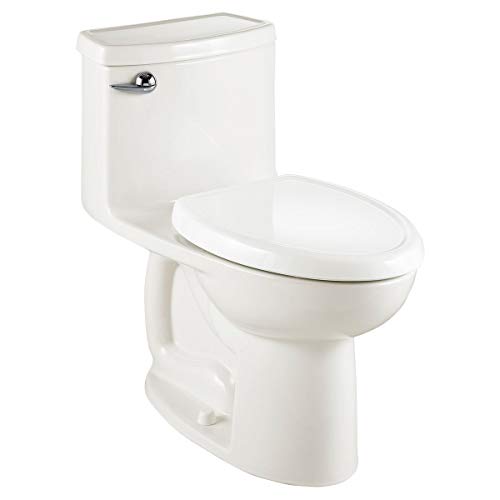
American Standard Compact Cadet 3 One-Piece — Best for Small Bathrooms
The Compact Cadet 3 solves a specific geometry problem: how to get an elongated bowl’s comfort into a bathroom whose floor space only allows a round-front’s footprint. American Standard shortened the tank profile and tightened the bowl’s projection so the overall length lands close to a round-front toilet while the seating area stays elongated. As a one-piece, it also brings the seamless exterior and easy wipe-down of the Champion flagship to a mid-tier position in the range, running at 1.28 gallons per flush. For condo bathrooms, ensuite conversions and older homes with a 10-inch rough-in feel, this is often the only model in the catalogue that fits without compromise.
Strengths
- Elongated comfort in a compact footprint that fits bathrooms designed for round-front toilets.
- One-piece body cleans fast and has no tank seam or bolt caps to trap grime.
- 1.28 GPF Cadet flush keeps water use at the modern standard.
Trade-offs
- One-piece weight makes installation a two-person job, especially in a tight room with little manoeuvring space.
- The compact tank holds less reserve, so the flush is tuned for efficiency rather than brute force.
- Standard proportions mean taller users should confirm the seat height suits them before ordering.
Small-bathroom buyers often discover the constraint too late: the door swings in, the vanity is fixed, and an elongated toilet simply does not fit the room’s geometry. The Compact Cadet 3 was designed for exactly that discovery. Because it is a one-piece, also budget a helper for installation day — you will be lowering a single heavy casting onto the flange bolts in a room where you can barely crouch. Once it is in, though, the ownership experience is the easiest in this guide: no seam, a glazed bowl that resists staining, and a flush that handles ordinary use without drama. It is the quiet overachiever of the American Standard range.
Best for: small bathrooms, condos and ensuite conversions where space is the binding constraint. Not suited for: households whose top priority is maximum flush power. Check the current price on Amazon.
Comparison Table
| Pick | Badge | Key spec | Best for |
|---|---|---|---|
| American Standard Champion 4 One-Piece Elongated | Best Overall | One-piece, 1.6 GPF, 4-inch flush valve | Maximum clog resistance |
| American Standard Champion PRO Two-Piece Elongated | Best for Clog-Prone Households | Two-piece, 1.28 GPF, chair height | Busy family bathrooms |
| American Standard Cadet PRO Round Front | Best Budget | Two-piece, 1.28 GPF, standard height | Small baths and rentals |
| American Standard Cadet PRO Right Height Elongated | Best Value Two-Piece | Two-piece, 1.6 GPF, Right Height | Older homes, tall users |
| American Standard H2Option Dual Flush Elongated | Best Water-Saving | Two-piece dual flush, chair height | Low water use, septic |
| American Standard Compact Cadet 3 One-Piece | Best for Small Bathrooms | One-piece, 1.28 GPF, compact elongated | Tight footprints |
How to Choose the Right American Standard Toilet
Start with the measurement that cannot be negotiated: the rough-in. Measure from the finished wall (not the baseboard) to the centre of the floor flange bolts. Twelve inches is standard; ten and fourteen inch rough-ins exist in older homes and limit your model choice sharply. Every toilet in this guide is a 12-inch rough-in design, so if your measurement is different, solve that first — either with a model built for your rough-in or with an offset flange fitted by a plumber. Next, choose bowl shape by space and preference: elongated bowls are more comfortable for most adults and project roughly two inches further; round-front bowls are the space-savers. Then seat height: standard height suits shorter users and children, while chair or Right Height (rim around 16.5 to 17 inches before the seat) is easier on knees and hips and is the default choice for main bathrooms and ageing in place.
After geometry, decide your flush priority. If your household history includes a plunger living beside the toilet, buy flush power — the Champion platform exists for you. If your drains are modern and your water bill is the pain point, buy efficiency — the H2Option’s dual flush or any 1.28-gallon model. If the toilet is for a rental or a little-used guest bath, buy simplicity — the Cadet PRO’s standard internals keep lifetime costs lowest. Finally, one-piece versus two-piece is mostly about cleaning and installation logistics: one-piece wipes down faster and looks cleaner, two-piece carries easier and repairs cheaper. Neither flushes inherently better; the valve inside matters more than the casting outside.
Budget Tiers Within the American Standard Range
American Standard’s catalogue falls into three natural tiers. The budget tier is the Cadet PRO two-piece line — straightforward toilets with standard parts, bought for rentals, guest baths and cost-led renovations. The mid-range tier holds the elongated Cadet configurations, the Compact Cadet 3 one-piece and the H2Option dual flush: you pay more for comfort geometry, one-piece construction or water-saving mechanics. The premium tier is the Champion one-piece flagship, where the money buys the 4-inch flush valve and the seamless body. A sensible way to allocate a renovation budget is to put the premium model in the bathroom with the worst clog history, mid-range models in the main baths, and budget Cadets in low-use rooms — rather than buying six identical toilets and over- or under-serving every room at once. Check the current price on Amazon for each tier before deciding, since the gaps between tiers move with promotions.
How to Install an American Standard Toilet
Most American Standard two-piece and one-piece toilets install the same way, and a careful DIYer can do it in about an hour. Turn off the angle stop and flush the old toilet to empty the tank, sponge out the remaining bowl water, and disconnect the supply line. Remove the bolt caps and nuts at the base, rock the old toilet gently to break the wax seal, and lift it straight up — have a helper for one-piece models. Scrape the flange clean, inspect it for cracks and confirm it sits roughly flush with the finished floor; a flange below floor level needs an extra-thick wax ring or a spacer. Set new flange bolts, press a fresh wax ring onto the toilet’s outlet (or the flange, per the ring’s instructions), and lower the new toilet straight down onto the bolts, pressing with body weight to seat the wax. Snug the nuts alternately — firm, never cranked, because porcelain cracks before the nut feels tight. Fit the tank on two-piece models with its gasket, connect the supply line, open the water and check the fill level against the line marked inside the tank. Flush several times, watching the base for any moisture, then caulk around the front and sides of the base — leaving the back uncaulked so a future leak reveals itself on the floor instead of hiding under the toilet.
Common Buying Mistakes
- Skipping the rough-in measurement. A 12-inch toilet on a 10-inch rough-in either will not fit or will sit oddly off the wall; measure from the wall to the flange bolts before ordering anything.
- Assuming the seat is included. Some American Standard configurations ship without a seat. Check the listing contents so you are not making a second order on installation day.
- Buying round-front for a main bathroom to save money. The saving is small and the comfort difference is daily. Round-front is a space decision, not a budget strategy.
- Overtightening the base nuts or tank bolts. Porcelain fails suddenly and without warning. Snug is enough; the wax ring, not bolt torque, makes the seal.
- Reusing the old wax ring or supply line. Both are cheap, both degrade, and a slow leak under a toilet destroys subfloors quietly. Replace them every time.
- Ignoring the drain line’s age. In older homes with rough cast-iron drains, the ultra-low flush that works beautifully in a new build may underperform; match flush volume to your plumbing, not to fashion.
Final Recommendation
For most households, the decision resolves quickly. Buy the Champion 4 One-Piece if clogs are your history and you want the strongest flush in the range. Buy the Champion PRO Two-Piece if you want nearly the same clearing power in an easier-to-install, lower-water package. Buy the H2Option if water use is the bill you are trying to shrink, and the Compact Cadet 3 if the room itself is the constraint. The two Cadet PRO models cover the budget and value slots honestly. Whichever you choose, measure the rough-in first — that single number decides more successful installations than any feature on this page. For neighbouring research, see Best And Most Reliable Toilets, Best And Easiest To Clean Toilets and Best And Coservative Toilets.
Flush Valves, Trapways and MaP Scores Explained
Three engineering details decide how a toilet flushes, and American Standard’s model names make more sense once you know them. The flush valve is the opening at the bottom of the tank: the wider it is, the faster water enters the bowl, and the faster the water moves, the stronger the siphon that carries waste away. That is why the Champion’s 4-inch valve outperforms conventional 2-inch designs and why the Cadet’s 3-inch valve is a meaningful step up from builder-grade toilets. The trapway is the S-shaped channel cast into the porcelain that waste travels through; a fully glazed trapway has a slick interior that resists build-up, and a wider trapway passes bulkier loads. The siphon jet — a directed port at the front of the bowl — fires water toward the trapway entrance to start the siphon decisively instead of waiting for bowl water to swirl its way there.
MaP testing ties these together. The Maximum Performance protocol, run by independent labs, flushes measured loads of soybean paste and paper and reports the grams a toilet clears in a single flush; 1000 grams is the top of the scale and roughly double what a typical household load demands. American Standard publishes MaP results for its main lines, and the Champion and Cadet platforms sit comfortably in the upper ranges. Treat MaP as a comparative tool rather than an absolute guarantee: your drain line’s slope, venting and condition still matter. But when two toilets both claim “powerful flushing” and only one publishes a test score, believe the score.
Water Use, Bills and Septic Systems
A toilet is usually the largest single indoor water user in a home, so the difference between flush volumes compounds quietly. A household of four flushing five times per person per day runs about twenty flushes daily; the gap between a 1.6-gallon and a 1.28-gallon model is roughly six gallons a day, or over two thousand gallons a year. A dual-flush model like the H2Option pushes further because most of those twenty flushes are liquid-only and clear on the reduced setting. Whether that saving matters depends on your water rates — trivial in some municipalities, significant in drought-priced districts — and on whether you are on a septic system, where every gallon not sent to the tank is a gallon the drain field never has to absorb. There is a floor to useful reduction, though: extremely low volumes can fail to carry solids all the way to the main line in long, flat drain runs, which is why this guide does not chase the lowest number and why the 1.6-gallon Cadet remains a rational choice for older housing.
Care and Maintenance: Keeping the Flush Strong for Decades
American Standard toilets are mechanically simple, and five minutes of attention a year keeps them that way. Once a year, lift the tank lid and watch a flush: the water level should sit at the line marked inside the tank, the fill valve should shut off decisively rather than sighing, and the flush valve seal should not let water trickle into the bowl between flushes — a silent leak that can waste more water than the flush volume debate ever will. If the toilet runs intermittently, the cause is almost always a worn flapper or valve seal, and replacements for Cadet and Champion models are inexpensive and tool-free to fit. Clean the bowl with a standard bowl cleaner and a brush; avoid drop-in tank tablets containing bleach, which attack rubber seals and are the single most common cause of premature flapper failure across all brands. Keep a spare seal in a drawer with the model’s part number written on the packet, and the toilet will very likely outlast the bathroom around it.
How American Standard Compares With Other Brands
Buyers cross-shopping this guide usually ask about two rivals. TOTO, the Japanese manufacturer, is the premium benchmark for flush engineering and glazed finishes, and its Drake line competes directly with the Cadet and Champion models — often at a higher price, with excellent performance and slightly less ubiquitous parts availability in smaller markets. Kohler, the other American giant, matches American Standard closely on distribution and design breadth, with its Highline and Cimarron lines occupying the same tiers as the Cadet and Champion. The honest summary is that all three brands make toilets that flush well in their mid and upper lines; American Standard’s edge is the Champion platform’s clog resistance at the top and the sheer ordinariness of its parts at every level. If your local plumber stocks one brand’s internals on the truck — and many stock American Standard — that logistical fact is worth more than a marginal difference in a spec table.
One-Piece vs Two-Piece: The Real Differences
Because this guide contains both formats, it is worth being precise about what the choice actually changes. A two-piece toilet is cast as a separate bowl and tank joined by bolts and a gasket during installation. It is lighter to move, cheaper to buy, and cheaper to repair if one half is damaged. Its costs are a seam that collects grime, two bolt caps that can corrode, and a slightly more dated silhouette. A one-piece toilet is a single casting: no seam, no tank bolts, a cleaner line and a faster wipe-down, at the price of greater weight, a higher purchase tier, and the reality that a cracked tank means a whole new toilet. Flushing performance is not inherently different — the Champion flush exists in both formats in this guide, which proves the point. Choose two-piece for practicality and staged installation; choose one-piece for hygiene, appearance and the easiest weekly cleaning. Households with young children often find the one-piece’s lack of a seam worth real money, because that seam is exactly where small accidents accumulate.
What to Check Before the Old Toilet Comes Out
Thirty minutes of preparation prevents most installation-day disasters. First, confirm the water shut-off valve behind the toilet actually works — turn it and flush; if the tank does not refill, the valve is good. If it will not close fully, plan to shut the house main and consider replacing the angle stop while the toilet is off, because a plumber will charge far less to do it now than on a second visit. Second, measure the rough-in as described earlier and check the distance from the flange to each side wall; building codes generally want fifteen inches from the bowl centreline to a side wall or fixture, and tight clearances argue for the round-front or compact models. Third, inspect the floor around the base for softness or staining — spongy flooring means water damage that should be repaired before a new toilet seals it in. Fourth, lay in supplies: a new wax ring (or two, in case the first set goes wrong), new flange bolts, a fresh braided supply line, and a plastic putty knife for the old wax. Finally, plan the old toilet’s exit: drain it fully, tape the tank lid, and know that a two-piece separates into manageable halves while a one-piece needs two people and a clear path to the door.
Troubleshooting: Weak Flushes, Double Flushing and Phantom Refills
If a toilet in this guide ever flushes weakly, work through the causes in order of likelihood before blaming the porcelain. First, check the tank water level: if it sits below the marked line, the bowl never receives its designed volume, and adjusting the fill valve takes a minute. Second, inspect the rim jets under the bowl’s rim with a mirror; in hard-water areas they scale over gradually, and a gentle clearing with a small Allen key or wooden skewer restores the swirl that starts the siphon — never use a metal tool aggressively, because chipped glaze stains faster. Third, look at the flush valve seal or flapper: a warped seal lets tank water seep into the bowl continuously, lowering the level and weakening every flush, and it is also the cause of the “phantom refill” — the fill valve topping up the tank briefly every so often when nobody has flushed. Fourth, consider the drain: a toilet that flushes well with a bucket of water poured directly into the bowl but poorly on its own flush has a tank-side problem, while one that rises and drains slowly even with the bucket test has a partial blockage in the trapway or the line beyond, which a closet auger — not a drain snake — is designed to clear. These four checks resolve the overwhelming majority of complaints about any modern toilet, American Standard included, and none of them requires a plumber.
Frequently Asked Questions
What is the difference between American Standard Champion and Cadet toilets?
The Champion line is built around a larger flush valve (4 inches on the flagship) and a wider trapway for maximum clearing power, while the Cadet line uses a 3-inch valve tuned for dependable everyday flushing at a lower cost. Champion models sit in the premium tier; Cadets are the value workhorses. Both use widely available parts.
Is a 1.28 or 1.6 gallon flush better?
Neither is universally better. A 1.28-gallon flush is the modern standard and works well with smooth, modern drain lines. A 1.6-gallon flush carries waste further, which can help in older homes with rough cast-iron drains. Match the flush to your plumbing and your water rates.
Do American Standard toilets come with a seat?
Some configurations include a slow-close seat and some are sold without one, particularly trade-oriented PRO models. Always check the “what’s in the box” details on the listing before ordering so installation day is not delayed.
What rough-in do I need for these toilets?
All six picks in this guide are designed for the standard 12-inch rough-in — the distance from the finished wall to the centre of the flange bolts. If your bathroom measures 10 or 14 inches, look for models built specifically for that rough-in instead.
Are American Standard toilet parts easy to find?
Yes — this is one of the brand’s real advantages. Flappers, seals, fill valves and seats for the Cadet and Champion lines are stocked by most hardware stores, and model-specific parts like the Champion flush-valve seal are easy to order by part number.
How long should an American Standard toilet last?
The porcelain itself can last for decades — there are Cadet and Champion toilets in service well past the twenty-year mark. The parts that wear are the seals, flapper and fill valve, which are inexpensive consumables rather than failures. Budget on refreshing the tank internals every five to ten years depending on your water quality, keep the correct seal for your model on hand, and avoid bleach drop-in tablets, which shorten seal life dramatically. Treated that way, any toilet in this guide is a twenty-plus-year fixture.
Can I install one of these toilets myself?
Yes, if you are comfortable with basic hand tools and can lift the weight involved — or have a helper for one-piece models. The job needs no special tools beyond a wrench, a putty knife and a level, and the step-by-step section above covers the sequence. The situations that justify calling a plumber are a damaged flange, a shut-off valve that will not close, soft or water-damaged flooring, or any rough-in that does not match the toilet you bought.
Is chair height better than standard height?
Chair height (also called Right Height or Comfort Height) puts the rim roughly at chair level, which most adults and anyone with knee or hip issues find easier. Standard height suits shorter users and households with small children. It is a comfort choice, not a quality difference.

