Disclosure: airfryerkitchensupply.com is reader-supported. When you buy through links on our site, we may earn an affiliate commission at no extra cost to you.
The best alternative toilets exist because the standard flush toilet has a non-negotiable demand — a water supply and a drain — and a surprising number of real situations cannot meet it: the cabin without plumbing, the basement below the sewer line, the van, boat or tiny home, the garden office, the emergency backup. “Alternative” is not one technology but a family of them, and choosing well means matching the technology to your constraint. Composting and urine-diverting toilets eliminate waste without water or drains. Macerating upflush systems keep the familiar flush but pump waste up to a drain that gravity cannot reach. Portable cassette toilets trade capacity for total freedom of placement. This guide covers the verified best of each family, explains honestly what ownership involves — the emptying, the media, the venting, the power — and tells you which family your situation actually calls for, because the most common alternative-toilet mistake is buying a good product from the wrong family.
Where to buy
All six picks are sold through Amazon, where you can check the current price on Amazon and read the full specification — dimensions, power needs and venting requirements matter more in this category than in any other. We do not print fixed prices here. Start with the confirmed options:
- Nature’s Head Self-Contained Composting Toilet — Best Overall: Check the current price on Amazon
- Separett Villa Urine-Separating Compost Toilet — Best for Cabins and Homesteads: Check the current price on Amazon
- OGO Origin Compact Composting Toilet — Best for Vans and RVs: Check the current price on Amazon
- Camco Portable Toilet 5.3 Gallon — Best Portable Budget: Check the current price on Amazon
- Saniflo SaniPLUS Macerating Upflush Kit — Best for Basements: Check the current price on Amazon
- Separett Tiny Self-Contained Urine-Separating Toilet — Best for Tiny Spaces: Check the current price on Amazon
In this guide
Quick Picks
- Best Overall — Nature’s Head Composting Toilet: the benchmark self-contained composter for boats, RVs and off-grid cabins, with a hand-cranked agitator and a devoted owner community. Check price on Amazon
- Best for Cabins — Separett Villa: a urine-diverting dry toilet with no mixing or additives, sized generously for full-time cabin and homestead use. Check price on Amazon
- Best for Vans and RVs — OGO Origin: a compact 15-inch-footprint composter designed for vehicle life. Check price on Amazon
- Best Portable Budget — Camco 5.3 Gallon: a simple cassette toilet with detachable tank for camping, boats and temporary needs. Check price on Amazon
- Best for Basements — Saniflo SaniPLUS: a macerating upflush kit that creates a real flushing bathroom below or away from the main drain. Check price on Amazon
- Best for Tiny Spaces — Separett Tiny: a self-contained urine-diverting toilet with built-in urine container, made for vans and the smallest cabins. Check price on Amazon
How These Picks Were Chosen
Alternative toilets fail in predictable ways — odour from bad venting, capacity misjudged, emptying dreaded — so our criteria started with the ownership experience rather than the showroom spec. We read owner routines as carefully as manufacturer claims, because in this category the truth of a product lives in its tenth emptying, not its first photograph, and the picks that survived are the ones whose routines real households sustain for years. Every pick had to be a real, complete product verified in Amazon’s catalog data, from a maker with a track record in its family: Nature’s Head and Separett anchor the dry-toilet world, Saniflo essentially created the residential macerating category, and Camco is a staple of RV life. We then matched each family to its honest use case and excluded anything whose premise misleads — incinerating toilets were researched but no listing we could verify with confidence as a complete, currently supported product made the cut, so that family is discussed in the guide without a pick rather than represented by a dubious link. Power requirements were checked carefully: several dry toilets need only a small 12V feed for a vent fan, the macerator needs a proper electrical supply, and the Camco needs none. Capacity claims were read against realistic usage, because a “weeks of capacity” headline always assumes a household size the marketing leaves vague. What remains is one strong answer per genuine situation.
The 6 Best Alternative Toilets
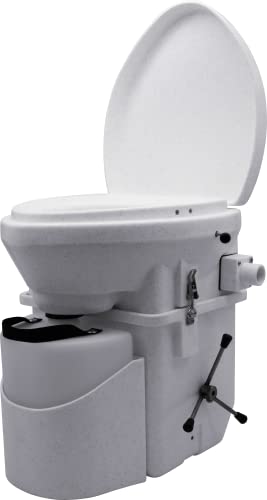
Nature’s Head Self Contained Composting Toilet — Best Overall
The Nature’s Head is the product most people picture when they picture a composting toilet, and its long production run in the marine and RV world has made it the category’s reference point. It is a self-contained unit: liquids are diverted to a front bottle, solids fall into a chamber with a composting medium (typically coco coir or peat), and a hand crank turns an agitator that mixes and aerates the contents — the process that keeps a well-run unit smelling of earth rather than waste. A small vent fan, run on 12V, exhausts moisture and any residual odour through a hose to the outside; that vent is not optional decoration, it is the mechanism the whole design depends on. The “close quarters spider handle” configuration in the verified listing suits tight installations where crank clearance is limited. It suits boaters, RVers, off-grid cabins and tiny homes ready to commit to the composting routine. It does not suit the squeamish about emptying — the solids chamber is emptied by hand on a cycle of weeks for a couple — nor installations where no vent path to outside air exists.
Strengths
- The reference self-contained composter, with a deep owner community and parts support.
- No water, no drain, no chemicals — only medium, venting and a small fan current.
- Urine diversion keeps the solids chamber dry, which is the key to odour control.
Trade-offs
- Solids chamber must be emptied by hand; the routine is real work, honestly described.
- Requires a vent hose to outside air and a 12V supply for the fan.
- Premium pricing for the category — this is the benchmark, not the bargain.
The Nature’s Head rewards owners who learn its two disciplines: keep liquids out of the solids chamber (the diverter does most of this, and user aim does the rest), and keep the vent fan running. Owners who do both report the famous result — a toilet that smells of nothing much — while owners who skip the vent or flood the chamber report the opposite and blame the product. Capacity is a couple using it full-time for several weeks between emptyings, and the emptied contents, partly composted, are typically bagged and disposed of per local rules or finished in a compost system where permitted. If your situation is a boat, van or cabin without plumbing and your temperament accepts the routine, this remains the default recommendation against which the rest of the family is measured.
Best for: boats, RVs, off-grid cabins and tiny homes / Not suited for: anyone unwilling to empty a solids chamber or unable to vent outside
Check the current price on Amazon

Separett Villa Urine-Separating Compost Toilet — Best for Cabins and Homesteads
Separett, a Swedish maker, approaches dry sanitation from a different philosophy: separate the urine, contain the solids in a bag-lined chamber, and skip the mixing medium and additives entirely. The Villa is the family’s full-size model, with a generous seat and capacity aimed at cabins, homesteads and off-grid houses where the toilet serves as the main facility rather than a weekend accessory. Because nothing is actively composted in the unit, there is no crank and no coir to manage; solids are collected dry — drying being what controls odour, assisted by a fan — and the bag is removed, sealed and disposed of or further composted according to local rules. The urine line can drain to a container, a soakaway or an ejector arrangement depending on your installation. It suits full-time off-grid homes, Scandinavian-style cabin culture transplanted anywhere, and users who prefer a simpler, no-medium routine. It is less suited to tiny vehicles, where its full-size footprint is a commitment, and to anyone who wants active in-unit composting rather than collection.
Strengths
- No mixing, no additives, no medium to buy or manage.
- Full-size comfort and capacity for a household’s main toilet.
- Simple, robust mechanism with very little to go wrong.
Trade-offs
- Collects rather than composts — disposal of bags is part of the routine.
- Full-size footprint is too much for small vans and boats.
- Consumable bags are an ongoing, brand-pattern purchase.
The Villa’s honesty is architectural: it does not promise that waste vanishes, it promises that waste is separated, dried and contained in the least unpleasant way the physics allows, and generations of Scandinavian cabin owners testify that the promise holds. Installation centres on the vent and the urine outlet — plan both before the unit arrives — and the fan’s small power draw suits solar cabins. For a homestead weighing this against a composting chamber system or an outhouse, the Villa’s case is dignity and simplicity: a normal-feeling seat, a normal sitting experience, and a maintenance routine measured in minutes per week. That combination is why it, rather than a second composter, takes the cabin slot in this guide.
Best for: off-grid homes, cabins and homesteads wanting a full-size dry toilet / Not suited for: small vehicles or buyers wanting in-unit composting
Check the current price on Amazon
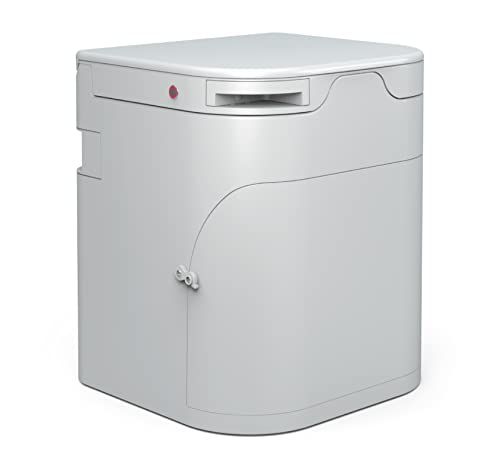
OGO Origin Compact Composting Toilet — Best for Vans and RVs
The OGO Origin was designed by people who measured van interiors first: a 15-inch footprint, a compact body, and a composting system that automates the part owners of hand-crank units sometimes neglect — an electric agitator mixes the medium at the push of a button. Liquids divert to a bottle, solids to the medium chamber, and a fan vents the unit, following the same proven physics as the Nature’s Head in a smaller, vehicle-oriented package. The smaller chamber is the honest trade: capacity suits one or two travellers between emptyings on a shorter cycle than the big units, which in vehicle life is usually acceptable because disposal opportunities come with the travelling. It suits vanlifers, small RVs, boats with tight heads and tiny homes where the Nature’s Head simply does not fit. It is less suited to families or full-time households, whose volume will outrun its chamber, and it needs its 12V supply for both fan and agitator.
Strengths
- Genuinely compact 15-inch footprint for vehicle installations.
- Push-button electric agitator simplifies the composting routine.
- Same urine-diverting, vented design as the category benchmarks.
Trade-offs
- Smaller chamber means a shorter emptying cycle for couples.
- Needs 12V power for fan and agitator.
- Compact seat dimensions are a compromise for larger users.
In a van, every fixture competes for the same cubic foot, and the Origin’s achievement is making the composting toilet — normally the bulkiest alternative — fit the vehicle’s discipline. Owners should plan the installation around the vent path and a service loop for emptying, because a toilet that must be unbolted to service will be serviced late. Medium choice matters in small chambers: coco coir, rehydrated and fluffed properly, is the community standard. For the solo traveller or couple whose alternative was a cassette toilet emptied every few days, the Origin stretches that rhythm to weeks and removes the chemical routine entirely — the exchange that defines its value.
Best for: vans, small RVs and tight boat heads / Not suited for: families or high-volume full-time use
Check the current price on Amazon

Camco Portable Toilet with Detachable Tank, 5.3 Gallon — Best Portable Budget
The Camco portable is the simplest alternative toilet in this guide and, for many buyers, the correct one: a two-piece cassette toilet with a freshwater reservoir and bellows flush on top, and a detachable 5.3-gallon holding tank below, sealed by a slide valve. There is nothing to install, vent or power. You fill the top, use it like a low toilet, and when the tank is full you carry it — by its built-in handle — to a toilet or dump point, empty, rinse and return. It is the standard equipment of campers, boaters, truck drivers, ice fishers, job sites and households nursing a bathroom renovation or a mobility need on a budget. Its limits are equally plain: capacity is days, not weeks; the sitting height is low; and the emptying, while simple, is the least pleasant version in this guide. It suits temporary, portable and occasional needs perfectly and full-time living poorly. Buy it for what it is — the honest, inexpensive answer to “we need a toilet where there isn’t one, this weekend” — and it will never disappoint you.
Strengths
- Zero installation: no water, drain, vent or power required.
- Detachable sealed tank with slide valve keeps transport as civilised as the format allows.
- The most affordable route into alternative sanitation in this guide.
Trade-offs
- Capacity measured in days; frequent emptying is the format’s nature.
- Low sitting height is hard on knees and mobility-limited users.
- Holding-tank chemicals or additives are part of the routine for most owners.
Two ownership tips separate a tolerable Camco experience from a miserable one. First, empty at three-quarters rather than brim-full: the tank is heavy when full, and the pour is cleaner with headroom. Second, use the slide valve and a rinse at every emptying, and let the tank dry with the cap off when stored — odour in cassette toilets is mostly a storage story. A third, smaller tip: keep a dedicated pair of gloves with the toilet, because a chore with its own kit is a chore that gets done properly. For camping families and worksites, that discipline makes this the best-value pick here by a wide margin; for anyone considering it as a home’s only toilet, let the capacity arithmetic talk you into the composting picks above instead.
Best for: camping, boats, job sites, renovations and temporary needs / Not suited for: full-time living or mobility-limited users
Check the current price on Amazon

Saniflo SaniPLUS Macerating Upflush Toilet Kit — Best for Basements
The SaniPLUS answers the most common alternative-toilet problem in ordinary houses: you want a real bathroom where gravity says no — a basement below the sewer line, a garage conversion, an under-stair WC. The system pairs an elongated rear-discharge bowl with a macerating pump unit that liquefies waste and pumps it upward through small-diameter pipe to the main drain, so a genuine flushing toilet (with the kit able to also serve a sink and shower in a full bathroom layout) can live almost anywhere with water and power. Saniflo created this category and supports it with the depth a pump product demands. The verified kit includes the elongated bowl and extension pipework for installations where the unit sits behind a wall. Ownership is real plumbing: the macerator is audible during its short cycle, it needs a proper electrical supply, and it must never meet the wipes and objects that defeat pumps. It suits basement bathrooms, additions and conversions where conventional drainage is impossible or ruinously expensive. It is not a portable or off-grid product in any sense.
Strengths
- Creates a true flushing bathroom below or beyond the reach of gravity drains.
- Small-bore discharge pipe avoids breaking concrete for a conventional line.
- Category-creating brand with established support and parts.
Trade-offs
- Pump is audible in operation and needs a proper power supply.
- Strict about what may be flushed — wipes and foreign objects can jam the macerator.
- Professional installation recommended; the most complex install in this guide.
The SaniPLUS should be judged against its true alternative, which is not a composting toilet but a sewage ejector pit or a jackhammered floor — against those, a macerating kit is cheaper, faster and far less disruptive. It also preserves the option value of the room: a macerating installation can be removed and the space returned to its original state far more easily than a pit can be un-dug, which matters in homes whose next owner may want the basement for something else entirely. Plan the installation with the discharge route first (the pump’s lift and run capabilities are specified; respect them), provide the electrical supply to code, and leave access to the unit for the service it will eventually need. Households that treat it as a normal toilet with one extra rule — nothing but waste and paper — report years of unremarkable service, which for a basement bathroom is the highest praise available.
Best for: basement bathrooms and conversions beyond gravity drainage / Not suited for: off-grid, portable or no-power situations
Check the current price on Amazon

Separett Tiny Self-Contained Urine-Separating Toilet — Best for Tiny Spaces
The Separett Tiny takes the Villa’s urine-diverting, no-additive philosophy and shrinks it for the spaces the Villa cannot enter: vans, small RVs, boats and micro-cabins. It is self-contained, with a built-in urine container (with an emptying sensor, per the verified product data) rather than an external line, and a bag-lined solids container — a combination that simplifies installation in a vehicle, where routing a urine drain is often the hardest part of a dry-toilet fit. A fan vents moisture and odour as in its larger sibling. Capacity is the deliberate sacrifice: this is a toilet for one or two people in a small space, emptied on a correspondingly attentive rhythm. It suits van conversions prioritising simplicity, tiny homes and boats where every system must be self-contained. It is less suited to families, to full-time household duty, and to anyone who will resent a smaller container’s schedule.
Strengths
- Self-contained urine handling removes the hardest part of vehicle installation.
- No additives or mixing medium; simple bag-based solids collection.
- Compact footprint from the dry-toilet category’s most experienced maker.
Trade-offs
- Small containers mean attentive emptying, especially the urine bottle.
- Bag consumables are an ongoing purchase.
- Not sized for family or full-time household volume.
The Tiny’s design intelligence is recognising that in a van, plumbing simplicity beats capacity: a urine line snaking through a vehicle floor is a leak waiting for a rough road, while a sealed internal container with a level sensor is a chore you can schedule. Pair it with a disciplined rhythm — urine container checked daily in use, solids bag changed before it becomes a weight — and the Tiny delivers the Separett promise at the smallest scale the family offers. For solo vanlifers especially, it may be the most livable product in this entire guide.
Best for: vans, micro-cabins and boats wanting self-contained dry sanitation / Not suited for: families or high-volume use
Check the current price on Amazon
Comparison Table
| Pick | Badge | Key spec | Best for |
|---|---|---|---|
| Nature’s Head Composting | Best Overall | Self-contained composter, urine diverting, 12V fan vent | Boats, RVs, off-grid |
| Separett Villa | Best for Cabins | Urine-separating, no additives, full-size | Homesteads, cabins |
| OGO Origin | Best for Vans and RVs | Compact composter, 15-inch footprint, electric agitator | Vehicle life |
| Camco Portable 5.3 Gal | Best Portable Budget | Cassette toilet, detachable tank, no power | Camping, temporary |
| Saniflo SaniPLUS | Best for Basements | Macerating upflush kit, elongated bowl | Below-drain bathrooms |
| Separett Tiny | Best for Tiny Spaces | Self-contained urine-diverting, built-in container | Micro spaces |
How to Choose an Alternative Toilet
Start from your constraint, not from a product, and write the constraint down in one sentence before you open a single listing — “no drain and no water in a cabin for two people” is a brief that chooses its own family, while “something alternative” is a mood that buys the wrong one. If you have water and power but no reachable drain, the answer is macerating upflush — the SaniPLUS family — and nothing else in this guide is really competing for your money. If you have neither water nor drain, you are in dry-toilet territory, and the choice becomes composting versus separating: composting (Nature’s Head, OGO) processes solids in the unit with a medium and suits owners who accept the crank-and-chamber routine for longer intervals; separating (Separett) collects solids dry in bags with no medium and suits owners who prefer simplicity and more frequent, simpler changes. If the need is temporary or mobile and light — camping, a renovation, a worksite — the cassette format wins on price and zero installation, and its capacity limits do not matter. Then check the unglamorous specifics before ordering: vent path to outside air for every dry toilet, 12V or mains power for fans and pumps, the physical footprint against your floor plan, and your local rules for disposing of bagged or composted waste. The right family plus those four checks is the whole decision; the picks above are the strongest current answer inside each family.
How to Install and Vent a Dry Toilet
Every dry toilet in this guide lives or dies on its vent, so installation begins there. Treat the vent with the seriousness you would give a flue on a wood stove — it is exhaust infrastructure for a biological process, and the fan’s small hum is the sound of the entire odour strategy working. Choose the shortest, straightest path from the unit’s vent outlet to outside air — through a wall, a roof, or a boat’s hull fitting — using the hose or pipe the maker specifies, and seal every joint; the small fan must move all of the unit’s air outside, because any leak vents into your living space instead. Secure the toilet to the floor or platform so it cannot shift (in vehicles, this is a safety matter, not a nicety), leaving the access you need to remove bottles and chambers without unbolting the unit. Connect the 12V supply for the fan with a fused feed, and test the fan’s draw direction before the first use. For separating models with a urine drain, give the line a continuous gentle fall to its container or outlet and avoid low spots where liquid can pool. Commission the unit with fresh medium where required, run the fan for a day before first use to confirm the vent pulls air inward at the seat — a tissue held at the seat opening should flutter toward the unit — and only then put it into service. That tissue test, repeated whenever odour appears, diagnoses nine of ten dry-toilet complaints: odour means air is moving the wrong way, and air movement is the vent’s job.
Living With a Dry Toilet: What the First Month Teaches
New dry-toilet owners go through a predictable education, and knowing it in advance smooths the curve. Week one is about the vent: you will check the fan, sniff suspiciously, and learn that the system works — provided your installation vent truly exhausts outside. The first urine-bottle emptying teaches the rhythm: it is a daily-or-so chore for full-time users, takes a minute, and becomes as unremarkable as taking out recycling. The first encounter with the solids side teaches the medium lesson: composting units want their medium fluffy and merely damp, and most early problems — excess moisture, the odd fly — trace to a chamber too wet, fixed by adding dry medium, confirming liquid diversion, and keeping the fan honest. Separating-unit owners learn the parallel lesson about bags: change on schedule, not on capacity, and the chore stays small. By the end of the first month, owners consistently report the same surprise — the toilet has become the least interesting system in the building, which is the entire goal. The households that fail with dry toilets almost never fail on the hardware; they fail in week one, on a vent installed as an afterthought, and conclude wrongly about the product. Install the vent like you mean it, and the month teaches you confidence instead.
Rules, Codes and Disposal: The Unglamorous Essentials
Alternative toilets sit at the edge of plumbing codes written for flush fixtures, and a responsible buyer checks the local picture before, not after, installation. Building and health codes vary widely: some jurisdictions accept composting and separating toilets as a dwelling’s sole sanitation, others permit them only as supplements, and many have specific rules for greywater and urine disposal that your installation must respect. Rental properties, workplaces and public-facing premises face stricter requirements than an owner-occupied cabin. Disposal of waste — bagged solids, finished compost, urine — is likewise regulated locally, and the makers’ guidance assumes you will confirm it. None of this is a reason to avoid the category; off-grid living depends on it, and the products in this guide are the established, documented kind that building officials recognise. It is a reason to make two phone calls — to your building department and, where relevant, your environmental health office — before the purchase rather than during an inspection. The macerating pick plays by ordinary plumbing and electrical codes and should be installed to them, with permits where your area requires them.
Macerating Toilet or Sewage Ejector Pit?
Basement shoppers face a genuine fork, and the SaniPLUS pick deserves its comparison. The traditional answer to a below-drain bathroom is a sewage ejector system: a pit is broken into the concrete floor, a basin and pump installed, and a conventional toilet drains into it by gravity before the pump lifts the waste. It is robust, fully conventional in use, and a significant construction project — concrete work, a sealed basin, venting and plumbing, usually professionally installed at a cost that dwarfs the fixtures. The macerating answer keeps the pump at the toilet, discharges through small pipe run on the surface or in walls, and typically installs in a day without touching the slab. Its trade-offs are the audible pump cycle, the strict no-wipes rule, and a fixture ecosystem tied to the macerator’s maker. For a single basement bathroom in a finished house, macerating usually wins on cost and disruption; for a new build or a major renovation where the floor is open anyway, the ejector pit’s conventional character can justify itself. Either way, the decision is about the building, not the toilet — which is why this guide treats the basement problem as its own family rather than a footnote.
The Running Costs of Each Family, Honestly Compared
Alternative toilets rearrange costs rather than abolishing them, and each family’s meter runs on different fuel. Composting toilets consume medium — coir or peat — in modest quantities, plus a trickle of electricity for the fan; their hidden cost is your time at emptying, which owners consistently rate as smaller than feared. Separating toilets consume their bag liners, a genuine ongoing brand-pattern purchase to budget for, and the same trickle of fan power. Cassette portables consume holding-tank treatment chemicals and your trips to the dump point — cheap per trip, frequent by design. Macerating systems consume mains electricity in short bursts and carry a pump’s eventual service cost; their saving is measured against construction they let you avoid. Against all of these, weigh the flush toilet they replace or preclude: water and sewer charges, or the septic and drain-field capacity a dry toilet never touches. In water-scarce and off-grid settings, the dry families’ near-zero water demand is not a footnote but the founding argument. Run your own household’s numbers with these categories in mind and the “expensive” alternative often reprices itself.
Choosing Between the Two Separetts, and the Two Composters
Two pairs in this guide invite direct comparison, and the deciding questions are simple. Between the Separett Villa and the Separett Tiny, ask where the toilet lives and how many people it serves: the Villa is a household fixture with external urine drainage and full-size comfort, the Tiny is a self-contained appliance for one or two people in a vehicle-sized space. Choose the Villa when the building is stationary and the users are a household; choose the Tiny when the floor plan is measured in inches and every external line is a liability. Between the Nature’s Head and the OGO Origin, ask the same space question and one more — how do you feel about the crank? The Nature’s Head is the larger, manual, maximally proven unit; the Origin is the smaller, push-button unit that trades chamber size for footprint and convenience. Van and small-RV builders will usually land on the Origin or the Tiny; boat and cabin owners with room will usually land on the Nature’s Head or the Villa. Notice what is not a deciding question: odour. All four, vented properly, control it — the differences are capacity, footprint and routine, and those are the grounds on which to choose.
Emergency and Backup Sanitation: The Quiet Use Case
A growing number of households meet this category through preparedness rather than lifestyle: a well or septic failure, a frozen-pipe week, a renovation that takes the only bathroom offline, a storm season that makes the news every year. For backup duty, the families rank differently than for daily life. The cassette portable is the natural emergency toilet — it stores dry and compact, deploys in minutes with no installation, and serves a household through a short crisis; the Camco pick exists in many garages for exactly this reason. A dry toilet is the long-outage answer, but only if it is already installed and vented — an emergency is the wrong time to learn venting. Households in outage-prone areas sometimes install a separating toilet in a secondary space as standing insurance, accepting its routine in exchange for independence from water and drains. Whichever route you take, store the consumables with the unit — medium, bags or tank treatment — because a backup toilet without its supplies is furniture. It is an unglamorous purchase that, exactly once, becomes the most valuable object in the house.
Accessibility and Dignity: The Human Factor in Alternative Sanitation
Alternative toilets are often bought for situations involving care — a ground-floor room for a recovering relative, a workshop for a parent who gardens all day, a cabin a grandparent should not have to leave at night for an outhouse. Judged on dignity, the families differ in ways spec sheets miss. A macerating system is the most dignified of all because it is indistinguishable from a normal toilet in use; nothing about it asks the user to learn or accept anything. The full-size dry toilets come next: a normal seat, a normal sitting experience, with the differences confined to maintenance that someone else can own. Cassette portables rank last on this measure — low height, small seat, chemical routine — and for a mobility-limited user they can be genuinely difficult, a fact worth weighing before buying one for exactly that purpose. Seat height deserves a tape measure in every family: several alternative toilets sit lower than the comfort-height fixtures modern users expect, and a stable, appropriately sized platform or a different family is the right answer when the user cannot rise from a low seat. The best alternative toilet is the one its user can use independently, safely and without embarrassment — hold every pick in this guide up to that standard for your situation.
Common Buying Mistakes
The first mistake is buying across families — a cassette for full-time living, a composter for a weekend tent, an upflush kit for an off-grid cabin with no power to run it. A subtler version of the same error is buying for the situation you wish you had — the boat you might buy, the homestead you might move to — instead of the floor, power and people in front of you today. The second is skipping the vent: every dry toilet installed without a proper outside vent becomes an odour complaint with a receipt. The third is believing capacity headlines without asking “for how many people?” — halve the claim for a family and halve it again for your peace of mind. The fourth is flushing wipes or objects into a macerator, which is a pump, not a garbage disposal. The fifth is ignoring local disposal rules for bagged and composted waste until the first emptying. The sixth is under-measuring the space: alternative toilets have service clearances as well as footprints, and a unit you cannot empty without removing it will be emptied late, with predictable results.
Final Recommendation
Match the family to the constraint and the pick follows: the Nature’s Head for committed composting in boats, RVs and cabins; the Separett Villa for full-size off-grid homes that prefer no-medium simplicity; the OGO Origin or Separett Tiny for vehicles and micro-spaces; the Camco portable for temporary and camping needs; and the Saniflo SaniPLUS when the problem is a drain gravity cannot reach. For conventional fixtures, continue with Best Affordable Toilets, Best Air Assisted Toilets, Best 1 Piece Toilets and Best American Made Toilets.
Frequently Asked Questions
Do composting toilets smell?
A correctly installed and vented composting toilet smells of very little — owners describe an earthy note when the chamber is opened for emptying. Odour in normal use almost always traces to a vent problem, excess liquid in the solids chamber, or a fan that is off. The design’s whole odour strategy is separation plus airflow, and it works when both are respected. Separating toilets follow the same law with drying in place of composting: moving air is the product, and the porcelain is merely where it sits.
What do you do with the waste from a dry toilet?
Urine, diluted, is typically emptied into a regular toilet, a drain or — where local rules allow — onto ground away from water sources and food gardens. Solids from composting units are partly broken down and are usually bagged for disposal with household waste or finished in a compost system, per local regulations. Bagged solids from separating toilets go out with household waste in most jurisdictions. Always confirm your local rules.
Can an alternative toilet serve as a home’s only toilet?
Yes, within the right family: full-size dry toilets like the Separett Villa and the Nature’s Head serve off-grid homes full-time, and a macerating system is simply a normal toilet for daily purposes. Cassette portables are the exception — their capacity makes them a poor only-toilet for a household. The deciding factors are the emptying routine and your household’s honest tolerance for it, which is why this guide describes those routines in plain terms rather than brochure terms. Give any new system its first month of grace while the routines become habits — every owner in this category reports the same arc, from initial vigilance to indifference, and indifference is the sound of sanitation working.
How much power do alternative toilets use?
Dry toilets use very little — a small vent fan, and on the OGO an agitator motor, running on 12V in vehicle-friendly fashion. Macerating systems draw proper mains power but only in short bursts when flushing and pumping. The Camco uses none at all. For a solar cabin or a van house battery, the dry families’ draw is small enough to disappear into the system’s rounding errors.
Are incinerating toilets a better alternative?
They are a legitimate fourth family — waste is burned to a small amount of ash, needing power or gas and careful venting — and for some remote installations they are ideal. We did not include a pick because we could not verify a complete, currently supported listing with the confidence this programme requires; if your situation points that way, buy through a specialist dealer who can support the unit.
What about winter and freezing conditions?
Dry toilets tolerate cold well once venting is maintained, though composting slows in deep cold and urine containers and lines must be protected from freezing like any water. Macerating systems in unheated spaces need the same freeze precautions as any plumbing. Cassette toilets should have their water systems drained or protected with suitable non-toxic antifreeze per the maker’s instructions.
How do guests react to an alternative toilet?
Better than owners fear, when the household does one thing: explain the one rule that matters before the first use. For dry toilets that rule is usually about the diverter or the bag system; for a macerator, it is “paper and waste only, nothing else, ever”. A small framed note in the bathroom removes embarrassment on both sides, and most guests adapt instantly to a seat that looks and sits like any other.


