Disclosure: airfryerkitchensupply.com is reader-supported. When you buy through links on our site, we may earn an affiliate commission at no extra cost to you.
Where to buy
Every machine in this roundup is sold on Amazon. Prices in this category move constantly with promotions, so instead of printing numbers that would go stale within weeks, each verified pick below links straight to its Amazon listing — use the links to check the current price on Amazon before you buy. Every product here was verified through this site’s Amazon product data feed on 2026-11-20, with ASIN, model and capacity matched from the listing titles. This guide is specifically about drip brewing — gravity-fed hot water through ground coffee — so pod machines and percolators were excluded by design, however good they may be at other jobs.
- Bonavita 8 Cup Coffee Maker BV1900TS — check the current price on Amazon
- Bonavita 8 Cup Coffee Maker BV1901TS — check the current price on Amazon
- OXO Brew 8-Cup Coffee Maker — Thermal Carafe — check the current price on Amazon
- OXO Brew 8-Cup Drip Coffee Maker — Glass Carafe — check the current price on Amazon
- Melitta Aroma Tocco 8 Cup Thermal Coffee Maker — check the current price on Amazon
- KRUPS Simply Brew 10 Cup Coffee Maker — The Budget Step-Up — check the current price on Amazon
The best 8 cup drip coffee makers are a study in doing one thing properly. Drip brewing is a simple physical process — hot water, evenly distributed, passing through ground coffee at the right temperature for the right time — and at the 8-cup scale, the machines that respect that physics produce cups that embarrass far larger and pricier brewers. This guide is for the reader who typed ‘drip’ deliberately: no pods, no pressure, no espresso pretensions, just a well-extracted pot of about forty ounces.
Because the drip field at this size is compact, the list leans into the specialists: two generations of Bonavita’s certified pour-over style brewer, both carafe variants of OXO’s certified machine, and Melitta’s programmable thermal — the company whose name is on the filter in most of these baskets. The sixth slot goes, transparently, to a budget 10-cup drip step-up for households that want drip value more than exact capacity, and it is labeled as such wherever it appears.
Every pick was verified against Amazon’s own product data for this site before linking. What follows weighs the drip-specific variables — showerhead design, temperature stability, pre-infusion, basket geometry — more heavily than timers and touchscreens, because that is what the search asks for.
It also helps to say what drip does better than every rival format at this scale: it makes a pot worth sharing. A great drip pot is a social object — it sits at the center of a table and improves a conversation for an hour. Pod and espresso formats serve individuals brilliantly and gatherings awkwardly. The 8-cup drip machine is sized precisely for the table-for-four moment, which is why, a century into its life, the format refuses to be displaced.
Key Takeaways
- Drip quality is decided by temperature, showerhead spread and pre-infusion — in that order.
- This guide is drip-only by design: no pods, no pressure, no percolators.
- Certified machines (Bonavita, OXO) are the flavor benchmark at 8 cups.
- Filters and water are half the system; the cheapest experiments are a filter change and a filtered-water pot.
In this guide
Quick Picks
- Bonavita 8 Cup Coffee Maker BV1900TS — Best Pure Drip Brewing. The original certified drip specialist: one-touch pour-over style brewing, a proper showerhead, and a thermal carafe — drip fundamentals executed without distraction. Check the current price on Amazon.
- Bonavita 8 Cup Coffee Maker BV1901TS — Best Overall Drip. The updated Bonavita drip machine: the same certified extraction, now with auto pause and a double-wall thermal carafe for real households. Check the current price on Amazon.
- OXO Brew 8-Cup Coffee Maker — Thermal Carafe — Best Drip for Varied Routines. Certified drip brewing at pot scale and single-cup scale in one machine, with thermal holding — drip for households whose days refuse to match. Check the current price on Amazon.
- OXO Brew 8-Cup Drip Coffee Maker — Glass Carafe — Best With Temperature Control. The glass-carafe OXO drip brewer with a temperature control setting — certified extraction you can fine-tune, in a carafe you can see into. Check the current price on Amazon.
- Melitta Aroma Tocco 8 Cup Thermal Coffee Maker — Best Programmable Drip. A programmable true 8-cup drip machine with thermal holding and a touch panel — scheduled drip from the company that invented the paper filter. Check the current price on Amazon.
- KRUPS Simply Brew 10 Cup Coffee Maker — The Budget Step-Up — Best Budget Drip (10-Cup Step-Up). Labeled honestly as a 10-cup machine: a simple, budget-tier drip brewer with a drip-free carafe and dishwasher-safe pot, for value-first households flexible on exact size. Check the current price on Amazon.
How These Picks Were Chosen
Candidates were verified feed, matching ASIN to brand, model and capacity from the listing titles. Non-drip formats were excluded on principle: this article answers a drip question, and padding it with pod or espresso machines would betray the search intent even if the individual products were excellent.
Ranking then followed drip fundamentals: verified brewing temperature and certification, water distribution over the basket, pre-infusion behavior, carafe holding, and only then convenience features. A machine that brews beautifully and does nothing else outranks a gadget that brews adequately and does everything else.
We weighted one more drip-specific behavior heavily: how evenly each machine’s basket performs at the end of the brew, when the last water meets the most-extracted grounds. Machines that channel produce a pot that is simultaneously sour and bitter — the signature failure of cheap drip — and that failure, more than any feature list, is what the certified picks here are engineered to prevent.
- Verified listing, model and capacity before linking.
- True drip format only: gravity brewing through ground coffee, no pods or pressure.
- Extraction engineering: certification, showerhead spread and pre-infusion ranked first.
- Carafe discipline: thermal holding preferred for flavor over time.
- Honest sizing: five true 8-cup machines plus one clearly labeled budget step-up.
The 6 Best 8 Cup Drip Coffee Makers

Bonavita 8 Cup Coffee Maker BV1900TS — Best Pure Drip Brewing
If this article has a thesis, the BV1900TS is it. Bonavita designed this machine by asking what a careful human doing pour-over actually does — water at a verified temperature, distributed evenly, given a moment to bloom the grounds — and automating exactly that, nothing more. It is SCA certified, it brews into a stainless thermal carafe, and it has one button. For the drip purist, that restraint is not a missing feature list; it is the entire point.
Strengths
- SCA-certified temperature with pour-over style distribution
- Pre-infusion logic lets fresh grounds bloom properly
- Thermal carafe preserves the extraction it worked to achieve
Trade-offs
- No auto pause and no timer — purity over convenience
- Superseded by the BV1901TS for shoppers wanting the latest
- Demands decent beans and dose to show its advantage
Key specs
- Capacity: 8 cups (true), drip
- Carafe: thermal, stainless steel
- Certification: SCA Certified
- Style: one-touch pour-over brewing
Drip quality lives in the first thirty seconds: whether the showerhead wets the whole basket evenly or drills a channel through the middle. The Bonavita’s wide distribution and bloom pause are why its pots taste uniform from first cup to last, with no sour top layer over a bitter bottom. That evenness is the hardest thing to retrofit and the easiest thing to taste.
Buy it as the purist’s tool and keep the newer BV1901TS in mind only if auto pause genuinely matters to your mornings. The coffee itself will not know the difference — and for this search, the coffee is the argument.
Best for: Drip purists and pour-over drinkers automating their routine / Not suited for: Timer households or first-cup thieves
Check on Amazon — check the current price on Amazon before you buy; listings, bundles and included accessories change over time.

Bonavita 8 Cup Coffee Maker BV1901TS — Best Overall Drip
The BV1901TS takes the purist formula of the original and admits that real households steal a first cup and hate scrubbing baskets. The certified one-touch brewing and pour-over style distribution carry over intact; added are auto pause, easier-cleaning parts and a double-wall stainless thermal carafe. It is the drip machine we recommend to the widest audience, because it makes no one choose between extraction quality and domestic practicality.
Strengths
- Certified extraction identical in spirit to the original
- Auto pause fixes the classic mid-brew drip problem
- Double-wall thermal carafe and easier cleaning
Trade-offs
- Premium pricing in the 8-cup drip class
- Still no programmability for dawn brewing
- Thermal carafe conceals the remaining level
Key specs
- Capacity: 8 cups (true), drip
- Carafe: stainless double-wall thermal
- Certification: SCA Certified
- Operation: one-touch, auto pause
The generational changes sound small and behave large. Auto pause means the first cup no longer costs a puddle on the warming surface — there is no warming surface, the carafe is thermal — and the revised parts go through cleaning with less swearing. Underneath, the water still arrives at certified temperature across the whole basket.
Against its own sibling, choose on price and on how your household actually behaves at 7 a.m. Against everything else in drip, this is the benchmark combination of extraction and livability at 8 cups.
Best for: Most drip households wanting certified quality without fuss / Not suited for: Programmability seekers
Check on Amazon — check the current price on Amazon before you buy; listings, bundles and included accessories change over time.

OXO Brew 8-Cup Coffee Maker — Thermal Carafe — Best Drip for Varied Routines
OXO’s thermal 8-cup is the drip machine for inconsistent lives. Its SCA-certified brewing covers the full carafe for group mornings, and its podless single-serve mode brews one honest mug of drip — from your grounds, through the same certified system — when the pot would be waste. The thermal carafe then protects the group pot across a slow morning. No other true 8-cup drip machine spans both scales this gracefully.
Strengths
- Certified drip at carafe and single-cup scales
- Thermal carafe keeps the pot’s flavor intact for hours
- Grounds-based single serve avoids pod costs and waste
Trade-offs
- Premium pricing for the dual-scale engineering
- Single-serve drip is slower than a pod machine’s instant cup
- Thermal carafe needs periodic deep cleaning
Key specs
- Capacity: 8 cups (true), drip, plus single serve
- Carafe: thermal, stainless steel
- Certification: SCA Certified Home Brewer
- Fuel: ground coffee
The single-serve mode deserves respect for what it is not: it is not a pod compromise bolted onto a drip machine. It is the same temperature-controlled drip process, scaled to a mug, which means your solo cup tastes like your pot — a consistency pod ecosystems cannot offer, at a per-cup cost they cannot match.
Households with a fixed, identical pot every morning gain nothing from the flexibility and should take a Bonavita. Households whose Tuesday and Saturday look nothing alike will find this machine quietly reorganizes their counter around one brewer.
Best for: Households alternating solo cups and full pots / Not suited for: Identical-pot-every-day routines
Check on Amazon — check the current price on Amazon before you buy; listings, bundles and included accessories change over time.

OXO Brew 8-Cup Drip Coffee Maker — Glass Carafe — Best With Temperature Control
This OXO variant adds the one control drip enthusiasts actually ask for: a temperature control setting, on an SCA-certified platform, with the coffee landing in glass. Different beans genuinely prefer different ends of the brewing range — light roasts reward the hotter settings, dark roasts often sweeten a touch cooler — and this machine lets an 8-cup household explore that without graduating to a kettle-and-pour-over ritual.
Strengths
- Temperature control setting on a certified drip platform
- Glass carafe for visible levels and fast-drinking mornings
- Podless single-serve mode retained from the OXO design
Trade-offs
- Warming plate degrades coffee held past the hour
- Glass carafe is the fragile option in a busy kitchen
- Premium pricing for the control and certification
Key specs
- Capacity: 8 cups (true), drip, plus single serve
- Carafe: glass with warming plate
- Certification: SCA Certified Home Brewer
- Control: temperature control setting
Temperature adjustability is a drip variable with real consequences, and at this size it is rare. The honest way to use it is methodically: one bean, three settings, three pots, notes taken. Drinkers who do that once learn more about their own palate than a year of random upgrades teaches.
The glass carafe confines the recommendation to households that finish pots promptly. Within that boundary, this is the most explorable drip machine in the 8-cup class — a small laboratory that also, incidentally, makes breakfast.
Best for: Bean explorers who finish pots within the hour / Not suited for: Slow grazers — take the thermal OXO instead
Check on Amazon — check the current price on Amazon before you buy; listings, bundles and included accessories change over time.

Melitta Aroma Tocco 8 Cup Thermal Coffee Maker — Best Programmable Drip
Melitta’s Aroma Tocco is the drip machine for scheduled lives. It programs the night before, brews a true 8-cup pot, and holds it in a thermal carafe — the complete drip brief with a timer attached, which neither certified specialist offers. The glass touch panel keeps the face sleek and wipeable, and there is a certain rightness in buying drip equipment from the house that put the paper filter into the world’s kitchens.
Strengths
- Programmable drip in a true 8-cup format
- Thermal carafe — scheduled coffee that does not stew
- Touch panel face cleans with a single wipe
Trade-offs
- Extraction is not SCA certified
- Grounds loaded overnight stale somewhat before brewing
- Touch controls divide opinion versus physical buttons
Key specs
- Capacity: 8 cups (true), drip
- Carafe: thermal
- Controls: programmable, glass touch panel
- Brand: Melitta
Every programmable machine negotiates the same trade: grounds wait in the basket overnight and lose a little brightness, in exchange for coffee that exists before you do. The Aroma Tocco negotiates it well, because the thermal carafe protects the finished pot — the second cup at eight tastes like the first at six-thirty, which is where lesser programmable machines fall apart.
If your mornings are timed to the minute, this is your drip machine. If they are leisurely and flavor-led, the certified pair above will reward you more. The keyword is drip; the variable is your alarm clock.
Best for: Scheduled households wanting timed drip at 8 cups / Not suited for: Flavor absolutists who grind fresh at dawn
Check on Amazon — check the current price on Amazon before you buy; listings, bundles and included accessories change over time.
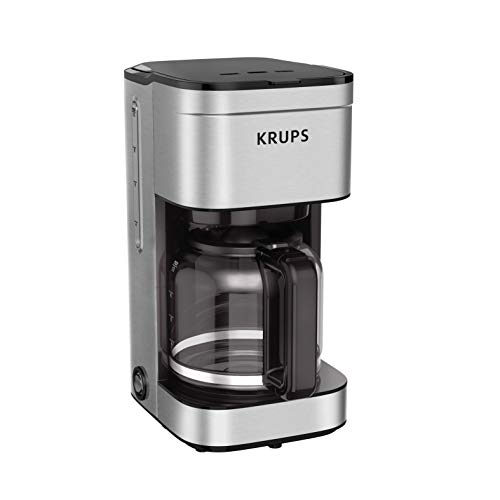
KRUPS Simply Brew 10 Cup Coffee Maker — The Budget Step-Up — Best Budget Drip (10-Cup Step-Up)
Transparency first: the KRUPS Simply Brew is a 10-cup drip machine, included because the true 8-cup drip field has no genuine budget tier — the specialists own it, and their prices reflect it. For the reader whose real brief is ‘good drip, small household, firm budget,’ this simple KRUPS is the honest answer: a 900-watt drip brewer in stainless and black, with a drip-free carafe and a dishwasher-safe pot, doing the drip job without certification badges or premium pricing.
Strengths
- Budget-tier route into proper drip brewing
- Drip-free carafe and dishwasher-safe pot for easy living
- Simple controls — nothing to misconfigure
Trade-offs
- 10 cups, not 8 — surplus can stale for small households
- No certification, timer or temperature control
- Glass carafe on a plate, with the usual holding limits
Key specs
- Capacity: 10 cups (step-up pick, not 8)
- Format: drip, 900 watts
- Carafe: glass, drip-free, dishwasher safe
- Positioning: budget tier
Judge it as the value floor of drip, and it acquits itself well: the fundamentals — hot water through a filter basket into a carafe that pours without dribbling — are all present and correctly executed. What the premium machines add is temperature verification and holding quality, which matter most to drinkers who taste critically and graze slowly.
If that is not you, and the budget is real, buy the KRUPS without apology and put the savings into fresh beans, which will improve your cup more than any badge. If it is you, the Bonavitas above are waiting.
Best for: Firm budgets flexible on the 8 vs 10 question / Not suited for: Exact-size shoppers or certified-extraction seekers
Check on Amazon — check the current price on Amazon before you buy; listings, bundles and included accessories change over time.
Comparison Table
The drip field at 8 cups, compressed: model, badge, the specification that defines its drip character, and the drinker it suits. Five entries are true 8-cup drip machines; the sixth is the labeled budget step-up, included for value-first readers.
| Pick | Badge | Key spec | Best for |
|---|---|---|---|
| Bonavita 8 Cup Coffee Maker BV1900TS | Best Pure Drip Brewing | Certified pour-over style drip, thermal carafe | Drip purists and pour-over drinkers automating their routine |
| Bonavita 8 Cup Coffee Maker BV1901TS | Best Overall Drip | SCA certified drip with auto pause, thermal | Most drip households wanting certified quality without fuss |
| OXO Brew 8-Cup Coffee Maker — Thermal Carafe | Best Drip for Varied Routines | Certified drip, thermal, single-serve mode | Households alternating solo cups and full pots |
| OXO Brew 8-Cup Drip Coffee Maker — Glass Carafe | Best With Temperature Control | Temperature control, glass carafe, SCA certified | Bean explorers who finish pots within the hour |
| Melitta Aroma Tocco 8 Cup Thermal Coffee Maker | Best Programmable Drip | Programmable 8-cup drip, thermal carafe | Scheduled households wanting timed drip at 8 cups |
| KRUPS Simply Brew 10 Cup Coffee Maker — The Budget Step-Up | Best Budget Drip (10-Cup Step-Up) | Budget drip step-up, drip-free dishwasher-safe pot | Firm budgets flexible on the 8 vs 10 question |
How to Choose the Best 8 Cup Drip Coffee Maker by Extraction, Not by Badge Count
In drip, the hierarchy of decisions is unusually clear. First, extraction: if you taste coffee critically, restrict yourself to the certified machines — verified temperature is the single largest quality lever in the category. Second, schedule: if coffee must exist before you are awake, the programmable Melitta is the only true 8-cup drip answer here, and its overnight-grounds trade is simply the price of that miracle. Third, scale flexibility: variable households should look hard at the OXO pair’s single-serve drip mode.
Carafe choice follows drinking pace, as always: thermal for pots consumed across hours, glass for pots finished within one. And size honesty closes the decision — five of these machines are exactly 8 cups, and the sixth is labeled a step-up because this guide believes a clear label beats a padded list.
One drip-specific test before ordering: check the basket’s filter ecosystem. Confirm the machine takes standard, easily bought filters in its geometry — or that its reusable basket suits your taste — because a drip machine married to an obscure filter size is a subscription you did not mean to buy. Every pick here uses mainstream filter formats, which is one of the quieter reasons they are the picks.
Showerheads, Bloom and Baskets: The Drip Variables That Matter
Three pieces of engineering decide a drip pot. The showerhead determines whether water meets all the grounds or channels through a few; wide, multi-hole distribution heads are why the certified machines taste uniform. Pre-infusion — a brief wetting pause — lets fresh grounds release gas and bloom, so the main extraction wets evenly instead of floating dry pockets. Basket geometry and filter fit complete the system: a basket that lets water pool too briefly under-extracts no matter how hot it arrives.
When you compare drip machines, interrogate those three things and ignore the rest until they are answered. Wattage is a weak proxy, carafe styling is none, and a touchscreen has never extracted a gram of coffee. The specialists in this list are specialists precisely because their engineering budgets went into water, not interfaces.
Drip vs. the Alternatives at 8 Cups: Why the Format Endures
Pod machines trade extraction control for speed and sell the coffee back to you in capsules. Espresso trades volume for intensity and demands a skill apprenticeship. Percolators recirculate brewed coffee through the grounds until subtlety surrenders. Drip’s claim is different: a full pot, gently and evenly extracted, at a per-cup cost measured in cents, with equipment a household can maintain for a decade.
That is why the format’s center of gravity sits exactly here, at the household pot. The 8-cup drip machine is not a compromise between single-serve convenience and batch excess; it is the original point of the technology, refined by a century of mornings.
Filters, Water and the Unglamorous Half of Drip Quality
The machine is only half the system. Paper filters vary: thick papers mute oils and bright notes, thin ones let more body through, and a reusable mesh trades clarity for economy and a sediment-kissed cup. Melitta’s presence in this list is a reminder that the filter itself was an invention, not an inevitability — choose yours deliberately rather than by the supermarket’s default.
Water is the other half’s other half. Coffee is mostly water, and heavily chlorinated or very hard tap water will flatten a certified machine’s work. If your pots taste dull despite good beans and a good brewer, brew one pot with filtered water before blaming any equipment. It is the cheapest experiment in all of coffee, and it settles the question in a single morning.
A Short History of Drip, Told Through This Shelf
Drip brewing began as a cloth and a pot, became an industry when Melitta patented the paper filter in 1908, and spent the twentieth century trading quality for convenience — until the specialty movement dragged it back. The machines in this list are that correction made physical: Bonavita and OXO applying laboratory temperature standards to a domestic ritual, Melitta modernizing its own invention with programmability and thermal holding.
Knowing the arc explains the shelf. The certified specialists exist because drinkers rebelled against decades of lukewarm, stewed drip; the programmable mainstream exists because the rebellion still has to get to work by eight. An 8-cup buyer today inherits both movements at once, which is a genuinely fortunate position in the history of breakfast.
Basket Geometry: Flat, Cone, and What Your Filter Is Telling You
Drip baskets come in two geometries, and they brew differently. Flat-bottom baskets spread grounds in a shallow, even bed that forgives dose variation and suits the showerhead machines in this list. Cone baskets concentrate the bed, intensify extraction, and reward precision while punishing sloppiness. Neither is superior; they are different instruments, and the filter you buy must match the geometry or the brew will channel around the mismatch.
The practical takeaway for owners: when a pot tastes uneven — bright and bitter in the same sip — check the filter fit before touching dose or grind. A cone filter folded into a flat basket, or the reverse, is one of the most common and least suspected causes of disappointing drip in home kitchens.
The Case for Brewing Less, More Often
Drip’s one structural weakness is time: a brewed pot is a depreciating asset from the moment the cycle ends. The 8-cup format is the drip world’s answer — a pot small enough to finish at its peak, brewed by machines fast enough that a second pot is a pleasure rather than a project. Households that internalize ‘less, more often’ stop experiencing drip’s weakness entirely.
Thermal carafes extend the window; they do not repeal it. Even the best-held pot is a shadow of itself by the third hour, while a fresh 8-cup brew takes minutes. Let the size of this category teach the rhythm it was designed for: brew the pot the moment needs, finish it happy, and brew again when the moment returns.
Grind Freshness: The Variable That Swamps All Others
It must be said in a drip guide, even at the risk of sounding like a grinder advertisement: the freshness of the grind moves drip quality more than any machine difference in this article. Pre-ground coffee stales measurably within days of opening; beans ground minutes before brewing carry aromatics that no showerhead can invent. The certified machines here will extract faithfully whatever they are given — which means they will faithfully expose stale grounds, too.
The practical hierarchy for a reader spending money in order: first a capable drip machine from this list, then fresh whole beans from a roaster with dates on the bag, then — when curiosity and budget allow — a burr grinder. Readers who follow that order are consistently delighted; readers who reverse it own excellent grinders feeding tired machines, and wonder why the cup does not sing.
The Drip Tasting: A One-Afternoon Experiment Worth Doing Once
Every drip household should, once, run the experiment that settles its arguments: brew three half pots of the same bean at three doses — your usual, a touch less, a touch more — and taste them side by side, blind if a helper will pour. The differences are larger than most drinkers predict, and the winner is frequently not the dose the household has used for years. One afternoon of mild ceremony permanently upgrades every pot that follows it.
Extend the experiment when curiosity allows: the same bean through paper and through mesh, the same pot at two temperatures if your machine allows it. Drip’s great democratic virtue is that its variables are cheap to test — no equipment beyond the machine you own and the notebook this guide keeps prescribing. Specialty cafés charge for tastings that your own kitchen will run for the cost of a few scoops.
Write the results down and tape them inside the cabinet door. Households change, beans rotate, palates drift — but a recorded baseline turns every future adjustment from a guess into a comparison. That small card of numbers is, in the end, the difference between owning a drip machine and knowing one.
Reading a Drip Machine’s Listing Like an Engineer
Drip listings reward a particular reading order. Start with the heater and temperature language: certified, stated range, or silence — in that order of credibility. Move to the showerhead: a named distribution system or a visible multi-hole head in the photographs beats a paragraph of adjectives. Then the basket: geometry, filter format, and whether a permanent option exists. Only after those three should the eye travel to timers, screens and finishes, which is the exact reverse of the order the listing was designed in.
Photographs deserve the same skepticism as text. Look for the basket with the lid open, the carafe at its markings, and the machine beside a human hand or a mug for scale — listings that show only beauty angles are telling you what they are selling. Apply this reading order to any drip machine, in this guide or beyond it, and the category’s marketing loses its power to confuse. What remains is engineering, and engineering is what ends up in the cup.
How to Dial In an 8-Cup Drip Brewer, Pot by Pot
Drip rewards methodical adjustment more than any other home format, because every variable is repeatable. Use this sequence when a new machine or a new bean arrives.
- Fix your dose first: weigh the grounds for a full 8-cup pot, or standardize on level scoops, and write the amount down. This becomes the control every other change is measured against.
- Set a medium grind — the texture of coarse sand — as the baseline. Too fine turns the pot bitter and slow; too coarse turns it sour and thin.
- Brew a full pot with fresh, cold, preferably filtered water. Judge it only after it has rested a couple of minutes in the carafe, when the extraction has equalized.
- Taste and diagnose honestly: sour and thin means under-extraction (grind finer or dose more); bitter and harsh means over-extraction (grind coarser or dose less). Change exactly one variable.
- Brew the next pot with the single change and compare against your notes. Two or three iterations will land most beans in their best window on most machines.
- If your machine offers pre-infusion or a temperature setting, explore those only after dose and grind are settled — they are fine adjustments, not foundations.
- Once dialed in, protect the result: rinse the basket and carafe daily, keep filters consistent, and descale on schedule so mineral buildup does not quietly move your temperatures.
- Re-dial when the bean changes, not when the mood does. A new roast is a new variable; your notebook from the last bag is the fastest route back to a great pot.
Keep the notebook. Three lines per pot — bean, dose, grind, verdict — turns a month of breakfasts into a personal brewing manual no review can write for you. Drip’s great virtue is repeatability; the notebook is how you cash it in.
Keep one more diagnostic in your pocket: the spent basket tells the truth. After brewing, a well-extracted bed looks flat and even, with no dry pockets and no deep crater in the center. A crater means channeling — water found one path and ignored the rest — and points at the showerhead, the filter fit or a dose that was tamped or leveled unevenly. Read the basket before you drink the verdict, and your adjustments will get twice as accurate.
Common Buying Mistakes
Chasing features before extraction
A drip machine with an app and a weak heater makes connected, disappointing coffee. Buy temperature credibility first; every other feature is negotiable, that one is the product.
Under-dosing partial pots
Four cups of water through a full-pot dose’s worth of basket, with half the grounds, extracts thin and sour. Either brew the full 8 into a thermal carafe, or use a machine with a true single-serve or small-batch mode.
Blaming the machine for the water
Chlorine and hardness flatten drip coffee regardless of equipment. One filtered-water test pot will tell you whether your next upgrade should be a machine or a filter jug.
Letting scale set your temperature
Mineral scale insulates the heater month by month, so brew temperature drifts downward and pots turn sour so gradually nobody notices. Descale on a calendar, and your certified machine stays certified in practice.
Mixing filters carelessly
Swapping between thick paper, thin paper and mesh changes extraction and flavor as surely as changing dose. Pick a filter style, dial in with it, and treat any change as a new experiment rather than a neutral substitution.
Stirring or shaking the basket mid-brew
Well-meaning tinkerers disturb the bed to ‘help’ extraction and reliably make it worse: agitation mid-cycle collapses the bed’s structure and invites channeling. A good drip machine’s showerhead does the distribution work. Set the pot up correctly, then let physics finish the job undisturbed.
Final Recommendation
For drip in its purest form, the Bonavita BV1900TS remains the connoisseur’s 8-cup machine, and the BV1901TS is its better-mannered modern self for everyone else. The OXO pair adds certified flexibility — thermal for grazers, glass with temperature control for explorers — and the Melitta Aroma Tocco owns the programmable drip brief outright.
The KRUPS stands by, honestly labeled, for the budget-first reader willing to step up to ten cups. Every pick is verified, so check the current price on Amazon through the links, decide which drip virtue matters most to your kitchen, and brew accordingly.
- Bonavita 8 Cup Coffee Maker BV1900TS — Best Pure Drip Brewing: Drip purists and pour-over drinkers automating their routine. Check the current price on Amazon.
- Bonavita 8 Cup Coffee Maker BV1901TS — Best Overall Drip: Most drip households wanting certified quality without fuss. Check the current price on Amazon.
- OXO Brew 8-Cup Coffee Maker — Thermal Carafe — Best Drip for Varied Routines: Households alternating solo cups and full pots. Check the current price on Amazon.
- OXO Brew 8-Cup Drip Coffee Maker — Glass Carafe — Best With Temperature Control: Bean explorers who finish pots within the hour. Check the current price on Amazon.
- Melitta Aroma Tocco 8 Cup Thermal Coffee Maker — Best Programmable Drip: Scheduled households wanting timed drip at 8 cups. Check the current price on Amazon.
- KRUPS Simply Brew 10 Cup Coffee Maker — The Budget Step-Up — Best Budget Drip (10-Cup Step-Up): Firm budgets flexible on the 8 vs 10 question. Check the current price on Amazon.
Keep exploring the cluster: Best 8 Cup Coffee Makers, Best 8 10 Cup Coffee Makers, Best Drip Coffee Makers, Best Affordable Drip Coffee Makers, Best Auto Drip Coffee Makers, Best 10 Cup Coffee Makers.
Frequently Asked Questions
What makes a drip coffee maker different from other coffee makers?
Drip brewing passes hot water by gravity through a bed of ground coffee and a filter, once, into a carafe. There is no pressure as in espresso, no capsules as in pod machines, and no recirculation as in a percolator. That single gentle pass is what gives drip its clean, balanced cup and its low per-cup cost.
Is pre-infusion (bloom) important in a machine?
For fresh beans, yes. A short wetting pause lets the grounds release gas so the main flow extracts evenly instead of channeling. Machines with a bloom or pre-infusion mode — the Bonavita design is built around it — produce noticeably more uniform pots from freshly roasted coffee. With older, pre-ground coffee the difference shrinks.
Why do two picks share the Bonavita name?
Because the 8-cup drip niche is small and Bonavita defines it. The BV1900TS is the original certified formula; the BV1901TS adds auto pause and easier cleaning. Both are current and verified, and choosing between them is a price-and-convenience decision, not a quality one.
Can an 8-cup drip machine use a permanent filter?
Most baskets accept a mesh permanent filter sized to the machine, and the trade is consistent: a little more body and sediment in the cup, a little less paper clarity, and no ongoing filter purchases. If you switch, re-dial your dose — mesh extracts differently than paper and the first pot will not taste identical.
How do I stop my drip pot tasting sour?
Sourness means under-extraction. Work the checklist in order: fresher water, correct dose, slightly finer grind, a descaled machine. If all four are right and the pot is still sour, the machine may simply brew too cool — which is the practical argument for the certified models in this list.
Paper or metal filter for the cleanest cup?
Paper, and it is not close: paper traps oils and fine sediment that mesh passes, producing drip’s signature clean cup. Metal filters win on waste and cost over time and produce a heavier cup some drinkers prefer. Neither is wrong; they are different drinks wearing the same name.
Why does my drip coffee taste different from the café’s pour-over?
Three usual reasons: the café grinds seconds before brewing, doses by weight rather than by scoop, and uses water chosen for the purpose. Your machine automates the pour itself very well — close those three input gaps at home and the gap in the cup narrows to the width of the barista’s experience, which is smaller than the industry admits.
How long should a full 8-cup drip cycle take, and what if mine is much faster or slower?
A healthy drip cycle for a full pot generally runs in the mid-single-digit minutes from switch to last drip, though exact times vary by machine design. Much faster usually means the water is bypassing proper contact — a basket seated wrong, a filter folded, or a dose too coarse and sparse to resist the flow. Much slower usually means the opposite resistance problem: too-fine grounds, a clogged showerhead, or scale narrowing the water path. Treat cycle time as a diagnostic instrument rather than a specification: a sudden change in either direction is your machine reporting that something in the system — grounds, filter, cleanliness — has drifted, and the fix is almost always in one of those three, not in the electronics.


