Disclosure: airfryerkitchensupply.com is reader-supported. When you buy through links on our site, we may earn an affiliate commission at no extra cost to you.
Where to buy
Every pick in this guide to the best bartender blenders was confirmed through Amazon’s own product data before it earned a link, so the model names and capacities below match what you will actually receive. Use the shortlist here to jump straight to a product page, or read the full reviews further down for the trade-offs behind each badge.
- Blendtec Classic 575 — Best Overall for Bars: Check the current price on Amazon
- Ninja Professional Blender BL610 — Best Budget Bar Blender: Check the current price on Amazon
- CRANDDI K85 Commercial Blender — Best Quiet Commercial: Check the current price on Amazon
- WantJoin Quiet Blender — Best High-Volume Quiet: Check the current price on Amazon
- Vitamix 5200 — Best Premium Bar Blender: Check the current price on Amazon
- CRANDDI K96 Professional Smoothie Blender — Best Large-Batch Value: Check the current price on Amazon
The best bartender blenders are defined by one sound: ice, destroyed completely, repeatedly, without the motor’s pitch climbing into complaint. Bar blending is a specific discipline — frozen margaritas, daiquiris, and slushies demand snow-fine, uniform ice with no surviving chunks, produced back-to-back through a service, in a machine loud enough to need managing and durable enough to treat crushing as a routine rather than an event. This guide ranks six machines confirmed through Amazon’s product data on exactly those terms, from a home-bar budget pick to quiet commercial units built for cafés and bars.
Home bartenders and working bartenders will read this list differently, and both are served. If your bar is a kitchen counter on Friday nights, the Ninja and Blendtec picks deliver professional texture without commercial pricing or footprint. If drinks are your business, the sound-enclosed CRANDDI and WantJoin machines exist because a blender that drowns conversation costs covers, and their duty cycles assume hundreds of blends a week. The Vitamix 5200 sits between the worlds, as it tends to. No static prices are printed — tiers are described in words — so check the current price on Amazon for your shortlist, and weigh the commercial picks against covers per night, not against home machines.
Key Takeaways
- Bar blending is ice texture at volume: uniform, snow-fine particles in pitcher batches, repeated all night — judge every pick on that job first.
- Home bars: the Ninja BL610 for budget pitcher power, the Blendtec Classic 575 for programmed consistency. Working bars: sound enclosures are not optional front-of-house.
- Duty cycle separates the worlds — home machines blend minutes a day; commercial machines (CRANDDI, WantJoin) are built for hundreds of blends a week.
- Price a spare pitcher with any commercial purchase; in a bar, it is insurance, not an accessory.
In this guide
Quick Picks
Blendtec Classic 575 — Best Overall for Bars
The WildSide+ jar and four preprogrammed cycles — including smoothie and self-cleaning — make the Classic 575 the most bar-ready all-rounder: huge capacity, one-touch frozen drinks, fast turnaround. Check the current price on Amazon
Ninja Professional Blender BL610 — Best Budget Bar Blender
Stacked Total Crushing blades and a 72 oz pitcher at a home tier. For a home bar, it produces pitcher after pitcher of frozen drinks without the commercial price of admission. Check the current price on Amazon
CRANDDI K85 Commercial Blender — Best Quiet Commercial
1500 watts, an 80 oz pitcher, a tamper, and a removable soundproof cover. Commercial ice-crushing power that lets conversation survive the blend. Check the current price on Amazon
WantJoin Quiet Blender — Best High-Volume Quiet
2200 watts behind a sound enclosure, with 15 speeds and pulse, an 80 oz pitcher, and even a to-go cup. The heavy-duty quiet option for coffee shops and bars with real volume. Check the current price on Amazon
Vitamix 5200 — Best Premium Bar Blender
The bartender’s classic: a variable dial for hands-on texture control, a container that self-cleans between rounds, and durability measured in decades of service. Check the current price on Amazon
CRANDDI K96 Professional Smoothie Blender — Best Large-Batch Value
An 80 oz, 1500-watt commercial-style blender without the sound enclosure — the large-batch value pick for back bars and prep areas where noise does not matter. Check the current price on Amazon
How These Picks Were Chosen
Every candidate was confirmed through Amazon data and judged on bar-specific criteria. Ice texture came first: the ability to reduce cubes to uniform snow without liquid assistance beyond the drink itself. Second, duty cycle and pitcher capacity — a bar machine works in runs, and an 80 oz pitcher changes service maths versus a 64 oz one. Third, noise, scored honestly: open high-power blenders are loud, and sound-enclosed models were credited for the problem they solve. Fourth, service practicality: dishwasher-safe or easily rinsed pitchers, controls that work with wet hands, and designs proven in commercial listings.
Home-only personal blenders were excluded regardless of power claims, because bar work is batch work. We also separated true commercial constructions — sound enclosures, high-capacity pitchers, heavy-duty positioning — from home machines with commercial adjectives, and labelled each pick’s world clearly. The result runs from the best budget bar blender a home can buy to machines specified for cafés and restaurants, with the badge on each pick naming the bar it belongs in.
The 6 Best Bartender Blenders

Blendtec Classic 575 — Best Overall for Bars
Blendtec built its name in commercial bars, and the Classic 575 carries that DNA home: a 90 oz WildSide+ jar whose fifth side pulls ingredients into the blade, five speeds, and four preprogrammed cycles. It suits serious home bars and small commercial counters that want one-touch consistency across a night’s drinks.
Strengths
- WildSide+ jar geometry is engineered for frozen drinks and big batches
- Preprogrammed cycles give repeatable results across different bartenders
- Self-cleaning cycle speeds turnaround between drinks
Trade-offs
- Loud at full power, with no sound enclosure
- Large jar is oversized for single small drinks
- Premium-home tier, above the Ninja budget pick
| Specification | Detail |
|---|---|
| Jar | WildSide+ jar, 90 oz class |
| Cycles | 4 preprogrammed blending cycles |
| Speeds | 5 speeds |
| Cleaning | Self-cleaning program |
Bar consistency is a systems problem: the same margarita, made by different hands, at hour one and hour five. The Classic 575 attacks it with jar geometry that keeps frozen loads circulating and programs that remove the human variable from cycle time. The WildSide+ jar’s extra side genuinely changes flow — frozen fruit and ice are folded into the blade path rather than riding the walls — and the resulting texture is the uniform slush bar drinks require. Capacity suits batching for a party or a small service. It is loud, as all unenclosed power is, and small single drinks look lost in the big jar. As the all-round bar standard in this guide, it earns the top badge.
The Classic 575’s bar credentials repay a closer look at its cycles. The preprogrammed options are tuned around the drinks-and-smoothies repertoire rather than a general kitchen list, which is why their timing feels right out of the box: the frozen-drink cycle runs long enough to equalise ice particles — the step home bartenders most often cut short. The self-cleaning cycle is the other professional touch, turning the between-rounds reset into a button press. Ownership costs are honest ones: the big jar wants a big sink, and the machine’s voice at full power will be heard in the next room. For a home bar that entertains seriously, or a small venue standardising its frozen menu, those are acceptable taxes on consistency.
Best for: serious home bars and small commercial counters wanting programmed consistency / Not suited for: quiet venues or solo drinkers making one small drink at a time
Check the current price on Amazon
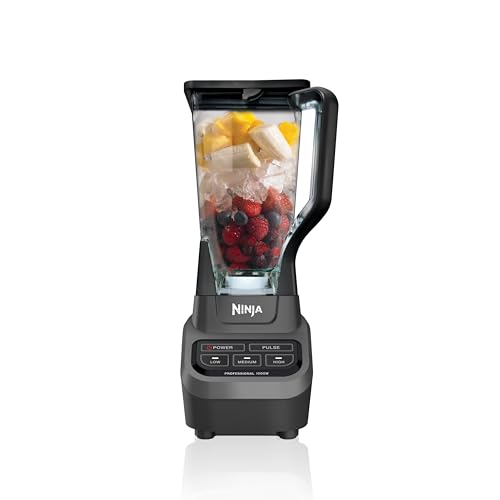
Ninja Professional Blender BL610 — Best Budget Bar Blender
Most home bars do not need a commercial machine; they need ice crushed properly, in pitcher quantities, a few nights a week. The BL610’s stacked blades were practically designed for the brief, circulating cubes through multiple blade levels until the texture evens. It suits home entertainers who want bar results on a household budget.
Strengths
- Stacked blades excel at pitcher-scale ice crushing
- 72 oz pitcher batches drinks for a group in one cycle
- Dishwasher-safe parts simplify party cleanup
Trade-offs
- Plastic pitcher rather than glass or commercial Tritan grades
- No programs — timing is the bartender’s job
- Home duty cycle; not built for hundreds of nightly blends
| Specification | Detail |
|---|---|
| Motor | 1000 watts |
| Pitcher | 72 oz |
| Controls | 3 speeds + pulse |
| Blades | Stacked Total Crushing |
The home bar’s economics are simple: drinks are occasional, so the machine must earn its counter space across smoothies and sauces too — and the BL610 is a fine everyday blender that happens to crush ice exceptionally well. In bar duty its stacked blades prevent the classic failure where cubes polish themselves into pebbles above a single blade; everything keeps falling through the cutting column. Frozen margaritas for six come out of one pitcher with uniform texture. Its limits are professional ones — duty cycle, noise, pitcher material — that home use never reaches. As the budget bar pick, it is not a compromise; it is the correct scale of tool.
Home bartenders should appreciate what the BL610’s simplicity does for a party. With three speeds and a pulse, there is nothing to misconfigure when a guest offers to make the next round — the machine’s worst-case outcome is a drink blended slightly long. The pitcher pours a full batch without the lid-dribble that plagues lesser spouts, and everything goes in the dishwasher when the night ends, which is when home bar equipment is usually abandoned until morning. Its stacked blades also forgive imperfect ice: cubes straight from a home freezer, slightly fused, still circulate and crush. Professional machines outperform it on every axis of refinement, and for a home bar’s actual duty — a few pitchers, a few nights a week — none of those axes are the binding constraint.
Best for: home bars and entertainers wanting pitcher-scale frozen drinks at a household tier / Not suited for: working bars needing commercial duty cycles and sound control
Check the current price on Amazon

CRANDDI K85 Commercial Blender — Best Quiet Commercial
The K85 is built for the venue where the blender works in earshot of customers: cafés, juice bars, and restaurants. Its soundproof cover tames the 1500-watt motor’s roar, the 80 oz pitcher batches for service, and the included tamper handles thick frozen bases. It suits businesses where noise is a genuine operational cost.
Strengths
- Removable soundproof cover transforms bar-side usability
- 80 oz pitcher sized for service batching
- 1500 watts with tamper for thick frozen mixtures
Trade-offs
- Commercial footprint and tier exceed home needs
- Cover adds a part to wash and store
- Overkill for occasional home entertaining
| Specification | Detail |
|---|---|
| Motor | 1500 watts |
| Pitcher | 80 oz |
| Cover | Removable soundproof cover |
| Includes | Tamper |
Noise is the hidden tax on bar blending, and the K85’s enclosure is the professional answer: the same crushing power, delivered at a volume a café can tolerate at the counter. Under the cover, the machine is a straightforward commercial tool — big pitcher, strong motor, tamper for the thick work — aimed at drinks made by the hundred each week. The cover being removable matters for cleaning and for venues that blend in a back room part of the time. Home buyers should admire and move on; this machine’s value only appears where drinks are revenue and quiet is ambience. For that venue, it is the guide’s clearest professional recommendation.
The K85’s enclosure deserves precise praise: it is removable, which separates it from fixed-shroud designs when the machine moves to a back room or needs a deep clean, and it seals well enough that the noise reduction is dramatic rather than marginal. Underneath it, the specification is a complete commercial brief — 1500 watts for sustained crushing, an 80 oz pitcher for batching through a rush, a tamper for the frozen bases that defeat vortex-only designs. Venues should budget counter depth for the enclosure’s footprint; it is the machine’s one spatial demand. For a café or restaurant whose blender shares air with its customers, this is the professional baseline in the guide.
Best for: cafés, juice bars, and restaurants blending in customer earshot / Not suited for: home bars, where its scale and tier buy nothing usable
Check the current price on Amazon

WantJoin Quiet Blender — Best High-Volume Quiet
The WantJoin pairs the strongest motor in this guide with the soundproofing that makes it usable, aimed squarely at coffee shops, bars, and restaurants. Fifteen speeds and pulse give bartenders control across a menu from slushies to nut-based drinks. It suits high-volume venues that refuse to choose between power and quiet.
Strengths
- 2200 watts is the most power here — ice is a formality
- Sound enclosure keeps front-of-house blending viable
- 15 speeds plus pulse cover a full drinks menu
Trade-offs
- Largest commitment of power, size, and tier in the guide
- Far beyond any home bar’s requirements
- Enclosure and pitcher are a substantial wash-up after service
| Specification | Detail |
|---|---|
| Motor | 2200 watts |
| Pitcher | 80 oz |
| Speeds | 15 speeds + pulse |
| Enclosure | Soundproof design |
At 2200 watts, the blending questions change: ice texture is limited by technique rather than power, and the machine’s real specifications become its enclosure, its pitcher throughput, and how its controls behave across a shift. The WantJoin answers those like a commercial tool — a broad speed range for menu variety, pulse for finishing, and sound management that keeps it front-of-house. The included to-go cup is a small café-friendly touch amid the heavy-duty framing. This is a purchase justified by covers and cups per day; venues doing that arithmetic will find it the strongest quiet option here, while everyone else should read its badge as a signpost to smaller machines.
The WantJoin’s 15-speed range, easy to dismiss as spec inflation, has a real bar rationale: a modern drinks menu spans slushies, frozen cocktails, smoothies, and nut- or seed-based drinks, each with a speed profile that textures it best, and a working bartender uses that range the way a cook uses burner sizes. Pulse handles the finishing corrections. The enclosure then makes all of that power deployable at the front counter rather than exiled to a back room, which is a service-speed advantage competitors without shrouds cannot match. It is the largest commitment in this guide by every measure, and the venues it fits will recognise themselves immediately: high volume, customer-facing, unwilling to trade quiet for power.
Best for: high-volume coffee shops, bars, and restaurants needing quiet power / Not suited for: homes and low-volume venues, where its capacity idles
Check the current price on Amazon

Vitamix 5200 — Best Premium Bar Blender
Generations of bartenders have kept a Vitamix within reach for the drinks that need finesse — frozen cocktails with precise texture, emulsified drinks, and small-batch experimentation. The 5200’s dial gives the control programs cannot, and its self-cleaning keeps it ready between rounds. It suits quality-focused bars and serious home bars alike.
Strengths
- Variable dial gives true hands-on texture control
- Self-cleaning cycle is the fastest reset between drinks
- Legendary durability suits daily professional use
Trade-offs
- Premium tier with no sound enclosure
- 64 oz container is smaller than the commercial 80 oz pitchers
- Manual control means results vary by bartender
| Specification | Detail |
|---|---|
| Container | 64 oz |
| Controls | Variable dial + high switch |
| Blades | Laser-cut stainless |
| Cleaning | Self-cleaning cycle |
The 5200’s bar case is control and trust. A dial lets an experienced bartender stop a frozen drink at the exact consistency the house style demands, night after night, and the machine’s reputation for decade-scale service is why it appears in professional kitchens that can expense anything. Between drinks, the self-clean cycle — warm water, a drop of soap, a minute — is operationally superior to rinsing rituals. It concedes pitcher size to the 80 oz commercial picks and quiet to the enclosed ones, and its premium tier buys build rather than features. For a bar whose identity is craft, it remains the connoisseur’s tool.
A bartender’s-eye detail seals the 5200’s case: the dial is operable by feel, with wet hands, without looking — a working advantage no touchscreen or program pad replicates mid-service. The container’s shape also pours a controlled stream for finishing drinks without sloshing, and the tamper, stored in the lid, handles the frozen bases that are this machine’s home territory. Its self-clean cycle doubles as the between-rounds rinse with a drop of soap. What it asks in return is a bartender: results ride on the hand that ramps the dial, which is either this machine’s charm or its disqualification depending on your bar’s staffing. Craft bars have answered that question the same way for decades.
Best for: craft-focused bars and serious home bars valuing control and longevity / Not suited for: high-volume venues needing 80 oz batching or sound enclosures
Check the current price on Amazon

CRANDDI K96 Professional Smoothie Blender — Best Large-Batch Value
The K96 takes the commercial formula — 80 oz pitcher, 1500 watts, stainless blade — and drops the enclosure, landing at a friendlier tier for venues that blend away from customers. It suits back bars, prep kitchens, and high-volume home entertainers who batch big and often.
Strengths
- 80 oz pitcher and 1500 watts for serious batching
- Commercial-style build at a value tier
- Stainless blade and simple operation suit staff turnover
Trade-offs
- No sound enclosure — back-of-house placement assumed
- Commercial scale is wasted on small home use
- Fewer refinements than the enclosed K85 sibling
| Specification | Detail |
|---|---|
| Motor | 1500 watts |
| Pitcher | 80 oz |
| Blade | Stainless steel |
| Format | Compact commercial, 120V |
Not every bar blends in front of an audience, and the K96 is priced for the ones that do not. Its value proposition is throughput per tier: the biggest pitcher class and a genuinely strong motor, in a compact commercial frame that a prep station can absorb. Ice crushing and frozen bases are its home territory, and simple controls survive staff rotation better than program libraries. The missing enclosure is a placement decision, not a flaw — put it where noise is free. Home entertainers who regularly batch for crowds are the crossover buyers; for them, this is the most capacity in the guide without the enclosed models’ tier.
The K96’s value sharpens when priced as throughput. An 80 oz pitcher across a service produces drinks at a rate the 64 oz class cannot match without extra cycles, and its 1500 watts keep those cycles short; multiplied across a week, the saved minutes are the machine’s real specification. Its compact commercial frame suits the under-counter and back-bar spaces where such machines actually live, and the stainless blade and simple controls tolerate staff rotation gracefully. The absence of an enclosure is a deliberate trade that buyers should make consciously: place it where noise is free, and the K96 is the most batching capacity in this guide without the enclosed models’ tier. Place it at a cocktail counter, and no saving justifies it.
Best for: back bars, prep areas, and crowd-scale home entertaining / Not suited for: front-of-house venues where noise reaches customers
Check the current price on Amazon
Comparison Table
| Pick | Badge | Key spec | Best for | Where to check |
|---|---|---|---|---|
| Blendtec Classic 575 | Best Overall for Bars | WildSide+ jar, 4 programs, 5 speeds | serious home bars and small commercial counters wanting programmed consistency | Check price on Amazon |
| Ninja Professional Blender BL610 | Best Budget Bar Blender | 1000W, 72 oz, stacked blades | home bars and entertainers wanting pitcher-scale frozen drinks at a household tier | Check price on Amazon |
| CRANDDI K85 Commercial Blender | Best Quiet Commercial | 1500W, 80 oz, soundproof cover | cafés, juice bars, and restaurants blending in customer earshot | Check price on Amazon |
| WantJoin Quiet Blender | Best High-Volume Quiet | 2200W, 80 oz, soundproof, 15 speeds | high-volume coffee shops, bars, and restaurants needing quiet power | Check price on Amazon |
| Vitamix 5200 | Best Premium Bar Blender | 64 oz, variable dial, self-cleaning | craft-focused bars and serious home bars valuing control and longevity | Check price on Amazon |
| CRANDDI K96 Professional Smoothie Blender | Best Large-Batch Value | 1500W, 80 oz, no enclosure | back bars, prep areas, and crowd-scale home entertaining | Check price on Amazon |
How to Choose a Bartender Blender
Start with venue, because it decides the two expensive features: sound enclosure and duty cycle. Blending in customer earshot makes an enclosure close to mandatory — the CRANDDI K85 and WantJoin exist for that room. Blending in a back bar or a home kitchen makes enclosures wasted money, and the same budget buys power or capacity instead. Second, size the pitcher to your batch pattern: 64 to 72 oz covers home parties and small services; 80 oz is for venues batching through a rush. Third, decide control philosophy: programs (Blendtec) standardise drinks across staff; a dial (Vitamix) rewards a skilled bartender’s judgement; simple speeds (Ninja, CRANDDI) split the difference for home use.
Finally, cost the machine per drink, not per purchase. A commercial unit blending hundreds of drinks weekly amortises quickly and its downtime is the real expense, which argues for proven constructions. A home unit blending six margaritas a week should be bought as a good everyday blender with excellent ice manners — the Ninja’s exact profile. Matching the machine’s world to your world’s volume is the whole art of this category.
Ice Texture: What Separates Bar Blenders From Kitchen Blenders
A kitchen blender crushes ice; a bar blender textures it. The target for frozen cocktails is uniform, snow-like particles that drink smoothly and dilute predictably — not a layer of slush floating on surviving chunks. Three things produce it: blade and jar geometry that keeps ice circulating through the cutting zone (stacked blades, the WildSide+ jar’s fifth side), enough sustained power to finish the job before friction melts the surface unevenly, and a cycle — programmed or practised — that runs long enough to equalise particle size without over-diluting.
Technique closes the remaining gap. Use cold, dry, standard cubes rather than half-melted ice; keep the drink’s liquid ratio as the recipe intends, since too little liquid stalls circulation and too much makes soup; and blend in the batch size the pitcher was designed for — a nearly empty large jar textures worse than a properly filled smaller one. The machines in this guide all can produce bar texture; the bartender’s loading discipline decides whether they do.
Noise, Duty Cycle, and the Real Cost of Bar Blending
An unenclosed high-power blender at full speed is loud enough to pause conversation within several metres — acceptable in a home kitchen, corrosive in a cocktail bar selling atmosphere. Sound enclosures cut that dramatically and are the single feature commercial buyers should never value-engineer away for front-of-house use. Duty cycle is the quieter spec: home machines are designed for minutes of blending a day, commercial machines for sustained runs across a service, with cooling and components to match. Running a home blender on commercial volume does not save money; it schedules a failure for your busiest night.
Pitcher wear is the third hidden cost. Ice is abrasive, and high-volume pitchers cloud and fatigue; commercial ecosystems price replacement pitchers as consumables, while home ecosystems treat them as parts. Venues should confirm pitcher availability and cost before standardising on a machine — a detail this guide’s picks, drawn from established commercial and consumer lines, handle better than no-name alternatives.
How to Use a Bartender Blender for Perfect Frozen Drinks
Step 1 — Chill and measure. Cold ingredients and correct ratios are texture’s foundation; a frozen drink is an emulsion of ice and liquid, and the ratio is the recipe. Step 2 — Load liquid first, ice last. Liquid at the blades starts circulation; ice added on top feeds down into it. Fill within the pitcher’s working range — neither a token amount nor a brimful load textures properly. Step 3 — Start firm, finish patient. Begin at a working speed (or the frozen-drinks program) and let the cycle run until the sound turns smooth and even and the surface moves as one mass — stopping early is the chunky drink’s only cause. Step 4 — Check and correct. Too thick: a splash of the drink’s own liquid and five more seconds. Too thin: a small handful of ice and a short pulse cycle. Step 5 — Reset fast. Rinse or run the self-clean cycle immediately; sugar and citrus dry into a film that flavours the next drink and slows the next service.
Setting Up a Home Bar Blending Station
A home bar blender earns its keep when the station around it is arranged for drinks rather than adapted from cooking. Keep the machine on a stable, low-vibration surface with the ice it will crush within one step — a countertop ice bucket or a freezer drawer adjacent to the blender — because frozen drinks are made in sequences and every extra trip breaks the rhythm. Stock the station with the drink’s supporting cast: a jigger, a bar spoon for checking texture, a fine strainer for the occasional over-blended batch, and the sweeteners and citrus the menu repeats. None of this is expensive; all of it is the difference between a blender that gets used at parties and one that gets admired.
Two habits separate home bars whose drinks taste professional. First, standardise your ice: the same cube size from the same tray or machine textures predictably, while mixed bags of half-melted gas-station ice defeat any blender’s consistency. Second, write down your house ratios and cycle times once you dial them in — the Blendtec’s programs do this mechanically, but a dial machine like the Vitamix rewards a notebook taped inside a cupboard door. Frozen drinks are a repeatable system, not an improvisation, and the small station discipline above is how a home bar with a guide-listed blender out-pours a commercial bar with a neglected one.
Commercial Buying Notes: Pitchers, Spares, and Standardisation
Venues standardising on a bar blender should make three decisions alongside the machine choice. First, pitchers: buy the spare pitcher with the machine, not after the first crack, and treat pitchers as rotating stock — one in service, one washing, one ready — because pitcher turnaround, not motor speed, is the real throughput limit at a busy bar. Confirm the replacement pitcher’s price and availability for your exact model before committing; the commercial lines in this guide publish theirs, which is one reason they are here. Second, standardise the drink builds: with programs, that means agreeing the cycle for each menu drink; with manual machines, it means timed house standards every bartender is trained to.
Third, plan the failure you hope never happens. A blender down on a Friday night costs more than any machine in this guide; venues above a modest volume should hold either a backup unit — the Ninja BL610 is the classic inexpensive understudy — or a service arrangement with realistic turnaround. These are unglamorous calculations, and they are exactly what separates a bar blender purchase from a bar blender programme. The machines ranked above were chosen to sit inside such a programme: proven constructions, available pitchers, and controls a new hire can be taught in one shift.
Frozen Drink Recipes as Equipment Tests: What to Blend First
When a new bar blender arrives — at home or at work — three drinks audit it better than any spec sheet. The classic margarita tests ice texture honestly: a correct result is a uniform, spoonable slush with no surviving shards and no watery layer forming within minutes. The frozen daiquiri tests consistency across a batch: the first glass and the last glass from the same pitcher should pour identically, which is where circulation design shows itself. The fruit smoothie test — frozen mango and banana with minimal liquid — tests the machine’s thick-load behaviour: whether it cavitates into an air pocket, how the tamper or program answers, and how much coaxing a working bartender must supply.
Run those three in the first week, while returns are painless, and score them against the standards in this guide’s ice-texture section. A machine that passes all three will pass your menu; a machine that fails one tells you exactly which compromise you bought, while you can still exchange it. Note the cycle times and settings that produced each pass, and write them where the next bartender — or the next party’s volunteer — will find them. Equipment testing ends, as everything in a bar does, with house standards: the drinks define them, the machine proves them, and the notebook keeps them true.
Training the Hand: Technique Standards for Bartenders New to Blending
Equipment only sets the ceiling; the bartender’s technique sets the result, and bars that standardise technique get Blendtec-grade consistency from almost any machine in this guide. The training core is four habits. First, ratio discipline: frozen drinks are formulas, and the ice-to-liquid ratio is measured, not eyeballed, until it is genuinely in the hand. Second, load order: liquid and soft ingredients first, ice last, every time, because circulation is built in the loading, not rescued in the blending. Third, full cycles: the drink is done when the sound evens and the surface moves as one mass, and new bartenders should be timed against a proven standard rather than trusted to feel it in week one.
Fourth, the reset: rinse or self-clean between drinks as a reflex, because sugar film is both a flavour contaminant and a friction tax on the next cycle. Bars should write these standards where the blender lives, pair new staff with one supervised service, and taste-test across the team monthly — the same drink, made by every bartender, compared side by side. That ritual sounds excessive until the first guest sends back a watery margarita on a machine fully capable of a perfect one. The machines ranked here reward trained hands immediately and forgive untrained ones gracefully; the standard a bar sets for itself decides which of those two properties it experiences.
Common Buying Mistakes
Mistake 1: Buying a home blender for commercial volume. Duty cycle is real; a machine built for minutes a day will fail on a service schedule. Mistake 2: Skipping the enclosure for front-of-house blending. Noise is an atmosphere cost customers pay attention to even when owners stop hearing it. Mistake 3: Blending half-melted ice. Wet, fused cubes texture unevenly and over-dilute; cold, dry, separate cubes are a bar basic. Mistake 4: Under-filling a big pitcher. Large jars need a working volume to circulate; tiny batches in an 80 oz pitcher texture worse than in a right-sized jar. Mistake 5: Stopping the cycle early. Frozen drinks need the full cycle for uniform particles — patience is the difference between slush and chunks. Mistake 6: Letting sugar dry in the pitcher. Immediate rinsing is a service-speed habit as much as a hygiene one.
Final Recommendation
For most readers, the bar decision resolves quickly: home bars should buy the Ninja BL610 for budget pitcher power or the Blendtec Classic 575 for programmed, party-proof consistency, while the Vitamix 5200 serves the craft-minded who value dial control and decades of service. Working venues should go straight to the enclosed machines — the CRANDDI K85 for café-scale quiet, the WantJoin for high-volume quiet power — with the CRANDDI K96 as the back-bar batching value.
Round out the picture with the value rankings in Best Bargain Blenders, the frozen-drink specialists in Best Affordable Blenders For Frozen Drinks, the ease-first guide at Best And Easy To Use Blenders, and the brand deep-dive in Best And Worst Vitamix Blenders. Then check the current price on Amazon for your pick — and if you are buying commercially, price the spare pitcher in the same visit, because in a bar the second pitcher is not an accessory, it is insurance.
Shortlist for a final price check: Blendtec Classic 575 — Check the current price on Amazon · Ninja Professional Blender BL610 — Check the current price on Amazon · CRANDDI K85 Commercial Blender — Check the current price on Amazon
The Home Bartender’s Upgrade Path
Home bars evolve, and the blender should evolve one step behind the menu rather than three steps ahead of it. The sensible path starts with the budget pitcher machine — the Ninja in this guide — which covers frozen classics completely and reveals, over a year of Fridays, what your bar actually is: how many drinks per session, which textures recur, whether guests or craft drive the menu. That evidence then justifies exactly one upgrade direction. Volume points to capacity and programs, the Blendtec pattern. Craft points to control, the Vitamix pattern. Frequency with an audience points, eventually, to quiet — the enclosed machines — though few home bars honestly reach that step.
Skipping steps is the category’s classic overspend: the commercial enclosure bought for a monthly margarita night, the flagship bought before the first daiquiri. Each machine in this guide is the correct final answer for some bar and an expensive intermediate for others, and the upgrade path’s virtue is that it converts guesses into observations before the serious money moves. Start where the drinks are, let a year of service write the specification, and upgrade once, into the machine your own evidence selected.
Glassware, Garnish, and the Blender’s Supporting Cast
A bar blender’s output is judged in the glass, and two supporting habits protect the texture the machine worked to create. Serve frozen drinks immediately in chilled glassware where possible: a warm, thick glass begins melting the drink’s structure on contact, and the first sip’s texture — the one that sets the guest’s verdict — is noticeably firmer from a cold vessel. Keep garnishes and finishing elements ready before the blend finishes, because a frozen drink waits for no one; its peak consistency is measured in minutes, and a bartender garnishing leisurely is serving a lesser drink than the blender made.
Finally, taste across the batch when the stakes justify it: the first pour and the last pour from a large pitcher should match, and a quick straw-taste of the final glass is the professional’s quiet quality check. When they differ, the cause is almost always circulation or an early-stopped cycle — technique items from this guide’s training section, not equipment failures. The blender’s job ends at the pour; the bar’s standards decide what the pour is worth.
Frequently Asked Questions
What makes a blender a bartender blender?
Ice texture at volume: uniform, snow-fine crushing in pitcher-sized batches, repeated across a service without strain. Bar machines add the operational features that surround that core — big pitchers, fast cleaning, and in commercial models, sound enclosures and heavy duty cycles.
How powerful does a bar blender need to be?
For home bars, 1000 watts with good blade geometry (the Ninja’s stacked design) textures frozen drinks properly. Commercial venues should look at 1500 watts and above with pitchers of 80 oz, where the extra power buys speed and consistency across hundreds of blends.
Are sound enclosures worth it?
In customer-facing venues, yes — an unenclosed blender pauses conversation, and the enclosure is what makes front-of-house blending viable. At home or in a back bar, the same money is better spent on capacity or a second pitcher.
Can I use a regular blender for frozen margaritas?
Occasionally, yes, with liquid-first loading and modest batches. Regularly, the ice load punishes home-duty motors and jars, and texture consistency suffers. If frozen drinks are a weekly ritual, a bar-oriented pick from this guide is the honest tool.
Blendtec or Vitamix for a bar?
Blendtec’s programs and WildSide+ jar standardise drinks across staff and batch large volumes; Vitamix’s dial rewards a skilled bartender’s control and offers legendary longevity. High-volume venues often choose programs; craft bars often choose the dial.
How do I stop frozen drinks coming out chunky?
Use cold, dry cubes; load liquid first and ice last; fill the pitcher within its working range; and run the full cycle until the sound evens out. Most chunkiness is an early stop or a circulation failure, both fixable with loading and patience.


