Disclosure: airfryerkitchensupply.com is reader-supported. When you buy through links on our site, we may earn an affiliate commission at no extra cost to you.
Where to buy
All six picks are sold on Amazon, and included cups and accessories vary between listings of the same model, so check the current price on Amazon and the exact box contents before ordering. When comparing the best and easiest blenders, count the steps in the full routine — assembling, blending, serving, washing — not just the buttons on the front, because that total is the ease you will actually live with.
- nutribullet Pro+ Personal Blender N12-1001MK, 1200W — Check the current price on Amazon
- nutribullet SmartSense Blender Combo NBF50700, 1400W — Check the current price on Amazon
- magic bullet Personal Blender MBR-1101, 250W — Check the current price on Amazon
- Ninja Nutri-Blender Pro BN401 with Auto-iQ, 1100 Peak Watts — Check the current price on Amazon
- KitchenAid K400 Variable Speed Blender with Tamper — Check the current price on Amazon
- Hamilton Beach Power Elite Blender 58148AG, 700W — Check the current price on Amazon
The best and easiest blenders are not necessarily the most powerful or the cheapest — they are the ones whose full routine, from cupboard to washed-up, asks the least of you. Ease lives in the details: a cup that is also the drinking vessel, a program that runs the right pulsing pattern so you do not have to, a dial a guest can read at a glance, a jar that circulates its own contents so nobody is stopping to stir. This list was built by counting steps and removing friction, not by reading specification sheets.
Two philosophies of easy compete here, and both are represented. The first is mechanical simplicity: personal bullet blenders with a twist and a press, where there is almost nothing to learn or assemble. The second is automation: machines like the SmartSense and the Auto-iQ Ninja that make the decisions for you — how long, how fast, when to pulse — so the user’s job shrinks to loading ingredients and pressing one button. Which philosophy suits you depends on whether you distrust complexity of mechanism or complexity of judgement more.
Every pick was verified for its real controls, programs and included parts, because ease claims are where listings exaggerate most freely. Where a machine’s ease comes with a genuine cost — power, batch size, manual control — the review states it plainly.
In this guide
Quick Picks
nutribullet Pro+ Personal Blender N12-1001MK, 1200W — Best Overall Easiest Blender. The easiest full routine in blending: fill the cup, twist it on, press to blend, twist off, drink. The Pro+ adds a proper pulse button and 1200 watts to the classic nutribullet simplicity, with 32 oz and 24 oz cups for real meal-size smoothies. Check on Amazon
nutribullet SmartSense Blender Combo NBF50700, 1400W — Easiest Fully Automatic Blender. Press one button and walk away: the smart auto cycle senses the load and adjusts speed, time and function itself. With a full-size pitcher and personal cups on a 1400W base, it is the easiest blender that also serves a family. Check on Amazon
magic bullet Personal Blender MBR-1101, 250W — Easiest Controls of All. No buttons at all: push the cup down to blend, release to stop. The magic bullet remains the easiest blender ever made to operate, with three to-go cups in the box — as long as your menu is shakes and soft ingredients, where its 250 watts belong. Check on Amazon
Ninja Nutri-Blender Pro BN401 with Auto-iQ, 1100 Peak Watts — Easiest Programs in a Personal Blender. Two Auto-iQ programs run the pulsing pattern that makes personal blends smooth — you press once and the machine does the technique. With 1100 peak watts and two 24 oz cups, it is the easiest personal blender for frozen-fruit lovers. Check on Amazon
KitchenAid K400 Variable Speed Blender with Tamper — Easiest Full-Size Blender to Use. One dial, three labelled presets, and a motor that holds its speed so you do not have to manage it. The K400 is the easiest full-size pitcher blender here — the machine a guest can operate without asking a single question. Check on Amazon
Hamilton Beach Power Elite Blender 58148AG, 700W — Easiest Budget Blender. Twelve clearly labelled buttons, a glass jar, and a Wave Action system that circulates the blend so you are not stopping to stir. The easiest budget blender is the one that needs the least technique — and that is this one. Check on Amazon
How These Picks Were Chosen
We scored candidates on the complete routine: steps to assemble, decisions required during blending, steps to serve, and effort to clean. Machines were verified for accurate control types, programs and box contents, then ranked within their format — personal, pitcher and combo — because ease means slightly different things in each.
Power was treated as an ease feature, not a separate luxury: a stronger machine finishes in one cycle, while a weak one demands shaking, stirring and second runs. Several otherwise-simple machines were excluded for exactly that reason — a one-button blender that needs three interventions per smoothie is not easy, whatever its interface promises.
We also weighted learnability for other people. The easiest blender in a household is the one everyone can operate, so controls were judged by whether a first-time user could succeed without instructions.
Cleanup was timed as part of the routine rather than treated as an afterthought, because in owner surveys of abandoned appliances the wash is the friction named most often. Machines whose every food-contact part is dishwasher-safe, or whose vessel rinses clean in seconds, scored accordingly. A blender that blends in thirty seconds and scrubs in ten minutes is, by the only arithmetic that matters, a ten-minute appliance — and it will be used like one.
The 6 Best and Easiest Blenders to Use Every Day

nutribullet Pro+ Personal Blender N12-1001MK, 1200W — Best Overall Easiest Blender
Ease in a blender is measured in steps between wanting a smoothie and drinking one, and the nutribullet Pro+ has the fewest steps of any capable machine here. There is no pitcher to assemble, no dial to learn, no lid-within-a-lid: the cup is the jar, you fill it, twist it onto the base, and the machine blends. The Pro+ generation adds what the original lacked — a dedicated pulse button for controlled bursts and 1200 watts, enough power that frozen fruit and greens stop being a negotiation. Two cups (32 oz and 24 oz) with travel lids cover big breakfast smoothies and standard ones, and everything goes in the dishwasher.
Strengths
- Fewest steps from ingredients to drinking of any pick here
- 1200W is serious power — frozen fruit and greens blend without coaxing
- Pulse button adds control the original design lacked
Trade-offs
- Personal servings only; no pitcher for family batches
- Twist-on cups need a firm hand to seal — arthritis sufferers should test the action
- Cups and blades are consumables over years of daily use
| Specification | Detail |
|---|---|
| Power | 1200W |
| Cups | 32 oz and 24 oz to-go cups with travel lids |
| Control | Press-to-blend + pulse button |
| Cleaning | Dishwasher-safe |
What makes the Pro+ the easiest blender overall is that every part of the routine was designed as one motion. Assembly is a twist. Blending is a press. Serving is the same cup. Washing is a rinse or the dishwasher. Even the learning curve is absent: a guest can operate it on sight. The power matters to ease more than specifications suggest — a strong machine finishes in one short cycle, while a weak one demands shaking, stirring and second cycles, which is where ‘easy’ goes to die. For one or two people blending daily, this is the machine most likely to still be in daily use next year, and that is the only ease metric that counts.
Best for: daily smoothie drinkers who want the simplest capable routine / Not suited for: families blending batches or anyone who struggles with twist seals

nutribullet SmartSense Blender Combo NBF50700, 1400W — Easiest Fully Automatic Blender
The SmartSense Combo is built around a genuinely useful idea: the blender should figure out the blend. Its smart auto cycle adjusts speed, time and function in response to what is in the pitcher, so the user contributes ingredients and one button press. At 1400 watts it is nutribullet’s most powerful blender, and the combo format — full-size pitcher plus personal cups — means the same one-button ease covers a family batch and a solo cup. For households that want automation without an app, a screen or a learning curve, this is the easiest full-capability option here.
Strengths
- Smart auto cycle adjusts the blend for you — true one-button operation
- 1400W flagship power handles frozen loads without technique
- Pitcher plus personal cups cover family and solo blending
Trade-offs
- Automation means less manual control for unusual recipes
- Larger footprint and more parts than personal-only machines
- Costs more than the simple machines — you are paying for the sensing
| Specification | Detail |
|---|---|
| Power | 1400W |
| Programs | Smart auto cycle (adjusts speed, time, function) |
| Format | Full-size pitcher + personal cups |
Automation earns its place when it removes decisions that users get wrong, and blend timing is exactly such a decision: most people under-blend gritty smoothies or over-blend warm, frothy ones. The SmartSense’s cycle lands in the right place consistently, which makes it the easiest blender here for beginners, teenagers, and anyone blending while doing three other things. The power underneath the automation is real, so frozen drinks and family batches are handled without the staged technique smaller machines need. Choose it if your household values walk-away ease across every serving size; choose the Pro+ if your world is strictly personal cups and you prefer the simplest possible mechanism.
Best for: households wanting one-button ease for both batches and personal cups / Not suited for: control enthusiasts or the tightest budgets

magic bullet Personal Blender MBR-1101, 250W — Easiest Controls of All
Every other blender on this list has at least one control to learn. The magic bullet has none: you push the cup down and it blends; you let go and it stops; you twist and lock it for hands-free running. That press-down action is why it remains, decades after launch, the easiest blender to operate ever sold — a child, a grandparent, a half-asleep adult at 6 a.m. can all use it perfectly on the first attempt. The kit includes a 22 oz cup and three to-go cups. The trade is power: at 250 watts this is a machine for shakes, soft-fruit smoothies, dips and small jobs, and this review recommends it strictly inside that world.
Strengths
- Push-to-blend operation — literally nothing to learn
- Three to-go cups make the routine effortless for households on the move
- Tiny, light and dishwasher-friendly throughout
Trade-offs
- 250W is the least power here — hard frozen loads are beyond it
- Small cups mean small servings, always
- Press-and-hold for longer blends is less convenient than a program
| Specification | Detail |
|---|---|
| Power | 250W |
| Cup | 22 oz blending cup |
| Includes | (3) to-go cups, (1) travel lid |
| Control | Push-down to blend |
Ease has two components — learning and doing — and the magic bullet eliminates the first entirely. There is no wrong button, no program to select, no speed to choose. For its intended jobs that simplicity is complete: a protein shake is fifteen seconds of pressing; a smoothie of banana, yoghurt and soft berries is thirty. Where it stops being easy is where it stops being suitable — frozen mango chunks turn the simplest controls in the world into a long, shaking negotiation. Buy it for what it is: the easiest blender for light duty, and a beloved second blender in countless kitchens for exactly that reason.
Best for: shakes, soft smoothies and anyone who wants zero learning curve / Not suited for: frozen-fruit blending or family servings
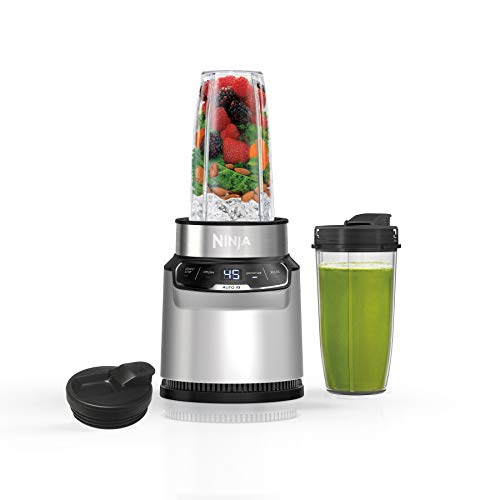
Ninja Nutri-Blender Pro BN401 with Auto-iQ, 1100 Peak Watts — Easiest Programs in a Personal Blender
The BN401’s ease is about technique rather than controls. Good personal-blender smoothies need a rhythm — pulse to break the frozen layer, pause to let it settle, run to finish — and most people either skip it (gritty) or over-run it (warm and frothy). Auto-iQ automates that rhythm into two programs, one for smoothies and one for salsa and dips, so the user’s entire job is loading the cup well and pressing a button. Power is a healthy 1100 peak watts, the two cups are a generous 24 ounces, and all parts are dishwasher-safe.
Strengths
- Auto-iQ programs automate the pulse technique for consistent results
- Strong power for the personal class — frozen fruit handled confidently
- Large 24 oz cups suit breakfast-size smoothies
Trade-offs
- Programs only — limited manual control for experimental recipes
- Personal format only, no pitcher option
- Peak-watt rating; sustained power is good rather than flagship-class
| Specification | Detail |
|---|---|
| Power | 1100 peak watts |
| Programs | 2 Auto-iQ programs |
| Cups | (2) 24-oz to-go cups |
| Cleaning | Dishwasher-safe |
Consistency is the underrated half of ease. A blender that produces the same good smoothie every morning, regardless of who loads it, removes the daily micro-decisions that wear a routine down. The BN401 does that for the personal format better than any rival here: load in the right order, choose the smoothie program, and the result is reliably smooth, including with frozen fruit that defeats lesser personal machines. It lacks the Pro+’s raw simplicity of mechanism and the SmartSense’s family range, but for one-button personal blending with real power behind it, it is the easiest choice in its class.
Best for: one-button personal smoothies with frozen fruit, made consistently / Not suited for: families or manual-control cooks

KitchenAid K400 Variable Speed Blender with Tamper — Easiest Full-Size Blender to Use
Full-size blenders often bury their users in touchscreens and twenty programs. The KitchenAid K400 takes the opposite approach: a single 5-speed dial you can read at a glance, three presets labelled by what they make (Ice Crush, Icy Drinks, Smoothie), and Intelli-Speed Motor Control working invisibly underneath to hold the chosen speed steady as the blend thickens. The die-cast base sits planted and wipes clean; the included tamper deals with thick mixtures. For households that want a real pitcher blender everyone can use — including people who did not buy it and never read the manual — this is the easiest full-size option.
Strengths
- One-dial control with clearly labelled presets — zero learning curve
- Intelli-Speed holds speed under load, removing mid-blend management
- Solid die-cast build that stays put and cleans easily
Trade-offs
- Less raw power than the flagship machines for the toughest jobs
- A pitcher always means more washing than a personal cup
- Mid-range tier pricing for its ease and build
| Specification | Detail |
|---|---|
| Controls | 5-speed variable dial |
| Presets | Ice Crush, Icy Drinks, Smoothie |
| Motor control | Intelli-Speed |
| Includes | Tamper |
The K400 understands that ease in a family appliance is social: the machine gets used by whoever is making the smoothie, including teenagers and grandparents, and its dial-and-presets interface has never confused anyone. The motor control deserves its credit — the surge-and-stall cycle of cheaper pitchers, which forces users to hover and adjust, simply does not happen. Smoothies, frozen drinks and sauces all land where the dial says they should. It is not the most powerful blender here, but as the easiest full-size machine to live with daily, it has no real rival on this list.
Best for: families wanting a pitcher blender anyone can operate confidently / Not suited for: power maximisers or personal-cup minimalists

Hamilton Beach Power Elite Blender 58148AG, 700W — Easiest Budget Blender
Budget blenders usually tax their users with technique: stop, stir, shake, repeat. The Power Elite’s Wave Action system is valuable precisely because it refunds that tax — the jar continuously pulls ingredients down into the blades, so a smoothie blends in one straightforward run at the press of a button. The controls are twelve labelled buttons that say what they do, the jar is glass and pours cleanly, and the whole machine can be understood in the time it takes to load it. For a first blender, a gift, or a household that wants budget pricing without a learning curve, this is the easiest route in.
Strengths
- Wave Action circulation removes the stop-and-stir routine
- Labelled push-button controls anyone can read instantly
- Glass jar at a budget tier, dishwasher-friendly routine
Trade-offs
- 700W — frozen loads still want sensible piece sizes
- Buttons offer less fine control than a dial for enthusiasts
- Not built for heavy grinding jobs
| Specification | Detail |
|---|---|
| Power | 700W |
| Jar | 40 oz glass |
| Functions | 12, including puree and crush ice |
| System | Wave Action |
Ease on a budget is mostly about not needing tricks, and the Power Elite’s circulation design is the trick built in so you do not have to perform it. Smoothies come together in one run; shakes and purees are button-press simple; cleanup is a glass jar that rinses clean or goes in the dishwasher. The power ceiling is real — this is not the machine for daily frozen-mango punishment — but within the everyday menu it is the easiest cheap blender to get a good result from on the first try, which is exactly what budget buyers actually need.
Best for: first-time buyers and budget households wanting foolproof operation / Not suited for: heavy frozen blending or fine-control enthusiasts
Comparison Table
| Pick | Badge | Key spec | Best for |
|---|---|---|---|
| nutribullet Pro+ Personal Blender N12-1001MK, 1200W | Best Overall Easiest Blender | 1200W, 32 oz + 24 oz cups, pulse | daily smoothie drinkers who want the simplest capable routine |
| nutribullet SmartSense Blender Combo NBF50700, 1400W | Easiest Fully Automatic Blender | 1400W, smart auto cycle, combo | households wanting one-button ease for both batches and personal cups |
| magic bullet Personal Blender MBR-1101, 250W | Easiest Controls of All | 250W, push-down control | shakes, soft smoothies and anyone who wants zero learning curve |
| Ninja Nutri-Blender Pro BN401 with Auto-iQ, 1100 Peak Watts | Easiest Programs in a Personal Blender | 1100 peak W, Auto-iQ, 2 × 24 oz | one-button personal smoothies with frozen fruit, made consistently |
| KitchenAid K400 Variable Speed Blender with Tamper | Easiest Full-Size Blender to Use | 5-speed dial, 3 presets, Intelli-Speed | families wanting a pitcher blender anyone can operate confidently |
| Hamilton Beach Power Elite Blender 58148AG, 700W | Easiest Budget Blender | 700W, 40 oz glass, Wave Action | first-time buyers and budget households wanting foolproof operation |
How to Choose an Easy-to-Use Blender
Decide which kind of easy you want. Mechanical simplicity (bullet blenders) means almost no learning and almost no decisions, but personal servings and light-to-moderate power. Automation (smart programs) means one button and no technique, at a higher price and with less manual control. Dial-and-preset pitchers sit between: a little learning, family capacity, and controls the whole household shares comfortably.
Count the wash, not just the blend. The easiest blender to use daily is the one whose parts rinse in seconds or go straight in the dishwasher. Personal cups win this category outright, which is why they dominate easy-blender lists; pitchers justify their washing with batch size. If you know you hate washing blender jars — most people do — let that knowledge choose your format.
Ease features that actually matter
In order of real-world value: blend-in-cup formats that eliminate transfers; programs that automate pulsing; self-cleaning cycles or fully dishwasher-safe parts; jars that circulate without stirring; controls labelled by food rather than by number. Touchscreens, app connectivity and twenty-program menus add steps and decisions, not ease, whatever the marketing says.
Who else will use it?
A blender operated by one enthusiast can be as complex as they enjoy. A household blender gets used by tired parents, teenagers and guests. If your machine has multiple users, weight the dial-and-preset and one-button designs heavily — their ease is social, and it compounds every single day.
The Anatomy of an Easy Blender Routine
Time a full routine on any blender you are considering: retrieve, assemble, load, blend, serve, rinse, store. Easy machines compress every stage — the cup lives on the base, loading is one vessel, blending is one press, serving is the same cup, rinsing is ten seconds, storage is a cupboard corner. A machine that wins only the blending stage and loses the other six is not the easy blender it claims to be.
Storage is the silent stage. A blender that lives on the counter gets used; a blender that must be assembled from a cupboard of parts gets used on weekends. The personal formats here win storage outright, and the combo and pitcher picks were chosen partly for footprints that can stay out in real kitchens.
There is a learning-curve asymmetry worth exploiting as a buyer: it is easy to grow into a simple machine and impossible to shrink a complicated one. A household that starts with a personal blender and later adds a pitcher has spent its money in the right order, because the personal machine remains useful forever as the weekday tool. A household that starts with a complex flagship often discovers its most-used setting is the smoothie button — which the simple machines on this list also have, at a fraction of the commitment.
Easy Does Not Mean Weak — Reading Power in This List
Several picks here carry serious power — 1200 and 1400 watts — and that is deliberate. Underpowered machines create work: the shake, the stir, the second cycle, the straw-clogging chunk. An easy blender must finish the job in one confident cycle for the foods you actually blend, so match the machine’s power to your menu first (frozen fruit daily means the stronger picks), then choose the simplest controls that come with that power.
Conversely, do not buy power you must manage. If your menu is shakes and soft smoothies, the magic bullet’s zero-control design is easier than any flagship, and its low power is irrelevant to your life. Ease is always relative to the job.
How to Use a Blender the Easy Way: Setup and Daily Routine
A few habits make any blender on this list feel effortless:
- Set up a permanent station: base on the counter, cups or jar beside it, and your usual ingredients within one step. A blender you must fetch is a blender you will skip.
- Load in the easy order — liquids and soft ingredients first, frozen last and in small pieces — so the first cycle succeeds and no stirring is needed.
- Use the program if your machine has one, and resist supervising it. Automation only pays when you let it work; use the minute to do anything else.
- Serve from the blending vessel whenever the format allows it. Every transfer is a step and a washing-up item you did not need.
- Rinse or load the dishwasher immediately, while residue has no grip. Ten seconds now replaces ten minutes of scrubbing later — the single highest-value habit in blender ownership.
- Keep the manual’s one useful page — the program or speed guide — on the fridge until the routine is memorised, then recycle it.
Why Blenders Get Abandoned — and How Easy Design Prevents It
Most blenders are not broken when they leave a kitchen; they are abandoned, and abandonment follows a script. The machine is bought with enthusiasm, used daily for two weeks, and then the friction accumulates: the jar that needs scrubbing, the lid that traps smoothie in its seams, the program nobody remembers, the assembly that takes four parts from two cupboards. Each use costs a little more effort than the drink feels worth, the interval between uses stretches, and one day the counter space is reclaimed. Ease of use is the engineering answer to that script, which is why this list treats it as a primary specification rather than a soft preference.
Designers attack friction at three points. The first is the vessel: blending in the serving cup deletes the transfer step and halves the washing. The second is the decision load: programs and smart cycles delete the judgement calls — speed, time, pulsing — that beginners get wrong and experts get tired of making at 7 a.m. The third is cleaning geometry: smooth interiors, dishwasher-safe everything, and seals that do not harbour residue. Every pick on this list is strong on at least two of the three, and the top picks are strong on all of them.
There is an accessibility dimension to ease that deserves plain statement. Twist seals need grip strength; heavy glass pitchers need wrist strength; touchscreens need vision and dry fingers; tall machines need reach. Households choosing for older relatives or anyone with limited hand strength should weight the push-down magic bullet, the one-button automatics and the planted, dial-controlled KitchenAid accordingly — and should be honest that the nutribullet’s twist, while simple, is the most grip-dependent action on this list.
Ease also compounds across people. A blender one person finds intuitive becomes the household default, gets used by everyone, and justifies its counter space daily. A blender only its buyer understands becomes a single-purpose shrine. This is why the guide above insists on asking who else will use the machine: in shared kitchens, legibility is a performance specification, as real as wattage and considerably harder to retrofit.
Finally, ease protects the routine that makes a blender worth owning at all. The value of a smoothie habit — cost saved against bought drinks, ingredients used before they spoil, breakfast actually eaten — accrues per use, and uses are what friction destroys. An easy blender is therefore not a luxury version of a blender; it is the version that delivers the category’s entire value proposition. The powerful-but-demanding machine in the cupboard delivers none of it.
It is worth being precise about what a program actually does, because ‘smart’ is the most abused word in small appliances. A good blending program is a recorded technique: a pattern of pulses that fracture frozen ingredients, ramps that build the vortex without splashing, a sustained high-speed finish, and a stop before the drink warms and froths. When you press the smoothie button on the BN401 or start the SmartSense cycle, you are playing back that technique exactly, every time. That repeatability is the real product — not intelligence in any grand sense, but the removal of variance from a daily routine.
Manual controls have their own ease argument, and it should not be undersold. A dial never needs a firmware decision, works with wet hands and eyes half open, and gives immediate, proportional feedback: turn it up, the machine goes faster. For cooks who blend varied recipes — a sauce today, a soup tomorrow — that directness is easier in practice than cycling through programs designed for drinks. The KitchenAid K400’s presence on this list is the acknowledgement that ‘easiest’ depends on whether your blending is a routine or a repertoire.
Sound belongs in any honest discussion of ease, because a blender the household dreads hearing is a blender that gets used less. All of these machines are loud at full power; the easy ones are loud briefly, finishing in one short cycle, and the automatic ones are loud while you are in another room doing something else. If your household blends at dawn, the practical easements are routine design — blend the night before into a sealed cup, or choose the personal machine behind a closed door — rather than shopping for a quiet blender, which at useful power does not meaningfully exist.
One last friction hides in the cupboard: parts sprawl. Every extra jar, lid, blade and tamper is a small retrieval cost and a small storage puzzle, multiplied by every use. The easiest systems here keep the working set tiny — a base, one or two cups, one blade — and that leanness is a design achievement in itself. When comparing two machines that both blend well, count their parts. The one with fewer will feel easier every single day, in a way no specification sheet captures.
Common Buying Mistakes
Buying features instead of ease
Twenty programs, an app and a touchscreen are twenty decisions. The easiest blenders here have between zero and three controls that matter.
Ignoring the wash
A blender that is annoying to clean will be used monthly, not daily. Judge the parts and the routine before the power figure.
Choosing a weak machine to save money
Underpowered ‘simple’ blenders create stirring, shaking and second cycles. That is not simplicity; it is labour with fewer buttons.
Forgetting other users
If a partner, parent or teenager cannot operate it confidently, it is not the household’s easiest blender — it is yours alone.
Overfilling personal cups
Even the easiest format fails when crammed. Leave headroom and the one-cycle routine works every time.
Matching Easy Blenders to Real Households
The solo professional: your blender works at 7 a.m. and again after the gym, and its enemies are time and washing-up. The Pro+ or the BN401 fits this life exactly — cup on, press, drink, rinse, out the door. Between them, choose the Pro+ for raw simplicity and power, the BN401 if you want the program to run the technique while you dress. Either will be used more in a month than a pitcher blender would be in a year in this household, and use is the metric.
The family kitchen: four people, three opinions, one blender. The SmartSense Combo covers the batch smoothie and the individual cup with the same one-button logic, and the KitchenAid K400 covers the household that prefers a dial everyone can read. What matters most here is that a teenager can make their own smoothie without a tutorial and a parent can run a family batch without a project. Both picks clear that bar; the choice is automation versus dial.
The shared or multi-generational house: grandparents, adult children, perhaps a carer. Legibility and forgiveness dominate — controls that cannot really be set wrong, machines that tolerate imperfect loading. The magic bullet for light duties and the KitchenAid for family ones are the natural pair, and the Hamilton Beach earns its budget place on the same grounds: buttons that say what they do, in a jar that forgives technique.
The small-space dweller: a studio, a dorm, a narrowboat of a kitchen. Footprint and storage decide everything, and the personal formats win by default — but choose the strong ones. A weak mini blender in a small kitchen produces the worst of both worlds: no space saved in practice, because it lives out anyway, and a smoothie that needs three interventions. The compact-but-powerful picks exist precisely for this life.
The reluctant cook equipping a kitchen for someone else — a student leaving home, a parent simplifying: buy the routine, not the machine. That means cups included, dishwasher-safe everything, and controls that survive being ignored. The magic bullet kit and the Power Elite are the classic gifts in this category for a reason: they will be used by people who never asked for a blender, which is the highest compliment ease of use can earn.
The holiday or second home: a blender that sits unused for weeks must work perfectly on the first morning, with no relearning and no missing part drama. Simple mechanisms win here — the magic bullet or the Power Elite, rinsed and stored dry, will greet you months later exactly as you left them. Automated machines also cope well, provided their cups and seals were stored clean. What fails in second homes is complexity plus absence: anything that needed a manual in week one needs it again in month six.
The health-routine household — the daily green smoothie as a fixed point of the day: your ease priority is a machine that handles greens and frozen fruit in one cycle at dawn, every dawn, without waking the house more than necessary or demanding a technique ritual. That points squarely at the Pro+ and the BN401, loaded the night before where the recipe allows, and it is why both sit at the top of this list’s recommendations for the most common real-world brief of all.
The blender-sceptic’s kitchen deserves a final word, because it is the household most likely to be reading a list like this one. If previous blenders have disappointed, the failure was almost certainly friction or power, not the concept: a machine that needed stirring, scrubbing or supervising, or one too weak for frozen fruit. The picks here are the corrective — start with the format that removes your specific past complaint, keep the first recipes simple and proven, and let a month of effortless smoothies rewrite the household’s opinion of what a blender is for.
Final Recommendation
For most people, the nutribullet Pro+ is the best and easiest blender: the fewest steps, real power, and nothing to learn. The SmartSense Combo extends one-button ease to family batches, the BN401 automates personal blending with frozen-fruit confidence, and the magic bullet remains the zero-learning-curve classic for light duty.
If your household needs a pitcher everyone can run, the KitchenAid K400’s dial is the easiest full-size interface here, and the Hamilton Beach Power Elite brings the same philosophy to a budget tier. Check the current price on Amazon for the configuration you want — included cups differ between listings.
Short on time? Start with our three most-bought picks: nutribullet Pro+ Personal Blender N12-1001MK, 1200W, nutribullet SmartSense Blender Combo NBF50700, 1400W, magic bullet Personal Blender MBR-1101, 250W — each links to Amazon so you can check the current price on Amazon for the exact model.
Keep exploring: Best Blenders Best Personal Blenders Best Smoothie Blenders Best Blenders For Smoothies Best And Easiest To Use Blenders Best Budget Blenders
Related guides
Frequently Asked Questions
What is the easiest type of blender to use?
Personal bullet blenders, for solo servings: you blend in the drinking cup, so assembly, serving and washing are all one motion. For families, a one-button automatic or a simple dial pitcher is easiest.
Are blenders with programs easier than manual ones?
For repeat drinks like smoothies, yes — a good program automates the pulsing pattern and timing that beginners get wrong. For varied cooking, a simple dial gives easier control. Match the style to your menu, and be honest about which kind of blending your household actually does most weeks of the year.
Which blender is easiest to clean?
Personal blenders whose cups and blades are dishwasher-safe, rinsed immediately after use. Among pitchers, glass jars and self-cleaning cycles are the easiest to live with.
Is a more powerful blender harder to use?
Usually the opposite: power finishes blends in one cycle without stirring or shaking. Controls determine difficulty, not wattage — several picks here pair flagship power with one-button operation.
What blender is easiest for a beginner or an older person?
The magic bullet’s push-to-blend action has no controls to learn at all, for light jobs. For frozen fruit, the Auto-iQ and SmartSense one-button programs are the easiest step up. Also weigh grip and weight: twist seals and full glass pitchers are the two actions most likely to challenge users with limited hand strength.
My last blender ended up in a cupboard. What should I do differently?
Buy for the routine, not the specification sheet: choose the format whose full cycle — assemble, blend, serve, rinse — takes the fewest steps in your kitchen, keep the machine out on the counter, and start with two or three proven recipes rather than experimenting daily. The picks at the top of this list were chosen precisely for households with a cupboarded predecessor.
Do I need a touchscreen or app for an easy blender?
No — they add steps and failure points. Every pick here achieves its ease with physical controls or a single button, which is why they were chosen. Physical controls also keep working with wet hands, in bright sunlight and in ten years’ time, none of which can be promised of an app-dependent appliance.


