Disclosure: airfryerkitchensupply.com is reader-supported. When you buy through links on our site, we may earn an affiliate commission at no extra cost to you.
Where to buy
Every sink in this roundup of the best 25 undermount stainless steel kitchen sinks was verified against Amazon listing data on 2026-11-20, and the links below go to the exact verified listings. Prices move constantly, so each pick is linked with a live price check instead of a printed number:
- Kraus KHU111-25 Standart Pro 25-Inch 16-Gauge — Check the current price on Amazon
- Kraus KHU641-25 25-Inch 18-Gauge — Check the current price on Amazon
- Sarlai 25-Inch Workstation 10-Inch Deep — Check the current price on Amazon
- Hovheir 25×19 Workstation — Check the current price on Amazon
- Oxwiser 25×18 Undermount 16-Gauge — Check the current price on Amazon
- TSIBOMU 25×18 Undermount — Check the current price on Amazon
Undermount at 25 inches is a precision game: the cabinet is a 30, the counter cutout leaves no room for improvisation, and the sink has to deliver full-size behavior in a compact footprint. The best 25 undermount stainless steel kitchen sinks are the ones engineered as seriously as their 30-inch siblings — and the headline of this verification round is that buyers here are spoiled: Kraus sells both a 16-gauge and an 18-gauge undermount at exactly this size, Sarlai and Hovheir bring workstations, and even the budget pick arrives with its grid included. All six were confirmed on 2026-11-20.
Because undermount installs are semi-permanent, this roundup weights support and specification honesty heavily. A 25-inch undermount is not the place for a mystery listing: the template has to be right, the clips have to hold, and the brand should still exist when you want a replacement grid in five years.
Undermount shopping at this size has one more trap worth naming up front: the counter cutout from a previous 25-inch sink almost never matches a new model’s template exactly, even at the same nominal size. Rim widths, corner radii and ledge geometry differ by brand. Treat any 25-inch undermount replacement as a fabrication conversation — new sink in hand, template on the counter — rather than a drop-in swap, and the install will go the way this article’s how-to section describes. The picks below were chosen partly for template discipline: every brand here publishes model-specific templates that fabricators work from daily.
In this guide
Quick Picks
If you only read one section, make it this one. These are the six best 25 undermount stainless steel kitchen sinks worth your money, each with a clear job:
- Best Overall: Kraus KHU111-25 Standart Pro 25-Inch 16-Gauge — 16 gauge stainless steel, 25 inches wide, undermount single bowl. Check the current price on Amazon
- Best Value: Kraus KHU641-25 25-Inch 18-Gauge — 18 gauge stainless steel, 25 inches wide, undermount single bowl. Check the current price on Amazon
- Best Deep Workstation: Sarlai 25-Inch Workstation 10-Inch Deep — 16 gauge stainless steel, 25 x 19 inches, 10-inch deep bowl. Check the current price on Amazon
- Best Workstation: Hovheir 25×19 Workstation — 16 gauge stainless steel, 25 x 19 inches, undermount workstation single bowl. Check the current price on Amazon
- Best Handmade Look: Oxwiser 25×18 Undermount 16-Gauge — 16 gauge stainless steel, 25 x 18 inches, undermount single bowl. Check the current price on Amazon
- Best Budget: TSIBOMU 25×18 Undermount — 304 stainless steel, 25 x 18 inches, 9-inch deep bowl. Check the current price on Amazon
How These Picks Were Chosen
We started from the full market for this search — every gauge claim, size and brand that surfaces when you search it — and then applied a verification filter that most roundups skip. Each candidate was searched through the airfry site’s own Amazon listing data connection, by brand and model, and only products whose listed title confidently matched the intended sink earned a place here. That process removed listings with vague specifications, unverifiable gauge claims and model numbers that did not resolve to a real product.
Surviving picks were then judged on the criteria that decide a decade of ownership: steel gauge and grade, bowl geometry (depth, corner radius, drainage), sound treatment, what is actually included in the box, and the depth of the brand’s support and accessory ecosystem. We deliberately mixed tiers — a flagship, a value pick and specialists — because the right sink depends on the kitchen, and a list of six near-identical bowls helps nobody. Where a tier of the market could not be verified honestly, we say so in the article rather than filling the slot with a guess.
For this undermount-specific list we weighted three things beyond the standard API verification: template quality, mounting hardware completeness, and the brand’s grid availability for the exact model — the trio that decides whether a semi-permanent install stays semi-permanent happily. Kraus’s double presence in the picks reflects that weighting honestly. The workstation models earned their slots by proving, in their verified listings, true integrated ledges rather than accessory theater, and the budget pick survived because its included grid closes the install without a second order.
The 6 Best 25 undermount stainless steel kitchen sinks

1. Kraus KHU111-25 Standart Pro 25-Inch 16-Gauge — Best Overall
The KHU111-25 is the forever-kitchen choice at 25 inches: buy it when the cabinet says 25 and you want 30-inch-class steel anyway.
Strengths
- Full 16-gauge Standart Pro build at the 25-inch size
- The dent-and-noise performance smaller sinks usually lack
- Kraus support, templates and accessory ecosystem
Trade-offs
- Premium of the 25-inch group
- Undermount only — counter material must suit it
- No workstation ledge
| Key specs (verified) | |
|---|---|
| Steel | 16 gauge stainless steel |
| Size | 25 inches wide, undermount single bowl |
| Mount / format | Undermount, single bowl |
| In the box | Kraus mounting hardware and template included |
This is the sink for the remodeler who measured twice, accepted a 25-inch bowl, and refused to accept 25-inch-grade steel. The Standart Pro construction — 16-gauge, padded, rounded corners — behaves exactly like its 30-inch siblings, just in a footprint that fits a 30-inch cabinet with room for plumbing. Nothing about it is trendy; it is simply the most substantial plain bowl at this size, from the brand with the deepest accessory bench if you later want the matching grid and drain upgrades.
Best for: best overall shoppers who want 16 gauge reliability in a 25 inches wide footprint / Not suited for: buyers whose cabinet, counter or routine conflicts with a undermount, single bowl format.
KHU111-25 ownership is the 25-inch endgame: flagship Kraus construction, template-perfect undermount fit, and a bowl that makes a small kitchen feel serious. Owners upgrading from thin small sinks describe the first disposal run as the moment of conversion — the drum is gone. The Standart Pro’s rounded corners and grooved floor keep the daily clean to a wipe. It costs the most in its class and justifies it the way the 30-inch flagship does: by being the last sink the kitchen needs. Pair it with the matching grid and a right-sized pull-down faucet and the compact kitchen stops apologizing.
Check the current price on Amazon

2. Kraus KHU641-25 25-Inch 18-Gauge — Best Value
The KHU641-25 is the sensible Kraus pick at 25 inches when budget matters more than maximum dent resistance.
Strengths
- Kraus drainage grooves and NoiseDefend pads at the 25-inch size
- Rounded corners genuinely resist gunk buildup
- Lighter 18-gauge bowl is DIY-install friendly
Trade-offs
- 18-gauge steel dents sooner than the 16-gauge KHU111-25 sibling
- No workstation ledge
- Single bowl only in this footprint
| Key specs (verified) | |
|---|---|
| Steel | 18 gauge stainless steel |
| Size | 25 inches wide, undermount single bowl |
| Mount / format | Undermount, single bowl |
| In the box | Kraus mounting hardware and template included |
Kraus sells two 25-inch undermounts, and this 18-gauge model is the value play: you keep the smart details — drainage grooves that actually move water, rounded corners, real sound pads — and give up a step of steel thickness. In a 25-inch bowl the spans are short, so the practical dent risk is lower than in a wide 18-gauge sink. For rental upgrades, laundry rooms and second kitchens, this is usually the rational buy; for a forever kitchen, its 16-gauge sibling is the step up.
Best for: best value shoppers who want 18 gauge reliability in a 25 inches wide footprint / Not suited for: buyers whose cabinet, counter or routine conflicts with a undermount, single bowl format.
KHU641-25 ownership is quiet competence. The grooves drain, the corners release grime, the pads hush the disposal, and the bowl asks for nothing unusual. Its natural habitats — rental upgrades, laundry rooms, second kitchens, budget remodels with brand standards — share one trait: the sink must work for years without attention. The 18-gauge steel rewards the included-grid habit, and Kraus’s templates make the undermount install a one-visit job. Owners upgrading from unbranded 25s notice the drainage first: a bowl floor engineered to move water is a daily, if unglamorous, luxury.
Check the current price on Amazon

3. Sarlai 25-Inch Workstation 10-Inch Deep — Best Deep Workstation
Sarlai’s deep workstation suits cooks in small kitchens who soak tall pots and want the ledge — and whose cabinet and plumbing can take a 10-inch bowl.
Strengths
- 10-inch depth is the deepest in the 25-inch group
- Workstation ledge with round corners — function without the grime traps
- 16-gauge steel with scratch-and-heat resistant positioning
Trade-offs
- Deep bowl plus undermount means a low drain line — check disposal clearance
- Accessory fit is brand-specific
- Costs more than plain 25-inch bowls
| Key specs (verified) | |
|---|---|
| Steel | 16 gauge stainless steel |
| Size | 25 x 19 inches, 10-inch deep bowl |
| Mount / format | Undermount workstation, single bowl |
| In the box | Accessories included per the verified listing |
Depth is this sink’s argument. Ten inches at 25 wide holds a stockpot under the faucet, keeps splash inside during aggressive rinsing, and makes the bowl feel a class larger than its footprint. Sarlai pairs that depth with a workstation ledge and sensibly rounded corners. The one real homework item is vertical clearance: a 10-inch undermount bowl plus a disposal is a tall stack, so measure the drain height before ordering. Fit that, and this is among the most capable small sinks sold.
Best for: best deep workstation shoppers who want 16 gauge reliability in a 25 x 19 inches footprint / Not suited for: buyers whose cabinet, counter or routine conflicts with a undermount workstation, single bowl format.
Sarlai ownership starts with a measurement and rewards it with depth. Ten inches of bowl in a 25-inch width changes what a small sink can hold — stockpots under the tap, soaking trays fully submerged, splash contained during pressure-rinsing. The workstation ledge layers prep on top of that volume. Owners who verified their plumbing stack report a sink that feels a class larger than the kitchen it serves. The rounded corners keep the deep bowl easy to clean despite the handmade-adjacent styling. For small kitchens with tall-pot cooking habits, it is a distinctive and rational pick.
Check the current price on Amazon
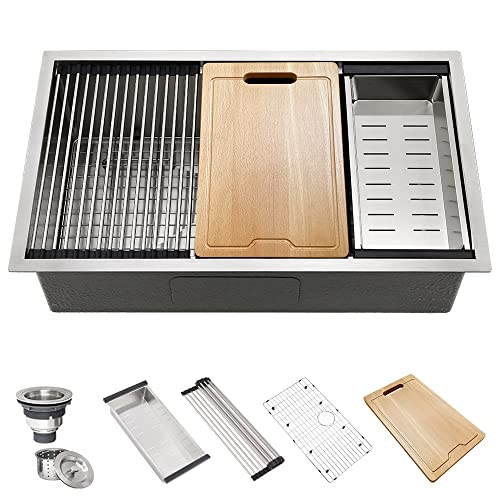
4. Hovheir 25×19 Workstation — Best Workstation
The Hovheir 25×19 is the small-kitchen workstation play: prep over the bowl, wash in a deep 16-gauge sink, all inside a 25-inch width.
Strengths
- Workstation ledge plus board at the 25-inch size
- Deep bowl and 19-inch front-to-back give real working volume
- 16-gauge steel under the accessories
Trade-offs
- Accessory ecosystem is Hovheir-only
- Front-to-back depth needs a cabinet clearance check
- Newer brand — keep purchase records
| Key specs (verified) | |
|---|---|
| Steel | 16 gauge stainless steel |
| Size | 25 x 19 inches, undermount workstation single bowl |
| Mount / format | Undermount workstation |
| In the box | Cutting board included per the verified listing |
Workstation sinks at 25 inches are scarce, and Hovheir’s entry understands the assignment — an integrated ledge, a cutting board in the box, a deep bowl and 16-gauge steel. The extra front-to-back inch versus 25×18 rivals is not trivia; it is where the working volume lives. In a small kitchen this sink can legitimately replace a section of counter during prep. The brand-depth caveats apply — accessories and support run through Hovheir alone — but the physical product checks the boxes that matter.
Best for: best workstation shoppers who want 16 gauge reliability in a 25 x 19 inches footprint / Not suited for: buyers whose cabinet, counter or routine conflicts with a undermount workstation format.
Hovheir owners bought counter space that folds away. The board lives on the ledge through cooking, the deep bowl takes the aftermath, and a 25-inch width behaves like a much larger station. The extra front-to-back inch versus 25 x 18 rivals is felt every time a big pot sits flat. Accessory loyalty is the deal: Hovheir’s ecosystem, Hovheir’s replacements. Owners who cook daily in small kitchens call it the highest-impact purchase of the remodel; occasional cooks should honestly consider whether a plain bowl plus a big board would serve them simpler.
Check the current price on Amazon

5. Oxwiser 25×18 Undermount 16-Gauge — Best Handmade Look
Oxwiser’s 25×18 suits style-led small kitchens that want the handmade look and real 16-gauge steel without flagship pricing.
Strengths
- 16-gauge handmade-style bowl at a mid-tier position
- Round corners keep the squared look cleanable
- Accessory-inclusive listing reduces second orders
Trade-offs
- Handmade flat floors drain less eagerly than pressed bowls
- Brand support is online-only
- Squared styling shows spots in hard water
| Key specs (verified) | |
|---|---|
| Steel | 16 gauge stainless steel |
| Size | 25 x 18 inches, undermount single bowl |
| Mount / format | Undermount, handmade style |
| In the box | Accessories included per the verified listing |
At 25 x 18 this Oxwiser takes the handmade formula — crisp lines, flat floor, round-enough corners — and applies it to the apartment-and-galley size class. The 16-gauge claim at this price position is the headline; verify the bowl’s heft when it arrives, because in this tier the steel is the whole value proposition. Drainage follows the handmade pattern: a shade slower, fixed by a rinse sweep habit. For a design-forward small kitchen, it is a compelling middle path between budget bowls and the Kraus flagship.
Best for: best handmade look shoppers who want 16 gauge reliability in a 25 x 18 inches footprint / Not suited for: buyers whose cabinet, counter or routine conflicts with a undermount, handmade style format.
Oxwiser’s 25-inch handmade-style bowl gives small kitchens the architectural look with real steel underneath. Owners live with the handmade trade honestly: a flatter floor that parks pans upright and drains with a little encouragement, corners that are rounded enough to clean without a specialist brush. The included accessories close the install in one order. In apartment remodels where the sink is the visible centerpiece of a small run of counters, this bowl carries the design weight of the room — and the 16-gauge construction means it is not a fragile way to do so.
Check the current price on Amazon

6. TSIBOMU 25×18 Undermount — Best Budget
TSIBOMU’s 25×18 is the apartment-and-rental friendly pick: right size, right depth, grid included, no premium-brand bill.
Strengths
- Grid included at a budget position
- 9-inch depth suits apartments and laundry installs
- Brushed finish forgives daily marks
Trade-offs
- Value brand with basic support
- Steel is mid-duty — not a cast-iron-proof bowl
- No workstation ledge
| Key specs (verified) | |
|---|---|
| Steel | 304 stainless steel |
| Size | 25 x 18 inches, 9-inch deep bowl |
| Mount / format | Undermount, single bowl |
| In the box | Bottom grid and sink accessories included per the verified listing |
For the enormous market of 25-inch replacements — apartments, rentals, laundry rooms, modest remodels — the TSIBOMU formula is well aimed: a brushed 304 bowl, 9 inches deep, with the bottom grid included so the floor survives tenant-grade use. It will not match a 16-gauge Kraus for hush or dent resistance, and it does not pretend to. It covers the fundamentals at a price that makes landlords and first-time renovators equally comfortable.
Best for: best budget shoppers who want 304 reliability in a 25 x 18 inches footprint / Not suited for: buyers whose cabinet, counter or routine conflicts with a undermount, single bowl format.
TSIBOMU’s 25-inch bowl is the landlord-and-first-remodel special: correct size, correct depth, grid in the box, brushed finish that hides tenant-grade history. Owners report the install as the easiest part of the purchase — standard footprint, standard hardware. As a main sink it serves light-to-moderate cooking households without complaint; the steel is mid-duty and priced like it. In the value tier, honesty is the differentiator, and this listing’s plain specifications — 304 steel, 9-inch depth, included grid — are exactly the honesty that matters.
Check the current price on Amazon
Undermount Scenarios at 25 Inches
The quartz-counter apartment remodel
A 30-inch cabinet, a new quartz top, and a landlord-grade sink to retire. The KHU111-25 is the flagship answer, templated cleanly into the new counter; the KHU641-25 is the same conversation at a friendlier tier when the remodel’s budget is spread across the whole unit.
The galley kitchen that preps seriously
No counters to spare, real cooking nightly. Sarlai’s deep workstation or Hovheir’s ledge model converts the sink into the prep station, with the bowl depth to absorb the aftermath. Measure the stack, commit to one accessory ecosystem, and the galley gains a workstation larger kitchens envy.
The second kitchen and suite
In-law suites, basement kitchens and laundry rooms with stone counters deserve undermount done properly too. The TSIBOMU, grid included, is the honest specification — correct format, correct steel family, no flagship money spent where flagship duty is not required.
Undermount at 25 Inches: Precision at Small Scale
Everything true about undermount sinks is truer at 25 inches. The reveal decision matters more because the counter area is smaller and the seam is proportionally more visible. The support question matters more because compact cabinets tempt installers to skip clips that ‘probably’ are not needed — they are. And the template question matters most of all, because at this size a quarter-inch of cutout error is a much larger fraction of the whole, and the difference between brands’ corner radii can leave a visible gap that no bead of silicone makes elegant. Small undermounts are precision work, and they reward the buyers who treat them that way.
The good news is that precision is available. The Kraus models in this list ship with the template-and-hardware ecosystem that fabricators prefer, which is a large part of why they anchor the picks. When a fabricator sees a familiar template, the cut goes where the drawing says, the reveal lands as agreed, and the sink seats flat — the unglamorous chain of events that separates a twenty-year install from a callback. Workstation models from Sarlai and Hovheir add their own precision demand: the ledge must sit at the height the accessories expect, which is one more reason the physical template, not a PDF approximation, should drive the cut.
Depth interacts with undermount at this size in a way worth planning on paper. A 10-inch bowl under a thick stone counter puts the working floor low — comfortable for soaking, a reach for shorter cooks — and stacks the disposal close to the trap arm. The 9-inch bowls thread that needle more easily. Neither is a mistake; both are measurements. The buyers who regret deep small undermounts are the ones who discovered the geometry after the silicone cured.
Approached with that respect — template in hand, support complete, stack measured — a 25-inch undermount is one of the most satisfying fixtures in a compact kitchen: flagship behavior, counter sweeping clean into the bowl, and nothing about it that feels small except the footprint it politely occupies. That is the standard the picks in this article were chosen to meet.
Comparison Table
| Pick | Badge | Key spec | Best for |
|---|---|---|---|
| Kraus KHU111-25 Standart Pro 25-Inch 16-Gauge | Best Overall | 16 gauge stainless steel; 25 inches wide, undermount single bowl | Best Overall |
| Kraus KHU641-25 25-Inch 18-Gauge | Best Value | 18 gauge stainless steel; 25 inches wide, undermount single bowl | Best Value |
| Sarlai 25-Inch Workstation 10-Inch Deep | Best Deep Workstation | 16 gauge stainless steel; 25 x 19 inches, 10-inch deep bowl | Best Deep Workstation |
| Hovheir 25×19 Workstation | Best Workstation | 16 gauge stainless steel; 25 x 19 inches, undermount workstation single bowl | Best Workstation |
| Oxwiser 25×18 Undermount 16-Gauge | Best Handmade Look | 16 gauge stainless steel; 25 x 18 inches, undermount single bowl | Best Handmade Look |
| TSIBOMU 25×18 Undermount | Best Budget | 304 stainless steel; 25 x 18 inches, 9-inch deep bowl | Best Budget |
Decide the reveal before the fabricator arrives
At 25 inches we recommend a slight negative reveal almost without exception: it hides the seam in shadow, forgives a hair of cutout variance, and keeps crumbs moving the right way. Bring the decision, not just the sink, to the fabrication appointment.
How to Choose a 25-Inch Undermount Sink
Template discipline
Undermount cutouts are cut from the manufacturer’s template for the exact model. At 25 inches the margin for error shrinks with the counter area, so buy the sink first, hand the physical template to the fabricator, and choose your reveal (we suggest a slight negative) before the saw starts.
The two-Kraus decision
Kraus offers the KHU111-25 in 16 gauge and the KHU641-25 in 18. The 16 is the forever-kitchen pick; the 18 keeps the same drainage grooves, rounded corners and NoiseDefend pads at a friendlier tier, and in a stiff little 25-inch bowl the practical gap is smaller than at 32 inches. Rentals and second kitchens: take the 18 without a second thought. Main kitchen, long horizon: the 16.
Workstation ledges in small cabinets
Sarlai and Hovheir prove a ledge works at 25 inches. The gain is real prep space; the costs are brand-specific accessories and, for Sarlai’s 10-inch depth, a plumbing stack that must be measured. If your kitchen has counters to spare, the plain Kraus bowls remain the cleaner daily tool.
Support and sealing at small scale
Small bowls still carry full loads of water. Use every clip the maker supplies, seat the rim on a continuous silicone bead, and cure fully before plumbing. Small cabinets make this work physically awkward — a second pair of hands is the best tool in the job.
How to Install a 25-Inch Undermount Sink Without Regrets
Receive and inspect the sink before the counter appointment: check the rim for flatness on a level surface and confirm the template matches the bowl.
Agree the reveal with the fabricator in writing. A small negative reveal is the forgiving, clean-running default at this size.
Dry-fit the bowl in the cabinet and mark every clip position; pre-drill or pre-set anchors while access is easy.
Apply a continuous silicone bead, lift the bowl into place with help, clip evenly in a star pattern, and wipe squeeze-out once with a gloved finger.
Cure fully, then plumb, fill-test with a brim-full bowl, and run the disposal while checking joints by touch. Record the model number inside the cabinet door.
Budget framing for 25-inch undermounts must be installed framing: bowl plus fabrication plus hardware. Within that, the value tier (TSIBOMU, or Kraus’s 18-gauge KHU641-25) delivers a correct, supported install; the core tier buys the 16-gauge KHU111-25’s permanence; the upper tier buys workstation format from Sarlai or Hovheir. The economizing that backfires here is never the bowl tier — it is skipping the fabricator’s template step or the fitted grid, the two cheapest lines in the whole project and the two that decide how it ages.
How to Water-Test and Commission a New Undermount
Fill the bowl to the rim and wait ten full minutes, hands dry, checking the drain, the seam and every supply connection by touch. Static leaks announce themselves in this window.
Drain the bowl and immediately run the disposal with water flowing, checking again. Vibration is the second test, and it finds what still water politely missed.
Run the faucet at full flow and confirm the stream lands mid-bowl without splashing the seam line — the daily-life test that faucet reach either passes or fails forever.
Load the cabinet only after both tests pass, and keep a dry paper towel under the trap for the first week. It is the cheapest leak detector ever made.
Write the model number and install date inside the cabinet door. Future you, ordering a grid in year six, will be grateful.
Common Buying Mistakes
Most sink regrets are not about the sink — they are about a measurement skipped, a gauge misunderstood, or an accessory forgotten until install day. These are the mistakes that come up again and again in this size and gauge class, and every one of them is cheaper to avoid on paper than in a finished kitchen.
- Letting the counter be cut before the sink arrives. Templates drift between production runs; the physical template is the contract.
- Choosing the deepest workstation bowl without stacking the disposal and trap heights on paper first.
- Mixing accessory brands on a workstation ledge. Boards and racks are model-specific; buy into one ecosystem.
- Under-clipping a small bowl because it ‘feels light’. Full of water and dishes, it is not light.
- Ignoring the faucet reach on a 25 x 19 bowl — the extra front-to-back inch moves the far corner out of a short faucet’s range.
After the Install: The First Year With a 25-Inch Undermount
Month one is about seals and habits. The silicone cures fully, the clips settle, and the household learns the new station: where the spray reaches, how the bowl sounds under the disposal, how the grid lifts for the weekly clean. This is also when the reveal choice proves itself — a negative reveal quietly swallowing crumbs, the seam staying invisible — and when any install shortcut would announce itself as a weep or a rattle. The two-act water test at install, plus a dry paper towel under the trap for the first week, catches the story while it is still a five-minute chapter.
Months two through six are the patina season. The brushed finish takes its fine, even scratch pattern — fastest where the grid’s feet meet the floor and where pans land — and then, counterintuitively, stops changing: a uniform patina reads as texture, and the sink settles into looking like a working fixture rather than a new purchase. Owners who fitted the grid watch this happen on the grid instead of the floor. This is also the season to order any accessory you deferred — the fitted rack, the ledge board — while the model numbers are still in your paperwork and the ecosystem is current.
The second half of the year is where undermount ownership becomes invisible, which is its reward. The seam needs nothing but its monthly fingertip check. The bowl’s routine is a rinse and a wipe. The cabinet below stays dry and unremarkable. Compare that trajectory with the drop-in it likely replaced — the rim that trapped grit, the caulk line that greyed — and the undermount premium explains itself without a single specification.
Year one ends with the only scheduled task: the annual look inside the cabinet. Clips snug, seal continuous, disposal mount dry, paperwork still filed by the door. Ten minutes. A fixture that asks ten minutes a year and gives back a counter that sweeps clean into a flagship bowl is not a luxury purchase — it is one of the most rational line items in the compact kitchen, and it is the standard every pick in this article was chosen to meet.
The Support Ecosystem Test: Five Years of Small Questions
Undermount ownership generates a slow drip of small questions that never appear in buying guides: the grid’s feet have perished in year three; a guest’s ring has marked the rim; the disposal is being replaced and its flange finish should match; a ledge accessory would be perfect for the new bread-making habit. Each question is trivial — if the brand’s ecosystem answers it. For the Kraus models anchoring this list, each is a part number and a delivery. For a discontinued no-name undermount, each is a research project conducted upside-down in a cabinet.
This is the deepest reason the undermount lists in this program lean toward established manufacturers, and it compounds with the install’s permanence. A drop-in sink with an orphaned parts trail can be swapped in an afternoon; an undermount is a fabrication event. Choosing the supported model is therefore not brand loyalty — it is the rational pricing of future friction, bought once, at the only moment it is cheap.
The test to apply to any candidate, in this list or beyond it, takes two minutes: find the model’s own product page, find its accessories and parts, and find evidence the model has existed long enough to have a history. Three finds and you are buying into an ecosystem. Anything less and you are buying a photograph of a sink, with the years left as an exercise for the owner.
Choosing Between the Two Kraus Picks, One Final Time
Because the KHU111-25 and the KHU641-25 anchor this list and share a brand, a size and a silhouette, the choice between them deserves a final, direct treatment. Buy the 16-gauge KHU111-25 when the kitchen is yours for the long term, the cooking is real and the counter going over it is a decades-long decision — the steel matches the commitment, and the price difference amortizes into invisibility across the install’s life. Buy the 18-gauge KHU641-25 when the horizon is shorter, the duty is lighter or the budget is genuinely needed elsewhere in the project — you keep the same design intelligence, the same drainage and sound treatment philosophy, and a support trail identical in every way that matters. What you should not do is split the difference with an unbranded middle option: the two Kraus picks already mark the honest ends of this size’s value spectrum, and everything between them that lacks a name also lacks the ecosystem that makes an undermount a safe purchase.
And a closing thought on the workstation models in an undermount list, because they ask the most of the installer and repay it most visibly. A ledge sink’s fabrication tolerance is tighter: the ledge must sit at the height its accessories were machined for, relative to a counter whose thickness the fabricator controls. This is one more conversation for the fabrication appointment — template, reveal, and ledge height, agreed in writing — and one more reason the physical sink belongs on site before the cut. Get it right and the result is the compact kitchen’s party trick: a 25-inch footprint that preps like a counter and washes like a flagship. Get it approximately right and the board rocks forever. Precision is the price of the trick, and at this size it is a fair one.
It is fitting to end where the install ends: with the first meal. The first full cooking session in front of a new 25-inch undermount — board on the counter or the ledge, bowl taking the trimmings, the spray rinsing corners that the old sink made unreachable — is when the project’s thousand decisions collapse into a single feeling of rightness or its absence. The picks in this article, installed with the discipline this article describes, reliably produce the rightness. That is not a small claim for a 25-inch hole in a counter. It is the entire reason the size class, the mount and the material have been worth ten thousand words of anyone’s attention: because a compact kitchen, specified honestly and installed precisely, gives up nothing that matters. Measure twice, template once, and cook.
The paperwork closes the loop one final time: photograph the finished install from above and below, file the template, the order and the measurements together, and leave a copy inside the cabinet door. The next person to work under that counter — plumber, owner, or you in a decade — inherits a documented fixture instead of a mystery, and the undermount’s twenty-year silence includes its own documentation.
25-Inch Undermount Checklist
- Physical template in the fabricator’s hands before any cut — nominal size matches are not accepted.
- Reveal decided in advance; slight negative is this size’s forgiving default.
- Full clip set used, rim seated on a continuous bead, cure respected before plumbing.
- Depth stack measured: bowl plus disposal versus trap arm height, on paper first.
- Water test in two acts — full static bowl, then a disposal run — before the cabinet is loaded.
Final Recommendation
If you buy one sink from this list, make it the Kraus KHU111-25 Standart Pro 25-Inch 16-Gauge — it is the most complete answer to “best 25 undermount stainless steel kitchen sinks” for the typical kitchen, balancing steel, size and support. If your kitchen points a different way — smaller cabinet, workstation ambitions, utility duty or a tighter budget — the Kraus KHU641-25 25-Inch 18-Gauge and the specialist picks above each own a clear scenario, and the reviews explain exactly where each one wins. Whichever you choose, budget the grid and the drain hardware with the sink, confirm your cabinet measurements against the template, and you will not be revisiting this purchase for a very long time.
Keep exploring the sink cluster while you plan the remodel:
- Best 25 Stainless Steel Kitchen Sinks
- Best 16 Gauge Stainless Steel Undermount Kitchen Sinks
- Best 24 Single Bowl Kitchen Sinks
- Best 18 Gauge Kitchen Sinks
Frequently Asked Questions
What is the best 25-inch undermount for a main kitchen?
The Kraus KHU111-25: full 16-gauge Standart Pro construction, proper sound treatment and the deepest support bench at this size. It is the pick that behaves like a 30-inch flagship in a 25-inch footprint.
Is the 18-gauge Kraus KHU641-25 a false economy?
No — it is the smart buy for rentals, second kitchens and budget remodels. You keep Kraus’s design details and pads; you give up a step of dent resistance that matters less in a small, stiff bowl.
How deep can a 25-inch undermount be with a disposal?
Nine inches is comfortable in most cabinets. Ten inches (Sarlai) works when the trap arm sits low; measure the full stack — bowl, disposal, trap — before ordering the deep option.
Can I undermount into a butcher block counter at 25 inches?
Yes, with the cutout edge sealed thoroughly and maintained. Wood and undermounts are compatible when the end grain at the cutout is treated as the wet zone it is; stone and quartz remain the lower-maintenance partners.
Do workstation accessories for 25-inch sinks interchange between brands?
Almost never. Ledge widths and accessory dimensions are model-specific. Buy the board, rack and colander from the sink’s own ecosystem, ideally in the same order.
How long does a 25-inch undermount install take?
For a prepared installer with the counter already cut, two to three hours including plumbing and testing. The fabrication of the cutout is a separate, earlier appointment — which is why the sink must be on site first.
Can a 25-inch undermount be installed in an existing cutout?
Sometimes, if the new model’s template matches the existing cutout’s dimensions and corner radii closely — a fabricator must confirm with the physical template. Nominal size equality is not enough; plan the conversation before assuming the swap is simple.
Is undermount worth it at only 25 inches?
Yes — arguably more than at large sizes. In a compact kitchen the counter is precious, and undermount’s sweep-clean edge plus the absence of a rim returns usable inches around the sink while making the small station feel deliberately designed.
Can I switch brands later within the same 25-inch cutout?
Only when the new model’s template matches the cutout’s dimensions and corner radii — a fabricator’s call with the physical template in hand. This is the practical reason to buy a durable, well-supported model now: the first install is the easy one to get right.
When can I use the sink normally after undermount installation?
Light use once the plumbing is connected and tested; full loads and hard disposal work after the silicone’s full cure, which your installer will specify — typically a day. The patience is cheap insurance for a seam that should last decades.


