Disclosure: airfryerkitchensupply.com is reader-supported. When you buy through links on our site, we may earn an affiliate commission at no extra cost to you.
Where to buy
Every sink in this roundup of the best 25 stainless steel kitchen sinks was verified against Amazon listing data on 2026-11-20, and the links below go to the exact verified listings. Prices move constantly, so each pick is linked with a live price check instead of a printed number:
- Kraus KHU111-25 Standart Pro 25-Inch 16-Gauge — Check the current price on Amazon
- Oxwiser 25×18 Undermount 16-Gauge — Check the current price on Amazon
- Hovheir 25×19 Workstation — Check the current price on Amazon
- Sarlai 25-Inch Workstation 10-Inch Deep — Check the current price on Amazon
- SINKVINE 25-Inch Prep Sink — Check the current price on Amazon
- TSIBOMU 25×18 Undermount — Check the current price on Amazon
Twenty-five inches is the in-between size that in-between kitchens depend on: too wide for bar duty, too narrow for the standard 30-inch cabinet run, and exactly right for 30-inch cabinets, apartment remodels and compact homes. The best 25 stainless steel kitchen sinks share one trait — none of them treat the size as an excuse. This list, verified on 2026-11-20, includes a full 16-gauge Kraus flagship, two 16-gauge workstations, a handmade-style bowl and two honest utility sets.
Stainless is effectively the only material conversation at 25 inches, so the real choices are gauge (16 dominates this list, unusually for a small size), format (plain bowl versus workstation) and depth (9 versus 10 inches). The buying guide walks through each; the picks are ordered by how completely they answer all three.
A sizing honesty note before the picks, because 25-inch shopping attracts a specific mistake: buyers with 30-inch cabinets sometimes drift to 27 or 28-inch sinks hoping to gain bowl, then discover the clips, plumbing and drawer hardware have nowhere to live. The 25 exists precisely because it is the largest bowl that a 30-inch cabinet hosts gracefully, with room for a disposal and hands during install. If your measurements say 25, trust them — and take comfort that this verification round found the size unusually well served, with flagship steel and workstation formats that larger classes would be proud of.
In this guide
Quick Picks
If you only read one section, make it this one. These are the six best 25 stainless steel kitchen sinks worth your money, each with a clear job:
- Best Overall: Kraus KHU111-25 Standart Pro 25-Inch 16-Gauge — 16 gauge stainless steel, 25 inches wide, undermount single bowl. Check the current price on Amazon
- Best Handmade Style: Oxwiser 25×18 Undermount 16-Gauge — 16 gauge stainless steel, 25 x 18 inches, undermount single bowl. Check the current price on Amazon
- Best Workstation: Hovheir 25×19 Workstation — 16 gauge stainless steel, 25 x 19 inches, undermount workstation single bowl. Check the current price on Amazon
- Best Deep Bowl: Sarlai 25-Inch Workstation 10-Inch Deep — 16 gauge stainless steel, 25 x 19 inches, 10-inch deep bowl. Check the current price on Amazon
- Best Utility Set: SINKVINE 25-Inch Prep Sink — Stainless steel, 25 x 18 inches, undermount single bowl. Check the current price on Amazon
- Best Budget: TSIBOMU 25×18 Undermount — 304 stainless steel, 25 x 18 inches, 9-inch deep bowl. Check the current price on Amazon
How These Picks Were Chosen
We started from the full market for this search — every gauge claim, size and brand that surfaces when you search it — and then applied a verification filter that most roundups skip. Each candidate was searched through the airfry site’s own Amazon listing data connection, by brand and model, and only products whose listed title confidently matched the intended sink earned a place here. That process removed listings with vague specifications, unverifiable gauge claims and model numbers that did not resolve to a real product.
Surviving picks were then judged on the criteria that decide a decade of ownership: steel gauge and grade, bowl geometry (depth, corner radius, drainage), sound treatment, what is actually included in the box, and the depth of the brand’s support and accessory ecosystem. We deliberately mixed tiers — a flagship, a value pick and specialists — because the right sink depends on the kitchen, and a list of six near-identical bowls helps nobody. Where a tier of the market could not be verified honestly, we say so in the article rather than filling the slot with a guess.
This list’s verification paid special attention to dimension integrity, because the 25-inch class is where listings round creatively — ’25 inch’ headlines over 24.5-inch bowls, depths quoted to the rim’s outer edge. Every pick’s Amazon title states its dimensions plainly enough to cross-check against the model, and the two workstation picks were confirmed as true ledge designs rather than rimmed bowls with an accessory laid across. What survived is a shelf where the tape measure and the listing agree.
The 6 Best 25 stainless steel kitchen sinks

1. Kraus KHU111-25 Standart Pro 25-Inch 16-Gauge — Best Overall
The KHU111-25 is the forever-kitchen choice at 25 inches: buy it when the cabinet says 25 and you want 30-inch-class steel anyway.
Strengths
- Full 16-gauge Standart Pro build at the 25-inch size
- The dent-and-noise performance smaller sinks usually lack
- Kraus support, templates and accessory ecosystem
Trade-offs
- Premium of the 25-inch group
- Undermount only — counter material must suit it
- No workstation ledge
| Key specs (verified) | |
|---|---|
| Steel | 16 gauge stainless steel |
| Size | 25 inches wide, undermount single bowl |
| Mount / format | Undermount, single bowl |
| In the box | Kraus mounting hardware and template included |
This is the sink for the remodeler who measured twice, accepted a 25-inch bowl, and refused to accept 25-inch-grade steel. The Standart Pro construction — 16-gauge, padded, rounded corners — behaves exactly like its 30-inch siblings, just in a footprint that fits a 30-inch cabinet with room for plumbing. Nothing about it is trendy; it is simply the most substantial plain bowl at this size, from the brand with the deepest accessory bench if you later want the matching grid and drain upgrades.
Best for: best overall shoppers who want 16 gauge reliability in a 25 inches wide footprint / Not suited for: buyers whose cabinet, counter or routine conflicts with a undermount, single bowl format.
KHU111-25 ownership is the 25-inch endgame: flagship Kraus construction, template-perfect undermount fit, and a bowl that makes a small kitchen feel serious. Owners upgrading from thin small sinks describe the first disposal run as the moment of conversion — the drum is gone. The Standart Pro’s rounded corners and grooved floor keep the daily clean to a wipe. It costs the most in its class and justifies it the way the 30-inch flagship does: by being the last sink the kitchen needs. Pair it with the matching grid and a right-sized pull-down faucet and the compact kitchen stops apologizing.
Check the current price on Amazon

2. Oxwiser 25×18 Undermount 16-Gauge — Best Handmade Style
Oxwiser’s 25×18 suits style-led small kitchens that want the handmade look and real 16-gauge steel without flagship pricing.
Strengths
- 16-gauge handmade-style bowl at a mid-tier position
- Round corners keep the squared look cleanable
- Accessory-inclusive listing reduces second orders
Trade-offs
- Handmade flat floors drain less eagerly than pressed bowls
- Brand support is online-only
- Squared styling shows spots in hard water
| Key specs (verified) | |
|---|---|
| Steel | 16 gauge stainless steel |
| Size | 25 x 18 inches, undermount single bowl |
| Mount / format | Undermount, handmade style |
| In the box | Accessories included per the verified listing |
At 25 x 18 this Oxwiser takes the handmade formula — crisp lines, flat floor, round-enough corners — and applies it to the apartment-and-galley size class. The 16-gauge claim at this price position is the headline; verify the bowl’s heft when it arrives, because in this tier the steel is the whole value proposition. Drainage follows the handmade pattern: a shade slower, fixed by a rinse sweep habit. For a design-forward small kitchen, it is a compelling middle path between budget bowls and the Kraus flagship.
Best for: best handmade style shoppers who want 16 gauge reliability in a 25 x 18 inches footprint / Not suited for: buyers whose cabinet, counter or routine conflicts with a undermount, handmade style format.
Oxwiser’s 25-inch handmade-style bowl gives small kitchens the architectural look with real steel underneath. Owners live with the handmade trade honestly: a flatter floor that parks pans upright and drains with a little encouragement, corners that are rounded enough to clean without a specialist brush. The included accessories close the install in one order. In apartment remodels where the sink is the visible centerpiece of a small run of counters, this bowl carries the design weight of the room — and the 16-gauge construction means it is not a fragile way to do so.
Check the current price on Amazon
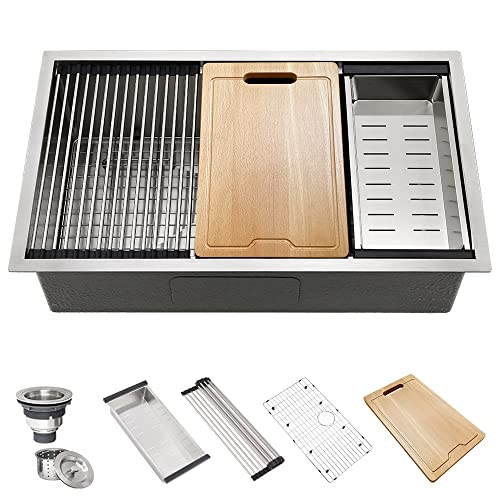
3. Hovheir 25×19 Workstation — Best Workstation
The Hovheir 25×19 is the small-kitchen workstation play: prep over the bowl, wash in a deep 16-gauge sink, all inside a 25-inch width.
Strengths
- Workstation ledge plus board at the 25-inch size
- Deep bowl and 19-inch front-to-back give real working volume
- 16-gauge steel under the accessories
Trade-offs
- Accessory ecosystem is Hovheir-only
- Front-to-back depth needs a cabinet clearance check
- Newer brand — keep purchase records
| Key specs (verified) | |
|---|---|
| Steel | 16 gauge stainless steel |
| Size | 25 x 19 inches, undermount workstation single bowl |
| Mount / format | Undermount workstation |
| In the box | Cutting board included per the verified listing |
Workstation sinks at 25 inches are scarce, and Hovheir’s entry understands the assignment — an integrated ledge, a cutting board in the box, a deep bowl and 16-gauge steel. The extra front-to-back inch versus 25×18 rivals is not trivia; it is where the working volume lives. In a small kitchen this sink can legitimately replace a section of counter during prep. The brand-depth caveats apply — accessories and support run through Hovheir alone — but the physical product checks the boxes that matter.
Best for: best workstation shoppers who want 16 gauge reliability in a 25 x 19 inches footprint / Not suited for: buyers whose cabinet, counter or routine conflicts with a undermount workstation format.
Hovheir owners bought counter space that folds away. The board lives on the ledge through cooking, the deep bowl takes the aftermath, and a 25-inch width behaves like a much larger station. The extra front-to-back inch versus 25 x 18 rivals is felt every time a big pot sits flat. Accessory loyalty is the deal: Hovheir’s ecosystem, Hovheir’s replacements. Owners who cook daily in small kitchens call it the highest-impact purchase of the remodel; occasional cooks should honestly consider whether a plain bowl plus a big board would serve them simpler.
Check the current price on Amazon

4. Sarlai 25-Inch Workstation 10-Inch Deep — Best Deep Bowl
Sarlai’s deep workstation suits cooks in small kitchens who soak tall pots and want the ledge — and whose cabinet and plumbing can take a 10-inch bowl.
Strengths
- 10-inch depth is the deepest in the 25-inch group
- Workstation ledge with round corners — function without the grime traps
- 16-gauge steel with scratch-and-heat resistant positioning
Trade-offs
- Deep bowl plus undermount means a low drain line — check disposal clearance
- Accessory fit is brand-specific
- Costs more than plain 25-inch bowls
| Key specs (verified) | |
|---|---|
| Steel | 16 gauge stainless steel |
| Size | 25 x 19 inches, 10-inch deep bowl |
| Mount / format | Undermount workstation, single bowl |
| In the box | Accessories included per the verified listing |
Depth is this sink’s argument. Ten inches at 25 wide holds a stockpot under the faucet, keeps splash inside during aggressive rinsing, and makes the bowl feel a class larger than its footprint. Sarlai pairs that depth with a workstation ledge and sensibly rounded corners. The one real homework item is vertical clearance: a 10-inch undermount bowl plus a disposal is a tall stack, so measure the drain height before ordering. Fit that, and this is among the most capable small sinks sold.
Best for: best deep bowl shoppers who want 16 gauge reliability in a 25 x 19 inches footprint / Not suited for: buyers whose cabinet, counter or routine conflicts with a undermount workstation, single bowl format.
Sarlai ownership starts with a measurement and rewards it with depth. Ten inches of bowl in a 25-inch width changes what a small sink can hold — stockpots under the tap, soaking trays fully submerged, splash contained during pressure-rinsing. The workstation ledge layers prep on top of that volume. Owners who verified their plumbing stack report a sink that feels a class larger than the kitchen it serves. The rounded corners keep the deep bowl easy to clean despite the handmade-adjacent styling. For small kitchens with tall-pot cooking habits, it is a distinctive and rational pick.
Check the current price on Amazon

5. SINKVINE 25-Inch Prep Sink — Best Utility Set
The SINKVINE 25 is the versatile second sink: outdoor kitchen, laundry, RV or prep station, arriving with its full accessory kit.
Strengths
- Grid, strainer and roll-up rack all in the box
- Positioned for outdoor kitchens, laundry and RV use as well as prep zones
- 25 x 18 is the most cabinet-friendly footprint in the group
Trade-offs
- Utility positioning — not a heavy-gauge flagship
- Accessory quality is functional grade
- Brand support is basic
| Key specs (verified) | |
|---|---|
| Steel | Stainless steel |
| Size | 25 x 18 inches, undermount single bowl |
| Mount / format | Undermount, single bowl |
| In the box | Bottom grid, 3.5-inch drain strainer and roll-up drying rack included per the verified listing |
Second sinks live different lives from main sinks — garden produce, grill tools, laundry soaking, RV dishes — and they are usually bought as bare bowls that then need three more orders. SINKVINE ships the grid, the strainer and the roll-up rack with the bowl, which is exactly the kit a utility install consumes. The steel specification is workmanlike rather than premium, and for the roles named that is the correct allocation of money.
Best for: best utility set shoppers who want Stainless steel reliability in a 25 x 18 inches footprint / Not suited for: buyers whose cabinet, counter or routine conflicts with a undermount, single bowl format.
SINKVINE ownership is about the second sink done properly: outdoor kitchens where the grid keeps grill tools off the floor, laundry rooms where the roll-up rack dries delicates, RVs where one bowl must do everything. The included kit is the value — no second and third orders to make a bare bowl usable. The steel is workmanlike, the finish practical, and the whole package priced for roles where a premium flagship would be wasted money. Owners consistently describe it as the sink that finished a space that had been ‘temporary’ for years.
Check the current price on Amazon

6. TSIBOMU 25×18 Undermount — Best Budget
TSIBOMU’s 25×18 is the apartment-and-rental friendly pick: right size, right depth, grid included, no premium-brand bill.
Strengths
- Grid included at a budget position
- 9-inch depth suits apartments and laundry installs
- Brushed finish forgives daily marks
Trade-offs
- Value brand with basic support
- Steel is mid-duty — not a cast-iron-proof bowl
- No workstation ledge
| Key specs (verified) | |
|---|---|
| Steel | 304 stainless steel |
| Size | 25 x 18 inches, 9-inch deep bowl |
| Mount / format | Undermount, single bowl |
| In the box | Bottom grid and sink accessories included per the verified listing |
For the enormous market of 25-inch replacements — apartments, rentals, laundry rooms, modest remodels — the TSIBOMU formula is well aimed: a brushed 304 bowl, 9 inches deep, with the bottom grid included so the floor survives tenant-grade use. It will not match a 16-gauge Kraus for hush or dent resistance, and it does not pretend to. It covers the fundamentals at a price that makes landlords and first-time renovators equally comfortable.
Best for: best budget shoppers who want 304 reliability in a 25 x 18 inches footprint / Not suited for: buyers whose cabinet, counter or routine conflicts with a undermount, single bowl format.
TSIBOMU’s 25-inch bowl is the landlord-and-first-remodel special: correct size, correct depth, grid in the box, brushed finish that hides tenant-grade history. Owners report the install as the easiest part of the purchase — standard footprint, standard hardware. As a main sink it serves light-to-moderate cooking households without complaint; the steel is mid-duty and priced like it. In the value tier, honesty is the differentiator, and this listing’s plain specifications — 304 steel, 9-inch depth, included grid — are exactly the honesty that matters.
Check the current price on Amazon
Three 25-Inch Kitchens, Three Stainless Answers
The serious cook in a compact home
The dishwasher runs nightly, the cookware is real, and the sink must be a flagship in miniature. The KHU111-25 is this kitchen’s sink — the purchase that ends the category. Add the grid, a right-sized pull-down, and the compact kitchen’s hardest-working station is finished.
The counter-starved remodel
Every inch of counter is spoken for, so the sink must manufacture workspace. Hovheir’s ledge or Sarlai’s deep workstation turn prep into an over-the-bowl activity, and the kitchen gains a station it never had. This is the scenario where the workstation premium is not a premium — it is rent on found space.
The rental and second-kitchen standard
Apartments, in-law suites and laundry rooms need the correct size, honest steel and no drama. TSIBOMU and SINKVINE cover it with grids included and footprints that fit the cabinets these spaces actually have.
Twenty-Five Inches: The Remodeler’s Sweet Spot
Every sink size class has a personality, and 25 inches is the pragmatist. It appears in the wild wherever a 30-inch cabinet anchors a kitchen that cooks seriously — apartments with real chefs, galley kitchens, compact family homes, in-law suites built to a standard rather than a budget. The class’s buyers are disproportionately remodelers rather than new-build shoppers, which shows in what the market offers them: fewer gimmicks, more steel. That this verification round found four distinct 16-gauge options at 25 inches — a size where 18 is the industry default — tells you exactly who manufacturers think is shopping here.
The geometry argument for 25 is the cabinet math. A 30-inch cabinet hosting a 25-inch undermount leaves working margins on every side: clips seat properly, the disposal body clears, a plumber’s hands fit. Squeeze a 28 into the same cabinet and every one of those becomes a negotiation. Meanwhile the bowl itself, especially at 9 to 10 inches deep, gives up surprisingly little to a 27: the difference is a roasting pan’s tilt, a few times a year. Remodelers who have done both installs tend to become 25-inch evangelists, and the conversion is usually about install day, not wash day.
The format split in this class — plain bowls versus workstations — maps to the two kinds of small kitchen. Where counters are the constraint, the Hovheir and Sarlai ledges manufacture workspace over the bowl, and owners treat them as the remodel’s smartest square footage. Where a dishwasher and adequate counters exist, the plain Kraus and Oxwiser bowls win on simplicity and clean in seconds. Neither camp is wrong; they are answers to different scarcities, and this article’s ordering puts the all-round flagship first while giving each camp its champion.
If there is a single takeaway from the 25-inch verification work, it is that this class punishes assumption and rewards measurement more than any other. The sinks are excellent; the cabinets are unforgiving. Measure the interior, stack the heights, choose the format by your scarcest resource — and the pragmatist’s size will pay you back for a decade.
Comparison Table
| Pick | Badge | Key spec | Best for |
|---|---|---|---|
| Kraus KHU111-25 Standart Pro 25-Inch 16-Gauge | Best Overall | 16 gauge stainless steel; 25 inches wide, undermount single bowl | Best Overall |
| Oxwiser 25×18 Undermount 16-Gauge | Best Handmade Style | 16 gauge stainless steel; 25 x 18 inches, undermount single bowl | Best Handmade Style |
| Hovheir 25×19 Workstation | Best Workstation | 16 gauge stainless steel; 25 x 19 inches, undermount workstation single bowl | Best Workstation |
| Sarlai 25-Inch Workstation 10-Inch Deep | Best Deep Bowl | 16 gauge stainless steel; 25 x 19 inches, 10-inch deep bowl | Best Deep Bowl |
| SINKVINE 25-Inch Prep Sink | Best Utility Set | Stainless steel; 25 x 18 inches, undermount single bowl | Best Utility Set |
| TSIBOMU 25×18 Undermount | Best Budget | 304 stainless steel; 25 x 18 inches, 9-inch deep bowl | Best Budget |
Price the step to a workstation honestly
The ledge models cost more and their accessories are brand-locked. If your kitchen’s counter scarcity is real, the premium buys daily workspace and is cheap at the price. If it is not, the same money in a plain 16-gauge bowl plus a large quality cutting board is the smarter allocation.
How to Choose a 25-Inch Stainless Steel Sink
Confirm the 25 is really your size
A 25-inch undermount typically serves a 30-inch cabinet. Measure the cabinet interior and the existing cutout if replacing — 25-inch sinks are often replacements for older 25s, and matching the footprint can save the counter. If you have room for 27 or 28 inches, price that step too; if you don’t, this list is your shelf.
Take the 16-gauge gift
Small sizes usually mean thin steel. This class is the exception: Kraus, Oxwiser, Hovheir and Sarlai all offer verified 16-gauge bowls at 25 inches. For a main sink, that is the single easiest quality decision in this article — the premium over 18 gauge is modest and the dent-and-noise returns are daily.
Workstation or plain bowl
Hovheir and Sarlai add ledges that turn 25 inches into a prep station — valuable when counter space is the scarcest resource in the kitchen. Plain bowls (Kraus, Oxwiser) clean faster and suit dishwasher-centric households. Choose by counter poverty, not by gadget appeal.
Depth check against plumbing
Nine inches is standard; Sarlai’s 10-inch bowl is the capacity king and the clearance risk. Undermount bowl depth plus disposal height must fit above your trap arm. Measure the stack before falling for the deep option.
How to Measure a Cabinet for a 25-Inch Undermount Sink
Measure interior width between cabinet walls, then subtract what the clips and any drawer hardware need. A 25-inch bowl in a true 30-inch cabinet is comfortable; in a nominal 30 with thick face frames, verify twice.
Measure front-to-back: 25 x 19 models (Hovheir, Sarlai) need more of it than 25 x 18s, and the faucet holes or counter depth must still land behind the bowl.
Stack the heights on paper: counter underside to drain outlet, minus bowl depth, minus disposal if planned. If the remainder beats your trap height, the install is clean.
Check door and drawer clearance with the bowl’s footprint taped inside the cabinet — tape is cheaper than returns.
Photograph and keep all measurements with the order paperwork; 25-inch replacements are the most measurement-sensitive swaps in the sink world.
Budget framing at 25 inches: the class’s unusual depth of 16-gauge options compresses the ladder. Value buys 304 utility sets with the grid included. Mid buys handmade styling or a workstation ledge. Premium buys the Kraus flagship formula at this exact size. The step from value to mid is the one most buyers should take for a main kitchen, because it buys either the format (workstation) or the finish (handmade) that the kitchen will present every day; the step to premium buys permanence, justified by horizon rather than by daily feel alone.
How to Keep a 25-Inch Stainless Sink Looking Fitted, Not Fitted-In
Keep the reveal line clean: a weekly pass with an old toothbrush along the undermount seam stops the dark line that makes an install look aged before its time.
Use the grid and lift it weekly; at 25 inches the grid covers most of the floor, and the contact points are where debris gathers.
Dry the bowl after the evening wash if your water is hard — smaller bowls concentrate the same mineral load on less steel, so spots show sooner.
Store the workstation accessories with intent: board vertical in a slim slot, rack rolled in a drawer. Accessories left permanently out make a compact kitchen feel smaller than it is.
Check the faucet’s base seal seasonally. On compact counters, water migrates from the faucet deck to the seam faster; catching it is a wipe, missing it is a project.
Common Buying Mistakes
Most sink regrets are not about the sink — they are about a measurement skipped, a gauge misunderstood, or an accessory forgotten until install day. These are the mistakes that come up again and again in this size and gauge class, and every one of them is cheaper to avoid on paper than in a finished kitchen.
- Assuming a 25-inch sink fits a 25-inch cabinet. It does not — undermounts need cabinet inches beyond the bowl.
- Buying the 10-inch-deep workstation without the plumbing stack to support it.
- Paying for a handmade-look bowl and then cleaning its corners with whatever is at hand; squared bowls want a brush in the caddy.
- Forgetting the faucet: at 25 inches, an oversized faucet dominates the counter and splashes. Scale the faucet to the bowl.
- Skipping the grid on a 16-gauge bowl because ‘it’s thick enough’. Thickness stops dents, not scratches.
Designing the Compact Kitchen Around a 25-Inch Sink
A 25-inch sink anchors a compact kitchen, and the design decisions around it decide whether the room feels edited or merely small. Begin with the counter run: in a galley or L-shaped compact kitchen, the sink should sit with its prep counter on the cook’s dominant side and the dishwasher — if present — on the other, so the station reads prep, wash, machine in one motion. The 25’s modest footprint is what makes this geometry possible in runs where a 30-inch sink would consume the prep counter entirely.
Faucet selection carries unusual design weight at this size, because the faucet is the station’s vertical element and its most visible object. Scale is the discipline: a right-sized pull-down looks intentional, while an oversized commercial-style faucet makes the whole station look like a compromise wearing a costume. Choose the faucet as the design accent and let the brushed stainless bowl be the quiet ground it stands on — the combination reads as designed at any budget.
Storage choreography is the third system. Under a 25-inch undermount, the cabinet holds the disposal, the cleaning kit and little else; the compact kitchen must place its trash, its boards and its chemicals with intent elsewhere. Owners who plan this on paper before install day get a cabinet that works; owners who improvise get a cabinet that stores things in the sink, which is how compact kitchens begin to feel chaotic.
The last system is light. A compact sink station under a window or a dedicated task light becomes the room’s workstation and its visual anchor; the same station in shadow becomes the room’s apology. If the remodel budget has one discretionary line near the sink, spend it there. The bowls in this article are good enough to carry a compact kitchen — these four systems decide whether they get the chance.
Resale, Appraisals and the Quiet Value of a Good Small Sink
Real-estate photographers know something remodelers learn slowly: kitchens sell houses, and within kitchens, the sink station is a disproportionate signal. It sits at the window, at the light, at the center of the work triangle — and a brushed stainless bowl with a quality faucet photographs as ‘updated’ in a way that a tired builder sink, however functional, never will. At 25 inches the effect is amplified, because compact kitchens are judged as wholes: one cheap-looking fixture downgrades the entire room’s story, and one flagship-grade station upgrades it.
The brands in this article carry part of that signal. A Kraus undermount in the listing photos is a name a buyer’s agent recognizes; an Elkay does the same work in the 18-gauge tier. This is not snobbery — it is information compression. A named fixture tells the next owner that the remodel was specified rather than improvised, and that parts exist. In a compact kitchen where every choice is visible, that compression is worth real money at resale, often more than the price difference that bought it.
None of this argues for remodeling for the market instead of for yourself. It argues that in the specific case of the 25-inch sink, the selfish choice and the resale choice coincide: the flagship bowl you enjoy daily is also the one the photographs love. Buy the sink you want to use for a decade, from a brand the next owner will recognize, and the value question answers itself twice.
The Two-Measurement Rule for 25-Inch Buyers
If this article could leave 25-inch buyers with one habit, it would be the two-measurement rule: never trust a single number for anything. The cabinet gets measured at the front and the back, because cabinets are not always square. The bowl’s stated width gets checked against its depth, because the pair together decide the fit. The plumbing stack gets measured from the counter down and from the floor up, and the two must agree before the deep workstation is ordered. Remodelers develop this paranoia from experience — every horror story in the 25-inch class is a single measurement that turned out to be the optimistic one. The sinks in this list are the predictable half of the project; your tape measure is the other half. Use it twice, buy once, and the pragmatist’s size will reward the discipline for as long as you own the kitchen.
Hold the two workstation picks up against each other once more, because they frame the class’s most interesting choice. Sarlai sells depth — ten inches of bowl that swallows the stockpot whole — with the ledge as a strong supporting feature. Hovheir sells balance — a deep-enough bowl, the extra front-to-back inch, and a ledge system that feels integrated rather than added. Neither is the other’s lesser version; they are different allocations of the same 25 inches, one vertical, one horizontal. Your kitchen knows which one it is short of. Measure the cabinet’s height stack and its counter poverty, and the choice between them makes itself — which is, in the end, the story of this entire size class: the tape measure decides, and the sinks in this article are all good enough to deserve being decided among.
A last pattern from this size class is worth naming for buyers comparing across the whole program of sink articles: 25 inches is where the market’s respect for the buyer becomes visible. At 24, you must still filter out shallow bar bowls wearing kitchen headlines. At 30, you must filter out thin flagships trading on size. At 25, the shelf this verification produced was unusually clean — real gauges, real depths, real templates, from brands prepared to be checked. That is the remodeler effect: a size bought mostly by people renovating their own long-term homes attracts manufacturers who expect to be audited. Shop the class with confidence, then — but keep the tape measure out anyway. The class has earned trust; the individual cabinet has not, and it is the cabinet, in the end, that every one of these excellent sinks has to fit.
If a single sentence must carry this article’s advice to the checkout, it is this: measure the cabinet like a skeptic, buy the steel like an owner, and let the format follow whichever resource — counter space or simplicity — your kitchen is honestly shortest of. The 25-inch class rewards exactly that order of operations, and every pick above was verified to be worth the discipline.
And when the install is done and the first load of dishes is washed, do the simplest quality check of all: stand back and look at the station as a whole. A 25-inch sink that was measured honestly, chosen by role and fitted with its own grid and faucet reads as a designed workstation at a glance — the compact kitchen’s center holding its own. That glance is the dividend the whole process was buying, and in this size class, with these verified picks, it is a dividend that reliably arrives.
That is the standard this roundup held every candidate to, and it is the standard your own shortlist should be held to as well.
25-Inch Stainless Checklist
- Cabinet confirmed as a true 30-inch class interior — the 25-inch bowl’s home.
- Listing dimensions cross-checked against the model, not just the headline size.
- Depth chosen against the plumbing stack: 9 inches standard, 10 with measurements in hand.
- Format decided by scarcest resource: counters argue workstation, simplicity argues plain bowl.
- Fitted grid and any ledge accessories ordered from the same brand, same cart.
Final Recommendation
If you buy one sink from this list, make it the Kraus KHU111-25 Standart Pro 25-Inch 16-Gauge — it is the most complete answer to “best 25 stainless steel kitchen sinks” for the typical kitchen, balancing steel, size and support. If your kitchen points a different way — smaller cabinet, workstation ambitions, utility duty or a tighter budget — the Oxwiser 25×18 Undermount 16-Gauge and the specialist picks above each own a clear scenario, and the reviews explain exactly where each one wins. Whichever you choose, budget the grid and the drain hardware with the sink, confirm your cabinet measurements against the template, and you will not be revisiting this purchase for a very long time.
Keep exploring the sink cluster while you plan the remodel:
- Best 25 Undermount Stainless Steel Kitchen Sinks
- Best 24 Stainless Steel Kitchen Sinks
- Best 16 Gauge Stainless Steel Kitchen Sinks
- Best 18 Gauge Kitchen Sinks
Frequently Asked Questions
What cabinet does a 25-inch sink need?
A 30-inch cabinet class is the standard pairing, giving room for clips, plumbing and a compact disposal. Always verify against the interior measurement rather than the cabinet’s nominal label.
Is 25 inches big enough for a family?
For a family that runs a dishwasher, yes — especially the 10-inch-deep Sarlai or a workstation model. Dishwasher-free families of four will find it tight at holidays; everyone else finds it sufficient within a week of adjusting.
Why do so many 25-inch sinks come in 16 gauge?
Because the size serves remodelers upgrading small kitchens, a market that pays for quality. Brands like Kraus carry their flagship construction down to this size rather than engineering a cheaper small line.
Workstation or standard at 25 inches?
Workstation if counter space is scarce — the ledge is genuinely extra workspace. Standard if you have counters and a dishwasher; it is simpler, cheaper and quicker to clean.
Can a 25-inch sink fit a garbage disposal?
Usually yes with a compact disposal and a 9-inch bowl. With a 10-inch bowl, measure the drain stack carefully — that pairing is the tight one.
Stainless or granite composite at 25 inches?
Stainless, for weight, cost and toughness in small cabinets. Composite at this size is heavy, pricey and offers mainly a color choice in return.
Is a 25-inch sink a standard size for parts and accessories?
The sink itself is a standard class, but its accessories — grids, ledge boards, racks — are model-specific rather than size-standard. Buy the fitted pieces from the sink’s own brand, ideally in the original order.
Is stainless the only sensible material at 25 inches?
For undermount use in small cabinets, effectively yes — it is light, thin-walled (saving precious inches), tough and available at every tier. Composite and fireclay exist but spend the size class’s scarce resources — cabinet room and budget — on appearance.
How do I stop a stainless sink from looking spotted in hard water?
The wipe habit, full stop: a twenty-second dry after the last wash prevents the mineral film entirely. A periodic vinegar wipe removes what forms anyway. No coating or product substitutes for the habit at any price tier.
What counter depth suits a 25 x 19 workstation sink?
Standard 25.5-inch counters host 25 x 19 bowls comfortably in undermount, but the faucet’s setback behind the deeper bowl must be confirmed — the extra front-to-back inch comes partly from the faucet’s territory. Bring the template to the counter conversation.


