Disclosure: airfryerkitchensupply.com is reader-supported. When you buy through links on our site, we may earn an affiliate commission at no extra cost to you.
Where to buy
Every sink in this roundup of the best 24 stainless steel kitchen sinks was verified against Amazon listing data on 2026-11-20, and the links below go to the exact verified listings. Prices move constantly, so each pick is linked with a live price check instead of a printed number:
- Ruvati RVM4132 24-Inch 16-Gauge — Check the current price on Amazon
- SANYCASA 24-Inch 11-Gauge — Check the current price on Amazon
- BoomHoze 24-Inch Workstation — Check the current price on Amazon
- MENATT 24×18 Undermount — Check the current price on Amazon
- FAUENPEEY 24×18 Undermount Set — Check the current price on Amazon
- TSIBOMU 24-Inch 18-Gauge — Check the current price on Amazon
Stainless steel owns the 24-inch class for practical reasons: it is light enough for small cabinets, tough enough for utility work, and available at every quality tier from budget 18 gauge to an 11-gauge plate-steel outlier. Shopping the best 24 stainless steel kitchen sinks is therefore less about material — stainless is the answer — and more about which tier of stainless, which depth, and which accessory bundle matches your job. Six models verified make up this list, and the spread between the first and last pick is wider than the size suggests.
A word on finishes, since this is the material-focused roundup: every pick uses a brushed finish, and that is deliberate. Brushed stainless hides the fine scratches that polished finishes advertise, and at 24 inches — where every dish works in close quarters — that forgiveness matters more than showroom shine.
Since this is the material-focused roundup, one myth deserves clearing before the picks: stainless steel is not one material in the market, it is a family. The 304 grade behind every pick here is the food-industry standard, chromium-nickel steel that resists corrosion and takes a brushed finish beautifully. The 200-series steels in the cheapest listings cut the nickel, and with it much of the corrosion margin — they can spot and tea-stain in exactly the wet duty a sink lives in. When a listing at this size declines to name its grade, the omission is the information.
In this guide
Quick Picks
If you only read one section, make it this one. These are the six best 24 stainless steel kitchen sinks worth your money, each with a clear job:
- Best Overall: Ruvati RVM4132 24-Inch 16-Gauge — 16 gauge stainless steel, 24 inches wide, undermount single bowl. Check the current price on Amazon
- Best Heavy-Duty: SANYCASA 24-Inch 11-Gauge — 11 gauge stainless steel (3mm class), 24 inches wide, undermount single bowl. Check the current price on Amazon
- Best Workstation: BoomHoze 24-Inch Workstation — 16 gauge stainless steel, 24 x 19 inches, undermount single bowl. Check the current price on Amazon
- Best Standard Pick: MENATT 24×18 Undermount — 304 stainless steel, 24 x 18 inches, 9-inch deep basin. Check the current price on Amazon
- Best Set: FAUENPEEY 24×18 Undermount Set — Stainless steel, 24 x 18 inches, undermount single bowl. Check the current price on Amazon
- Best Budget: TSIBOMU 24-Inch 18-Gauge — 18 gauge 304 stainless steel, 24 x 18 inches, 9-inch deep bowl. Check the current price on Amazon
How These Picks Were Chosen
We started from the full market for this search — every gauge claim, size and brand that surfaces when you search it — and then applied a verification filter that most roundups skip. Each candidate was searched through the airfry site’s own Amazon listing data connection, by brand and model, and only products whose listed title confidently matched the intended sink earned a place here. That process removed listings with vague specifications, unverifiable gauge claims and model numbers that did not resolve to a real product.
Surviving picks were then judged on the criteria that decide a decade of ownership: steel gauge and grade, bowl geometry (depth, corner radius, drainage), sound treatment, what is actually included in the box, and the depth of the brand’s support and accessory ecosystem. We deliberately mixed tiers — a flagship, a value pick and specialists — because the right sink depends on the kitchen, and a list of six near-identical bowls helps nobody. Where a tier of the market could not be verified honestly, we say so in the article rather than filling the slot with a guess.
Verification for the stainless-focused list leaned harder on construction claims than any other in this batch: stated 304 grade, stated gauge where claimed, and a finish described as brushed rather than polished. Several listings with attractive photography failed on grade silence alone. We also checked that each model’s care story matched its material — a sink whose own listing recommends abrasive pads is telling you its finish will not survive its owners, and none of those appear below.
The 6 Best 24 stainless steel kitchen sinks

1. Ruvati RVM4132 24-Inch 16-Gauge — Best Overall
The Ruvati RVM4132 is the buy-once 24-inch sink: small footprint, flagship-grade steel, and a finish picked for real kitchens.
Strengths
- True 16-gauge steel at a size where most rivals are 18 or 20 gauge
- Brushed finish is chosen specifically to hide scratches
- Ruvati’s fit and finish are a step above value brands
Trade-offs
- Premium pricing for the 24-inch class
- No workstation ledge
- Undermount only
| Key specs (verified) | |
|---|---|
| Steel | 16 gauge stainless steel |
| Size | 24 inches wide, undermount single bowl |
| Mount / format | Undermount, single bowl |
| In the box | Ruvati sink with standard mounting hardware per the verified listing |
Ruvati built its name by putting thick steel into sizes other brands treat as afterthoughts. The RVM4132 is a 24-inch bowl with the same 16-gauge construction as full-size premium sinks, so it shrugs off the dents and disposal drone that plague small sinks. The brushed finish is a practical choice, not a style one — fine scratches from daily washing disappear into the grain. If this sink will serve as a main kitchen sink in a small home, the upgrade over budget 24s is worth it every single day you use it.
Best for: best overall shoppers who want 16 gauge reliability in a 24 inches wide footprint / Not suited for: buyers whose cabinet, counter or routine conflicts with a undermount, single bowl format.
Ruvati ownership at 24 inches feels like cheating the size class: the steel is flagship-thick, the finish hides the evidence of work, and the bowl behaves like a 30-inch sink that happens to be smaller. Owners who cook seriously in small kitchens — the audience this model exists for — report it as the one appliance-grade fixture in a compact space. It wants a grid to protect that brushed floor and a faucet scaled to its depth. Judged over a decade, the premium over budget 24s amortizes to very little per year of noticeably better days.
Check the current price on Amazon

2. SANYCASA 24-Inch 11-Gauge — Best Heavy-Duty
The SANYCASA 24 is for buyers who want the thickest steel they can get in a 24-inch bowl — utility sinks, outdoor kitchens, hard-use rentals.
Strengths
- Extra-thick 11-gauge steel is close to dent-proof in home use
- Bottom grid included to protect the floor
- Quiet Drain design focus suits disposal-heavy kitchens
Trade-offs
- Heavy — undermount support and a second pair of hands are mandatory
- Thick-steel premium in a small footprint
- Brand is newer than the legacy names
| Key specs (verified) | |
|---|---|
| Steel | 11 gauge stainless steel (3mm class) |
| Size | 24 inches wide, undermount single bowl |
| Mount / format | Undermount, single bowl |
| In the box | Bottom grid included per the verified listing |
Eleven-gauge steel is plate, not sheet — at roughly 3mm it is the kind of thickness commercial fabricators use, and in a 24-inch bowl it makes the sink feel carved rather than stamped. Dropped pans become a non-event and disposal noise dies in the mass of the metal. The price of that mass is literal weight: plan the undermount support properly and do not attempt a solo install. For a hard-use small sink, nothing else in this group is built like it.
Best for: best heavy-duty shoppers who want 11 gauge reliability in a 24 inches wide footprint / Not suited for: buyers whose cabinet, counter or routine conflicts with a undermount, single bowl format.
Living with 11-gauge steel changes your relationship with a sink: you stop being careful. Pans land, tools drop, the disposal growls against a bowl that absorbs all of it into mass and silence. SANYCASA owners in utility and outdoor roles describe something closer to a stainless workbench basin than a kitchen fixture. The weight shapes the install — proper support, two people, no heroics — and after that the sink simply endures. The included grid is almost redundant protection, yet still useful as a rack. For hard-use small spaces, this is the end of the shopping conversation.
Check the current price on Amazon

3. BoomHoze 24-Inch Workstation — Best Workstation
BoomHoze’s 24-inch workstation suits small kitchens, outdoor kitchens and utility spaces that want ledge prep without a 30-inch footprint.
Strengths
- Workstation ledge at 24 inches — a rare combination
- 16-gauge steel in a value-tier package
- Deep front-to-back 19-inch bowl suits outdoor and utility use too
Trade-offs
- Younger brand with thinner support network
- Accessory fit is BoomHoze-specific
- Inspect on arrival — finishing is a notch below premium brands
| Key specs (verified) | |
|---|---|
| Steel | 16 gauge stainless steel |
| Size | 24 x 19 inches, undermount single bowl |
| Mount / format | Undermount workstation, single bowl |
| In the box | Workstation format per the verified listing; also positioned for outdoor kitchens |
A workstation ledge changes a small sink’s life: the board bridges the bowl, prep happens over the water, and a 24-inch footprint suddenly works like a bigger station. BoomHoze pairs that ledge with genuine 16-gauge steel and a deep 19-inch front-to-back bowl, which also makes it a favorite for outdoor kitchens and laundry rooms. The compromises are brand-depth ones — support, accessory availability, finish consistency — rather than anything about the steel itself.
Best for: best workstation shoppers who want 16 gauge reliability in a 24 x 19 inches footprint / Not suited for: buyers whose cabinet, counter or routine conflicts with a undermount workstation, single bowl format.
The BoomHoze 24’s owners bought a workstation that fits where workstations should not: galley kitchens, outdoor kitchens, serious laundry rooms. The ledge hosts a board for prep, the deep 19-inch front-to-back bowl takes a stockpot, and the 16-gauge steel shrugs at utility duty. Outdoor owners particularly value the format — grill tools soak inside, produce rinses under the board. Support runs through a younger brand, so keep the paperwork; the hardware itself has the spec to last. In small kitchens it is the rare accessory-led sink whose accessories genuinely get used.
Check the current price on Amazon

4. MENATT 24×18 Undermount — Best Standard Pick
MENATT’s 24×18 is the straightforward replacement pick: standard size, sensible depth, no exotic requirements, for kitchens, prep areas and laundry rooms.
Strengths
- Standard 24 x 18 footprint drops into common cabinet layouts
- 9-inch depth is right for the size — deep without awkward reach
- Brushed 304 steel is the proven, repairable finish
Trade-offs
- Gauge is not the headline here — treat as a mid-duty bowl
- Value-brand support channels only
- No grid included in the base listing
| Key specs (verified) | |
|---|---|
| Steel | 304 stainless steel |
| Size | 24 x 18 inches, 9-inch deep basin |
| Mount / format | Undermount, single bowl |
| In the box | Strainer included per the verified listing |
Not every sink purchase needs a story. The MENATT is a correctly sized 24 x 18 undermount in 304 stainless with a 9-inch basin and a strainer in the box — the checklist a replacement buyer actually has. It suits the enormously common job of swapping a tired builder sink for something cleaner and deeper without touching the cabinet or counter cutout beyond the undermount conversion. Judge it as transportation, not a sports car, and it delivers exactly what the listing promises.
Best for: best standard pick shoppers who want 304 reliability in a 24 x 18 inches footprint / Not suited for: buyers whose cabinet, counter or routine conflicts with a undermount, single bowl format.
MENATT ownership is the replacement experience done right: the old tired bowl out, a correctly sized 24 x 18 in, deeper and cleaner than what it replaced, no surprises in the cabinet. Owners in prep and laundry roles value the standard footprint — future replacements stay easy — and the brushed finish’s indifference to marks. It is not a sink that generates stories, and for the enormous class of buyers who need a sink to be a solved problem by Friday, that is precisely the recommendation.
Check the current price on Amazon
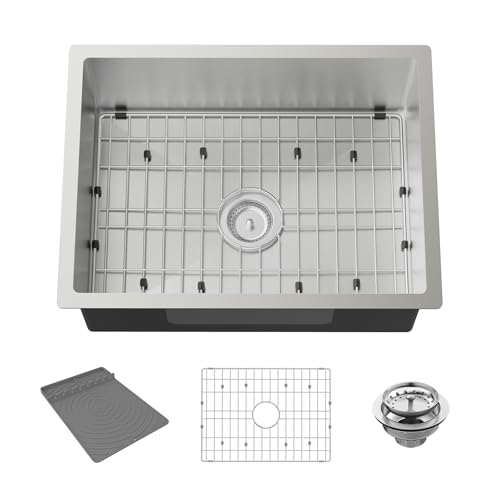
5. FAUENPEEY 24×18 Undermount Set — Best Set
The FAUENPEEY set suits first-time undermount buyers who want everything in the box, and bar or prep areas where the silicone mat earns its keep.
Strengths
- Complete set — grid, mat and drain included in one box
- Silicone mat adds a soft landing for glassware
- Standard 24 x 18 size fits common cabinets
Trade-offs
- Accessory-led value brand — long-term support is basic
- Steel specification is less detailed than premium listings
- Mat and grid need regular lifting and cleaning underneath
| Key specs (verified) | |
|---|---|
| Steel | Stainless steel |
| Size | 24 x 18 inches, undermount single bowl |
| Mount / format | Undermount, single bowl |
| In the box | Set includes stainless grid, silicone mat and drain assembly per the verified listing |
The bundle is the product here: a 24 x 18 undermount bowl plus the grid, drain assembly and a silicone mat that most buyers would otherwise buy in two more orders. The mat is genuinely useful at a bar or coffee station, where glassware meets steel all day. Underneath the accessories this is a conventional stainless bowl for light-to-mid duty — entirely adequate for prep, drinks and dishes, and honest about not being a heavy-gauge flagship.
Best for: best set shoppers who want Stainless steel reliability in a 24 x 18 inches footprint / Not suited for: buyers whose cabinet, counter or routine conflicts with a undermount, single bowl format.
The FAUENPEEY set’s ownership story is the unboxing: bowl, grid, mat, drain — the install shopping list already handled. The silicone mat finds its calling at bar and coffee stations, cushioning glassware against steel all day. The grid does quieter work protecting the floor. Underneath the bundle, the bowl is a conventional mid-duty stainless unit, and owners in prep, bar and light kitchen roles find it entirely sufficient. First-time undermount buyers especially value arriving at install day with nothing forgotten.
Check the current price on Amazon

6. TSIBOMU 24-Inch 18-Gauge — Best Budget
The TSIBOMU 24 is a budget-honest pick for bars, laundry rooms, rentals and small kitchens that need a real undermount without premium pricing.
Strengths
- Honest 18-gauge 304 steel at a budget position
- 9-inch depth is generous for the 24-inch class
- Brushed finish hides everyday marks well
Trade-offs
- Value brand — support is online-only
- Thinner steel is more disposal-drummy than 16-gauge rivals
- Accessory bundle is minimal beyond the strainer
| Key specs (verified) | |
|---|---|
| Steel | 18 gauge 304 stainless steel |
| Size | 24 x 18 inches, 9-inch deep bowl |
| Mount / format | Undermount, single bowl |
| In the box | Sink strainer included per the verified listing |
What you want from a budget 24-inch sink is honesty: real 304 stainless, a stated 18 gauge, a proper 9-inch depth and a brushed finish that does not demand polishing. TSIBOMU delivers exactly that list. It will sound thinner under a disposal than a padded 16-gauge Kraus, and it will dent if you drop a cast-iron pan into it — those are the known costs of the tier, stated plainly. For a prep or utility role, the math works in its favor.
Best for: best budget shoppers who want 18 gauge 304 reliability in a 24 x 18 inches footprint / Not suited for: buyers whose cabinet, counter or routine conflicts with a undermount, single bowl format.
TSIBOMU ownership is expectations-managed value: the bowl is honestly specified, the depth is real, and the finish forgives. In bars and laundry rooms it is an unambiguous upgrade over plastic or porcelain; as a light-duty kitchen sink with the strainer fitted, it handles dishes and produce without drama. Owners accept the thinner steel’s voice under a disposal as the price of the tier. For landlords and utility installs, the calculus — real 304 steel, real depth, minimal spend — is exactly right, and the sink’s plain competence is the whole review.
Check the current price on Amazon
Stainless Scenarios at 24 Inches
The design-conscious small kitchen
Stainless is the material that lets a small kitchen look intentional: the Ruvati’s brushed finish reads as a deliberate material choice, pairs with any appliance finish, and hides the working marks that a small bowl accumulates faster than a big one.
The outdoor kitchen
Heat, weather, grill tools and ice — stainless is the only common sink material that shrugs at all four. The SANYCASA’s plate-thick build or the BoomHoze workstation serve this life; composite fades, fireclay fears frost and impact, stainless simply continues.
The working laundry and utility room
Bleach, dye, soil, tools: the utility room is a chemical and impact environment wearing a domestic costume. A 304 stainless bowl — TSIBOMU at value tier, MENATT as the standard — is the material answer, cleanable with anything and dented by almost nothing it will meet.
Stainless at 24 Inches: Grade, Gauge and Grain
Three words organize everything worth knowing about a stainless sink: grade, gauge and grain. Grade is the alloy — 304, with its chromium-nickel recipe, is the benchmark because it shrugs off the acids, salts and standing water of kitchen life without rusting or pitting in normal service. Gauge is the thickness, and at 24 inches the ladder in this article runs from an honest 18 through the sweet-spot 16 to SANYCASA’s 11-gauge plate. Grain is the finish direction in brushed steel, and it is a functional choice disguised as an aesthetic one: the fine lines of a brushed finish scatter light so that scratches — which are coming, in any working sink — read as texture rather than damage.
The interplay between the three is where buying skill lives. A thick sink in a poor grade is a durable sink that stains; a 304 sink at 20 gauge is a corrosion-proof sink that dents; a polished finish on either advertises every event in the bowl. The picks here are the combinations that get all three right for their tier: the budget TSIBOMU names its 304 and brushes its finish, accepting mid-duty gauge; the Ruvati maxes grade and gauge together; the SANYCASA pushes gauge past the point where the word ‘sheet’ applies. There is no wrong pick in the list — there are only wrong expectations, and the reviews work to set them precisely.
Brushed grain also explains stainless’s famous forgiveness over time. A granite composite sink chips or it does not; a fireclay sink crazes or it does not; stainless accumulates a fine, even scratch pattern that owners stop seeing within months because it is uniform — the sink develops a patina rather than damage. Maintenance is mostly about not fighting that process: clean with the grain, keep abrasives out, let the grid take the impacts. The steel underneath, at 304, has no clock running on it in any realistic kitchen scenario.
Which is why stainless owns this size class so completely. At 24 inches, in small cabinets and hard-working second locations, the alternatives ask more — weight, money, fragility — and give back mostly appearance. Stainless gives back decades. Choose your tier by role, your finish by forgiveness, and your grade by the number 304, and the material question is closed.
Comparison Table
| Pick | Badge | Key spec | Best for |
|---|---|---|---|
| Ruvati RVM4132 24-Inch 16-Gauge | Best Overall | 16 gauge stainless steel; 24 inches wide, undermount single bowl | Best Overall |
| SANYCASA 24-Inch 11-Gauge | Best Heavy-Duty | 11 gauge stainless steel (3mm class); 24 inches wide, undermount single bowl | Best Heavy-Duty |
| BoomHoze 24-Inch Workstation | Best Workstation | 16 gauge stainless steel; 24 x 19 inches, undermount single bowl | Best Workstation |
| MENATT 24×18 Undermount | Best Standard Pick | 304 stainless steel; 24 x 18 inches, 9-inch deep basin | Best Standard Pick |
| FAUENPEEY 24×18 Undermount Set | Best Set | Stainless steel; 24 x 18 inches, undermount single bowl | Best Set |
| TSIBOMU 24-Inch 18-Gauge | Best Budget | 18 gauge 304 stainless steel; 24 x 18 inches, 9-inch deep bowl | Best Budget |
Read finish descriptions like a skeptic
‘Satin’, ‘brushed’ and ‘commercial grade finish’ all describe the forgiving family you want. ‘Mirror’ and ‘polished’ describe a showroom finish that a working 24-inch bowl will mark within weeks. At this size, choose forgiveness every time.
How to Choose a 24-Inch Stainless Steel Sink
Know your stainless grades
T-304 (18/8) is the quality standard: corrosion-resistant, food-safe and the grade behind every premium pick here. Cheaper 200-series steels can tea-stain and pit in wet duty. Listings that state ‘304’ plainly — MENATT and TSIBOMU both do — are giving you the single most useful spec in this class after size.
Gauge ladder at 24 inches
This list spans 18 gauge (TSIBOMU) through 16 (Ruvati, BoomHoze) to 11 (SANYCASA). At 24 inches the price steps between gauges are small and the bowls are stiff by geometry, so even the 18-gauge pick is respectable — but a main-sink buyer should take the cheap step up to 16.
Brushed beats polished in small bowls
Polished stainless shows every scratch and water spot; brushed grain camouflages both. In a 24-inch bowl where cookware constantly contacts the walls, brushed is the finish that still looks good in year three.
Stainless care is a system, not a product
Grid in the bowl, non-abrasive cleaners, a wipe in hard-water homes, no steel wool left sitting. Stainless rewards these small habits with decades of service and punishes their absence cosmetically, never structurally.
How to Care for a Small Stainless Sink So It Keeps Its Finish
Rinse after acidic or salty loads — tomato, citrus, brine — rather than letting them sit on the steel for hours.
Clean with a soft cloth or sponge and a non-abrasive cleaner, always rubbing with the grain of the brush finish, never across it.
Dry the bowl after the last wash in hard-water homes; the 20-second wipe prevents the spotty mineral film that makes stainless look tired.
Keep the grid in place and lift it weekly to clean beneath — the contact points are where debris collects on any sink.
Remove surface rust marks (almost always deposits from other steel items, not the sink) with a paste of baking soda and water before assuming the sink itself is failing.
Budget framing for stainless at this size: the tiers are really steel decisions. Value buys named 304 at working gauge with bundled basics. Mid buys format and completeness — workstations, sets, standard footprints from known brands. Premium buys mass: 16-gauge Ruvati, 11-gauge SANYCASA, the tiers where the bowl becomes effectively permanent. Because stainless has no wear-out clock in 304, the premium tiers amortize honestly over decades — but only in roles that keep the sink that long. Match the steel to the horizon, not to the showroom feeling.
How to Remove the Marks Owners Blame on Stainless
Water spots and mineral film: wipe with a cloth dampened in diluted white vinegar, rinse, and dry. Prevention is the nightly wipe in hard-water homes.
Rust-colored marks: these are almost always iron deposits from other items — a wet steel pan, steel wool fibers — sitting on the surface. A baking-soda paste and a soft cloth lift them without touching the sink’s own steel.
Fine scratches: blend them by rubbing a non-abrasive pad strictly with the grain. Never scrub across the grain, which creates visible cross-hatching.
Heat tint from a screaming-hot pan: usually cosmetic and shallow; a stainless cleaner and patience fade it into the brushed pattern.
Dullness overall: a thorough clean, a full dry and a light buff with a microfiber cloth restores the brushed glow. Stainless rarely needs products; it needs technique.
Common Buying Mistakes
Most sink regrets are not about the sink — they are about a measurement skipped, a gauge misunderstood, or an accessory forgotten until install day. These are the mistakes that come up again and again in this size and gauge class, and every one of them is cheaper to avoid on paper than in a finished kitchen.
- Using steel wool or abrasive pads, which embed iron particles and scratch the grain — the rust spots that follow get blamed on the sink.
- Choosing a polished showroom finish for a working small sink. The first month of scratches will read as damage instead of patina.
- Ignoring the 304 question at the budget end. A 200-series bowl is the one stainless purchase that can genuinely disappoint.
- Letting cast iron soak overnight in the bowl repeatedly — the rust transfer marks are removable but entirely avoidable.
- Assuming thicker is always better: the 11-gauge SANYCASA is magnificent and heavy; a small cabinet and a solo installer may be happier with 16.
Stainless Versus Everything Else at 24 Inches
It is worth running the material contest honestly, because at other sizes the alternatives have real cases. Fireclay at 24 inches offers a glossy, traditional look and a genuinely hard surface — and weighs several times what a stainless bowl weighs, demands cabinet support to match, and can chip at the rim in exactly the utility roles where small sinks work hardest. In a small cabinet, its thick walls also steal bowl volume that a 24-inch kitchen cannot spare. The case exists for a design-led bar sink; for working roles it collapses under its own weight, literally.
Granite composite brings color — the one thing stainless cannot offer — and a stone-like solidity that photographs beautifully. Its costs at this size are price, weight and a care regime that punishes the utility chemicals a laundry or outdoor sink meets weekly. Heat and impact tolerance are good but not stainless-good, and a chip is a permanent event rather than a patina contribution. Kitchens choosing composite at 24 are buying a color, and should know that is the transaction.
Copper and specialty metals appear at this size as design statements, with living finishes that change monthly and prices that change the subject. They belong in bars and show kitchens where the patina is the point. For the roles this article covers — main small kitchens, prep, laundry, outdoor, RV — they are answers to questions nobody in those rooms is asking.
Which leaves stainless, and the honest summary is that at 24 inches it is not the default by habit but by elimination: lightest for small cabinets, thinnest walls for maximum bowl, toughest under impact and heat, indifferent to utility chemicals, repairable in appearance, and available from budget 304 to plate-thick 11 gauge. The contest at this size is not really among materials. It is among the tiers of one material — and that is the contest this article’s picks were chosen to settle.
Water, Steel and Time: The Chemistry Owners Actually Meet
A stainless sink lives in water, so its long story is a chemistry story — and a reassuring one for the 304 grade behind every pick here. The chromium in the alloy forms an invisible oxide film that repairs itself in air, which is the entire secret of ‘stainless’: scratches do not rust because the film re-forms over them. This is why a 304 bowl can be scratched daily for a decade and never corrode, and why the marks owners do see are almost never the sink itself failing.
The marks have three usual authors. Mineral film comes from hard water evaporating — calcium and magnesium left behind as a dull map, answered by the wipe habit or a vinegar pass. Surface rust comes from other iron: a wet steel pan, a scouring pad’s fibers, a cast-iron trivet left in the bowl, oxidizing on the surface and lifting off with a baking-soda paste. Heat tint comes from extreme pans and fades into the brushed pattern with cleaning. Notice what is absent from the list: the sink, dissolving. In normal kitchen chemistry, 304 stainless simply does not do that.
The practical consequence is a maintenance philosophy of calm. You are not preserving a fragile finish; you are housekeeping a self-repairing surface. Keep abrasives and steel wool away — not because the steel fears them, but because their debris creates the very marks owners then blame on the bowl. Rinse the chemistry set of daily cooking — acids, brines, bleach-based cleaners left pooling — rather than letting it sit for days. Do those few things and the material science does the rest, for about as long as the house stands.
A Word on Sound at 24 Inches
Small stainless bowls have an acoustic reputation that deserves a fair hearing. A bare, thin 24 rings because it is, acoustically, a small drum with stiff walls — and in a quiet apartment at night, that voice carries. The picks in this article answer it three ways: mass, in the SANYCASA’s plate steel and the Ruvati’s 16 gauge; geometry, because a 24-inch span is inherently harder to excite than a wide one; and the owner’s own setup, since a grid in the bowl and a well-seated disposal remove the two loudest excitation sources. Judge any candidate in this class by those three together rather than by a showroom knock, which tells you how the sink sounds empty, in a warehouse, struck by a stranger — three conditions your kitchen will never reproduce. In your cabinet, padded by water and work, a good 24-inch stainless bowl is a quiet fixture, and the value picks approach that standard more closely than their prices suggest.
It is also worth saying what stainless at this size is not, because the material’s fans can oversell it. It is not silent by nature — that takes pads or mass. It is not scratch-proof — that takes a grid and a habit. It is not maintenance-free — that takes a wipe in hard water. What it is, uniquely at 24 inches, is the material with no disqualifying weakness: nothing it does badly cannot be answered by a ten-dollar habit or a fitted accessory. Fireclay chips, composite fades and stains at the edges of its care rules, copper demands a relationship. Stainless asks for a grid and a cloth and then serves for decades in any room of the house. In a size class bought for working spaces, that profile is not merely the best available. It is close to the ideal.
Finally, a note on buying stainless in person versus online, since this class rewards the hybrid approach. Online wins on range and on the verification this article is built on — the listing-confirmed listings, the stated grades, the comparable specifications. In person wins on the senses: the knock test on the bowl wall, the thumb on the floor, the grain under real light. The strongest process uses both in sequence — shortlist online by the numbers, then, where a showroom allows, touch the finalists before the order. Where it does not, the doorstep audit stands in: weight, rim flatness, finish consistency, checked on arrival while the return window is wide open. Stainless is an honest material; it tells you what it is the moment you handle it. Give yourself one handling — at the store or at the door — and the material will confirm everything the listing claimed, or quietly correct it.
One sentence of summary, earned by everything above: at 24 inches, buy 304 stainless, brushed, at the thickest gauge your role justifies, with its grid in the same box — and you have made the correct material decision in this size class, whatever the brand on the bowl turns out to be.
Keep the receipt, photograph the model label under the bowl before it goes in, and write the install date on the cabinet floor in pencil. Stainless will outlast your memory of its own paperwork, and those three small acts are the entire difference between a fixture and a documented fixture when a part is needed in year eight.
Stainless Verification Checklist
- Grade named as 304 in the listing — the single most important line in a stainless specification.
- Gauge stated, and consistent with the sink’s weight and price tier.
- Finish brushed or satin for a working bowl; mirror finishes reserved for bars that polish.
- Grid available and budgeted — stainless’s scratch strategy at any gauge.
- Care kit realistic: non-abrasive cleaner, soft cloths, no steel wool in the house’s sink caddy.
Final Recommendation
If you buy one sink from this list, make it the Ruvati RVM4132 24-Inch 16-Gauge — it is the most complete answer to “best 24 stainless steel kitchen sinks” for the typical kitchen, balancing steel, size and support. If your kitchen points a different way — smaller cabinet, workstation ambitions, utility duty or a tighter budget — the SANYCASA 24-Inch 11-Gauge and the specialist picks above each own a clear scenario, and the reviews explain exactly where each one wins. Whichever you choose, budget the grid and the drain hardware with the sink, confirm your cabinet measurements against the template, and you will not be revisiting this purchase for a very long time.
Keep exploring the sink cluster while you plan the remodel:
- Best 24 Kitchen Sinks
- Best 24 Single Bowl Kitchen Sinks
- Best 16 Gauge Stainless Steel Kitchen Sinks
- Best 18 Gauge Kitchen Sinks
Frequently Asked Questions
Why is stainless better than fireclay or composite at 24 inches?
Weight and toughness. A stainless 24 weighs a fraction of a fireclay one, installs kindly in small cabinets, tolerates dropped cookware and thermal shock, and costs less at every tier. The alternatives win on looks for some buyers, not on practicality.
What is the best gauge for a 24-inch stainless sink?
Sixteen gauge is the sweet spot for a main sink; 18 is fine for prep and utility; 11 (SANYCASA) is heavy-duty overkill that some buyers will love. Below 18 at this size, you are in disposable territory.
Does stainless steel stain?
Quality 304 stainless resists staining strongly. What owners call stains are usually mineral film, surface deposits from other metals, or heat tint — all cleanable with non-abrasive methods. True corrosion in a 304 kitchen sink is rare.
How do I remove scratches from a brushed stainless sink?
Fine scratches blend by rubbing a non-abrasive pad strictly with the grain. Deep scratches are effectively permanent but become part of the brushed patina over time — one more reason the grid matters from day one.
Is a stainless sink noisy?
Unpadded thin ones are. Padded models — and heavier gauges generally — reduce it to background. If noise matters, read the sound-treatment description and prefer 16 gauge with pads.
Can stainless handle boiling water and hot pans?
Yes — it is the most heat-tolerant common sink material. Use the grid or rack as a buffer for screaming-hot cast iron to protect the finish, but the steel itself is unbothered.
Is 304 stainless magnetic, and does it matter?
304 is only weakly magnetic and may attract a magnet slightly after forming. It does not matter for performance — but it is a rough field check: a strongly magnetic ‘stainless’ sink is likely a 400-series or 200-series alloy wearing the family name.
Will magnets stick to a quality stainless sink?
Weakly at most — 304 is essentially non-magnetic, though forming can induce slight attraction. A magnet test is a rough field check only; the listing’s stated grade is the evidence that counts.
Does stainless steel get hot in an outdoor kitchen?
The bowl will take on ambient heat like any metal, but it tolerates boiling water, hot pans and freeze-thaw cycles that damage rival materials — which is why it dominates outdoor installs despite conducting heat.
Does stainless clash with modern matte-black or gold faucets?
No — brushed stainless is the neutral ground of kitchen metals and pairs with matte black, gold, chrome and nickel finishes without fighting any of them. It is the safest sink material choice when the faucet is the design statement.


