Disclosure: airfryerkitchensupply.com is reader-supported. When you buy through links on our site, we may earn an affiliate commission at no extra cost to you.
Where to buy
Every sink in this roundup of the best 16 gauge stainless steel undermount kitchen sinks was verified against Amazon listing data on 2026-11-20, and the links below go to the exact verified listings. Prices move constantly, so each pick is linked with a live price check instead of a printed number:
- Kraus KHU100-30 Standart Pro 30-Inch — Check the current price on Amazon
- Kraus KWU110-30 Kore Workstation 30-Inch — Check the current price on Amazon
- Kraus KWU112-30 Kore Double Bowl 30-Inch — Check the current price on Amazon
- Kraus KHU100-28 Standart Pro 28-Inch — Check the current price on Amazon
- Kraus KHU100-26 Standart Pro 26-Inch — Check the current price on Amazon
- Kraus KA1US33B 33-Inch — Check the current price on Amazon
Undermount is the mount that makes a kitchen feel finished — no rim to trap crumbs, counters that sweep straight into the bowl — and 16 gauge is the steel that makes it feel solid. Together they are the default specification for a serious remodel, which is why the best 16 gauge stainless steel undermount kitchen sinks are such a crowded, confusing shelf. This roundup narrows it to six Kraus models we could verify end-to-end, spanning plain bowls, workstations and a double bowl, from 26 inches up to 33.
A note on scope: every pick here is a Kraus because, at the time of verification, Kraus is the brand whose 16-gauge undermount listings consistently expose full model numbers, steel grade and construction details that the API can confirm. Value brands appear in our general 16-gauge roundup; for undermount specifically, the install stakes are higher — the sink is married to the counter — so this list leans on the deepest support network in the class.
It is worth stating plainly why this list is worth trusting on fit, because undermount is where sink shopping goes wrong expensively. Every model here comes with a manufacturer template that fabricators actually use, published minimum-cabinet requirements, and a support ecosystem that stocks the model’s own grid and hardware. In a category where the product disappears under stone for twenty years, those boring attributes outrank any single performance claim — and they are the reason the verification bar for this particular roundup was set higher than for drop-in or utility sinks.
In this guide
Quick Picks
If you only read one section, make it this one. These are the six best 16 gauge stainless steel undermount kitchen sinks worth your money, each with a clear job:
- Best Overall: Kraus KHU100-30 Standart Pro 30-Inch — 16 gauge T-304 stainless steel, 30 x 18 inches external, 10.5-inch depth class. Check the current price on Amazon
- Best Workstation: Kraus KWU110-30 Kore Workstation 30-Inch — 16 gauge T-304 stainless steel, 30 inches wide, workstation single bowl. Check the current price on Amazon
- Best Double Bowl: Kraus KWU112-30 Kore Double Bowl 30-Inch — 16 gauge T-304 stainless steel, 30 inches wide, 50/50 double bowl with low divider. Check the current price on Amazon
- Best for Tight Cabinets: Kraus KHU100-28 Standart Pro 28-Inch — 16 gauge stainless steel, 28 inches wide, undermount single bowl. Check the current price on Amazon
- Best Mid-Size: Kraus KHU100-26 Standart Pro 26-Inch — 16 gauge stainless steel, 26 inches wide, undermount single bowl. Check the current price on Amazon
- Best Large Bowl: Kraus KA1US33B 33-Inch — 16 gauge T-304 stainless steel, 33 inches wide, undermount single bowl. Check the current price on Amazon
How These Picks Were Chosen
We started from the full market for this search — every gauge claim, size and brand that surfaces when you search it — and then applied a verification filter that most roundups skip. Each candidate was searched through the airfry site’s own Amazon listing data connection, by brand and model, and only products whose listed title confidently matched the intended sink earned a place here. That process removed listings with vague specifications, unverifiable gauge claims and model numbers that did not resolve to a real product.
Surviving picks were then judged on the criteria that decide a decade of ownership: steel gauge and grade, bowl geometry (depth, corner radius, drainage), sound treatment, what is actually included in the box, and the depth of the brand’s support and accessory ecosystem. We deliberately mixed tiers — a flagship, a value pick and specialists — because the right sink depends on the kitchen, and a list of six near-identical bowls helps nobody. Where a tier of the market could not be verified honestly, we say so in the article rather than filling the slot with a guess.
For this undermount-specific list we added two filters beyond the standard verification. First, template integrity: the model’s cutout template had to be a real, model-specific document, not a generic size chart, because undermount fabrication is only as good as the template. Second, mounting hardware quality: the included clips and rails had to be rated for a water-filled bowl’s full weight, since a 16-gauge undermount is among the heaviest objects in a kitchen cabinet. Models that treated mounting as an afterthought did not make the cut, whatever their steel.
The 6 Best 16 gauge stainless steel undermount kitchen sinks

1. Kraus KHU100-30 Standart Pro 30-Inch — Best Overall
This is the sink most 30-inch shoppers should start with. It suits family kitchens that run a disposal daily, cook with heavy cast iron, and want one deep bowl that swallows sheet pans flat.
Strengths
- Thick TRU16 steel resists dents from dropped pans and heavy stockpots
- NoiseDefend padding noticeably dulls disposal and running-water noise
- Rounded corners wipe clean without a brush fight in the corners
Trade-offs
- Needs a 33-inch minimum cabinet, so it will not fit compact 30-inch bases
- Undermount install really wants a professional or a confident DIYer with a template
- The brushed finish shows water spots in hard-water homes unless wiped down
| Key specs (verified) | |
|---|---|
| Steel | 16 gauge T-304 stainless steel |
| Size | 30 x 18 inches external, 10.5-inch depth class |
| Mount / format | Undermount, single bowl |
| In the box | Bottom grid, drain assembly with strainer, mounting hardware, cutout template and towel included in the verified kit listing |
What separates the KHU100-30 from cheaper 30-inch sinks is the combination of true 16-gauge steel and full-coverage sound pads. Drop a cast-iron skillet into a thin 20-gauge bowl and you hear a clang and sometimes keep a dent; in this bowl the impact sounds like a thud. The channel grooves in the floor are not decoration — they keep a thin sheet of water moving toward the drain instead of pooling under a drying rack, which is where slimy film usually starts. The included grid matters more than people expect: it lifts dishes off the steel floor, so the sink itself stops being the scratch surface, and it doubles as a trivet zone for hot pans while the faucet is in use.
Best for: best overall shoppers who want 16 gauge T-304 reliability in a 30 x 18 inches external footprint / Not suited for: buyers whose cabinet, counter or routine conflicts with a undermount, single bowl format.
Living with the KHU100-30 day to day, the detail owners mention most is the drainage. The grooved floor means the puddle that normally lives under a drying rack simply is not there, so the bowl wipes down in seconds and never develops that grey film line. The grid earns its space during canning and holiday cooking, when the sink becomes a staging area for hot jars and pans. Expect the brushed finish to take on a soft, even patina over the first year — that is normal stainless behavior, and it hides the micro-scratches that a polished bowl would advertise. Paired with a pull-down faucet that reaches both back corners, this is a sink you stop thinking about, which is the highest compliment kitchen equipment can earn.
Check the current price on Amazon

2. Kraus KWU110-30 Kore Workstation 30-Inch — Best Workstation
The 30-inch Kore workstation fits smaller kitchens that cannot spare counter space for prep — the board and rack live over the bowl instead of beside it.
Strengths
- Ledge accessories convert wash space into prep space on demand
- Full 16-gauge build — not a thin workstation shell
- Roll-up rack doubles as a trivet and extra drying zone
Trade-offs
- Accessories need storage when the full bowl is in use
- Costs more than a plain bowl of the same size
- Ledge corners collect crumbs and need a brush pass
| Key specs (verified) | |
|---|---|
| Steel | 16 gauge T-304 stainless steel |
| Size | 30 inches wide, workstation single bowl |
| Mount / format | Undermount with integrated accessory ledge |
| In the box | Cutting board and roll-up rack included per the verified listing |
In a compact kitchen the KWU110-30 behaves like two fixtures: a proper deep 16-gauge sink, and a temporary counter extension whenever the board slides onto the ledge. The roll-up rack is the accessory people underestimate; it holds a hot pan off the counter, air-dries glasses without a towel pile, and rolls away in seconds. Underneath, NoiseDefend padding keeps disposal runs civilized. The routine does require discipline — accessories left permanently on the ledge turn a workstation into a shelf — but cooks who mise en place daily will use this sink exactly as designed.
Best for: best workstation shoppers who want 16 gauge T-304 reliability in a 30 inches wide footprint / Not suited for: buyers whose cabinet, counter or routine conflicts with a undermount with integrated accessory ledge format.
The KWU110-30’s ownership pattern is about rhythm: the board lives on the ledge during cooking hours, the rack handles the evening’s glasses, and the bowl underneath stays a bowl. In apartments and compact homes this sink quietly deletes the need for a separate dish rack on the counter — a daily space dividend that owners consistently say they underestimated at purchase. The 16-gauge bowl underneath means none of this flexibility costs durability. One habit matters: put the accessories away when guests cook, because a workstation mid-routine confuses helpers, and a clear bowl is the universal language.
Check the current price on Amazon

3. Kraus KWU112-30 Kore Double Bowl 30-Inch — Best Double Bowl
Pick the KWU112-30 if your household is split between soakers and rinsers, or you hand-wash delicate items while the disposal side handles the mess.
Strengths
- 50/50 split with a low divider — soak on one side, rinse on the other, still fit big pans across the top
- Workstation ledge adds prep space a plain double bowl lacks
- 16-gauge steel throughout, including the divider
Trade-offs
- Each bowl is smaller than a single 30-inch bowl for oversized items
- Divider is one more surface to scrub
- Heaviest install of the 30-inch Kraus options
| Key specs (verified) | |
|---|---|
| Steel | 16 gauge T-304 stainless steel |
| Size | 30 inches wide, 50/50 double bowl with low divider |
| Mount / format | Undermount workstation |
| In the box | Cutting board and roll-up rack included per the verified listing |
Double bowls fell out of fashion because old dividers were too tall for modern pans. Kraus answers with a low divider: low enough that a sheet pan bridges across both bowls, high enough to keep a soaking load separate from a rinsing load. Add the ledge and this becomes the most flexible 30-inch footprint in the Kraus range — prep on the board, soak left, rinse right. The cost of that flexibility is raw volume per bowl, so dedicated single-bowl cooks should look at the KWU110-30 instead.
Best for: best double bowl shoppers who want 16 gauge T-304 reliability in a 30 inches wide footprint / Not suited for: buyers whose cabinet, counter or routine conflicts with a undermount workstation format.
Households that choose the KWU112-30 usually have a standing disagreement it settles: one person soaks, the other rinses and loads. The low divider keeps both workflows in one footprint, and on roasting days a sheet pan bridges the divider and the argument disappears entirely. Owners note the divider adds one scrubbing surface to the weekly clean, repaid by never again moving soaking dishes to the counter. The ledge accessories see slightly less use than on the single-bowl Kore, simply because the split bowl already organizes work — but the board-over-bowl prep session remains the party trick that justifies the format.
Check the current price on Amazon

4. Kraus KHU100-28 Standart Pro 28-Inch — Best for Tight Cabinets
The 28-inch model suits renovators whose cabinet is a couple of inches short of the 30-inch standard but who cook like it is a 30-inch kitchen.
Strengths
- Near-30 capacity in a cabinet-friendlier footprint
- 16-gauge steel with the Standart Pro rounded-corner interior
- Good depth for soaking without stooping over a shallow bowl
Trade-offs
- Still undermount-only, so counter material must support it
- No ledge or included workstation accessories
- Biggest sheet pans need a tilt to soak
| Key specs (verified) | |
|---|---|
| Steel | 16 gauge stainless steel |
| Size | 28 inches wide, undermount single bowl |
| Mount / format | Undermount, single bowl |
| In the box | Kraus mounting hardware and template included |
Think of the KHU100-28 as the problem-solver of the line. Many older kitchens have 33-inch sink bases with plumbing or drawer hardware that steals the clearance a 30-inch undermount needs; the 28 drops in with room to spare while keeping the same steel, the same quiet pads and nearly the same working volume. In daily use the difference versus the 30 shows up only with the largest bakeware. In install week, the difference shows up as a job that finishes on schedule instead of a cabinet rebuild.
Best for: best for tight cabinets shoppers who want 16 gauge reliability in a 28 inches wide footprint / Not suited for: buyers whose cabinet, counter or routine conflicts with a undermount, single bowl format.
The KHU100-28 tends to be bought by renovators who measured carefully, and it rewards them by never coming up in conversation again. It fits where the 30 would not, washes like the 30 for all but the biggest bakeware, and its depth keeps splash inside during the after-dinner rush. In practice the two-inch sacrifice versus the flagship shows up perhaps twice a year — roasting-pan day and preserving day — and both are solved by a tilt. For the other 363 days, this is simply a thick, quiet, correctly sized sink, which is exactly what its buyers wanted.
Check the current price on Amazon
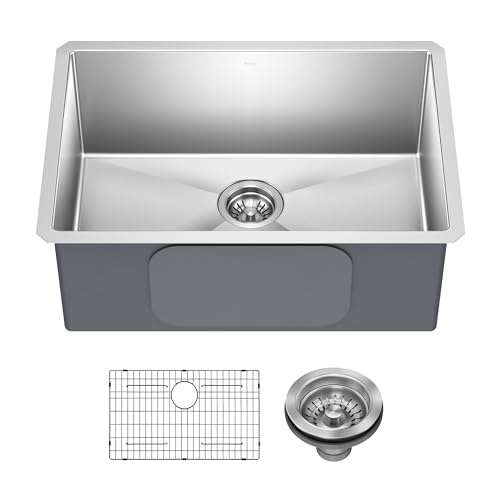
5. Kraus KHU100-26 Standart Pro 26-Inch — Best Mid-Size
Choose the 26-inch KHU100-26 when a 30-inch sink will not fit your cabinet but you refuse to drop to thin steel — apartments, galley kitchens and modest remodels.
Strengths
- Mid-size footprint fits cabinets too small for a 30-inch bowl
- Same 16-gauge dent resistance as the larger Standart Pro sinks
- Single deep bowl handles most family cookware except the biggest pans
Trade-offs
- Roasting pans fit only at an angle
- Less counter-flexibility than a workstation model
- Undermount only — no drop-in fallback if your counter is laminate
| Key specs (verified) | |
|---|---|
| Steel | 16 gauge stainless steel |
| Size | 26 inches wide, undermount single bowl |
| Mount / format | Undermount, single bowl |
| In the box | Kraus mounting hardware and template included |
The 26-inch class is the honest middle of the undermount market: big enough for a stockpot and a dinner service, small enough for a 30-inch cabinet. Kraus keeps the gauge at 16 here, which matters because mid-size sinks in big-box stores are frequently 18 or 20 gauge with a premium-looking finish hiding the downgrade. You give up flat sheet-pan washing and workstation tricks; you keep quiet, dent-resistant steel and rounded corners that clean fast. For a two-to-four-person household with a dishwasher, that trade is usually the right one.
Best for: best mid-size shoppers who want 16 gauge reliability in a 26 inches wide footprint / Not suited for: buyers whose cabinet, counter or routine conflicts with a undermount, single bowl format.
KHU100-26 ownership is defined by relief: the cabinet that could not take a 30-inch sink still got a proper one. Daily life is unremarkable in the best way — dishes, produce, a stockpot, all handled without the flex or clang of the thin sinks this one usually replaces. The bowl’s proportions suit a pull-down faucet particularly well, since the spray covers the whole floor from a sensible height. Owners upgrading from builder-grade 25-inch drop-ins consistently cite the quiet as the surprise: disposal runs stop being an event the whole apartment can hear.
Check the current price on Amazon

6. Kraus KA1US33B 33-Inch — Best Large Bowl
The KA1US33B suits big kitchens and heavy entertainers who want the largest mainstream Kraus bowl and a finish that forgives daily metal-on-metal contact.
Strengths
- Radiant pearl finish hides the fine scratches stainless always collects
- 33-inch bowl takes the largest roasting pans and grill grates flat
- Foil-layer NoiseDefend treatment is the quietest in this group
Trade-offs
- Needs a genuinely wide cabinet — confirm 36-inch class clearance
- Large flat floor can drain slowly if the counter install is dead level
- Premium end of the Kraus price ladder
| Key specs (verified) | |
|---|---|
| Steel | 16 gauge T-304 stainless steel |
| Size | 33 inches wide, undermount single bowl |
| Mount / format | Undermount, single bowl |
| In the box | Kraus mounting hardware and template included |
Every stainless sink scratches; the question is whether the finish advertises it. The radiant pearl surface on this 33-inch model diffuses light so hairline marks blend instead of streaking, which is why it stays presentable in busy kitchens without babying. The foil-layer soundproofing is also a step up — disposal vibration and pot clatter come through muffled rather than drummy. Size is the real commitment: at 33 inches this is a two-person install and a cabinet check you must do before ordering, not after the counter is cut.
Best for: best large bowl shoppers who want 16 gauge T-304 reliability in a 33 inches wide footprint / Not suited for: buyers whose cabinet, counter or routine conflicts with a undermount, single bowl format.
The KA1US33B is the sink entertainers describe with unusual affection, because it removes the staging problem from big cooking days: grill grates, roasting pans and a full service for twelve all fit the flat floor at once. The pearl finish is the other long-term story — it genuinely does shrug off the hairline scratching that makes other big stainless bowls look tired by year two. Owners do plan around its size at install: two people, a clear path, and patience with the clips in a wide cabinet. After that, it asks for nothing but a grid and a wipe, and gives back the calmest wash-up in the house.
Check the current price on Amazon
Matching the Undermount to the Kitchen: Three Scenarios
The stone-counter family remodel
Quartz or granite is going in, the cabinet is a 33, and the kitchen feeds a family nightly. The KHU100-30 with a negative reveal and its fitted grid is the set-and-forget answer — the install your fabricator has done a hundred times, in the size that fits the pans you actually own.
The compact kitchen, maximized
A 30-inch cabinet, minimal counter, serious cooking. The KWU110-30 workstation is the force multiplier: prep on the ledge, wash in a flagship bowl, counters clear. If the cabinet is tighter still, the KHU100-26 keeps the same steel and hush in a footprint that fits, sacrificing only the largest bakeware.
The entertainer’s wide kitchen
A 36-inch cabinet and a social kitchen argue for the KA1US33B: the biggest bowl, the most forgiving finish, room for a full party’s worth of pans at once. Pair it with a faucet whose reach respects the width, and the wash-up after twelve guests becomes a one-person, one-load job.
Undermount, Explained: Reveals, Support and Seams
An undermount sink hangs beneath the counter, and that single fact creates three decisions that will outlive every other choice in your remodel. The first is the reveal — how the counter edge relates to the sink rim. A negative reveal tucks the counter edge slightly inside the bowl’s opening, hiding the rim and the seam; it is the professional default because crumbs sweep in and the silicone line lives in shadow. A flush reveal aligns counter and rim in one plane, beautiful and demanding. A positive reveal exposes a shelf of steel rim, which shows off the sink and collects every crumb the counter produces. Choose negative unless you have a specific design reason and a fabricator who welcomes the harder cut.
The second decision is support. Silicone sealant is waterproofing, not structure. A 16-gauge bowl full of water, dishes and a disposal can exceed the weight of a grown adult, and it must hang from clips, rails or a cradle frame anchored to the cabinet — never from adhesive and optimism. Quality systems, like the hardware Kraus ships with the sinks in this list, distribute that load around the rim so no single point works loose. When you read an undermount review that never mentions support, you are reading marketing, not guidance.
The third decision is the seam itself: a continuous bead of quality silicone, a rim seated flat, and a full cure before the plumbing goes in and the cabinet gets loaded. Most undermount failures years later — the slow weep, the stained cabinet floor — trace back to a rushed seam or a rim that was never flat. This is also why the sink must be on site before fabrication: the fabricator cuts to the physical template, checks the rim, and the installer inherits a system designed to fit, rather than a hope.
Get those three decisions right and undermount delivers its famous daily dividend: a counter that wipes straight into the bowl, no rim to trap grit, and a kitchen that cleans in minutes. Get them wrong and the same sink becomes a service call. The picks in this article are all models whose manufacturers support doing it right — templates, hardware and documentation included.
Comparison Table
| Pick | Badge | Key spec | Best for |
|---|---|---|---|
| Kraus KHU100-30 Standart Pro 30-Inch | Best Overall | 16 gauge T-304 stainless steel; 30 x 18 inches external, 10.5-inch depth class | Best Overall |
| Kraus KWU110-30 Kore Workstation 30-Inch | Best Workstation | 16 gauge T-304 stainless steel; 30 inches wide, workstation single bowl | Best Workstation |
| Kraus KWU112-30 Kore Double Bowl 30-Inch | Best Double Bowl | 16 gauge T-304 stainless steel; 30 inches wide, 50/50 double bowl with low divider | Best Double Bowl |
| Kraus KHU100-28 Standart Pro 28-Inch | Best for Tight Cabinets | 16 gauge stainless steel; 28 inches wide, undermount single bowl | Best for Tight Cabinets |
| Kraus KHU100-26 Standart Pro 26-Inch | Best Mid-Size | 16 gauge stainless steel; 26 inches wide, undermount single bowl | Best Mid-Size |
| Kraus KA1US33B 33-Inch | Best Large Bowl | 16 gauge T-304 stainless steel; 33 inches wide, undermount single bowl | Best Large Bowl |
Plan the cabinet interior as a system
The bowl, disposal, water filter, trash pull-out and cleaning supplies all want the same cubic foot. Sketch the cabinet’s interior with the sink’s depth and the disposal’s body before ordering either. At 26 and 28 inches this planning is the difference between a cabinet that works and one that merely contains things.
How to Choose a 16-Gauge Undermount Sink
Cabinet math comes first
The rule is bowl width plus roughly three inches: 26-inch sink, 30-inch cabinet class; 30-inch sink, 33-inch cabinet; 33-inch sink, 36-inch cabinet. Then check the unglamorous details — drawer boxes above the cabinet, water lines and the disposal body all compete for the same space the bowl wants. Measure the actual interior, not the cabinet’s nominal size, because face frames and side panels eat real inches.
Pick your reveal with the fabricator
Undermount sinks meet the counter in one of three ways: negative reveal (counter overlaps the rim), flush, or positive reveal (a lip of sink rim visible). Negative is the most forgiving and the easiest to keep clean at the seam; positive shows off the steel but creates a ledge that catches crumbs. This decision belongs in the fabrication conversation, with the actual sink or its exact template on site.
Single bowl, double bowl, or workstation
Single bowls fit the biggest pans and dominate modern kitchens. A low-divider double like the KWU112-30 splits soaking from rinsing while still bridging sheet pans. Workstations add a ledge that converts the bowl into prep space — genuinely transformative in small kitchens, unnecessary in large ones. Choose by how you actually cook, not by which product photo looks busiest.
Soundproofing is a specification, not a bonus
Undermount sinks sit in a wooden box that can amplify noise. Full-coverage rubber pads plus a sprayed undercoating — the NoiseDefend approach across this Kraus list — is what separates a quiet sink from a drum. If a listing does not describe its sound treatment, assume it has little.
How to Prepare for an Undermount Sink Installation
Confirm the counter material supports undermounting: stone, quartz, solid surface or sealed butcher block. Bring the sink’s template — ideally the sink itself — to the fabricator before the counter is cut.
Plan the support system: clips, rails or a cradle. A water-filled 16-gauge sink with a disposal hanging from it is a serious load, and the mechanical support, not the silicone, carries it.
Dry-fit everything below the counter before sealing: bowl, drain, disposal and faucet lines. Undermount work happens in a cabinet, upside down, once — rehearsing it in the open is how you avoid discovering a clearance problem with adhesive curing.
After install, water-test with a full bowl for several minutes, then a disposal run, checking every joint by hand. Log the model number and keep the template; both are gold if you ever replace the sink.
Budget framing for undermount 16-gauge: the bowl is only part of the installed cost, so tiers should be judged installed. The value tier is a Standart Pro in a smaller width — same steel and support, less bowl. The core tier, where most buyers should land, is the 30-inch class with grid and quality drain hardware included in the plan. The upper tier buys workstations and oversized designer bowls. What no tier should economize on is the mounting hardware and the fabricator’s time: an undermount is the wrong place to save the last few percent, because every future fix costs ten times the saving.
How to Maintain an Undermount Seam and Bowl
Run a fingertip along the seam monthly. It should feel continuous and firm. Any gap, however small, gets cleaned, dried and resealed before water finds the cabinet.
Keep the bowl’s routine simple: rinse, wipe, grid in place. Undermount bowls are no harder to clean than drop-ins; it is the seam that adds one item to the checklist.
Avoid hanging heavy, water-filled pots from a faucet mounted behind a deep bowl for long periods — the leverage stresses both the faucet and, on deck-mounted setups, the sink rim.
If you ever hear a new drip or see cabinet-floor staining, look first at the disposal mount and the seam, in that order. Those two interfaces account for nearly every undermount leak story.
Keep the model’s template and paperwork in the cabinet. If the sink is ever replaced, the next installer will thank you, and the replacement conversation starts from facts.
Common Buying Mistakes
Most sink regrets are not about the sink — they are about a measurement skipped, a gauge misunderstood, or an accessory forgotten until install day. These are the mistakes that come up again and again in this size and gauge class, and every one of them is cheaper to avoid on paper than in a finished kitchen.
- Letting the counter be cut from a downloaded template for a ‘similar’ model. Undermount cutouts are model-specific; close is not close enough.
- Hanging a heavy 16-gauge bowl on silicone alone. It will hold — until the day it doesn’t, usually full of water.
- Choosing a 33-inch bowl for a 33-inch cabinet. The math needs clearance; measure the interior and respect the plus-three rule.
- Forgetting that a deeper bowl lowers the drain: with a disposal, confirm the drain outlet still clears the bowl bottom and trap geometry.
- Skipping the grid because the sink is ‘scratch resistant’. No stainless is scratch-proof; the grid is the scratch strategy.
- Installing a workstation sink but never buying into the routine — if the board lives in a drawer, you paid for a ledge you don’t use.
The Fabricator Conversation: Getting the Cut Right
Every great undermount install is decided in a conversation most buyers never hear — the one between the sink’s template and the fabricator’s saw. Your job in that conversation is logistics and decisions, in that order. Logistics: the physical sink, or at minimum its manufacturer template, must be in the fabricator’s hands before the counter is cut. Not the listing’s dimensions, not a PDF of a similar model — the template for your exact unit, because rim widths and corner radii vary between production runs of even the same model, and the cutout is the one part of this purchase that cannot be returned.
Decisions: the reveal, as covered earlier, and the faucet placement. With the counter off and the template down, mark where the faucet and any soap dispenser or air gap will drill, and check those positions against the cabinet below — a faucet centered on the sink can still land its supply lines inside a drawer box’s travel path. Five minutes with a tape at this stage is the cheapest problem-solving in the entire remodel.
Ask the fabricator two professional questions. First: how will the sink be supported — clips into the stone, rails, or a cradle — and is that hardware included in their scope or yours? Second: who seals, and with what? The answers reveal whether you are hiring an installer or a countertop delivery. The sinks in this article ship with credible mounting ecosystems, but someone still has to install them as designed, and the time to discover a scope gap is before the stone arrives, not under it.
When the day comes, be present for the dry fit. Watch the rim seat, confirm the reveal matches what was agreed, and approve the seal before it cures. After that, the water test is the ceremony that closes the project: a full bowl, dry hands, five honest minutes. Undermounts installed this way disappear into the kitchen for decades — which, for a fixture you will use ten thousand times, is exactly the fate you are paying for.
What Installers Wish Buyers Knew
Ask a countertop fabricator what ruins undermount jobs and the answer is never the sink — it is the schedule. Sinks that arrive after the stone, templates downloaded instead of shipped, reveals decided on install morning: the professional literature of complaint is entirely logistical. The buyers installers love are the ones who treat the sink as the first purchase of the remodel rather than the last, who have it on site, unboxed and inspected, before the fabrication appointment is even booked.
The second installer wish is about honesty in the cabinet. Old plumbing that ‘probably’ is fine, a disposal at the end of its life, a cabinet floor with historic water damage — install day exposes all of it, at install-day prices. A pre-install look inside the cabinet, ideally with the plumber who will do the hookup, converts those surprises into planned line items. The sink itself, in the models listed here, is the most predictable object in the whole project.
And the third wish: let the cure happen. Every premature load — the cabinet stuffed, the disposal worked, the heavy pot parked in the bowl on day one — spends the seam’s early strength for no benefit. A day of patience is the cheapest structural material in the entire installation, and it is the one most often skipped. The professionals’ consensus is boring because it is true: template early, support mechanically, seal once, cure fully, test honestly. Follow it and the undermount becomes the least interesting part of your kitchen for twenty years — which is to say, perfect.
Undermount Readiness Checklist
- Fabricator has the physical sink or its exact model template before the counter is cut — confirmed, not assumed.
- Reveal chosen and written into the fabrication order (negative recommended).
- Support system on site: clips, rails or cradle rated for a full bowl’s weight.
- Cabinet interior sketched with disposal, filter and pull-outs competing honestly for the same space.
- Silicone, cure time and a two-person lift planned — undermount day is not a solo job.
Final Recommendation
If you buy one sink from this list, make it the Kraus KHU100-30 Standart Pro 30-Inch — it is the most complete answer to “best 16 gauge stainless steel undermount kitchen sinks” for the typical kitchen, balancing steel, size and support. If your kitchen points a different way — smaller cabinet, workstation ambitions, utility duty or a tighter budget — the Kraus KWU110-30 Kore Workstation 30-Inch and the specialist picks above each own a clear scenario, and the reviews explain exactly where each one wins. Whichever you choose, budget the grid and the drain hardware with the sink, confirm your cabinet measurements against the template, and you will not be revisiting this purchase for a very long time.
Keep exploring the sink cluster while you plan the remodel:
- Best 16 Gauge Stainless Steel Kitchen Sinks
- Best 18 Gauge Kitchen Sinks
- Best 25 Undermount Stainless Steel Kitchen Sinks
- Best 24 Single Bowl Kitchen Sinks
Related guides
- Best And Cheapest Kitchen Sprayers For Sinks
- Best Entry Level Kitchen Sinks
- Best Aluminum Kitchen Sinks
- Best Designer Kitchen Sinks
Frequently Asked Questions
Why do most 16-gauge undermount picks come from one brand?
Because verification matters more for undermounts — the sink is permanently married to the counter. Kraus publishes complete, API-confirmable specifications across its whole 16-gauge undermount range, and its template and support ecosystem is the deepest. Other brands make good sinks; fewer make this specific verification easy.
What countertop materials work with undermount sinks?
Granite, quartz, marble, solid surface and properly sealed butcher block are the standard partners. Laminate and tile counters are poor candidates because their edges and grout lines cannot handle the exposed, wet cutout edge an undermount creates.
How much overhang should the counter have over the sink rim?
The common choice is a small negative reveal — the counter edge sits slightly inside the bowl opening — which hides the seam and sheds crumbs into the sink. Flush and positive reveals are valid design choices but demand more precise fabrication and more seam cleaning.
Can an undermount sink be replaced later?
Yes, but it is real work: the sink is sealed and clipped beneath a fixed counter, so replacement usually means cutting the seal, dropping the bowl into the cabinet and fitting the new one from below. Choosing a durable 16-gauge sink now is partly a strategy to postpone that job for decades.
Do undermount sinks need special faucets?
Not special, but matched: check the faucet’s reach against the bowl’s depth and width so water lands mid-bowl, and confirm the deck or counter drilling pattern before fabrication. A tall gooseneck suits deep bowls; a short faucet in a 33-inch bowl leaves corners unrinsable.
Are workstation ledges worth it on an undermount?
In kitchens under roughly 150 square feet of counter space, yes — the ledge is found space. In large kitchens with generous counters, a plain bowl is simpler to clean and nothing is lost. The KWU110-30 is the pick that proves the concept at 30 inches.
Can an undermount sink fall down?
A correctly supported one cannot — the load path is mechanical, through clips or rails into the cabinet. The rare failures involve sinks hung on sealant alone or clips omitted during a rushed install. This is a workmanship question, not a format question, and it is why the support hardware in the box matters.
How long does an undermount installation take once the counter is ready?
Typically two to three hours for the sink, drain and disposal, including the fill test. The silicone then cures before heavy use — most installers ask for a day of patience before the cabinet is loaded and the disposal is worked hard.
What happens if my undermount sink needs replacing in fifteen years?
The replacement is chosen by the existing cutout, which is why keeping the template matters: a same-model or same-template successor drops in; a different model may need the cutout adjusted by a fabricator. It is a half-day professional job, not a remodel — another reason to buy the durable tier now.
Who should install an undermount sink — plumber, fabricator or DIY?
The counter professional owns the cutout and usually the mounting; the plumber owns the drain and supply connections; a confident DIYer can do the plumbing half. The seam and support are the steps to leave to experience if any step is.


