Disclosure: airfryerkitchensupply.com is reader-supported. When you buy through links on our site, we may earn an affiliate commission at no extra cost to you.
Where to buy
Indoor grills live or die by their Amazon listings, because serving claims are written by marketing departments. Every pick in this roundup of the best 9 serving size indoor grills was verified — model, function set, and capacity claim checked against the live listing — and each link goes to that exact model so you can check the current price on Amazon and confirm the plate size before ordering.
- George Foreman 15-Serving Indoor/Outdoor Electric Grill — Best Overall for a Crowd. Check the current price on Amazon.
- Ninja Foodi Smart XL Grill DG551 — Best Smart XL. Check the current price on Amazon.
- Techwood 15-Serving Indoor/Outdoor Electric Grill — Best Budget 15-Serving. Check the current price on Amazon.
- Chefman Smokeless Indoor Grill XL — Best Low-Smoke Open Grill. Check the current price on Amazon.
- T-Fal OptiGrill XL Electric Grill — Best Guided Cooking. Check the current price on Amazon.
- Hamilton Beach Indoor Searing Grill — Best Searing Lid Grill. Check the current price on Amazon.
A word before the list: there is no standardized “serving” in indoor grills. One brand counts a serving as a four-ounce burger, another as a chicken breast. The guide below translates the claims into food you can picture, which is the only honest way to shop this category.
Finding the best 9 serving size indoor grills starts with an uncomfortable truth: almost no indoor grill is honestly labeled for nine servings, and the ones that claim big numbers use very small servings. What does exist — and what this guide rounds up — is a class of extra-large indoor grills whose surfaces genuinely cook for a crowd: platter-size contact grills, 15-serving indoor/outdoor electrics, and smart XL models that fit family-size batches of chicken, burgers, or kebabs in one run.
Why does serving math matter? Because a grill that is too small does not just cook slower, it cooks worse. Crowded plates steam instead of sear, batches finish at different times, and the cook eats last, standing up. A true crowd-size indoor grill keeps a single batch to one or two runs, holds its temperature when cold food lands on it, and cleans up without a fight afterward.
So this list is built on surface and recovery, not slogans. Each pick was verified against its live Amazon listing, its capacity claim is translated into real food in its review, and the trade-offs — smoke, storage, plate cleaning — are stated plainly. If you regularly cook for six to ten people under a roof, one of these six is your size.
In this guide
Quick Picks
If you feed a crowd indoors, these six are the verified large-format options — ranked by real cooking surface and crowd usefulness, not by the number printed on the box.
- Best Overall for a Crowd: George Foreman 15-Serving Indoor/Outdoor Electric Grill — the 15-serving indoor/outdoor platter — the biggest verified cooking surface in this guide, on a stand or a counter.
- Best Smart XL: Ninja Foodi Smart XL Grill DG551 — the Smart XL with a thermometer-driven cook system — family-size grilling that ends on doneness, not guesswork.
- Best Budget 15-Serving: Techwood 15-Serving Indoor/Outdoor Electric Grill — a double-layer 15-serving indoor/outdoor electric at a value tier — sheer surface per dollar is its whole argument.
- Best Low-Smoke Open Grill: Chefman Smokeless Indoor Grill XL — an extra-large open electric grill with a water-tray smoke system — the apartment-friendliest big surface here.
- Best Guided Cooking: T-Fal OptiGrill XL Electric Grill — the OptiGrill XL reads thickness and doneness itself — nine automatic programs that make batch grilling nearly hands-off.
- Best Searing Lid Grill: Hamilton Beach Indoor Searing Grill — a lidded indoor grill that hits 450°F with a viewing window — outdoor-style browning, monitored without lifting the lid.
How These Picks Were Chosen
We searched the indoor grill category by capacity first, then verified every candidate connection: the model number, cooking functions, and manufacturer capacity claim on the listing had to match the product described. Several famous-name models failed the size test — excellent grills, but four-to-five-serving machines wearing XL badges — and were cut. What survived had to clear three bars: a surface that fits at least six burgers or four large chicken breasts at once, temperature recovery strong enough to sear the second side after a cold load, and plates or surfaces that come off or wipe clean without tools.
We also weighted honesty of format. A contact grill cooks both sides at once and halves cooking time, but flattens delicate food. An open grill with a lid behaves more like an outdoor grill and handles thick cuts better. A grill-air fryer hybrid trades raw grilling area for versatility. Rather than crown one format, the list badges each pick for the crowd job it does best, and the comparison table keeps the formats side by side.
Smoke behavior was judged from design, not promises: enclosed contact grills with drip channels and water trays genuinely reduce kitchen smoke, while any open surface cooking fatty food at high heat will scent the apartment. No indoor grill is truly smokeless with ribeyes; the good ones are manageable with a range hood, and we say which is which.
The 6 Best Large Indoor Grills Reviewed
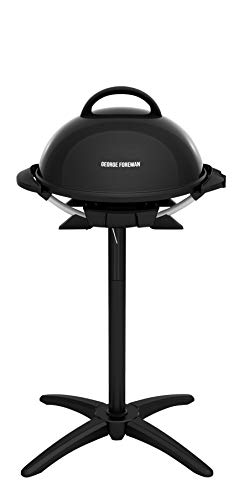
George Foreman 15-Serving Indoor/Outdoor Electric Grill — Best Overall for a Crowd
When the brief is literally “feed the most people indoors,” the George Foreman 15-serving is the heavyweight. Its round platter is the largest verified surface here, rated by the manufacturer at fifteen servings, and it works two ways: on its removable stand as a patio-style electric grill, or on the counter as a giant indoor grill. For big families and game-day batches, nothing else in this category starts with this much room.
Strengths
- Largest cooking surface in this guide — burgers for a crowd in one batch
- Removable stand converts it between indoor counter and outdoor patio duty
- Sloped surface drains fat into a drip tray, which also cuts smoke
Trade-offs
- Single temperature dial control is blunt — no precise degrees, just zones of heat
- The round platter is awkward to store and too big for many sinks
- No lid-driven convection, so thick cuts cook slower than on contact grills
| Capacity | 15 servings (manufacturer rating) |
| Stand | Removable stand included |
| Fuel | Electric (corded) |
Translate the capacity claim honestly: fifteen “servings” means fifteen small burgers or pieces; in real food it is eight to ten standard burgers, or a family pack of chicken thighs with room to spare — still the biggest single batch in this guide. The electric element heats the platter evenly enough for batch cooking, and the slope that made George Foreman famous does quiet work here, pulling fat away from food and away from the heat, which is why this grill behaves better in a kitchen than its size suggests. Cleanup is a wipe-down once the platter cools, though its diameter makes sink-washing a two-handed negotiation. If your household is big, your gatherings are bigger, and your kitchen has the counter to spare, this is the crowd answer.
Best for: large families and hosts who cook burger-and-brunch batches for eight to ten indoors / Not suited for: small kitchens, precision-temperature cooks, or anyone who needs a lid for thick roasts
Check on Amazon — check the current price on Amazon before you buy; listings, bundles and included accessories change over time.
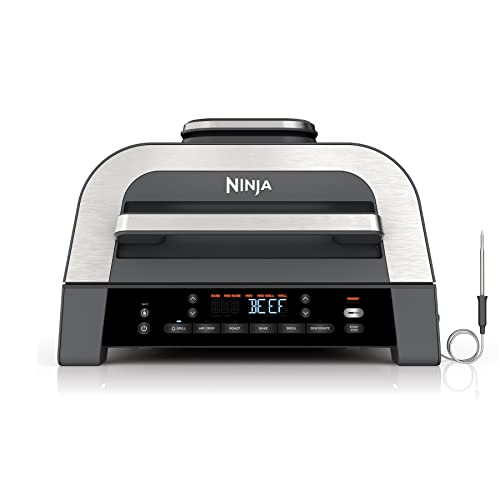
Ninja Foodi Smart XL Grill DG551 — Best Smart XL
The Ninja Foodi Smart XL DG551 attacks the crowd problem differently: not the biggest surface, but the smartest batch management. Its Smart Cook System works with the included Foodi thermometer, so a tray of chicken thighs or a row of steaks finishes by internal temperature rather than by timer and hope — which matters enormously when you are cooking for nine and cannot afford a tray of underdone or dried-out food.
Strengths
- Thermometer-driven cooking removes the guesswork from batch grilling
- Six functions — grill, air fry, roast, bake, dehydrate, broil — replace several appliances
- Cyclonic air circulation gives genuine char-grilled marks and flavor indoors
Trade-offs
- The XL footprint is counter-hungry and it is tall with the lid open
- Family-size batches of burgers may still need two runs for nine adults
- Premium tier pricing within this category, and parts are Ninja-specific
| Functions | 6-in-1 grill and air fryer |
| System | Smart Cook System |
| Probe | Foodi Smart Thermometer |
The honest capacity story: the DG551 grills roughly four large steaks or six burgers per run, and air-fries family quantities in its basket. For nine servings that means one full run plus a short second run — but because the thermometer ends each run exactly at doneness, the two runs match in quality, which is where lesser grills fall apart. The grill grate preheats to serious searing temperatures, the air-fryer side handles the fries and wings that crowd menus demand, and the whole cooking pot and grate are dishwasher-friendly. If your crowd cooking is mixed-menu rather than single-item, this is the most capable machine here.
Best for: mixed-menu crowd cooking where doneness consistency across batches matters / Not suited for: single-item mega-batches, or counters short on height and depth
Check on Amazon — check the current price on Amazon before you buy; listings, bundles and included accessories change over time.
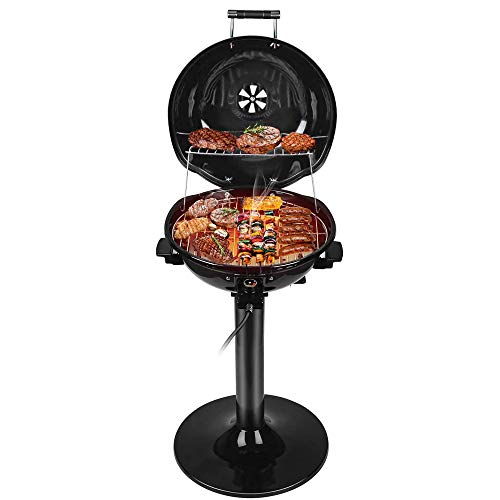
Techwood 15-Serving Indoor/Outdoor Electric Grill — Best Budget 15-Serving
Techwood’s 15-serving indoor/outdoor grill makes one promise and keeps it: a very large electric cooking surface, in a double-layer design, at a value-tier position well below the famous names. Like the George Foreman it can stand on a patio or sit on a counter, and like the Foreman its manufacturer rating is fifteen servings — in real food, a solid eight burgers with elbow room.
Strengths
- 15-serving-class surface at a budget tier — the most area per dollar here
- Double-layer design helps heat distribution across the big platter
- Stand-or-counter flexibility matches the indoor/outdoor brief exactly
Trade-offs
- Brand support and spare parts are thinner than George Foreman or Ninja
- Temperature control is basic dial territory — no digital precision
- Fit and finish feel value-tier: lighter materials, simpler hardware
| Capacity | 15 servings (manufacturer rating) |
| Design | Double-layer grill body |
| Fuel | Electric (corded) |
Value-tier electrics live or die on two questions: does the element heat the whole surface, and does the thermostat cycle so wide that food steams between surges? The double-layer construction is Techwood’s answer to the first, spreading heat more evenly than a single-skin platter, and in batch cooking that evenness is what you taste — burgers at the edge browning like burgers in the middle. On the second question, expect honest budget behavior: recovery after a cold load is slower than the premium picks, so do not crowd it to the rim and do preheat it fully. As a second grill for gatherings, or a first grill for a big household on a budget, it earns its place; as your only precision instrument, look up the list.
Best for: big households and party hosts who need maximum surface on a budget / Not suited for: cooks who want brand-depth support, digital controls, or fast recovery
Check on Amazon — check the current price on Amazon before you buy; listings, bundles and included accessories change over time.

Chefman Smokeless Indoor Grill XL — Best Low-Smoke Open Grill
Chefman’s Smokeless XL is built around the complaint that kills most indoor grilling: smoke. Its design routes drippings into a water tray beneath the element, so fat never sits on a hot surface smoking — and the cooking surface itself is extra-large, an open flat grill rather than a contact press, which means thick burgers, skewers, and vegetables cook the way they would outdoors.
Strengths
- Water-tray drip system genuinely reduces smoke versus open elements
- Extra-large open surface fits skewers, thick cuts, and mixed batches
- Adjustable temperature dial covers gentle to searing ranges
Trade-offs
- Open format cooks one side at a time — slower than contact grills for thin food
- The water tray must be filled and emptied; skip it and smoke returns
- Nonstick surface wants plastic or wood tools and gentle cleaning
| Surface | Extra-large grilling surface |
| Plates | Nonstick |
| Fuel | Electric (corded) |
Judge this grill by its intended job: apartment and condo cooking where the smoke alarm is the real head chef. With the tray filled, fatty burgers and sausages produce a fraction of the smoke of a cast-iron pan, and the open surface gives you outdoor-style control — move food to cooler edges, flip when the crust says so. Capacity in real food is six to eight burgers, which serves the “nine servings” brief with one quick second batch of the small items. It will not mark food like the Ninja or sear like a 450-degree lidded grill, but it will let you grill on a Tuesday in a small apartment without opening every window, and that is a superpower the bigger names do not all share.
Best for: apartment cooks feeding groups who need smoke control above all / Not suited for: contact-grill speed seekers or cooks who hate managing a drip tray
Check on Amazon — check the current price on Amazon before you buy; listings, bundles and included accessories change over time.

T-Fal OptiGrill XL Electric Grill — Best Guided Cooking
T-Fal’s OptiGrill XL is the grill for the cook who is also hosting. Its automatic programs measure the thickness of the food and track doneness levels — rare to well-done — with indicator lights and beeps, across nine intelligent cooking modes. You load the plates, choose the program, and the grill manages the batch while you manage your guests. For crowd cooking by distracted humans, that automation is worth more than raw area.
Strengths
- Automatic thickness sensing and doneness indicators remove timing guesswork
- Nine programs cover burgers, chicken, sandwiches, sausage, fish, and more
- Contact plates cook both sides at once — the fastest batch cycle here
Trade-offs
- Rated at six servings; nine servings means two disciplined runs
- Contact format flattens soft foods and cannot take very thick cuts
- Plates and drip tray are dishwasher work after every session — plan the cleanup
| Capacity | 6 servings (manufacturer rating) |
| Modes | 9 automatic cooking programs |
| Functions | Grill and panini press |
The OptiGrill’s party trick is real engineering: a sensor measures plate angle to infer thickness, and the program adjusts its cycle and signals doneness stages as it cooks. In practice, a batch of burgers emerges evenly at the doneness you selected, including the ones you forgot about — which, mid-gathering, is all of them. The XL plates are the largest in the OptiGrill line, and frozen food programs handle the straight-from-freezer reality of impromptu crowds. Its limits are format limits: no open-surface skewers, no extra-thick chops, and two runs for nine adults. If your crowd cooking is burgers, chicken breasts, panini, and sausages, run by a host with a drink in one hand, this is the smartest seat in the guide.
Best for: hosts who cook and socialize at the same time and want doneness handled / Not suited for: skewer and thick-cut cooking, or one-run feeding for nine adults
Check on Amazon — check the current price on Amazon before you buy; listings, bundles and included accessories change over time.

Hamilton Beach Indoor Searing Grill — Best Searing Lid Grill
Hamilton Beach’s Searing Grill is the traditionalist in this XL roundup: an open grate under a proper hood, heating to 450°F, with a viewing window so you can watch the cook without dumping the heat. The grate fits a family batch — four large steaks or six to eight burgers — and the lidded format handles thick cuts and bone-in chicken better than any contact press in this guide.
Strengths
- 450°F top heat delivers real searing among lidded indoor grills
- Viewing window lets you monitor without losing heat to lid-lifting
- Removable grate and drip tray go to the sink or dishwasher
Trade-offs
- Open format produces more kitchen smoke than contact or water-tray designs
- Serving count is family-size, not party-size — nine servings takes two runs
- No digital smarts: a dial, a light, and your attention run the cook
| Max temp | 450°F |
| Lid | Hood with viewing window |
| Fuel | Electric (corded) |
There is a reason outdoor grills have lids: convection. With the hood down, hot air finishes the top of thick food while the grate works on the bottom, and that is how bone-in thighs and inch-thick pork chops cook evenly indoors. The window sounds like a gimmick until your third cook, when you realize you have stopped opening the lid “just to check” and your temperatures — and results — have stabilized. Smoke is the honest cost: run the range hood, expect aroma, and do not believe any open grill that promises otherwise. For cooks who want indoor food that tastes like it came off a small outdoor grill, and who feed five to six at a time with nine as an occasional stretch, this is the purist pick.
Best for: cooks who want lidded, outdoor-style grilling indoors for family-size batches / Not suited for: smoke-sensitive apartments or true one-run party quantities
Check on Amazon — check the current price on Amazon before you buy; listings, bundles and included accessories change over time.
Comparison Table
| Pick | Badge | Key spec | Best for |
|---|---|---|---|
| George Foreman 15-Serving Indoor/Outdoor Electric Grill | Best Overall for a Crowd | 15 servings (manufacturer rating) — capacity | large families and hosts who cook burger-and-brunch batches for eight to ten indoors |
| Ninja Foodi Smart XL Grill DG551 | Best Smart XL | 6-in-1 grill and air fryer — functions | mixed-menu crowd cooking where doneness consistency across batches matters |
| Techwood 15-Serving Indoor/Outdoor Electric Grill | Best Budget 15-Serving | 15 servings (manufacturer rating) — capacity | big households and party hosts who need maximum surface on a budget |
| Chefman Smokeless Indoor Grill XL | Best Low-Smoke Open Grill | Extra-large grilling surface — surface | apartment cooks feeding groups who need smoke control above all |
| T-Fal OptiGrill XL Electric Grill | Best Guided Cooking | 6 servings (manufacturer rating) — capacity | hosts who cook and socialize at the same time and want doneness handled |
| Hamilton Beach Indoor Searing Grill | Best Searing Lid Grill | 450°F — max temp | cooks who want lidded, outdoor-style grilling indoors for family-size batches |
Use the table as a filter, not a verdict: eliminate the rows whose key spec fights your space, fuel rules, or headcount, and the best 9 serving size indoor grills decision usually narrows to two finalists whose full reviews above will settle it.
How to Choose the Best 9 Serving Size Indoor Grills for Your Kitchen
Translate every serving claim before you compare anything. A “serving” in this category ranges from a slider to a chicken breast depending on the brand’s optimism. Convert claims to your food: count how many of your burgers, thighs, or steaks fit on the grate in one layer with a finger’s width between pieces. That number — not the box number — is the grill’s serving size for your household. For a genuine nine-serving single run you need the 15-serving platter class; everything else honest does nine in a run and a half.
Contact, open, or hybrid — pick your format first
Contact grills (OptiGrill, Griddler) cook both sides at once, finish batches fastest, and contain smoke best, but they press food and cap its thickness. Open grills (Foreman platter, Chefman, Hamilton Beach) take any thickness and cook like a backyard grate, one side at a time, with more aroma. Hybrids like the Ninja trade some grill area for an air fryer that absorbs side dishes and second batches. For nine servings of one food, format matters less than area; for nine servings of a mixed menu, the hybrid quietly wins.
Temperature recovery is the hidden spec
No listing prints recovery time, but it decides whether batch two sears or steams. Heavier plates, higher wattage, and lids all help; thin open elements suffer most. Practical test when your grill arrives: cook two identical batches back to back. If batch two takes half again as long and browns less, the grill is undersized for your crowd — exchange up a class while you can.
Serving-Size Math: What “9 Servings” Really Requires
Do the arithmetic with your own menu. Nine adults eating burgers need nine patties at roughly a quarter-pound each — laid out with spacing, that is about 230–260 square inches of grate, which is platter-class territory. Nine servings of chicken thighs need less area but more time, because thighs cook slower and crowd worse. Nine servings of kebabs need width more than area, which favors the long open grills. This is why the 15-serving-rated models headline this guide: their marketing number finally overlaps your real number.
Also count the second run honestly. A grill that does six beautifully and three quickly is a nine-serving grill for real life, provided its recovery is strong — the Ninja and OptiGrill pattern. A grill that does nine barely, in one steamed and crowded layer, is not. When in doubt, size for the 80-percent meal — the family dinner you cook weekly — and let the 20-percent party meal take two runs. You will be happier every ordinary Tuesday, which is when grills earn their counter space.
Smoke, Splatter, and Ventilation: The Indoor Reality Check
Every indoor grill review should be forced to print its smoke behavior in bold. Here is the hierarchy from this guide’s designs: water-tray open grills (Chefman) smoke least with fatty food; enclosed contact grills (OptiGrill) contain most of what they make; lidded open grills (Hamilton Beach) make honest smoke that a range hood handles; giant open platters (Foreman, Techwood) scent the home in proportion to the fat on them. None of them — none — grills ribeyes in a sealed apartment invisibly.
Manage what you cannot eliminate. Preheat fully so food sears on contact instead of weeping, pat proteins dry, keep sugary marinades for the last minutes because sugar smokes early, and run the hood from the first minute, not the first alarm. Splatter follows the same rules: drier food, hotter surfaces, less drama. Choose your grill from this guide by the smoke column as much as the serving column, and indoor grilling becomes a weeknight habit instead of a special occasion with open windows.
Plate Geometry: Why Shape Matters as Much as Size
Two grills with identical square inches can feed a crowd very differently, because shape decides what fits. A round platter — the Foreman and Techwood pattern — is generous with burgers and awkward with anything rectangular: skewers overhang, a spatchcocked chicken negotiates, and a row of asparagus becomes a jigsaw. A rectangular contact grill — OptiGrill, Griddler — packs sandwiches, chicken breasts, and kebab trays with Tetris efficiency but caps thickness at the hinge. The Ninja’s deep XL cavity trades flat area for volume, which is why it air-fries family batches that flat grills cannot.
Match geometry to your crowd’s actual menu. Burger-and-brunch households should shop platters and open rectangles. Sandwich-and-chicken households belong on contact rectangles. Mixed menus — wings in the basket, steaks on the grate, vegetables wherever they land — belong to the hybrid cavity. The serving-count translation in the buying guide gets you to the right size class; geometry gets you to the right member of it. Bring a mental photograph of your most-cooked family dinner to this decision and the correct shape usually announces itself.
One more geometric truth: edges cook slower than centers on every indoor grill, because elements end before surfaces do. The practical consequence is rotation — halfway through a big batch, swap the edge pieces to the middle. Cooks who rotate get one uniform batch; cooks who do not get a gradient and call it the grill’s fault. On a nine-serving brief, rotation is not fussiness; it is the technique that makes the big surface honest.
The Second-Batch Problem: Recovery, Holding, and Serving Nine Plates Hot
Feeding nine indoors is a logistics problem wearing a cooking costume. Batch one finishes while batch two is raw, and the cook’s real job is making those two batches taste like one meal. Three tools solve it. First, recovery: a grill with heavy plates or a strong element returns to searing temperature quickly after a cold load, so batch two browns like batch one — the Ninja and the lidded Hamilton Beach are built for this, and thin open elements are where second batches go to steam.
Second, holding: a low oven — around 200°F — with a rack over a tray is the crowd cook’s staging area. Finished food rests there, crust intact, juices settling, for the ten minutes batch two needs. Microwaves are where crust goes to die; the low oven is where it waits like a professional. Third, menu design: choose crowd menus where one component holds gracefully — grilled chicken, sausages, and kebabs hold; delicate fish and rare steaks do not — and let the hold-sensitive item be the second batch, served the moment it lands.
Sequence it and nine servings stop being a stress test: stage everything, grill the holders first into the low oven, grill the stars last onto warm plates, and wipe the grill while it is still warm. The grills in this guide supply the surface and the recovery; this system supplies the rest. It is also, not coincidentally, exactly how restaurants plate for a table of nine — the home version just has better music.
Indoor Grill Storage, Cords, and Countertop Logistics
The unglamorous truth about XL indoor grills is that they are furniture, and furniture needs a plan. Measure three things before ordering: the counter footprint with the lid fully open (contact grills swing tall, and upper cabinets are unforgiving), the cabinet or shelf it will live in (a grill stored in the garage is a grill used twice a year), and the distance to an outlet it does not have to share with the coffee maker and the microwave at the same moment. The platters are the storage extreme — wide, round, and happiest living on the counter they serve — while the contact grills fold flatter than their cooking size suggests.
Cords deserve their own sentence because they cause a disproportionate share of indoor grill misery. These are high-draw appliances: plug directly into a wall outlet, never a power strip shared with other loads, and route the cord so it cannot drape across the hot body or dangle where a hip can catch it during a crowded cook. When the session ends, let the grill cool on the counter before it travels to its cabinet — a warm grill in a closed cabinet is a smell that moves in permanently.
Finally, plan the cleaning station before the first cook. XL plates and platters need a sink strategy: if your sink is small, the bathtub is not a joke but a method, and a large sheet pan under the grill during cooking catches the splatter that otherwise repaints the counter. None of this is difficult, and all of it is the difference between an XL grill that becomes a weeknight habit and one that becomes a lesson in optimistic purchasing. The cooks who feed nine indoors regularly are simply the ones who solved the logistics in week one.
Feeding Nine on a Weeknight: Three Menus Built for These Grills
Menu one is burger night, the XL grill’s home game. Nine patties across the platter or in two disciplined contact batches, cheese melted under a lid or in the final closed minute, buns toasted on the cooling surface while the meat rests, and a tray of sliced onions and peppers grilled in the rendered fat at the edges. The whole production takes twenty-five minutes and one grill, and it scales down to Tuesday-for-four without changing a single habit.
Menu two is the mixed grill, built for the hybrid and lidded machines: chicken thighs started first because they take longest and hold best, sausages into the gaps, skewered vegetables on the open edge or second batch, and flatbreads warmed at the end. The sequencing is the recipe — longest and most forgiving first, delicate and fast last — and it works identically on the Ninja’s cavity, the Hamilton Beach’s lidded grate, and the Chefman’s open surface.
Menu three is breakfast for the houseful, the meal where big indoor grills quietly out-earn their price. Bacon or sausage first (its fat seasons the surface), eggs or pancakes in waves, toast and fruit handled by the rest of the kitchen. A contact grill pressed into panini duty at lunch and a platter doing burgers at dinner can feed a holiday house all day without the oven ever warming the kitchen. Plan the three menus once, shop them on rotation, and the “nine servings” brief that sounded like a party problem becomes your ordinary, well-fed routine.
Cleaning Systems Compared: Plates, Platters, and Trays
Cleanup decides whether an XL indoor grill is a habit or a storage unit, so compare the systems honestly before you buy. Removable contact plates — the OptiGrill and Griddler pattern — are the gold standard: they unclip, go to the sink or dishwasher, and return genuinely clean, at the cost of washing two plates and a drip tray after every session. Removable grates and trays, as on the Hamilton Beach, split the difference: the food-contact parts wash easily while the body wants a wipe. Fixed platters — the Foreman and Techwood pattern — clean in place with a warm wipe and a plastic scraper; fastest on a good day, and the reason a damp-towel-while-warm ritual appears in this guide’s how-to.
The Chefman’s water tray is a cleaning feature disguised as a smoke feature: grease lands in water instead of baking onto a hot surface, so the post-cook wash is a tray rinse rather than a scrubbing session — but only if you empty it the same day, because yesterday’s tray is its own punishment. The Ninja’s pot, grate, and basket are dishwasher-friendly and nonstick, which suits its hybrid role, though its size means the dishwasher run is a commitment. Whichever system you choose, the rule is identical: clean it warm, clean it the same day, and the next cook starts at zero. The grill whose cleaning you dread is the grill you will stop using by the second month, whatever its serving count promised.
A Note on Wattage and Circuits for Big Indoor Grills
Large indoor grills draw at the top of what a household circuit offers, and a two-minute electrical plan prevents the only failure mode that can ruin a crowd cook mid-batch. Run the grill on its own circuit where you can identify one; if the kitchen’s outlets share a breaker with the microwave and the coffee maker, stagger those loads while the grill runs. Never use a lightweight extension cord or a power strip — sustained high draw is exactly what they are not built for — and if an extension is unavoidable, it should be short, heavy-gauge, and outdoor-rated, laid flat where nobody trips into a hot grill by way of its cord.
This is not bureaucratic caution; it is batch insurance. A tripped breaker at minute six of batch one costs you the preheat, the sear, and the schedule, and it announces itself at the worst possible moment — when the counter is full of raw food and the guests are arriving. The grills in this guide are all standard household appliances that behave beautifully on a sane circuit. Give yours that circuit, and the electrical chapter of indoor crowd cooking closes permanently, leaving only the enjoyable chapters open.
How to Grill for Nine Indoors Without Chaos
A big indoor grill is only half the system; the other half is batch discipline. This is the workflow that turns a 15-serving platter or an XL contact grill into nine plates that land hot, together, and correctly cooked.
- Stage everything before heat: portion, season, and tray all the food first. Indoor grills preheat fast and wait for no one; the cook who is still forming patties when the grill is ready is the cook whose first batch burns.
- Preheat fully, then oil the food, not the surface: a complete preheat gives you sear instead of steam. Lightly oil the proteins themselves — oil on a hot nonstick surface just smokes.
- Cook in menu order, longest first: bone-in and thick items start earliest and hold best; burgers and fish go last. Use a low oven or the grill’s cool edge as a holding zone for finished batches.
- Leave space between pieces: a finger’s width minimum. Crowded food steams in its own juice and never browns — two honest runs beat one crowded failure.
- Rest batches on a rack, not a plate: a wire rack over a tray keeps rested food from sitting in its juices and undoing your crust while the second run finishes.
- Clean while it is warm: the moment the last batch lands, lay a damp paper towel on the closed contact plates or wipe the open surface. Ninety seconds now saves twenty minutes of scrubbing later.
Run this sequence twice and it becomes choreography: stage, preheat, longest-first, rest on a rack, wipe warm. The grill you choose from this guide supplies the surface; this system supplies the other half of feeding nine people indoors without breaking a sweat.
Common Buying Mistakes
Believing the serving number on the box. Serving claims are unregulated marketing. Translate them into your burgers and your chicken before you buy, or you will own a four-person grill with a nine-person badge.
Crowding to avoid a second run. One steamed, grey, crowded batch is worse than two proper runs every time. Space is an ingredient.
Buying a contact grill for thick-cut cooking. Presses have a thickness ceiling. Bone-in chicken, thick chops, and skewers belong on open or lidded formats.
Ignoring the sink test. If the plates do not fit your sink or dishwasher, you will dread cleaning them, and a grill you dread cleaning is a grill you stop using. Check dimensions before ordering.
Storing it somewhere inconvenient. XL grills are big. If yours lives in a garage or a high cabinet, weeknight use dies. Measure the counter or cabinet it will actually live in.
Final Recommendation
For the literal brief — the most servings indoors — the George Foreman 15-Serving Indoor/Outdoor Electric Grill remains the answer, with the Techwood 15-Serving Indoor/Outdoor Electric Grill as its budget shadow. For mixed menus and guaranteed doneness, the Ninja Foodi Smart XL Grill DG551 is the smartest crowd machine here, and for hosts who cook while they entertain, the T-Fal OptiGrill XL Electric Grill all but runs itself.
Apartments should start at the Chefman Smokeless Indoor Grill XL for its smoke manners, and traditionalists who want a hood and a hard sear should take the Hamilton Beach Indoor Searing Grill. Every one of these was verified against its live listing, so the capacity you read about is the capacity that ships.
Measure your counter, translate the serving claim into your food, and pick the format your menu actually uses. Do that, and “indoor grill for nine” stops being a marketing phrase and becomes your Tuesday night.
Keep comparing within the same family before you decide: Best 1500 Wtt Smokeless Indoor Grills · Best Affordable Electric Grills · Best 8 Grills.
Frequently Asked Questions
Is there really an indoor grill that serves nine people?
In one run, only the 15-serving platter class truly does — and even then, nine modest servings. Most XL indoor grills serve nine in a full run plus a short second run, which is perfectly practical with good temperature recovery.
Why do serving counts differ so much between brands?
There is no standard. Brands count anything from a 4-ounce patty to a full chicken breast as one serving. Compare cooking surface area and translate it into your own food instead.
Which indoor grill format is fastest for a crowd?
Contact grills, because they cook both sides at once. The OptiGrill and Griddler formats finish a batch in roughly half the time of an open grill of similar size.
How do I reduce smoke when grilling indoors?
Choose a water-tray or enclosed contact design, preheat fully, pat food dry, add sugary marinades late, and run the range hood from the start. Fatty food on any open surface will still produce some smoke.
Can an indoor grill replace an outdoor grill entirely?
For burgers, chicken, vegetables, and sandwiches, yes for most households. For smoke flavor, very thick cuts, and true high-heat searing at scale, outdoor grills still hold advantages.
Are the plates dishwasher safe on these grills?
Most picks here have removable plates, grates, or drip trays that are dishwasher safe or easy sink washing — but check the specific listing, and measure your sink against XL platters before buying.
Related reading: Best 10 Grills · Best Affordable Bbq Grills · Best 2 Burner Gas Grills.


