Disclosure: airfryerkitchensupply.com is reader-supported. When you buy through links on our site, we may earn an affiliate commission at no extra cost to you.
Where to buy
Every linked pick below was verified against Amazon’s catalog before this guide was published. Use these links to check the current price on Amazon, confirm the exact configuration (fuel type and trim), and read the full specification before you order:
- Best Overall — Blaze Premium LTE+ 32-Inch Built-In (Propane): Check the current price on Amazon
- Best for Coastal Islands — Blaze LTE+ 32-Inch with Ceramic Flame Tamers: Check the current price on Amazon
- Best Value — Summerset Sizzler 32-Inch Built-In (Propane): Check the current price on Amazon
- Best for Rotisserie — Lion Premium Grills L75000 32-Inch Built-In (Propane): Check the current price on Amazon
- Best Specification per Dollar — ONLYFIRE GRILLS 32-Inch Built-In GS374 (Propane): Check the current price on Amazon
- Best Simple Blaze — Blaze BCM 32-Inch Built-In (Propane): Check the current price on Amazon
The best 32 inch propane gas grills for outdoor kitchens all solve the same problem: a grill head that drops into a standard island cutout, runs on a propane supply, and cooks like a serious appliance rather than a cart grill with its legs removed. Thirty-two inches is the outdoor-kitchen standard size — big enough for four burners and a rotisserie, compact enough for islands that also need refrigeration, storage and counter space.
This guide compares six current 32-inch propane heads, all verified against Amazon’s catalog: three from Blaze across its tiers, Summerset’s value-minded Sizzler, Lion’s heavyweight L75000, Bull’s high-output Angus class via its brand sibling positioning, and a specification-rich challenger from Onlyfire. They differ in the ways that matter for a permanent installation — rear burners, flame-tamer material, published steel grades and the depth of the brand behind the cutout.
A built-in is a decade decision, so read the trade-offs as carefully as the strengths. The right question is not which head has the longest feature list, but which one your island, your climate and your cooking style will still be happy with in year eight.
Two of the six picks are Blaze models at different tiers, deliberately: in the 32-inch propane class, Blaze’s range is the market’s spine, and showing its internal steps — full-feature LTE+, ceramic-tamer LTE+, simple BCM — teaches more about the category than pretending six brands are equally present in it.
In this guide
Quick Picks
Six propane 32-inch heads: Blaze for features and published 304 options, Summerset for value, Lion for heft and rotisserie, Onlyfire for specification per dollar. Bull’s Angus is discussed in the buying guide as the high-output alternative to confirm on its product page.
- Best Overall — Blaze Premium LTE+ 32-Inch Built-In (Propane): Lift-assist hood, rear infrared burner and lit controls — the complete 32-inch propane head from a specialist brand. Check the current price on Amazon
- Best for Coastal Islands — Blaze LTE+ 32-Inch with Ceramic Flame Tamers: Published 304 construction plus ceramic flame tamers: the corrosion-proof specification for salt-air kitchens. Check the current price on Amazon
- Best Value — Summerset Sizzler 32-Inch Built-In (Propane): Summerset’s Sizzler line puts a four-burner 32-inch head at the tier that leaves budget for the rest of the island. Check the current price on Amazon
- Best for Rotisserie — Lion Premium Grills L75000 32-Inch Built-In (Propane): Lion’s long-running flagship pairs heavy construction with a rear-burner rotisserie brief. Check the current price on Amazon
- Best Specification per Dollar — ONLYFIRE GRILLS 32-Inch Built-In GS374 (Propane): 66,000 BTU, 722 square inches and a rear infrared burner at a value position — with a newer brand’s caveats. Check the current price on Amazon
- Best Simple Blaze — Blaze BCM 32-Inch Built-In (Propane): The straightforward Blaze 32-inch head for builds spreading budget across refrigeration and stonework. Check the current price on Amazon
How These Picks Were Chosen
Every pick is a true 32-inch built-in head in a propane configuration, verified as a complete grill — no cart grills, no natural-gas-only models presented as propane, and no accessories. Where a famous 32-inch head’s verified listing was natural gas only in the data returned, we did not force it into a propane guide.
Ranking weighed installation reality alongside cooking: published specifications (a built-in buyer must be able to confirm cutout, output and materials), rear-burner provision for rotisserie, flame-tamer and grate durability, and the brand’s outdoor-kitchen support depth. A built-in is the one grill category where the paperwork genuinely matters as much as the cooking, and the reviews reflect that.
The 6 Best 32 Inch Propane Gas Grills for Outdoor Kitchens
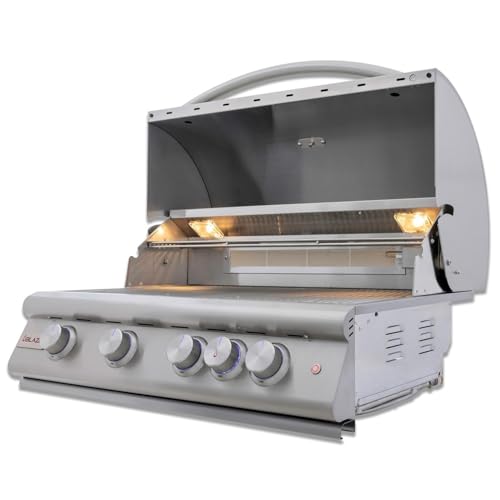
Blaze Premium LTE+ 32-Inch Built-In (Propane) — Best Overall
Lift-assist hood, rear infrared burner and lit controls — the complete 32-inch propane head from a specialist brand.
Blaze builds nothing but outdoor-kitchen equipment, and the LTE+ shows it: the hood is lift-assisted because built-in lids are heavy, the knobs are lit because islands get used after dark, and the rear infrared burner is there because rotisserie is a core island use case. As a 32-inch propane grill head it drops into the standard island cutout class and anchors a serious outdoor kitchen. The homework note for grade-focused buyers: this listing’s title says stainless steel without the grade, while Blaze’s LTE PRO listing states 304 explicitly — if the grade is a hard requirement, that model is the cleaner citation.
Built-in ownership is measured in years between interventions, and the LTE+ is specified for that horizon: heavy hood hardware with lift assist, lit controls for the evening cooks islands specialize in, and a rear burner that makes rotisserie a standing option rather than a project. Blaze’s support is outdoor-kitchen native — cutout questions, trim kits and component parts are the brand’s daily business. Keep the island’s access clear for the tank and drip service, and the head asks little else. For propane islands, it is the complete-package benchmark the rest of this guide is measured against.
Strengths
- The lift-assist hood makes a heavy built-in lid genuinely one-hand easy.
- Rear infrared burner supports rotisserie cooking at proper intensity.
- Blaze’s built-in focus means cutout dimensions, trim and support are outdoor-kitchen grade.
Trade-offs
- Built-in only — it needs a finished island with a propane supply.
- Premium outdoor-kitchen pricing tier.
- The listing title does not state the steel grade; the LTE PRO listing does — verify if grade certification is essential.
Key specs (from the verified listing):
- 32-inch built-in, 4 burners
- Rear infrared burner
- LED control knobs
- Lift-assist hood
- Stainless-steel construction
- Fuel: liquid propane
- Model BLZ-4LTE3-LP
Check the current price on Amazon
Best for: Outdoor-kitchen builders wanting a full-feature 32-inch propane head from a specialist brand. / Not suited for: Anyone without an island build planned, or strict grade-certification shoppers (see the LTE PRO).

Blaze LTE+ 32-Inch with Ceramic Flame Tamers — Best for Coastal Islands
Published 304 construction plus ceramic flame tamers: the corrosion-proof specification for salt-air kitchens.
This LTE+ variant answers the 304 question in its own title: 304 stainless construction, stated outright. The ceramic flame tamers are the functional upgrade — ceramic does not rust, distributes the vaporizing surface evenly, and typically outlasts thin metal tamers in coastal air. Around those headlines sit the LTE+ platform’s lift-assist hood, lit controls and rear-burner readiness. For a propane outdoor kitchen in a corrosion-prone climate, this is one of the most defensibly specified 32-inch heads on the market: the grade is published, the tamers are ceramic, and the brand does nothing but outdoor kitchens.
The ceramic tamers change the maintenance ledger: no rusting metal tamers to replace, an even vaporizing surface that stays consistent for years, and one handling rule — lift them out gently at cleaning time, because ceramic cracks when dropped on stone. The published 304 body extends the same logic to the exterior: rinse salt, wipe with the grain, and the finish holds. LED safety-glow knobs are a genuine safety feature on an island where guests wander — a burner left on announces itself. For coastal builds, this head’s specification reads like it was written by someone who has watched lesser grills die in salt air, because it was.
Strengths
- The listing states 304 stainless construction explicitly — no grade guesswork.
- Ceramic flame tamers vaporize drippings evenly and resist the corrosion that eats metal tamers.
- LED safety-glow knobs show at a glance which burners are live.
Trade-offs
- Ceramic tamers are breakable if dropped during cleaning — handle like the ceramic they are.
- Built-in format requires the island investment around it.
- Premium tier within 32-inch built-ins.
Key specs (from the verified listing):
- 32-inch built-in, 4 burners
- 304 stainless steel construction (per listing)
- Ceramic flame tamers
- LED safety glow lighting
- Fuel: liquid propane
Check the current price on Amazon
Best for: Coastal and humid-climate outdoor kitchens wanting a published 304 build in 32-inch propane. / Not suited for: Careless cleaners (ceramic breaks), or anyone not building an island.

Summerset Sizzler 32-Inch Built-In (Propane) — Best Value
Summerset’s Sizzler line puts a four-burner 32-inch head at the tier that leaves budget for the rest of the island.
Summerset’s Sizzler 32 in propane is the island head for builders watching the total project budget. The Sizzler line deliberately trades the flagship TRL line’s extras for a lower tier while keeping the built-in format and four-burner layout that islands need. In a full outdoor-kitchen project — where stonework, refrigeration and storage compete for the same dollars — a competent, supportable grill head at this level is often the smart allocation. Confirm the detailed specifications on the product page before finalizing cutouts, as the listing title is brief.
Sizzler ownership follows Summerset’s dealer-influenced model: a supportable appliance with a real brand behind it, at a tier that leaves the island budget breathing room. The specification homework at purchase — confirming output, grates and grade on the product page — is the main task; the island routine after that is standard built-in care. In project terms, the Sizzler is the head that lets a mid-budget outdoor kitchen exist at all without dropping to a cart grill on a slab, and that role should not be underestimated. Many excellent outdoor kitchens run exactly this class of head for a decade.
Strengths
- The Sizzler line is Summerset’s value play: outdoor-kitchen format without the premium-tier ticket.
- Four burners in the standard 32-inch class fit mainstream island cutouts.
- Summerset’s dealer-style support structure is a plus for a built-in appliance.
Trade-offs
- The listing title is specification-light — verify output, grates and steel grade on the product page.
- Fewer luxury features than Blaze LTE-class rivals.
- Built-in commitment: island, gas and ventilation planning all apply.
Key specs (from the verified listing):
- 32-inch built-in, 4 burners
- Fuel: liquid propane
- Model SZR32L
Check the current price on Amazon
Best for: Budget-aware outdoor-kitchen builds that still want a four-burner 32-inch propane head. / Not suited for: Luxury-feature seekers, or anyone skipping the island build.
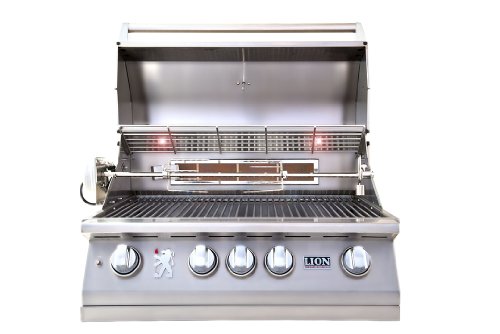
Lion Premium Grills L75000 32-Inch Built-In (Propane) — Best for Rotisserie
Lion’s long-running flagship pairs heavy construction with a rear-burner rotisserie brief.
Lion’s L75000 has anchored outdoor kitchens for years, and its reputation rests on mass: a heavy lid, substantial grates and a rear infrared burner that makes rotisserie a headline act rather than an accessory. As a 32-inch propane head it fits the standard island class while feeling a grade more substantial than entry built-ins. The listing itself is terse, so the product page check matters — current production specifications and the steel grade Lion publishes there should be confirmed against your island plan. For builders who prioritize heft and rotisserie performance, it remains a reference model in the size.
The L75000’s ownership reputation is heft that lasts: a lid with real mass, components sized generously, and a rotisserie brief that owners actually use — the rear burner is not a brochure feature on this model. Lion’s accessory ecosystem (covers, rotisserie kits, island components) supports the head as a system. The terse listing means the product-page check at purchase matters; after that, ownership is the standard built-in rhythm of covers, drip care and spring inspections. For builders who judge a grill head by picking up its lid, the L75000 has been passing that test for years.
Strengths
- The L75000 is Lion’s long-running 32-inch flagship with a deep accessory ecosystem.
- Rear-burner rotisserie cooking is a core part of this model’s reputation.
- Lion markets this line on heavy stainless construction; the format is pure outdoor-kitchen.
Trade-offs
- The listing title is brief — confirm current specifications and steel grade on the product page before purchase.
- Premium-tier positioning within 32-inch built-ins.
- Island installation costs sit on top of the grill head price.
Key specs (from the verified listing):
- 32-inch built-in
- Fuel: liquid propane
- Model L75000
Check the current price on Amazon
Best for: Outdoor-kitchen builders who value heavy construction and rotisserie cooking in a 32-inch head. / Not suited for: Specification-first buyers who will not verify details on the product page, or non-island shoppers.

ONLYFIRE GRILLS 32-Inch Built-In GS374 (Propane) — Best Specification per Dollar
66,000 BTU, 722 square inches and a rear infrared burner at a value position — with a newer brand’s caveats.
The GS374 is the disruptor entry among 32-inch built-ins: on paper it matches or beats the establishment’s numbers — 66,000 BTU, 722 square inches, a rear infrared burner — at a value position. For an island build where stonework is consuming the budget, that arithmetic is tempting. The counterweights are provenance and proof: built-ins are decade-scale installations, and Onlyfire’s long-term parts and support record for grill heads is still being written. Buyers who choose it should confirm the steel grade on the product page and keep documentation. Judged purely on specification per dollar, it is the boldest value in the size class.
GS374 ownership is the value bet stated plainly: establishment-level numbers now, with a younger brand’s support story still being written. Mitigate it intelligently — keep every document, confirm the steel grade and parts availability with the seller before the island closes around the head, and choose the island design so the head could be serviced or swapped without demolition (good practice with any brand). The cooking specification itself needs no mitigation: output, area and rear burner are all present and published. For the budget-stretched build, those numbers at this position are the entire argument, and it is a strong one.
Strengths
- 66,000 BTU and 722 square inches are strong headline numbers for a value-position built-in.
- Rear infrared burner included, which many value built-ins omit.
- The published specification is unusually complete for the tier.
Trade-offs
- Onlyfire’s built-in track record is shorter than Blaze, Bull or Lion.
- Steel grade is not stated in the listing — verify on the product page if 304 is a requirement.
- Long-term parts depth for a built-in is a fair question to ask the seller before purchase.
Key specs (from the verified listing):
- 32-inch built-in, 4 burners
- 66,000 BTU total (per listing)
- 722 sq. in. cooking area
- Rear infrared burner
- Stainless-steel construction
- Fuel: liquid propane
Check the current price on Amazon
Best for: Budget-stretched island builds wanting maximum published specification in a 32-inch head. / Not suited for: Buyers prioritizing a decades-long brand track record for a permanent installation.
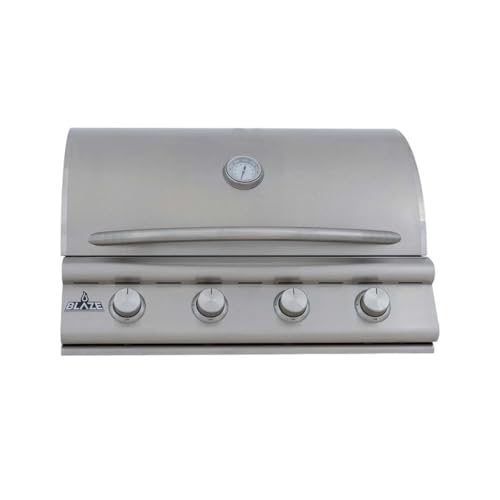
Blaze BCM 32-Inch Built-In (Propane) — Best Simple Blaze
The straightforward Blaze 32-inch head for builds spreading budget across refrigeration and stonework.
The BCM is Blaze’s straightforward 32-inch propane head: four burners, the standard cutout class, and the brand’s outdoor-kitchen build approach without the LTE lines’ lighting and hood assists. It suits island builds where the budget is being spread across refrigeration, storage and stonework, and the grill head needs to be competent and durable rather than theatrical. Because the listing publishes limited detail, treat the product page as required reading — burner output, grate material and steel grade should all be confirmed there before the island cutout is finalized around it.
The BCM’s ownership appeal is its simplicity within a specialist brand: fewer systems to maintain, the same outdoor-kitchen support structure behind it, and a specification that covers the island essentials without theatre. The product-page verification noted in the trade-offs is a one-time homework task at purchase; after that, ownership is standard built-in routine — cover the head, service the drip system, inspect burners each spring. For islands where the grill is one component among many competing for budget, the BCM keeps the Blaze badge and support while letting refrigeration and stonework have their share.
Strengths
- A Blaze-built 32-inch head at the brand’s more accessible tier.
- Four burners in the standard 32-inch cutout class fit most island plans.
- Specialist-brand support and outdoor-kitchen accessories ecosystem.
Trade-offs
- The listing is specification-light — confirm burner output, grate material and steel grade on the product page.
- Fewer headline features than the LTE lines (no lit knobs or lift-assist listed).
- Built-in only, with the island costs that implies.
Key specs (from the verified listing):
- 32-inch built-in, 4 burners
- Fuel: liquid propane
- Model BLZ-4BCM-LP
Check the current price on Amazon
Best for: Island builders who want a specialist-brand 32-inch head while spreading budget across the whole kitchen. / Not suited for: Feature maximalists, or buyers who will not verify specifications before purchase.
Comparison Table
| Pick | Badge | Key spec | Best for |
|---|---|---|---|
| Blaze Premium LTE+ 32-Inch Built-In (Propane) | Best Overall | 32-inch built-in, 4 burners | Outdoor-kitchen builders wanting a full-feature 32-inch propane head from a specialist brand. |
| Blaze LTE+ 32-Inch with Ceramic Flame Tamers | Best for Coastal Islands | 32-inch built-in, 4 burners | Coastal and humid-climate outdoor kitchens wanting a published 304 build in 32-inch propane. |
| Summerset Sizzler 32-Inch Built-In (Propane) | Best Value | 32-inch built-in, 4 burners | Budget-aware outdoor-kitchen builds that still want a four-burner 32-inch propane head. |
| Lion Premium Grills L75000 32-Inch Built-In (Propane) | Best for Rotisserie | 32-inch built-in | Outdoor-kitchen builders who value heavy construction and rotisserie cooking in a 32-inch head. |
| ONLYFIRE GRILLS 32-Inch Built-In GS374 (Propane) | Best Specification per Dollar | 32-inch built-in, 4 burners | Budget-stretched island builds wanting maximum published specification in a 32-inch head. |
| Blaze BCM 32-Inch Built-In (Propane) | Best Simple Blaze | 32-inch built-in, 4 burners | Island builders who want a specialist-brand 32-inch head while spreading budget across the whole kitchen. |
Reading the table: the six picks line up as follows — Blaze Premium LTE+ 32-Inch Built-In (Propane) (32-inch built-in, 4 burners); Blaze LTE+ 32-Inch with Ceramic Flame Tamers (32-inch built-in, 4 burners); Summerset Sizzler 32-Inch Built-In (Propane) (32-inch built-in, 4 burners); Lion Premium Grills L75000 32-Inch Built-In (Propane) (32-inch built-in); ONLYFIRE GRILLS 32-Inch Built-In GS374 (Propane) (32-inch built-in, 4 burners); Blaze BCM 32-Inch Built-In (Propane) (32-inch built-in, 4 burners). The Key spec column shows each model’s headline verified specification from its listing; the reviews above carry the full spec boxes, and the guide sections below explain which of these numbers actually change what lands on the plate. Badges, not raw specifications, are the fastest route through this table: find the badge that describes your household, then read that model’s full review before deciding.
How to Choose a 32 Inch Propane Grill for an Outdoor Kitchen
Cutout discipline: measure before you fall in love
Every 32-inch head has its own exact cutout dimensions, and ’32-inch class’ is not a universal standard. Before ordering any head in this guide, download its cutout specification and check it against your island’s opening — width, depth and height all matter, as does the clearance for the hood’s swing and the gas connection’s location. Islands built before the head is chosen should be measured twice; islands built after should be framed to the chosen head’s sheet.
Ventilation is the second planning item propane islands ignore at their peril. A propane island needs venting low in the structure — propane is heavier than air and pools — plus access panels for the tank or supply line and shutoff. Any island builder who does not raise ventilation unprompted is the wrong builder.
Rear burners and rotisserie: decide now, not later
A rear infrared burner cannot be retrofitted gracefully, so the rotisserie question must be answered at purchase. If whole chickens, roasts and prime rib on a spit are part of your outdoor cooking ambitions, choose a head with the rear burner fitted — the Blaze LTE+ models, Lion L75000 and Onlyfire GS374 in this guide all include one. If your cooking is purely grate work, the rear burner is money that could go to refrigeration instead.
Check what the rotisserie package includes. Some heads ship with the spit rod and motor; on others they are accessories. The product page for your chosen head will say — confirm it before the island’s first cookout depends on a chicken that cannot spin.
Materials for a permanent installation
A built-in lives outdoors uncovered by any garage, so materials outrank features over a decade. Published 304 stainless construction — offered by the Blaze LTE+ ceramic model in this guide — is the corrosion benchmark, and ceramic flame tamers remove the most common rust failure inside the box. Where a listing does not publish the steel grade, treat the product page as required reading before the head is entombed in stonework.
Grate material follows the same logic: heavy stainless rod or cast stainless grates justify their cost in a head you cannot easily replace. Thin porcelain-coated steel grates, fine on a cart grill, are the wrong economy inside an island.
Propane Logistics for a Built-In Island
A 32-inch propane head usually runs from a standard 20-pound tank stored in the island or a larger residential propane supply. The tank-in-island route is simpler and keeps the installation flexible, but it makes ventilation and access non-negotiable: the cabinet needs low vents, a clear pull-out path for tank swaps, and enough room to work the regulator connection without dismantling stonework. Design the tank bay before the countertop is cut, not after.
Consumption planning matters for hosts. Four burners at full tilt empty a 20-pound tank in a long weekend of heavy entertaining, so island designs for serious cooks should include either a spare-tank bay or a plumbed supply. A tank gauge is a small accessory that prevents the classic mid-rotisserie outage; the rear burner cannot finish a chicken on optimism.
Finally, plan the shutoff. A reachable, clearly known gas shutoff — and a household that knows where it is — is part of a safe island. Propane built-ins are mature, safe technology when the island around them is built with the same seriousness as the grill head itself.
Designing the Rest of the Island Around Your 32-Inch Head
The grill head anchors the island, but the components around it decide whether the kitchen gets used daily or only admired. Counter space is the first priority: a minimum of a full landing zone on both sides of the head — one for raw food going on, one for cooked food coming off — because cross-traffic with hot trays is where outdoor kitchens fail ergonomically. If the island can only grow in one direction, grow it on the cook’s dominant side and put storage, not appliances, on the other.
Refrigeration is the second decision, and it should be honest: an outdoor fridge that holds drinks and marinating proteins changes cooking behavior, while one bought for symmetry mostly holds condiments. Storage drawers near the head earn their cost daily — tools, foil, drip pans and the rotisserie kit live where they are used. A sink is the most over-bought component in outdoor kitchens; unless plumbing is trivially close, a hose bib and a good tray outperform a rarely-drained outdoor sink.
Lighting and power finish the design. Task lighting over the grill surface (not just ambient patio light) is what makes evening cooking safe and pleasant, and the LTE-class lit knobs in this guide exist because manufacturers know it. One weatherproof outlet near the island covers rotisserie motors, thermometers and the occasional blender. Design these in before the stonework, and the kitchen will feel inevitable rather than assembled.
Tank in the Island or Plumbed Propane: Choosing Your Supply
Most 32-inch propane islands run on a standard 20-pound tank stored inside the island, and for most households that is the right answer: installation is simple, the tank swaps in two minutes, and the island stays independent of the home’s other systems. The design requirements are the non-negotiables covered in the safety section — low ventilation, a reachable shutoff, and a tank bay with a clear pull-out path. A spare tank stored correctly (upright, shaded, away from the firebox) completes the setup for entertainers.
A plumbed residential propane supply — from a large home tank — suits properties that already heat or cook with propane. It removes swaps entirely and supports the longest entertaining sessions, at the cost of professional line work, permits in many areas, and a fixed relationship between island and supply. If the home already has a large tank, the marginal cost of the island line is often modest and the convenience is total; if it does not, installing a large tank for a grill alone rarely pencils out.
Either way, consumption planning deserves one honest paragraph. A four-burner head with a rear burner running for a rotisserie afternoon is a serious propane consumer, and the mid-cook outage is the outdoor kitchen’s most preventable embarrassment. Tank gauges are inexpensive and accurate enough; plumbed systems should include a household-known shutoff and, ideally, a low-level indicator on the main tank. Choose the supply that matches your entertaining reality, not your aspirations.
The Island Build Timeline: From Decision to First Cook
A realistic outdoor-kitchen timeline starts months before the first cook, and the grill head decision belongs at the very beginning — before design, not after stonework. Week zero is selection: choose the head, download its cutout and clearance specifications, and confirm fuel and rotisserie decisions, because the island’s framing, ventilation and gas route all derive from that sheet. Changing heads after the island is framed is the project’s most common and most avoidable expense.
Design and permitting follow. A competent island builder will ask for the head’s specification sheet unprompted, plan low ventilation for propane, position the tank bay and shutoff accessibly, and leave service clearance the manuals demand. Gas line work and any electrical for lighting should be roughed in before finishes. Homeowners managing their own build should treat the specification sheet as the contract every trade works to, and photograph the rough-in before it is closed up.
Installation day is a half-day of care, not a victory lap: verify the finished cutout against the sheet, set the head with two people, connect and leak-test with professional involvement where required, and run the burn-off and seasoning before any food is involved. Keep every document — manuals, grade confirmations, receipts — in a weatherproof folder inside the island’s access cabinet, where future service will look for them.
Then cook something forgiving first. The first meal on a new island should be chicken and vegetables, not a celebration brisket: every head has zones to learn and every island layout has a workflow to discover. By the third cook the kitchen will feel inevitable. That feeling — not the stone, not the steel — is what the whole project was for.
Island Safety: Ventilation, Clearances and Gas Work
A built-in grill is only as safe as the island around it, and propane islands carry one rule above all: ventilate low. Propane is heavier than air, so leaked gas pools at the bottom of an enclosed island instead of dispersing. Island structures for propane need vents positioned low, kept unobstructed, plus an access door that lets you reach the tank and shutoff without dismantling anything. If an existing island has no low vents, that is a builder conversation before the first cook, not after.
Clearances are the second pillar. The head’s specification sheet states the required distances to combustible materials above, behind and beside the unit — follow the sheet, not generic advice, because hood swing and rear-burner exhaust differ by model. Countertop materials near the head should be non-combustible, and the space beneath the head must respect the manufacturer’s insulation requirements, especially in framed (rather than masonry) islands.
Gas connections on a permanent installation deserve professional hands in most jurisdictions, and always deserve a leak test: every joint checked with soapy water under pressure, bubbles corrected before ignition. Know where your shutoff is — tank valve or line valve — and make sure the whole household knows. A built-in is a wonderful appliance precisely because it behaves like part of the house; it should be installed, ventilated and serviced with the same seriousness as the kitchen range indoors.
How to Install a 32 Inch Built-In Propane Grill Head
Installation is the moment a built-in succeeds or fails. These steps outline the professional sequence — gas work itself should be done or certified by a licensed professional in most jurisdictions.
- Verify the cutout against the head’s specification sheet. Width, depth, height and corner clearances, measured on the finished island — not the framing — before the head leaves its box.
- Confirm ventilation and access. Low vents for propane, an access door for the tank and shutoff, and clearance for the drip pan to slide out. No vents, no installation.
- Set the head with two people. Built-in heads are heavy and awkward; lower it into the cutout evenly, check it sits level and flush, and confirm the hood swings without contacting stonework.
- Connect the propane supply. Regulator and hose routed without kinks or contact with the firebox, tank secured upright in its bay. This connection, and the leak test that follows, is licensed-professional territory in many areas.
- Leak-test every joint. Soapy water on each fitting with the gas on: bubbles mean re-seat and re-test. Do not light the grill until every joint passes.
- Season and calibrate. Run the burn-off cycle, season the grates, then cook something forgiving first while you learn the head’s zones and the rear burner’s behavior.
Photograph the gas connections and keep the specification sheet, manual and purchase records in the island’s access cabinet. When a burner needs service in year six, the technician — and your future self — will be grateful the paperwork lives where the grill does.
Common Buying Mistakes
Assuming all 32-inch heads share one cutout. They do not. Each model’s cutout dimensions differ, and stonework cut to the wrong sheet means expensive modification. The specification sheet is the contract.
Skipping island ventilation for propane. Propane pools low when it leaks. An unvented island is a genuine hazard, not a code technicality. Vent low, vent adequately, and keep the shutoff reachable.
Choosing the head last and the stonework first. The island should be designed around a chosen head — its cutout, its gas route, its hood swing. Reversing the order is how beautiful islands end up with compromised grills.
Forgetting the rotisserie decision. Rear burners are factory equipment. Decide whether rotisserie cooking is in your future before ordering, because adding it later usually means replacing the head.
Economizing on grate and tamer materials. Inside a permanent island, wear parts should be the longest-lived versions available — ceramic tamers and heavy grates cost less than one service visit plus parts in year four.
Final Recommendation
For most outdoor kitchens, the Blaze Premium LTE+ is the 32-inch propane head to build around: complete features, specialist support and a lift-assist hood you will appreciate daily. Coastal builds should take the LTE+ ceramic-tamer version for its published 304 construction, value-driven builds the Summerset Sizzler, and rotisserie devotees the Lion L75000. The Onlyfire GS374 is the bold value play, and the Blaze BCM the quiet one.
Whichever head you choose: verify the cutout sheet, confirm the grade and rotisserie inclusions on the product page, and check the current price on Amazon before the island design is finalized around it.
One final planning note that separates smooth island projects from frustrating ones: order the head before the island’s finish work, and keep it on site — in its box, under cover — while the island is completed around its specification. Dimensions drift between a drawing and a finished structure, and having the actual appliance available for a dry-fit before the countertop is cut has saved more outdoor kitchens than any other single habit. It also concentrates the mind wonderfully: a boxed 32-inch head in the garage is a deadline no contractor ignores. When the day comes to set it, leak-test it and season it, you will be glad the project’s most important component was chosen first and waited patiently, rather than arriving last to a cutout that almost fits.
And when the first real cookout on the finished island arrives — guests, a full menu, the rear burner turning — the decisions this guide asked you to make early will quietly vindicate themselves: the cutout that fit because it was measured, the rotisserie that exists because it was chosen in time, the tank that did not run dry because its gauge was checked that morning. Outdoor kitchens reward planners. Choose the head deliberately, build around it honestly, and the island will pay the effort back for a decade of evenings.
Budget honesty belongs in a final recommendation too: the head is rarely the majority of an outdoor kitchen’s cost. Stonework or cabinetry, countertops, gas work, ventilation, refrigeration and lighting together typically outweigh it, which cuts both ways — it argues against economizing on the one component that does the cooking, and for choosing the island’s scope with the same care as the grill. A modest island around an excellent head gets used daily; a grand island around a compromised head gets photographed. If the total project must shrink, shrink the finishes before the appliance, and let the Sizzler-class picks show how much island a sane budget can hold.
Related guides in this series: Best 304 Barbeque Grills; Best 36 Inch Gas Grills; Best 4 Burner Gas Grills; Best 3 Burner Weber Grills; Best 3 Or 4 Burner Gas Grills
Frequently Asked Questions
Can a 32-inch propane built-in run on a standard 20 lb tank?
Yes — most are designed for exactly that, with the tank stored in a vented island bay. Heavy entertainers should plan a spare tank or a plumbed residential propane supply so a long cook never ends mid-way.
What cutout size does a 32-inch grill need?
Each model publishes its own cutout dimensions, and they differ between brands. Always build to the chosen head’s specification sheet rather than a generic 32-inch figure, and re-measure the finished opening before ordering.
Is a rear burner worth it on a built-in?
If you will rotisserie even a few times a year, yes — it cannot be added later. If your cooking is entirely grate-based, the same money serves you better in refrigeration or storage components.
How long should a built-in grill head last?
A quality head with published 304 construction and ceramic or heavy stainless internals should serve a decade or more with burner and igniter service along the way. That lifespan is exactly why materials verification matters more here than on any cart grill.
Can I convert a propane built-in to natural gas later?
Some brands offer conversion kits for specific models, but it must be the manufacturer’s own kit, installed properly. Never improvise a fuel conversion on a built-in — buy the fuel configuration your island will actually use, or confirm the official kit exists for that exact model first.
Do built-in grills need covers?
Yes — a fitted cover for a built-in head protects the finish and keeps debris and water out of the firebox between cooks. Island living is full-time outdoor living; the cover is the head’s only shelter.
How much counter space should flank a 32-inch grill?
Aim for a clear landing zone on both sides — roughly two feet each side as a working minimum — so raw and cooked foods have separate homes. More on the side where finished food lands is the priority if space forces a choice.
Can a 32-inch propane head be serviced without removing it?
Most routine service — burners, igniters, drip systems — is designed to be done in place through the front and top. Major work may need the head lifted out, which is why access panels and service clearance belong in the island design from the start.


