Disclosure: airfryerkitchensupply.com is reader-supported. When you buy through links on our site, we may earn an affiliate commission at no extra cost to you.
Where to buy
For shoppers comparing the best 2 pump toilets, every linked model below was verified through Amazon’s catalog data for this site on 2026-11-20, so the product page you land on is the exact configuration described. Toilets are heavy, fragile freight: whichever retailer you use, confirm the rough-in, bowl shape and height on the manufacturer’s spec sheet before ordering, keep the box until the toilet is test-fitted on your flange, and arrange delivery to a ground-floor location if you cannot move a boxed toilet with a second person.
- Flodream Macerating Toilet with Pump (Complete Kit) — Check price on Amazon
- VEVOR Macerating Toilet System 700W — Check price on Amazon
- SUPERFLO 750W Macerating Toilet System — Check price on Amazon
- Simple Project Macerating Toilet System 500W — Check price on Amazon
- maceratingflo 750W Macerating Toilet System — Check price on Amazon
- Kohler Wellworth Pressure Lite (Pressure-Assist) — Check price on Amazon
The best 2 pump toilets require a translation before a list, because ‘2 pump’ is not a category any manufacturer prints on a box. Read generously, the search points at the two families of toilets that use a pump to do what gravity cannot — and this guide covers both, honestly labeled. Family one is the macerating or upflush toilet: an electric pump behind or beneath the bowl grinds waste and pumps it upward or horizontally to a drain that a normal toilet could never reach, which is how bathrooms appear in basements, attics and additions without breaking concrete. Family two is the pressure-assist toilet: a sealed vessel inside the tank uses water pressure to deliver a far more forceful flush, the pump-adjacent technology of hotels and clog-plagued homes.
Five of the six picks are complete macerating systems — toilet plus pump — because that is where most ‘pump toilet’ shoppers actually land: they have a below-grade space, a slab floor, or a room far from the main drain, and a conventional toilet is not an option at any price. The sixth pick represents pressure-assist, for the shopper whose drain is fine but whose flush is not. If your situation is neither — if a standard gravity toilet fits your bathroom — stop here and buy one instead; pump systems add cost, noise and maintenance that only an impossible drain justifies.
Every system below was verified through Amazon’s catalog data for this site on 2026-11-20, and the reviews use only listing-verified figures: pump wattage where stated, inlet counts, and lift claims as the makers state them. Two disciplines apply throughout: local plumbing and electrical codes govern these installations (a GFCI outlet and often a permit are part of the real project), and a macerator is a machine with a motor and blades, which means it has a service life and rules about what may be flushed that a porcelain gravity toilet never imposes.
The cost picture deserves the same honesty before the picks. A macerating system costs more than a gravity toilet, uses electricity, and will eventually need its pump serviced or replaced — and it is still routinely the cheapest way to add a bathroom below grade, because the alternative is concrete work: saw-cutting a slab to reach the main drain, or excavating for a sewage ejector pit, either of which can exceed the entire macerator project cost before a single fixture is bought. The correct comparison is never macerator versus gravity toilet; it is macerator versus the construction project it replaces. Judged that way, the systems below are not exotic compromises — they are the budget option, with rules.
The macerator market’s honest state: capable systems at consumer prices, sold largely on specification sheets, with quality variance wider than the porcelain world’s. That variance is why this guide weighted documentation and kit completeness so heavily — in a category where the pump is the product, a maker who publishes real duty figures and includes the pipework is signaling the engineering seriousness the installation deserves. The category is mature enough to trust and young enough to verify; both instincts are built into the picks.
In this guide
Quick Picks
- Best Overall — Flodream Macerating Toilet with Pump (Complete Kit): a complete upflush kit with a 4-inlet pump, a stated 24 ft vertical lift and an extension pipe included
- Best Power Value — VEVOR Macerating Toilet System 700W: a 700W pump with rear discharge and dual flush in a space-saving 3-inlet kit
- Best for Garage and Workshop Baths — SUPERFLO 750W Macerating Toilet System: the strongest pump class here at 750W, with four inlets for a full basement or garage bathroom group
- Best for a Simple Addition — Simple Project Macerating Toilet System 500W: a 500W four-inlet system with extension pipe included, sized for the straightforward basement toilet-and-sink project
- Best Strong-Pump Alternative — maceratingflo 750W Macerating Toilet System: another 750W four-inlet system with extension pipe, for comparison shoppers in the strong-pump class
- Best Pressure-Assist — Kohler Wellworth Pressure Lite (Pressure-Assist): the second pump family: a pressure vessel inside the tank delivers a forceful 1.1 GPF flush on a normal drain
How These Picks Were Chosen
Candidates had to be complete, purchasable systems: a toilet with its macerating pump, or a pressure-assist toilet from a major line — not bare replacement pumps, which belong to a parts search, not a toilet guide. Verification ran through the site’s Amazon catalog data on 2026-11-20. The macerating five were balanced by pump power (500W to 750W class), inlet count (the extra fixtures each system can also drain — sink, shower, laundry), discharge style and form factor, including one one-piece design.
We also weighted honesty factors this category demands: how a maker states its lift figures, whether the system is a full kit, and how serviceable the pump unit appears. Macerator quality varies more than porcelain quality, and the pump — not the bowl — decides owner satisfaction in year three. The pressure-assist slot went to Kohler’s Wellworth Pressure Lite, the established name in that family, so both pump philosophies are represented by their strongest available form.
We also screened out systems whose listings hide the basics — no stated wattage, no inlet count, no discharge specification — because in this category the specification sheet is a safety document as much as a shopping one: the pump must be matched to a real discharge duty, and a maker who will not state the duty has not earned the installation. Every pick here states its pump class and inlet count in its own listing. Finally, we treated the pressure-assist slot as a first-class citizen rather than a footnote, because a meaningful share of ‘pump toilet’ searchers have ordinary drains and extraordinary clog problems, and sending them to a macerator would be a disservice.
The 6 Best 2 pump toilets

Flodream Macerating Toilet with Pump (Complete Kit) — Best Overall
Flodream’s kit is the complete-package entry: toilet, 4-inlet macerator pump and extension pipe in one purchase, with a stated 24-foot vertical lift and a noise claim aimed at basement bedrooms and attic conversions where the pump will be heard.
Strengths
- Complete kit reduces parts-matching guesswork
- Four inlets let the pump also drain a sink, shower or laundry
- Extension pipe included for rear-discharge layouts
Trade-offs
- Lift and noise figures are maker claims — design with margin below them
- Macerator rules apply: nothing but waste and toilet paper, ever
- Requires a GFCI-protected outlet near the unit
| M | a |
| 4 | – |
| 2 | 4 |
| E | x |
The kit format matters in this category because the pump, discharge pipe and toilet must agree with each other; a matched system removes the most common DIY failure. Four inlets future-proof the rough-in — today’s powder room can become tomorrow’s full basement bath on the same pump. Design your discharge run well inside the stated lift, keep the pipe run’s elbows few and wide, and this system delivers the thing it promises: a real bathroom where gravity said no.
The Flodream’s four inlets deserve a planning note: cap the ones you do not use on day one rather than omitting them from the diagram — a capped inlet is a future basin or a laundry conversion waiting patiently, while adding an inlet later means opening the system. The stated 24-foot lift should be designed against with margin, as the guide insists: a real-world run with elbows and a horizontal section should live comfortably inside that figure. With the extension pipe in the box, the rear-discharge layout most basement walls want is achievable without a parts hunt. It is the most complete answer to the most common version of this project.
Versus the VEVOR, the Flodream wins on kit completeness and stated noise ambition; the VEVOR answers with pump wattage per dollar. Versus the SUPERFLO, it is the balanced household system against the heavy-duty group server. It leads because the modal project — one bathroom, moderate run, heard through a floor — is its design center.
In practice, the Flodream’s ownership turns on the discipline its category demands: households that post the rules and provide the bin report a system that simply works — a real bathroom where the slab said no. The pump’s cycles become background within a week. Its capped spare inlets wait patiently for the basin or laundry the project grows into. It is the complete kit behaving like one.
Best for: basement and attic bathrooms planned as complete projects / Not suited for: any bathroom where a gravity toilet already works
Check the current price on Amazon.

VEVOR Macerating Toilet System 700W — Best Power Value
VEVOR’s entry leads with pump muscle — a 700W macerator — in a rear-discharge, space-saving kit with dual flush and three inlets for adding a basin or shower later.
Strengths
- Strong 700W pump class for longer discharge runs
- Dual flush trims the water each pump cycle must move
- Space-saving format suits under-stair and closet conversions
Trade-offs
- Three inlets versus four on some rivals — plan fixtures accordingly
- Value-brand support is thinner than legacy plumbing brands
- Rear discharge layout must match your wall and pipe plan
| M | a |
| 7 | 0 |
| 3 | – |
| R | e |
| D | u |
Pump wattage is this category’s honest proxy for capability: more power sustains flow against lift and horizontal distance. At 700W this system sits in the strong half of the consumer class while keeping the kit price in the value tier — VEVOR’s familiar formula. The dual flush is a subtler virtue than it looks: every light flush is water the pump never has to grind and move. For a long run to the main drain, this is the value pick with its priorities straight.
VEVOR’s value formula in this category mirrors its power tools: strong headline specifications, kit completeness, and support that runs through the seller rather than a dealer network. For a macerator, that support model makes the documentation discipline in this guide non-optional — save everything, photograph the rating plate, and order any model-specific wear part while the listing is current. The 700W pump and dual flush are the right priorities for the money, and the 3-inlet layout covers the standard basement brief (toilet, basin, one more) without paying for a fourth port many projects never use.
Versus the Flodream, the VEVOR trades a fourth inlet and kit polish for the strongest value in pump power. Versus the Simple Project, it is the long-run answer against the right-sized one. Its buyer has measured a serious discharge run and priced the margin honestly.
In practice, the VEVOR’s 700W headroom shows on the worst morning, not the average one: simultaneous demands and a long run absorbed without complaint. Its dual flush trims the water the pump must move, cycle by cycle. Owners who sized it to a real diagram rather than a hope describe it as unremarkable in operation — the precise compliment a macerator should earn.
Best for: longer discharge runs on a value budget / Not suited for: projects needing four fixture inlets on day one
Check the current price on Amazon.

SUPERFLO 750W Macerating Toilet System — Best for Garage and Workshop Baths
SUPERFLO’s 750W system is the heavy-duty entry: the highest pump rating in this guide and four inlets, aimed at basements and garages where the pump may serve a toilet, sink, shower and laundry together.
Strengths
- 750W class pump is the strongest here
- Four inlets support a complete bathroom group
- Suited to garage and workshop conversions as well as basements
Trade-offs
- Power is wasted on a short, easy run — match the pump to the job
- Full-group plumbing on one pump demands careful venting and code review
- Maker claims should be derated in your design, as with all macerators
| M | a |
| 7 | 5 |
| 4 |
A pump serving four fixtures lives a harder life than a toilet-only unit, and headroom is the correct response: the 750W rating buys margin against the day the shower, sink and toilet discharge together. Garages and workshops also forgive pump noise that a basement bedroom would not, which suits this system’s work-first character. If your project is a full below-grade bathroom group, start the comparison here.
A four-fixture group on one pump is a small plumbing system, and the SUPERFLO’s 750W rating is best understood as headroom for simultaneity: the morning when the shower drains while the toilet flushes and the laundry pumps out. Sizing for that moment, rather than for the average moment, is what separates systems that age gracefully from systems that alarm their owners. Garages and workshops forgive this system’s industrial character and reward its capacity — a utility sink on one inlet is the kind of unglamorous addition that makes a workspace genuinely self-contained.
Versus the maceratingflo, its 750W twin in class, the SUPERFLO’s case rests on its documentation and group-bathroom brief. Versus the Flodream, it is capacity against balance. Full below-grade bathroom groups are the territory where that trade resolves in its favor.
In practice, the SUPERFLO’s group capacity makes it the system a basement bathroom grows around: toilet today, shower next season, laundry when the hookup budget lands — one pump, planned once. The garage and workshop settings it also serves forgive its industrial voice completely. Sized with margin and vented properly, it is infrastructure rather than appliance, and owners treat it accordingly.
Best for: full basement or garage bathroom groups on one pump / Not suited for: a simple toilet-only addition with a short run
Check the current price on Amazon.
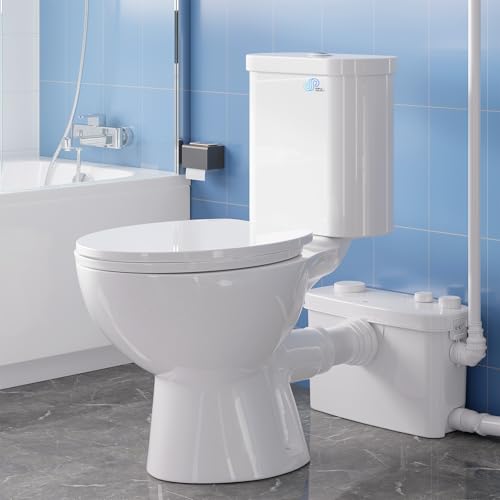
Simple Project Macerating Toilet System 500W — Best for a Simple Addition
Not every upflush project is a full bathroom group. This 500W Simple Project system — four inlets, extension pipe included, space-saving format — is sized for the common case: a basement toilet and sink on a modest run to the drain.
Strengths
- Right-sized pump for short, simple runs
- Four inlets still allow a sink and future additions
- Extension pipe included simplifies the rear layout
Trade-offs
- 500W class has less margin for long or high lifts
- A full shower-and-laundry group deserves a stronger pump
- Same macerator flushing discipline as every system here
| M | a |
| 5 | 0 |
| 1 | . |
| E | x |
Oversizing a macerator wastes money; undersizing it guarantees regret. The skill is matching pump to run, and for the modal project — toilet plus basin, a few feet of lift, a short horizontal run — this 500W class is the honest size, with inlets to spare for the sink. The included extension pipe removes a fiddly sourcing step. Buy the pump your plumbing diagram needs, not the biggest number on the page.
The Simple Project’s 500W class is a reminder that macerator sizing is engineering, not shopping: pump power must overcome your run’s lift and friction, and beyond that duty, extra watts buy noise and cost rather than performance. For the canonical project — a basement toilet and basin a few feet below and a short run from the main drain — this system is sized the way a plumber would size it. Its four inlets preserve the option that matters (the basin, plus a spare), and the included extension pipe closes the kit. Buy the duty, not the digit.
Versus the VEVOR, the Simple Project is the discipline pick: less pump, correctly matched, money saved for the vent and the electrician. Versus the Flodream, it concedes kit ambition and keeps the same inlet generosity. Most real projects look like its brief, which is why it exists.
In practice, the Simple Project’s right-sizing is its virtue made visible: a pump matched to a short duty runs briefly, quietly and without strain, and the system’s total cost stays in the territory that makes the addition an easy decision. Its spare inlets cover the basin and the plausible future. It is the pick that respects the project’s actual shape instead of its anxieties.
Best for: straightforward basement toilet-and-sink additions / Not suited for: long lifts or full multi-fixture groups
Check the current price on Amazon.

maceratingflo 750W Macerating Toilet System — Best Strong-Pump Alternative
This maceratingflo system matches the guide’s top pump class — 750W, four inlets, extension pipe included — giving strong-pump shoppers a second complete option to compare on layout, warranty and price at purchase time.
Strengths
- Top-class 750W pump rating
- Four inlets for a full fixture group
- Extension pipe included in the kit
Trade-offs
- Brand is a category specialist rather than a household name — vet support terms
- Compare discharge geometry carefully against your plan
- Maker lift figures deserve the usual design margin
| M | a |
| 7 | 5 |
| 4 | – |
| E | x |
In a category sold largely on specifications, a second credible 750W kit disciplines the market: compare its discharge outlet position, inlet arrangement and warranty language against the SUPERFLO, and let your plumbing diagram — not the headline wattage, which ties — make the call. The fundamentals here are the right ones for a multi-fixture below-grade bathroom.
Comparison shoppers should put this maceratingflo system and the SUPERFLO side by side on three documents: the discharge geometry diagram, the inlet arrangement, and the warranty terms. On headline specifications they tie — 750W, four inlets, extension pipe — so the decision lives in those documents and in which layout matches the wall you actually have. That is a healthy place for a category to be, and this pick’s inclusion is what forces the comparison. As with every system here, design the run inside the ratings and the flushing rules on the wall.
Versus the SUPERFLO, the maceratingflo ties on headline specification and differentiates on layout documents and terms — the comparison its review insists you make. Versus the 500W class, it is the group-capacity tier. Two credible 750W kits discipline each other’s pricing, to the buyer’s benefit.
In practice, the maceratingflo’s owners are comparison shoppers who chose it on documents — geometry, inlets, terms — and that diligence predicts their ownership: systems bought this way get installed to the manual and serviced on schedule. Its 750W class handles the group duty it was bought for. In a specification-driven category, it is the specification-driven pick.
Best for: comparison shoppers building a full below-grade bathroom / Not suited for: buyers who want a long-established brand name
Check the current price on Amazon.

Kohler Wellworth Pressure Lite (Pressure-Assist) — Best Pressure-Assist
The Pressure Lite represents the other pump family: no electricity, no macerator, no special drain — a sealed pressure vessel inside the tank charges from water pressure and releases a flush far more forceful than gravity alone, at just 1.1 GPF.
Strengths
- Solves weak-flush and clog problems on a standard drain
- No electrical work, no pump maintenance, no flushing restrictions
- Kohler platform with national parts support
- Very efficient 1.1 GPF rating
Trade-offs
- Pressure-assist flush is noticeably louder — the whoosh is the point
- Seat is sold separately (‘less seat’)
- Requires adequate household water pressure to charge the vessel
- Does nothing for a bathroom with no drain access — that is the macerators’ job
| P | r |
| 1 | . |
| E | l |
| L | e |
| W | e |
Include this model in your thinking only if your drain is conventional: pressure-assist is a flush upgrade, not a plumbing workaround. Where it fits, it is superb — hotels use the technology because it simply does not clog under guest abuse, and at 1.1 GPF it does so while sipping water. The noise is the honest tax, and light sleepers with an ensuite should weigh it. For the clog-plagued standard bathroom, this is the pump toilet that asks the least of you afterward.
The Pressure Lite’s vessel technology has one maintenance personality to know: the pressure cartridge inside the tank is a sealed unit with a long service life, and when it eventually tires, it is replaced as a unit rather than rebuilt — a slightly higher part cost against years of indifference in between. It also asks one thing of the house: supply pressure healthy enough to charge the vessel, which most municipal supplies provide easily. In return it delivers the only flush in this guide that hotel engineers specify for abuse resistance, on an ordinary flange, with no electricity and no flushing rules for guests to break.
Versus every macerator here, the Pressure Lite is playing a different sport: no location problem solved, no rules imposed, no electricity consumed. Versus a standard gravity toilet, it is the flush-force upgrade. Its presence in this guide is the honesty mechanism — the pick that tells a whole class of searchers they never needed a pump room at all.
In practice, the Pressure Lite’s ownership is the lightest in this guide: no rules to post, no motor to hear, no power to draw — just a flush with commercial authority, year after year, on an ordinary flange. Its whoosh becomes the bathroom’s signature and then its background. For the household whose only problem was force, it is the pump toilet that asks for nothing back.
Best for: standard-drain bathrooms plagued by weak flushes and clogs / Not suited for: below-grade bathrooms — choose a macerating system instead
Check the current price on Amazon.
Comparison Table
| Pick | Badge | Key spec | Best for |
|---|---|---|---|
| Flodream Macerating Toilet with Pump (Complete Kit) | Best Overall | 4-inlet pump, 24 ft lift claim, complete kit | basement and attic bathrooms planned as complete projects |
| VEVOR Macerating Toilet System 700W | Best Power Value | 700W pump, 3-inlet, rear discharge, dual flush | longer discharge runs on a value budget |
| SUPERFLO 750W Macerating Toilet System | Best for Garage and Workshop Baths | 750W pump, 4 inlets, upflush system | full basement or garage bathroom groups on one pump |
| Simple Project Macerating Toilet System 500W | Best for a Simple Addition | 500W pump, 4 inlets, extension pipe included | straightforward basement toilet-and-sink additions |
| maceratingflo 750W Macerating Toilet System | Best Strong-Pump Alternative | 750W pump, 4 inlets, extension pipe included | comparison shoppers building a full below-grade bathroom |
| Kohler Wellworth Pressure Lite (Pressure-Assist) | Best Pressure-Assist | Pressure-assist, 1.1 GPF, elongated, less seat | standard-drain bathrooms plagued by weak flushes and clogs |
Sizing a Macerator: Duty, Head and the Arithmetic of a Discharge Run
Macerator sizing is arithmetic, not appetite. Start with static head: the vertical distance from the pump’s outlet to the highest point of the discharge run. Add friction: every elbow behaves like additional pipe, and long horizontal runs spend pressure the way height does. The sum is your duty point, and the pump you choose should meet that duty with visible margin inside its stated maxima — never at them, because maxima are measured on a bench, not through your joists. The wattage classes in this guide (500W, 700W, 750W) are a rough proxy for where each system sits on that curve; the maker’s lift-and-run documentation is the actual map.
Inlet count is the second sizing axis, and it is a floor-plan figure rather than a performance one: count the fixtures the pump will serve on the busiest conceivable morning, and choose the system whose inlets cover that count with the layout your walls allow. A toilet-only project on a 500W four-inlet system is correctly sized; the same system asked to carry a shower and laundry is not underpowered so much as misassigned. The reviews in this guide size each pick to its honest duty, which is why the strongest pump here is not the default recommendation.
How to Choose a Pump Toilet (Macerating or Pressure-Assist)
N
o
M
a
E
a
M
a
A
Noise: what to expect and how to plan for it
A macerator runs for several seconds per flush — a motor-and-grinder sound roughly in the appliance family, transmitted through whatever the unit touches. Placement is the mitigation: mount per the manual, avoid rigid contact with stud walls shared with bedrooms, and prefer kits whose makers state a noise figure (the Flodream in this guide does) when the room adjoins sleeping space. Pressure-assist makes a different sound — a short, forceful whoosh through the bowl — with no motor at all. Neither is silent; both are plannable.
Discharge pipework: diameter, slope and access
Macerator discharge lines are small-diameter by design — the pump provides the pressure gravity lines lack — but they must follow the manual’s diameter exactly, slope horizontal runs as directed, and rise vertically before turning horizontal where the layout allows. Every fitting is a future service point, so unions and access matter more than tidiness. Photograph the run before closing any wall; the next person to service the system may be you, in worse light, under time pressure.
When the ejector pit is honestly better
A primary basement bathroom in a forever home, serving a full household daily for decades, is the ejector pit’s best case: gravity-simple, silent, rule-free, and immortal in the ways macerators are not. The pit costs more first and less forever. This guide’s systems win on additions, conversions, rentals, workshops and budgets — a large and legitimate territory — but a guide that will not name its own boundary is selling something. If your project is the forever case and the budget can absorb concrete, get the pit quote before deciding.
Macerator Versus Breaking Concrete: The Real Cost Comparison
The traditional route to a basement bathroom is a saw-cut trench to the main drain, or a sewage ejector pit — reliable, code-simple and expensive, with concrete dust in every room of the house. A macerating system trades that permanence for flexibility: surface-run discharge piping, no slab work, a system that can even move if the floor plan changes. The honest ledger includes the macerator’s finite service life, its noise, its flushing rules and its electricity, against the ejector route’s higher first cost and near-immortal simplicity. For a forever home’s primary basement bath, many plumbers still argue for the pit. For additions, conversions, rentals and budgets that cannot absorb concrete work, the macerator is the technology that makes the bathroom exist at all — and an existing bathroom with rules beats a perfect bathroom that was never built.
How to Plan a Macerating Toilet Installation
Successful upflush projects are won on the diagram, not on install day. Plan in this order and the physical work stays simple.
- Confirm local code and permit requirements for a macerating installation, and locate the drain you will discharge into.
- Sketch the discharge run: vertical lift, horizontal distance, every elbow — then choose a pump class with comfortable margin over that duty.
- Count fixtures and inlets: toilet alone, or sink, shower and laundry as well; size the system to the group.
- Plan power (GFCI receptacle within cord reach, never an extension cord) and the vent path the manual requires.
- Position the unit for service access — the pump will need attention one day, so do not entomb it behind fixed cabinetry.
- Install per the manual’s pipe diameter and slope specifications, test with clean water through every inlet before first real use.
- Post the flushing rules in the room and brief the household: waste and toilet paper only, bin provided for everything else.
Macerator Versus Breaking Concrete: The Real Cost Comparison
The traditional route to a basement bathroom is a saw-cut trench to the main drain, or a sewage ejector pit — reliable, code-simple and expensive, with concrete dust in every room of the house. A macerating system trades that permanence for flexibility: surface-run discharge piping, no slab work, a system that can even move if the floor plan changes. The honest ledger includes the macerator’s finite service life, its noise, its flushing rules and its electricity, against the ejector route’s higher first cost and near-immortal simplicity. For a forever home’s primary basement bath, many plumbers still argue for the pit. For additions, conversions, rentals and budgets that cannot absorb concrete work, the macerator is the technology that makes the bathroom exist at all — and an existing bathroom with rules beats a perfect bathroom that was never built.
The technology has a lineage worth knowing: upflush maceration was refined in Europe, where retrofitting bathrooms into centuries-old buildings is a way of life, by moving the pump into the fixture itself — grind the waste fine, pump it through a small pipe, and let the room’s layout stop negotiating with the drain. Pressure-assist descends separately from commercial buildings that needed decisive flushing on ordinary drains. The modern shopper’s task is simply to keep the lineages straight: maceration solves location, pressure solves force.
Ownership Notes for Pump Toilets
Macerator ownership is a contract with three clauses. Keep the unit accessible — a service panel or a removable enclosure, never a sealed wall. Keep the flushing rules absolute — waste and toilet paper only, with a lidded bin in the room so guests are never tempted to test the boundary. And keep the documentation complete — rating plate photographed, manual saved, spare inlet caps and any model-specific parts stored with it — because the pump’s service day will come on a weekend, and preparation is the difference between a repair and an emergency. Owners who honor the three clauses routinely get long service; the category’s horror stories almost always trace to a broken one.
Pressure-assist ownership is lighter: the vessel is sealed, the parts are a major brand’s, and the only habits required are the ordinary toilet ones — no bleach tablets, supply line inspected, and an ear for a flush that changes character, which is the vessel asking for attention years in advance. Both families share one final note: a pump toilet of either kind should be the household’s considered choice, not its surprise. Brief everyone who will use the room on what the fixture is and what it asks, and the technology settles into the background of the house exactly as plumbing should.
Common Buying Mistakes
Buying a bare pump for a toilet project. Complete systems match pump, pipe and porcelain. Parts-bin builds are the category’s top failure story.
Designing to the maximum lift figure. Maxima are ceilings under ideal conditions, not design targets. Margin is reliability.
Flushing wipes. The single most common macerator killer, including every wipe marketed as flushable. Bin them, always.
Skipping the vent or the GFCI. Both are safety and function requirements, not garnish. An unvented pump gurgles and underperforms; an unprotected circuit is a hazard.
Hiding the pump permanently. Macerators are machines with service lives. Build the access panel you will thank yourself for in year four.
Real-World Scenarios: Who Buys What, and Why
The finished-basement guest suite. A below-grade bedroom and bath for visiting family, main drain across the slab. Concrete work is quoted at a figure that ends the conversation; the Flodream kit is not. The run is sketched, the lift is half the stated maximum, the vent ties into the existing stack, and the suite opens for the holidays. This is the macerator’s founding scenario, and it happens in thousands of houses a year.
The workshop bathroom. A detached garage workshop whose owner is done walking to the house. A toilet and a utility sink, a long run to the septic line. The SUPERFLO’s capacity and inlet count fit the sink-and-toilet group with headroom, and the garage forgives the pump’s voice entirely. Productivity, dignity and a shorter walk in January: the scenario sells itself.
The clog-plagued ranch. A standard-drain bathroom, a long flat drain run, and a plunger with seniority. No location problem exists, so no macerator is bought; the Pressure Lite ends the clog era on the existing flange in an afternoon. The scenario is the guide’s honesty in action — the right pump toilet for this house is the one with no pump in the ground at all.
Before You Order: The Pump-Toilet Checklist
One: the problem classified — location (macerator) or force (pressure-assist) — in writing, before any product is compared. Two: discharge route sketched with lift, run and elbows counted. Three: pump class chosen with margin inside the stated maxima. Four: inlets counted against the full fixture group, present and planned. Five: power (GFCI) and vent routes confirmed physically possible in the actual room. Six: local permit and code requirements checked with the authority, not assumed. Seven: the household briefed on flushing rules, with a bin specified for the room. A pump project that passes all seven is a system; one that skips them is a story.
Final Recommendation
For the complete basement or attic project, the Flodream kit is the balanced default; long runs favor the VEVOR 700W, full fixture groups the SUPERFLO 750W or the maceratingflo 750W, and the simple toilet-and-sink addition the right-sized Simple Project 500W. If your drain is conventional and only your flush is failing, skip maceration entirely for the Kohler Pressure Lite. Match the pump family to the problem, design inside the ratings, and a bathroom that gravity forbade becomes the most appreciated room in the house.
The pump decision in one paragraph: no drain, moderate project — Flodream. No drain, long run — VEVOR. No drain, whole bathroom group — SUPERFLO or maceratingflo by their documents. No drain, simple addition — Simple Project. Drain present, flush failing — Pressure Lite. And drain present, flush fine — none of the above, with the guide’s blessing.
The bottom line of the pump-toilet world is classification before product: location problems get macerators, force problems get pressure-assist, and working gravity bathrooms get left alone. Inside the correct family, size to the measured duty with margin, respect the vent, the circuit and the flushing rules, and the technology delivers what gravity would not. The six picks above are the current best expression of both families, with their limits stated as plainly as their powers.
Frequently Asked Questions
N
o
B
a
I
t
Y
e
T
h
O
f
Can a macerating toilet discharge into any drain?
It must discharge into a suitable soil stack or main drain per the manufacturer’s instructions and local code — not into a vent, not into a rain leader, and not uphill beyond its rated duty. The planning steps in this guide exist to confirm the route before purchase.
What happens to a macerator in a power outage?
It does not pump. One flush’s worth of capacity typically remains in the unit, but the bathroom is effectively out of service until power returns — a real consideration for a home’s only bathroom, and one more reason macerators suit additional bathrooms best.
Is a pressure-assist toilet safe for old plumbing?
Its flush is forceful at the bowl but the drain sees ordinary volumes — 1.1 gallons in the Kohler here. Homes with fragile or partially blocked drains should have the line’s condition checked, since a stronger flush reveals restrictions a weak one politely hid.
Can I install a macerating toilet myself?
Many owners do — the systems are kitted for it — but the project touches plumbing, electrical and venting, each with code implications. Confident DIYers with a permit where required succeed routinely; anyone unsure about the vent or the circuit should hire those trades for those pieces.
How much electricity does a macerator use?
Very little in household terms: the pump runs for seconds per flush, so annual consumption is a rounding error on a home’s bill. The electrical requirement that matters is not cost but the GFCI-protected circuit’s presence and placement.


