Disclosure: airfryerkitchensupply.com is reader-supported. When you buy through links on our site, we may earn an affiliate commission at no extra cost to you.
Where to buy
For shoppers comparing the best 2 piece toilets, every linked model below was verified through Amazon’s catalog data for this site on 2026-11-20, so the product page you land on is the exact configuration described. Toilets are heavy, fragile freight: whichever retailer you use, confirm the rough-in, bowl shape and height on the manufacturer’s spec sheet before ordering, keep the box until the toilet is test-fitted on your flange, and arrange delivery to a ground-floor location if you cannot move a boxed toilet with a second person.
- TOTO Drake Two-Piece Elongated (CST776CSFG) — Check price on Amazon
- Kohler Highline Two-Piece Round-Front — Check price on Amazon
- American Standard Champion PRO Elongated — Check price on Amazon
- Gerber Maxwell Crest Elongated Two-Piece — Check price on Amazon
- Kohler Wellworth K-3988 Dual-Flush — Check price on Amazon
- HOROW 17-Inch Two-Piece — Check price on Amazon
The best 2 piece toilets dominate the market for reasons that have nothing to do with fashion. A two-piece toilet — separate tank and bowl, bolted together at installation — is cheaper to manufacture, cheaper to ship, easier to carry through a house, and dramatically easier to repair than a one-piece design. When a tank cracks, you replace a tank. When a flush valve wears, the part costs little and lives in every hardware store. That ownership logic is why the best-selling toilets in America, from the TOTO Drake to the Kohler Highline to the American Standard Champion PRO, are two-piece designs, and why plumbers keep recommending the format.
Honesty requires the trade-offs up front. A two-piece toilet has a seam where tank meets bowl — one more place to clean, and a joint whose bolts and gasket deserve a periodic check. Its silhouette shows the trapway curves that skirted one-piece designs hide. And because the format spans every price tier, quality varies more widely than in the one-piece world: the best two-piece toilets are superb, and the worst are false economy. This guide exists to sort the first group from the second.
The six picks below were verified through Amazon’s catalog data for this site on 2026-11-20, and they span the format’s real range: the benchmark Drake, Kohler’s Class Five Highline, the clog-focused Champion PRO, a value Gerber with its install kit bundled, a dual-flush Wellworth, and a 17-inch HOROW that brings chair height to the format at a value tier. Between them, every two-piece brief — performance, serviceability, efficiency, height, budget — has a considered answer.
It is worth understanding why the format’s economics are so durable, because they explain the picks. Porcelain is heavy and fragile; shipping a toilet as two smaller cartons breaks less of it and stacks it denser, and manufacturing tank and bowl separately lets one tank design serve several bowls. Those savings are why a two-piece toilet of genuinely excellent quality can sell at a tier a one-piece equivalent cannot match — and why the format’s best models are not cheap substitutes but the industry’s center of gravity. The picks below were chosen from that center outward: first the platforms with the deepest reputations, then the configurations that serve the format’s specific briefs.
The two-piece market’s breadth creates one shopping hazard the other formats avoid: near-identical listings. A single product family can appear at several prices differing only by configuration — bowl shape, height, rough-in, seat inclusion — and the cheapest listing is routinely the configuration you do not want. The discipline is unglamorous and total: decide the configuration first, then shop its exact model number. Every pick in this guide is named to that standard so the discipline is easy to practice.
In this guide
Quick Picks
- Best Overall — TOTO Drake Two-Piece Elongated (CST776CSFG): the benchmark: tornado flush, CEFIONTECT glaze and Universal Height in the format’s best-selling form
- Best Efficient Classic — Kohler Highline Two-Piece Round-Front: Class Five canister flushing at 1.28 GPF, comfort height, in a round-front footprint
- Best Anti-Clog — American Standard Champion PRO Elongated: the Champion brief — clog resistance first — in a chair-height elongated two-piece at 1.28 GPF
- Best Value Bundle — Gerber Maxwell Crest Elongated Two-Piece: a glazed-trapway elongated two-piece with soft-close seat and a tool-free install kit including the wax ring
- Best Standard-Height Classic — Kohler Wellworth K-3988 Dual-Flush: the Wellworth institution with an elongated bowl and dual-flush Class Five system at traditional height
- Best Chair-Height Value — HOROW 17-Inch Two-Piece: a full 17-inch ADA chair height in a simple two-piece at 1.28 GPF
How These Picks Were Chosen
Candidates had to be genuine two-piece models with verifiable catalog listings, and the final six were chosen to represent the format’s decision points rather than six near-identical boxes: flush platform (tornado, canister, trade siphonic), height class (standard through 17-inch chair height), bowl shape, and support depth. Each model was verified through the site’s Amazon catalog data on 2026-11-20; spec boxes state only what the listings confirm.
Scoring weighted the ownership virtues this format promises: parts availability, tank-to-bowl hardware quality, seat inclusion transparency, and flush reputation. A two-piece toilet that fails at serviceability fails at its own reason to exist, so models from lines with generic, stocked internals scored above equally pretty designs with proprietary guts. Water ratings span 1.28 to 1.6 GPF, and the reviews say plainly which households should care.
We gave unusual weight to a factor spec sheets hide: the quality of the tank-to-bowl hardware and gasket design, because that joint is the format’s one inherent weakness and good makers engineer it seriously — wide gaskets, sensible bolt patterns, tanks that seat without rocking. Models whose joint design felt like an afterthought did not survive the cut, however attractive their flush numbers. We also checked that each pick’s rated configuration is the one its listing actually sells, since two-piece families sprawl across heights and bowl shapes under one product name, and a review of the wrong configuration helps no one.
The 6 Best 2 piece toilets

TOTO Drake Two-Piece Elongated (CST776CSFG) — Best Overall
The Drake is the two-piece toilet the rest are compared to: TOTO’s tornado rim flush, a self-cleaning glaze, Universal Height and an elongated bowl, in a design whose every wear part is stocked nationally.
Strengths
- Benchmark flush performance and bowl cleanliness
- Deepest parts ecosystem in the format
- Universal Height suits most adults
Trade-offs
- 1.6 GPF rating trails efficiency leaders
- Seat is a separate purchase in this configuration
- Exposed trapway shows the format’s traditional silhouette
| T | w |
| U | n |
| 1 | . |
| C | E |
Ownership is the Drake’s argument. The flush clears decisively, the glaze stretches the interval between brush sessions, and when anything wears in year nine, the part exists and the knowledge to fit it is universal. The 1.6 rating is the one dated figure in an otherwise modern package — water-strict households should take the 1.28 Highline below and accept a small step down in bowl-cleaning luxury.
The Drake’s tank deserves a sentence of its own: it is uninsulated and unapologetic, a simple reservoir whose internals any homeowner can understand at a glance — which is precisely why it so rarely causes trouble. In humid climates a sweating tank is possible (the fix is an insulated model or a mixing valve, not regret), and the two-piece seam collects the dust this format is known for. Neither dents the model’s standing. Bought in the right configuration for your rough-in and room, the Drake is the two-piece purchase the fewest households ever reconsider.
Versus the Highline, the Drake is the cleanliness maximalist against the efficiency classic. Versus the Champion PRO, it is refinement against force. It leads the format’s guide because its combination of platform, glaze and ecosystem is the one the most households would choose with unlimited deliberation time.
In practice, the Drake’s service events arrive as errands rather than emergencies — a flapper from any shelf, a fill valve any neighbor has fitted — and between events, the bowl’s glaze keeps the brush in the cupboard for long stretches. Owners upgrading from an anonymous builder toilet describe the change as the bathroom growing up. It is the format’s benchmark because its ownership curve is the flattest: high satisfaction, immediately, sustained indefinitely.
Best for: a primary bathroom bought for the long term / Not suited for: strict water budgets or skirted-styling briefs
Check the current price on Amazon.

Kohler Highline Two-Piece Round-Front — Best Efficient Classic
The Highline pairs Kohler’s canister Class Five flush with comfort height and an efficient 1.28 rating — the modern-spec legacy two-piece, in a round-front body that fits ordinary bathrooms.
Strengths
- Efficient 1.28 GPF with a decisive canister flush
- Comfort height in a standard footprint
- Kohler support and parts nationwide
Trade-offs
- Round bowl is compact for larger users
- Seat sold separately
- Right-hand lever only in this configuration
| T | w |
| C | o |
| 1 | . |
| R | o |
| R | i |
If the Drake is the benchmark, the Highline is the benchmark at 1.28 gallons — the rating efficiency codes reward and septic systems prefer. The canister design ages gracefully and its seals are standard fare. Round-front keeps it honest in smaller rooms. For most households replacing a hall-bath toilet, this is the two-piece with the fewest asterisks.
The Highline’s canister flush has a maintenance personality worth knowing: instead of a flapper on a chain, a canister lifts to release water and reseats on a seal — a design whose wear part is the seal ring, inexpensive and widely stocked. Owners coming from flapper toilets sometimes misread the first canister they meet; the manual’s diagram resolves it in a minute. At 1.28 GPF with comfort height and Kohler’s support, this remains the efficiency-first legacy specification, and its round-front form is the one most real bathrooms actually need.
Versus the Drake, the Highline wins the water argument and the code argument in strict jurisdictions. Versus the Wellworth K-3988, its brand-mate in spirit, it is the comfort-height expression of the same legacy logic. Ordinary bathrooms are its empire.
In practice, the Highline’s canister system asks one new habit of flapper-raised owners — learning that the seal ring is the wear part — and repays it with years of decisive, efficient flushes. Its round front’s spatial manners suit the ordinary bathroom it usually serves. At 1.28 gallons with Kohler’s network behind it, this is the two-piece specification a cautious household can sign without a second meeting.
Best for: efficiency-minded households wanting a legacy platform / Not suited for: elongated-bowl loyalists — see the K-6393 variant in the 17-class guide
Check the current price on Amazon.

American Standard Champion PRO Elongated — Best Anti-Clog
Champion PRO takes American Standard’s clog-resistance engineering into a pro-serviceable two-piece at chair height and 1.28 GPF — the family-bathroom and rental-upgrade specification.
Strengths
- Engineered around ending clogs
- Chair height plus elongated comfort
- PRO internals are trade-serviceable
Trade-offs
- Utilitarian appearance
- Seat and supply line separate
- Flush-first design will not win styling contests
| T | w |
| C | h |
| 1 | . |
| E | l |
Households with a plunger permanently stationed beside the toilet do not need styling advice; they need this toilet’s design brief. The PRO line wraps that brief in parts any plumber stocks. At 1.28 it also answers the efficiency question its 1.6 ancestors could not. Plain, purposeful and effective — the two-piece virtues in their purest form.
Champion PRO ownership has a rhythm landlords recognize: install it, and the toilet leaves the maintenance ledger for years at a time. The PRO line’s internals are chosen for exactly that outcome. Households should still observe the format’s one ritual — the annual dry-towel check at the tank seam — but the Champion’s joint hardware is built to pass it indefinitely. Its chair height and elongated bowl make it a legitimate primary-bathroom toilet rather than a utility compromise, and its 1.28 rating keeps it legal and sensible in efficiency-regulated jurisdictions.
Versus the Drake and Highline, the Champion PRO declines the refinement contest and wins the household with a history. Versus the Gerber, it is the branded specialist against the bundled generalist. Its buyer knows exactly who they are.
In practice, the Champion PRO’s ownership is measured in absences: no plunger stationed, no guest briefing, no Sunday-evening hardware run. The PRO internals make the rare service event a formality. For the family bathroom that processes a household’s full traffic, that reliability is not a feature among features — it is the product, and this model is its purest two-piece form.
Best for: clog-prone family bathrooms and landlord upgrades / Not suited for: design-led remodels
Check the current price on Amazon.

Gerber Maxwell Crest Elongated Two-Piece — Best Value Bundle
Gerber is a trade brand most homeowners meet through their plumber, and the Maxwell Crest shows why: an elongated two-piece with a glazed trapway, soft-close seat, and the install kit — wax ring included — bundled in the box.
Strengths
- Most complete box in this guide: seat and install kit included
- Glazed trapway resists the buildup that starts clogs
- Trade brand with pro-oriented distribution
Trade-offs
- Brand is less familiar to consumers than the big three
- Flush platform is competent rather than class-leading
- Confirm the kit contents on arrival before install day
| T | w |
| E | l |
| S | o |
| T | o |
| G | l |
Bundling is a genuine virtue for a DIY installer: the seat and wax ring arriving with the toilet removes two errands and two chances to buy the wrong part. Gerber’s trade heritage shows in the glazed trapway and the no-drama design. If the budget is firm and the installer is you, this package respects both constraints better than any rival here.
Gerber’s trade heritage shows in a place consumers rarely look: the trapway is glazed, a finish step value brands often skip because buyers cannot see it in a photo. A glazed trapway is smoother where waste actually travels, which is where clogs begin. Combined with the bundled seat and install kit, the Maxwell Crest is the most completely considered value package in this guide — the toilet for the buyer who reads the whole box rather than the headline. Its brand unfamiliarity is a retail artifact, not a quality signal; plumbers have installed Gerber for generations.
Versus the legacy trio, the Gerber’s counter is the complete box and the glazed trapway at a value tier. Versus the HOROW, it is trade-heritage completeness against height-led value. DIY installers doing the whole job from one delivery are its constituency.
In practice, the Gerber’s bundled completeness compresses the whole project: delivery, unbox, install, done — with the seat and ring that other purchases send you back out for. Its glazed trapway keeps the flush honest over years, and its trade internals keep service ordinary. DIY installers consistently underrate how much of a toilet project is logistics; this pick is engineered by people who never did.
Best for: DIY installers wanting one complete box at a value tier / Not suited for: buyers chasing a flagship flush platform
Check the current price on Amazon.
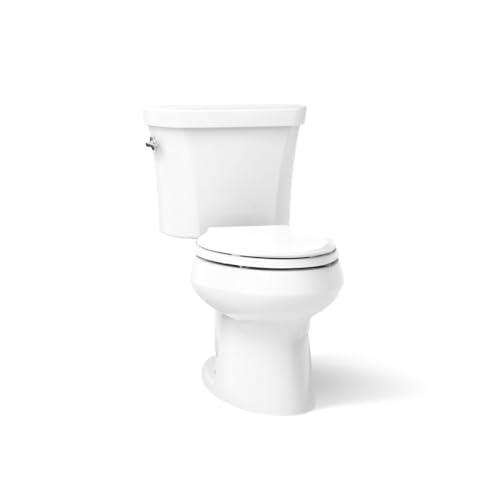
Kohler Wellworth K-3988 Dual-Flush — Best Standard-Height Classic
Not every two-piece buyer wants chair height. The K-3988 keeps the traditional standard height on the Wellworth platform, stretched to an elongated bowl with dual flush — the classic, modernized in exactly two places.
Strengths
- Proven platform with generational parts support
- Dual flush adds water discipline
- Elongated comfort at standard height
Trade-offs
- Standard height will not suit chair-height briefs
- Left-hand lever configuration
- Seat typically separate
| T | w |
| D | u |
| E | l |
| W | e |
The Wellworth’s installed base is an argument no new design can rebut: parts forever, knowledge everywhere. This configuration is the one for a traditional household’s primary bathroom — elongated where it counts, dual-flush where it saves, standard height where the family prefers it. Buying it is less a decision than an inheritance of the market’s most-traveled road.
The Wellworth K-3988 illustrates the format’s breadth in a single model: a platform older than most of its buyers, still in production, wearing a dual-flush update and an elongated bowl at the traditional height. That combination — heritage platform, current features — is something only the two-piece world’s production volumes make economical. Its left-hand lever is the one configuration detail to verify against your room. For a household that wants the market’s most traveled road with the water choice of a modern toilet, this is the exact address.
Versus the Highline, the Wellworth K-3988 holds the standard-height, dual-flush corner of the legacy world. Versus the Gerber, it is the generational institution against the trade bundle. Traditional households will not be argued out of it, and this guide does not try.
In practice, the K-3988 behaves like what it is: the current model year of a very old, very successful idea. The dual flush modernizes its water ledger, the elongated bowl modernizes its comfort, and everything underneath remains the platform a generation of plumbers can service blindfolded. Traditional households are not being nostalgic when they choose it; they are being actuarial.
Best for: traditional households and standard-height loyalists / Not suited for: chair-height or mobility briefs
Check the current price on Amazon.

HOROW 17-Inch Two-Piece — Best Chair-Height Value
The HOROW closes the guide’s range: the tallest brief — a 17-inch ADA chair-height elongated bowl — delivered in the two-piece format at a value tier with an efficient single flush.
Strengths
- Full chair height without the legacy-brand price tier
- Simple single-flush internals
- Elongated bowl at 1.28 GPF
Trade-offs
- Single flush, no light-flush option
- Brand support thinner than the big three
- Plain styling
| T | w |
| 1 | 7 |
| S | i |
Chair height used to be a premium feature; this model is evidence it has become a commodity — which is good news for accessibility budgets. The internals are simple, the rating is efficient, and the height is exact. The support caveat is real but proportionate: at this tier, the toilet costs less than a legacy model’s premium, and its wear parts follow common patterns. For a mobility-driven purchase on a firm budget, it is the rational two-piece.
The HOROW’s presence in a guide anchored by legacy brands is deliberate: it proves the format’s accessibility tier has matured. A full 17-inch ADA height, elongated bowl and efficient single flush in a two-piece that undercuts the legacy chair-height models is a genuinely new market fact, driven by the same manufacturing economics that built the format. The ownership discipline is the standard newer-brand one — documentation saved, part numbers recorded — and the internals follow common patterns that soften even that caveat. For a mobility purchase on a hard budget, it is the rational two-piece.
Versus the Champion PRO, the HOROW matches chair height and undercuts on tier while conceding support depth. Versus the Gerber, it is the height-led value play against the completeness-led one. Accessibility on a budget is a real brief, and this is its two-piece answer.
In practice, the HOROW delivers its 17 inches without ceremony — installed in an afternoon, operated by everyone, serviced with common patterns. Its value tier shows in the brand’s support depth rather than in the porcelain’s performance, and the documentation habit closes most of that gap. For the accessibility purchase on a real budget, it converts money saved into the grab bars and lighting the same project deserves.
Best for: accessibility purchases on a firm budget / Not suited for: buyers wanting dual flush or flagship support
Check the current price on Amazon.
Comparison Table
| Pick | Badge | Key spec | Best for |
|---|---|---|---|
| TOTO Drake Two-Piece Elongated (CST776CSFG) | Best Overall | Universal Height, TORNADO FLUSH, 1.6 GPF | a primary bathroom bought for the long term |
| Kohler Highline Two-Piece Round-Front | Best Efficient Classic | Comfort height, Class Five 1.28 GPF, round | efficiency-minded households wanting a legacy platform |
| American Standard Champion PRO Elongated | Best Anti-Clog | Chair height, 1.28 GPF, Champion PRO | clog-prone family bathrooms and landlord upgrades |
| Gerber Maxwell Crest Elongated Two-Piece | Best Value Bundle | Elongated two-piece, seat + install kit included | DIY installers wanting one complete box at a value tier |
| Kohler Wellworth K-3988 Dual-Flush | Best Standard-Height Classic | Standard height, dual flush Class Five, elongated | traditional households and standard-height loyalists |
| HOROW 17-Inch Two-Piece | Best Chair-Height Value | 17in height, two-piece, 1.28 GPF | accessibility purchases on a firm budget |
Anatomy of a Two-Piece: The Parts You Are Actually Buying
A two-piece toilet is five purchases wearing one price tag. The bowl contributes the trapway, the glaze and the geometry your body meets. The tank contributes capacity and the lid you will remove a dozen times in ownership. The flush valve — flapper or canister — is the engine, and its design decides both performance and the part you will replace in year seven. The fill valve decides noise and refill speed and is the component most likely to announce its age audibly. And the seat, often sold separately on legacy lines, is the only part you touch every time. Judging a two-piece model means judging those five purchases separately; the reviews in this guide do exactly that, which is why their verdicts differ even among models with identical headline ratings.
The joint between tank and bowl deserves its own line in the anatomy: a wide rubber gasket, two or three bolts, and a seating procedure that rewards patience. Good makers engineer this joint generously; poor ones make it the warranty claim. When you compare models in a showroom, look underneath the tank rim and at the gasket’s footprint — it is the one place a two-piece toilet shows its quality before water ever touches it.
How to Choose a Two-Piece Toilet
T
a
T
h
T
w
T
o
V
a
Tank-to-bowl hardware: what good looks like
A wide, supple gasket; bolts that draw the tank down evenly without porcelain-to-porcelain contact; and a tank that sits level without shimming. At install, tighten alternately and stop at firm — the gasket seals by compression, not by force. After the first week of use, one re-check of bolt snugness settles the joint for years. Models in this guide were screened with this joint in mind, because it is the only place the format can embarrass itself.
Swapping a one-piece mindset for a two-piece reality
Buyers cross-shopping formats should reprice honestly: the one-piece premium buys silhouette and cleaning ease; the two-piece saving buys a seat upgrade, a better flush platform tier, or the plumber’s visit itself. Neither is the ‘real’ price of quality. In this guide’s judgment, households that clean their own bathrooms and keep homes long-term split on the question legitimately — which is why both formats have full guides on this site rather than a verdict imposed from above.
Rough-in and configuration sprawl
Two-piece families are sold in 10, 12 and 14-inch rough-ins and every height-bowl combination, frequently under one product name with suffix-coded variants. The discipline from the other guides applies with extra force here: order by full model number, verify rough-in and bowl on the manufacturer’s sheet, and confirm the listing’s configuration matches before paying. The format’s breadth is its gift; the suffix is how you claim it.
Two-Piece Versus One-Piece: The Honest Ledger
One-piece toilets win the photograph: no seam, smooth trapway covers, a sculptural calm. Two-piece toilets win the decade: cheaper purchase, cheaper freight, a tank that can be replaced alone, internals that any store stocks and any plumber knows, and the ability to carry the fixture into a bathroom in two light trips instead of one heavy lift. The ledger flips only when cleaning effort dominates your thinking — skirted one-piece designs genuinely do wipe down faster — or when the design brief is uncompromisingly modern. For the majority of households, and nearly all rentals and second bathrooms, the two-piece ledger wins, which is why this format owns the market’s center. Choose it knowingly and you will never feel you settled.
How to Install a Two-Piece Toilet (and Set the Tank Right)
The two-piece install adds one operation to a standard swap — joining tank to bowl — and that joint is where leaks are born or prevented. Take it slowly.
- Prepare the flange as with any install: clean, sound, roughly flush with the floor, new bolts in place.
- Assemble the tank first on a padded surface: fit the flush valve and fill valve per the manual, then the tank-to-bowl gasket.
- Set the bowl on the flange with a new wax or silicone ring, snug the closet nuts alternately, and confirm no rocking (shim if needed).
- Lower the tank onto the bowl, aligning bolts through the bowl’s holes; snug the tank bolts alternately, a little at a time, until the tank is level and firm — never crank one side down.
- Connect the supply, open the valve slowly, and watch the tank-to-bowl joint through three flushes; a dry paper towel reveals seeps fingers miss.
- Fit the seat, adjust the water level to the tank’s marked line, and re-check the joint again after 24 hours of use.
- Record the model’s part numbers for flapper, seal and fill valve in the manual and store it — future you says thanks.
Two-Piece Versus One-Piece: The Honest Ledger
One-piece toilets win the photograph: no seam, smooth trapway covers, a sculptural calm. Two-piece toilets win the decade: cheaper purchase, cheaper freight, a tank that can be replaced alone, internals that any store stocks and any plumber knows, and the ability to carry the fixture into a bathroom in two light trips instead of one heavy lift. The ledger flips only when cleaning effort dominates your thinking — skirted one-piece designs genuinely do wipe down faster — or when the design brief is uncompromisingly modern. For the majority of households, and nearly all rentals and second bathrooms, the two-piece ledger wins, which is why this format owns the market’s center. Choose it knowingly and you will never feel you settled.
The two-piece toilet is also a child of logistics that became a virtue: porcelain ships denser and breaks less as two cartons, foundries can pair one tank with several bowls, and the resulting parts economy spans continents. When one-piece designs arrived as the premium alternative, they won the design press and a minority of the market, while the two-piece quietly became the default specification of builders, landlords, hotels and homeowners who had owned a toilet long enough to repair one. That history is this guide’s confidence: the format’s best models are mature products at the center of an enormous support ecosystem.
Ownership Notes for Two-Piece Toilets
Two-piece ownership has one ritual and one rule. The ritual is the annual seam check: after a flush, run a dry paper towel around the tank-to-bowl joint and the supply connection; any dampness earns a bolt snug or a gasket, caught years before it could matter. The rule is new seals at every disturbance — if the tank comes off for any reason, it goes back on with a fresh gasket, because the old one has taken a set and will not reseal to its first standard. Both habits take minutes and together they neutralize the format’s only structural weakness.
Everything else is the industry’s ordinary calendar: flappers, canister seals and fill valves on multi-year rhythms, all of them shelf parts for every model in this guide, and a standing ban on bleach drop-in tablets that degrade rubber indiscriminately. Keep the model’s full number and the seat’s specification in the house file, and a two-piece toilet’s lifetime cost of ownership is the lowest in the entire fixture category — which, more than any flush statistic, is why the format endures.
Common Buying Mistakes
Overtightening the tank bolts. The classic two-piece crack. Snug alternately until firm and level; porcelain is not a lug nut.
Reusing the old tank-to-bowl gasket. It has taken a set and will weep. New gasket every install, no exceptions.
Skipping the 24-hour re-check. Slow seeps at the seam announce themselves late. One planned inspection prevents a rotted floor discovery.
Buying the bundle without checking bowl shape. Two-piece breadth is the format’s gift — confirm round versus elongated against your measured clearance.
Ignoring water level adjustment. A level set too high wastes water every flush; too low weakens it. The tank’s marked line takes ten seconds to honor.
Real-World Scenarios: Who Buys What, and Why
The upstairs-downstairs problem. A toilet must reach a second-floor bathroom up a switchback stair, installed by one person of ordinary strength. The two-piece format is not a preference here; it is the enabling technology — two cartons, two trips, no hernia. The Gerber’s bundled kit closes the job in one delivery. Logistics chose the format; the guide chose the model.
The twenty-year house. A couple furnishing the home they intend to age in, buying the primary bathroom’s toilet as infrastructure. The Drake is chosen for the ecosystem, with the seat upgraded separately and the part numbers filed. Their reasoning — that the toilet’s second decade outranks its first impression — is the format’s founding logic, and this scenario is why the guide leads with it.
The duplex conversion. Two bathrooms, one weekend, a hard budget and a landlord who self-manages. The HOROW serves the unit being fitted for an older tenant at chair height; the Gerber serves the other with its complete box. The scenario shows the format’s real superpower: at every tier and brief, there is a two-piece that fits it without a special order.
Before You Order: The Two-Piece Checklist
One: configuration decided first — height, bowl shape, rough-in — and the exact model number shopped, never the family name alone. Two: complete cost assembled including seat, ring and supply line. Three: tank-to-bowl hardware reviewed in the model’s documentation — wide gasket, sensible bolt pattern. Four: flush platform matched to household history. Five: lever side and supply position checked against the room. Six: a spare gasket and flapper added to the house kit at purchase, while the model is in front of you. Seven: packaging kept until the seam check passes dry after the first day’s flushes. The format rewards the methodical; this is the method.
The Decision, Compressed: A Five-Minute Framework
The two-piece decision compresses into five steps, and the format’s breadth is what makes each step decisive. First, fix the configuration in writing — height class, bowl shape, rough-in — before looking at a single price, because this family’s listings punish configuration drift like no other. Second, name the household’s flush history in one word and take the platform that answers it: tornado-and-glaze for stains, canister for balanced efficiency, Champion architecture for clogs, trade siphonic for quiet competence. Third, inspect the joint on paper: the model’s gasket design and bolt pattern are in its documentation, and a generous gasket footprint is the format’s quality signature. Fourth, assemble the complete cost — porcelain, seat, wax ring, supply line, and a spare gasket and flapper for the house kit — and compare models on that total, never on the porcelain alone. Fifth, verify the exact model number against the manufacturer’s sheet one final time before paying, suffix and all. Run the five, and the two-piece purchase delivers what the format promises: a toilet bought once, serviced forever, and thought about never — the correct relationship between a household and its plumbing.
Final Recommendation
The TOTO Drake remains the format’s benchmark for a primary bathroom, with the Kohler Highline its equal at 1.28 GPF. Clog history chooses the Champion PRO, a firm DIY budget the bundled Gerber Maxwell Crest, traditional standard height the Wellworth K-3988, and chair height on a budget the HOROW 17-inch. Every one of them honors the two-piece promise: buy it once, repair it forever, and never think about it in between.
The format in one paragraph: Drake for the benchmark, Highline for the efficient classic, Champion PRO for the clog, Gerber for the complete box, Wellworth for the traditional house, HOROW for the accessible budget. Six briefs, six answers, one format — the two-piece market’s breadth is the reason a guide like this can be specific instead of general.
The bottom line of the two-piece market is that its dominance is earned anew every time one is repaired in twenty minutes with a part bought the same day. The six picks above span its benchmark, its efficiency classic, its clog specialist, its complete box, its institution and its accessibility value — which is to say, they span the reasons the format owns the center of the market. Choose the brief, then the model, and the format does the rest for a couple of decades.
Frequently Asked Questions
A
T
h
S
l
O
f
F
l
T
w
Can I mix a tank from one model with a bowl from another?
Generally no — bolt patterns, gasket sizes and flush calibration are model-specific even within a brand. Replace like with like using the full model number; the two-piece advantage is replaceable parts, not interchangeable ones.
Why do some 2 piece toilets cost several times others?
The porcelain, glaze quality, flush platform refinement and support network differ enormously within the format. The budget end buys a functional toilet with basic internals; the premium end buys engineering and parts depth. This guide’s mid-tier legacy picks are where lifetime value usually peaks.
Is a 2 piece toilet a good choice for a small bathroom?
Yes — the format includes round-front and compact configurations at every height, several of which appear in this site’s depth and small-bathroom guides. Choose by measured clearance and bowl shape, not by piece count.
Can I upgrade a 2 piece toilet’s flush performance later?
Within limits: fill valves and flappers tune water level and timing, and some platforms accept manufacturer update kits. The bowl and trapway — the performance foundation — are fixed at purchase, which is why the platform choice in this guide matters more than any later adjustment.
Do 2 piece toilets come in 10-inch rough-in?
Yes — several models in this site’s 10-inch guides are two-piece, including the Drake and Cadet Pro configurations. Rough-in is a configuration axis independent of format; order it by full model number as always.
A Final Word on the Format That Asks the Least
There is a species of product whose excellence consists of never being thought about, and the two-piece toilet is its type specimen. It asks for a gasket’s attention once a year, a flapper’s replacement twice a decade, and nothing else — no firmware, no filter subscription, no proprietary anything. In a house filling with objects that demand updates, accounts and apps, that silence is worth naming as the luxury it has quietly become. The six picks in this guide are the format’s best current keepers of that silence, varied by every brief a household can bring except the need to be impressed. Choose the configuration, choose the platform, file the model number, and go think about literally anything else for twenty years. The toilet will be fine; that was always the point of it.
One last practical note for the format: because a two-piece toilet arrives as two cartons, verify both against the model number before the carrier leaves — a mismatched tank-and-bowl pairing is rare, but it is exactly the kind of rare that ruins an install Saturday. Open both boxes the same day, check the bowl rim and tank corners for hairline cracks, and confirm the gasket and bolt kit are present in the tank carton. Ten minutes of inspection at delivery is the cheapest insurance in the entire project, and it converts the format’s one logistical complexity into a complete non-event.
And if the toilet is headed for a bathroom shared by generations — grandparents at chair height, grandchildren on a step — remember that the format’s breadth is the household’s friend: the same trusted platform often exists in both heights, letting one house standardize on a single parts ecosystem while fitting each bathroom to its users. That is the two-piece market at its most useful, and it is available in this guide’s legacy picks today.


