Disclosure: airfryerkitchensupply.com is reader-supported. When you buy through links on our site, we may earn an affiliate commission at no extra cost to you.
Where to Buy 1 Cu Ft Microwaves
The fastest way to compare the models in this guide is on Amazon, where each listing shows its current finish options, dimensions and delivery details. Use the links below to check the current price on Amazon for each pick, and always confirm the exterior dimensions and, for over-the-range models, the venting configuration on the product page before you order. Prices and availability change, so we do not print fixed prices here; the listing you land on is the accurate one.
- Panasonic NN-SF57RM Flatbed Microwave 1.0 Cu. Ft. — Best Overall: Check price on Amazon
- BLACK+DECKER Countertop Microwave 1.1 Cu. Ft. (Stainless Steel) — Best Step-Up: Check price on Amazon
- BLACK+DECKER Countertop Microwave 0.9 Cu. Ft. (Stainless Steel) — Best Value: Check price on Amazon
- TOSHIBA Microwave 0.9 Cu. Ft. (Black Stainless Steel) — Best for Small Apartments: Check price on Amazon
- Chefman Countertop Microwave 0.9 Cu. Ft. (Black) — Best Budget Black: Check price on Amazon
- COMFEE’ Retro Microwave 0.9 Cu. Ft. (Apricot) — Best Style: Check price on Amazon
The hunt for the best 1 cu ft microwaves has a quirk that shoppers discover quickly: very few ovens are actually rated at exactly 1.0. The compact market clusters at 0.9 and 1.1 cu. ft., with brands treating the round number as a neighbourhood rather than an address. This guide respects the search properly. It leads with a genuine exact-1.0 model, a flatbed Panasonic with technology most larger ovens would envy, and then brackets it with the best 0.9 and 1.1 alternatives, each labelled with its true size so you can choose your direction knowingly.
Which direction suits you depends on the constraint that sent you shopping. If a cabinet niche, a shelf or a tight counter run dictates the footprint, the exact and 0.9 models protect the fit. If the wish is simply a compact oven that cooks a bit faster and swallows taller mugs, the 1.1 step-up is the pragmatic buy and usually the value sweet spot of the whole class. Neither answer is a compromise to apologise for; at this size, a tenth of a cubic foot either way changes little in daily cooking.
What changes more is technology. This class contains the full spread, from basic 900W boxes to an inverter flatbed with a current-generation sensor, so the reviews weigh cooking systems as heavily as capacity. No fixed prices or star ratings appear anywhere in the guide, because both change constantly; check the current price on Amazon for each candidate, and confirm its exterior dimensions there, since at this size the outside measurements matter as much as the inside ones.
In this guide
Quick Picks: Best 1 cu ft microwaves
If you are in a hurry, these are the short answers. Every pick below was verified through the marketplace data available at the time of writing, and each one is reviewed in full further down with its strengths, trade-offs and a clear verdict on who it suits.
Best Overall — Panasonic NN-SF57RM Flatbed Microwave 1.0 Cu. Ft.. The genuine article for this search: an exact 1.0 cu. ft. rating with a flatbed floor, inverter power and Panasonic’s newest sensor generation. Check the current price on Amazon.
Best Step-Up — BLACK+DECKER Countertop Microwave 1.1 Cu. Ft. (Stainless Steel). The step-up just above target size: 1.1 cu. ft. and a full 1000W from a mainstream brand, still at a sensible tier. Check the current price on Amazon.
Best Value — BLACK+DECKER Countertop Microwave 0.9 Cu. Ft. (Stainless Steel). The value anchor just below the target size: a 0.9 cu. ft. stainless model from a mainstream brand at a budget-leaning tier. Check the current price on Amazon.
Best for Small Apartments — TOSHIBA Microwave 0.9 Cu. Ft. (Black Stainless Steel). A compact black stainless model with a mute function, aimed at apartments where the microwave sits close to living and sleeping space. Check the current price on Amazon.
Best Budget Black — Chefman Countertop Microwave 0.9 Cu. Ft. (Black). A black, budget-leaning 0.9 with the two features small-space buyers ask for most: a mute button and an eco mode. Check the current price on Amazon.
Best Style — COMFEE’ Retro Microwave 0.9 Cu. Ft. (Apricot). The style pick: a retro-styled 0.9 with rounded lines and an apricot finish, for kitchens where the microwave is on show. Check the current price on Amazon.
How These Picks Were Chosen
All six models were verified against live marketplace data for this site, and every linked listing confirms the capacity, wattage and finish printed in its review’s specification box. Exactness came first: the genuine 1.0 cu. ft. model leads on merit as well as accuracy. The bracketing models were admitted only where they added a distinct reason to exist: a step-up in size and power at a sensible tier, a value anchor, a mute-equipped apartment specialist, a budget black option, and a style-led retro design.
The ranking criteria were cooking technology, since inverter and sensor systems transform results at this size; wattage, where 1000W and above separates the brisk from the patient; turntable or flatbed geometry, judged against real plates and dishes; noise behaviour, including mute functions, because compact ovens live close to sofas and beds; and brand support. Footprint honesty mattered throughout: a compact oven that needs a large clearance is not compact in any useful sense.
Excluded were models whose listings could not confirm their size class, models with unclear support, and anything relying on a specification the listing itself did not state. The guide prints no fixed prices and no fixed ratings, and it does not round a 0.9 up or a 1.1 down: the bracket is the honest shape of this market, and the reviews treat it that way.
The 6 Best 1 Cu Ft Microwaves Reviewed

1. Panasonic NN-SF57RM Flatbed Microwave 1.0 Cu. Ft. — Best Overall
The genuine article for this search: an exact 1.0 cu. ft. rating with a flatbed floor, inverter power and Panasonic’s newest sensor generation. At this size a tenth of a cubic foot is a real proportion of the whole, so each review is explicit about whether the model sits on, below or above the 1.0 target.
Strengths
- Exact 1.0 cu. ft. capacity, not a rounded-up 0.9 or stretched 1.1
- Flatbed floor takes rectangular dishes a turntable cannot
- Inverter plus Genius Sensor 2.0 is the strongest cooking tech at this size
Trade-offs
- Premium positioning; it costs like a technology product, not a basic oven
- Flatbed cooking behaves differently, so there is a short learning curve
- Availability can be patchy because it is a newer Japanese-market-style model
| Specification | Detail |
|---|---|
| Capacity | 1.0 cu. ft. |
| Cooking power | 1200W |
| Format | Countertop flatbed |
| Finish | Clean-design finish (see listing) |
| Key feature | Exact 1.0 cu. ft., flatbed, Genius Sensor 2.0, inverter technology |
Exact 1.0 cu. ft. models are rarer than the search results pretend, because most ovens in this neighbourhood are 0.9 or 1.1. Panasonic’s flatbed is the real thing, and the flat floor makes the stated capacity more usable than a turntable model of the same size, since a rectangular dish can use the corners. Inverter power at 1200W in a compact body is unusually strong, and the sensor generation is current. The price positioning is the argument against, and it is a fair one: you pay for engineering here, not for size.
Day to day, the ownership experience of the Panasonic NN-SF57RM Flatbed Microwave 1.0 Cu. Ft. is shaped by its countertop flatbed format and 1.0 cu. ft. cavity more than by any single program. Loading and unloading happen at the height and reach the format dictates, the door and controls are touched hundreds of times a month, and small frictions there matter more than a preset nobody uses. At 1200W where stated, pace is predictable once you learn how your own dishes behave, and most households settle into two or three trusted settings within the first week and rarely leave them afterwards.
Judge this class by turntable diameter and wattage together: at around one cubic foot, those two numbers decide daily satisfaction far more than the preset list. For this model that means weighing the exact 1.0 cu. ft. against the trade-offs listed above, in the context of your own cooking rather than a laboratory ranking.
Best for: buyers who want the exact size with the best cooking tech / Not suited for: buyers who need family-size capacity
Check on Amazon to see the current listing, dimensions and finish options.

2. BLACK+DECKER Countertop Microwave 1.1 Cu. Ft. (Stainless Steel) — Best Step-Up
The step-up just above target size: 1.1 cu. ft. and a full 1000W from a mainstream brand, still at a sensible tier. At this size a tenth of a cubic foot is a real proportion of the whole, so each review is explicit about whether the model sits on, below or above the 1.0 target.
Strengths
- 1.1 cu. ft. and 1000W beat the 1.0 target on both headline numbers
- Push-button door suits galley kitchens and tight corners
- Mainstream brand, mainstream controls, minimal learning curve
Trade-offs
- Slightly larger footprint than the true 1.0 class
- No sensor or inverter technology at this tier
- Styling is functional rather than distinctive
| Specification | Detail |
|---|---|
| Capacity | 1.1 cu. ft. |
| Cooking power | 1000W |
| Format | Countertop |
| Finish | Stainless steel |
| Key feature | 6 auto cook presets, push-button door, child safety lock, 10 power levels |
If the exact 1.0 models feel pricey or scarce, this is the pragmatic step sideways and slightly up: a tenth more room, a full 1000W, and controls anyone can use without a manual. The extra capacity shows with taller mugs and bigger bowls more than the number suggests. It lacks the sensor finesse of the Panasonic, and reheats will occasionally need a stir and a second burst, but as an everyday family-of-two oven it is very hard to argue with.
What owners tend to report valuing, in models of this type, is consistency: the BLACK+DECKER Countertop Microwave 1.1 Cu. Ft. (Stainless Steel) heats the same bowl the same way on a tired Tuesday as on a careful Sunday. Its stainless steel finish sets the cleaning rhythm, its 1.1 cu. ft. cavity sets the largest honest load, and its control layout sets how much thought dinner requires. None of that appears in a feature list, and all of it decides whether an appliance is still liked in its third year.
Judge this class by turntable diameter and wattage together: at around one cubic foot, those two numbers decide daily satisfaction far more than the preset list. For this model that means weighing the 6 auto cook presets against the trade-offs listed above, in the context of your own cooking rather than a laboratory ranking.
Best for: households happy to gain a little size for value / Not suited for: kitchens with truly tight counters
Check on Amazon to see the current listing, dimensions and finish options.
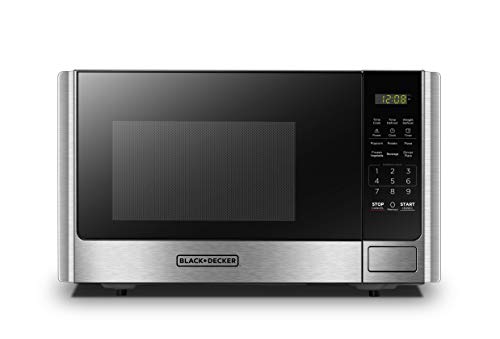
3. BLACK+DECKER Countertop Microwave 0.9 Cu. Ft. (Stainless Steel) — Best Value
The value anchor just below the target size: a 0.9 cu. ft. stainless model from a mainstream brand at a budget-leaning tier. At this size a tenth of a cubic foot is a real proportion of the whole, so each review is explicit about whether the model sits on, below or above the 1.0 target.
Strengths
- Mainstream brand with simple, proven controls
- Push-button door is easier than a handle in tight counter runs
- Child safety lock and 10 power levels cover family basics
Trade-offs
- 0.9 cu. ft. and 900W sit a step below the 1.0 target on both measures
- No sensor cooking, so reheats need time judgement
- Turntable size limits very large plates
| Specification | Detail |
|---|---|
| Capacity | 0.9 cu. ft. |
| Cooking power | 900W |
| Format | Countertop |
| Finish | Stainless steel |
| Key feature | 6 auto cook presets, push-button door, child safety lock, 10 power levels |
A lot of 1.0 cu. ft. searches end here, at the 0.9 model that costs meaningfully less and cooks for one or two people perfectly well. The honest differences are a slightly smaller cavity and 900W pace, which adds a minute here and there rather than changing what you can cook. For a first apartment, a dorm-adjacent setup or an office kitchenette, those trade-offs are usually worth the saving. For a family reheating big plates nightly, they are not, and the step-up models in this list exist for exactly that reason.
Position the BLACK+DECKER Countertop Microwave 0.9 Cu. Ft. (Stainless Steel) in your shortlist by the job it will actually do. As a countertop model of 0.9 cu. ft., it is bought for a defined pattern of meals, and its specification, 6 auto cook presets, push-button door, child safety lock, 10 power levels, should be read against that pattern rather than against the largest or cleverest rival on this page. If your pattern matches, its trade-offs will feel theoretical; if it does not, no discount or badge will rescue the mismatch, which is why the verdict line below is written as plainly as it is.
Judge this class by turntable diameter and wattage together: at around one cubic foot, those two numbers decide daily satisfaction far more than the preset list. For this model that means weighing the 6 auto cook presets against the trade-offs listed above, in the context of your own cooking rather than a laboratory ranking.
Best for: first apartments and small households on a budget / Not suited for: families reheating large plates nightly
Check on Amazon to see the current listing, dimensions and finish options.

4. TOSHIBA Microwave 0.9 Cu. Ft. (Black Stainless Steel) — Best for Small Apartments
A compact black stainless model with a mute function, aimed at apartments where the microwave sits close to living and sleeping space. At this size a tenth of a cubic foot is a real proportion of the whole, so each review is explicit about whether the model sits on, below or above the 1.0 target.
Strengths
- Mute function silences beeps for early starts and late-night snacks
- Black stainless finish looks premium at a compact size
- LED interior lighting and a tidy control layout
Trade-offs
- 0.9 cu. ft. with a 10.6-inch turntable is for plates, not family dishes
- 900W is adequate rather than fast
- No sensor, so defrosting needs supervision
| Specification | Detail |
|---|---|
| Capacity | 0.9 cu. ft. |
| Cooking power | 900W |
| Format | Countertop |
| Finish | Black stainless steel |
| Key feature | 6 auto menus, mute function, child lock, 10.6-inch turntable, LED lighting |
In a studio or a small apartment, a microwave is an appliance you hear as much as use, and Toshiba’s mute button is the feature that respects that. The black stainless finish also punches above the size class visually, matching larger appliances in an open-plan kitchen. Cooking is conventional 900W work: fine for bowls, mugs and single plates, slower for dense frozen meals. Buy it for the quiet and the finish, with eyes open about the capacity, and it will not disappoint.
Day to day, the ownership experience of the TOSHIBA Microwave 0.9 Cu. Ft. (Black Stainless Steel) is shaped by its countertop format and 0.9 cu. ft. cavity more than by any single program. Loading and unloading happen at the height and reach the format dictates, the door and controls are touched hundreds of times a month, and small frictions there matter more than a preset nobody uses. At 900W where stated, pace is predictable once you learn how your own dishes behave, and most households settle into two or three trusted settings within the first week and rarely leave them afterwards.
Judge this class by turntable diameter and wattage together: at around one cubic foot, those two numbers decide daily satisfaction far more than the preset list. For this model that means weighing the 6 auto menus against the trade-offs listed above, in the context of your own cooking rather than a laboratory ranking.
Best for: compact kitchens near living and sleeping space / Not suited for: family-size dishes, at 0.9 cu. ft.
Check on Amazon to see the current listing, dimensions and finish options.

5. Chefman Countertop Microwave 0.9 Cu. Ft. (Black) — Best Budget Black
A black, budget-leaning 0.9 with the two features small-space buyers ask for most: a mute button and an eco mode. At this size a tenth of a cubic foot is a real proportion of the whole, so each review is explicit about whether the model sits on, below or above the 1.0 target.
Strengths
- Mute button and eco mode suit apartments and shared houses
- Express cook covers the one-to-six-minute shortcuts people actually use
- True black finish at a budget-leaning tier
Trade-offs
- 0.9 cu. ft. and 900W are a step below the 1.0 target
- Build feel is lighter than the legacy brands
- Preset cooking still needs checking; there is no sensor
| Specification | Detail |
|---|---|
| Capacity | 0.9 cu. ft. |
| Cooking power | 900W |
| Format | Countertop |
| Finish | Black |
| Key feature | 6 cooking presets, express cook, eco mode, mute button, child safety lock |
Chefman aims squarely at first kitchens: black finish, simple presets, a mute for thin walls and an eco mode that cuts standby draw. Nothing here pretends to be premium, and that honesty is the appeal at this tier. It reheats, defrosts and handles frozen meals the way a 900W oven should. If it will be the main family oven, step up; if it is for one or two people in a small space, it covers the brief without wasting money or counter.
What owners tend to report valuing, in models of this type, is consistency: the Chefman Countertop Microwave 0.9 Cu. Ft. (Black) heats the same bowl the same way on a tired Tuesday as on a careful Sunday. Its black finish sets the cleaning rhythm, its 0.9 cu. ft. cavity sets the largest honest load, and its control layout sets how much thought dinner requires. None of that appears in a feature list, and all of it decides whether an appliance is still liked in its third year.
Judge this class by turntable diameter and wattage together: at around one cubic foot, those two numbers decide daily satisfaction far more than the preset list. For this model that means weighing the 6 cooking presets against the trade-offs listed above, in the context of your own cooking rather than a laboratory ranking.
Best for: black-finish kitchens on a tight budget / Not suited for: sensor-cooking enthusiasts
Check on Amazon to see the current listing, dimensions and finish options.

6. COMFEE’ Retro Microwave 0.9 Cu. Ft. (Apricot) — Best Style
The style pick: a retro-styled 0.9 with rounded lines and an apricot finish, for kitchens where the microwave is on show. At this size a tenth of a cubic foot is a real proportion of the whole, so each review is explicit about whether the model sits on, below or above the 1.0 target.
Strengths
- Retro design is the point, and it is done convincingly
- Multi-stage cooking and a mute function add real substance
- Compact footprint suits small counters and coffee corners
Trade-offs
- Apricot will not match stainless or black suites
- 0.9 cu. ft. and 900W are below the 1.0 target on paper
- Style-led models hold their price more than basic equivalents
| Specification | Detail |
|---|---|
| Capacity | 0.9 cu. ft. |
| Cooking power | 900W |
| Format | Countertop |
| Finish | Apricot (retro) |
| Key feature | Retro styling, 6 auto menus, multi-stage cooking, mute function, LED display |
Some kitchens are styled, and a silver box ruins the photograph and the feeling. Comfee’s retro line leans into rounded corners and a soft apricot finish while keeping a modern control set underneath, including staged cooking for defrost-then-cook routines. Performance is standard compact-class work. The decision here is aesthetic and legitimate: if the microwave lives on an open counter in a kitchen you have carefully put together, enjoying looking at it every day is a real feature, as long as the 0.9 size fits your plates.
Position the COMFEE’ Retro Microwave 0.9 Cu. Ft. (Apricot) in your shortlist by the job it will actually do. As a countertop model of 0.9 cu. ft., it is bought for a defined pattern of meals, and its specification, retro styling, 6 auto menus, multi-stage cooking, mute function, led display, should be read against that pattern rather than against the largest or cleverest rival on this page. If your pattern matches, its trade-offs will feel theoretical; if it does not, no discount or badge will rescue the mismatch, which is why the verdict line below is written as plainly as it is.
Judge this class by turntable diameter and wattage together: at around one cubic foot, those two numbers decide daily satisfaction far more than the preset list. For this model that means weighing the retro styling against the trade-offs listed above, in the context of your own cooking rather than a laboratory ranking.
Best for: styled kitchens where the microwave is on show / Not suited for: stainless or black appliance suites
Check on Amazon to see the current listing, dimensions and finish options.
Comparison Table
| Pick | Badge | Key Spec | Best For |
|---|---|---|---|
| Panasonic NN-SF57RM Flatbed Microwave 1.0 Cu. Ft. | Best Overall | Exact 1.0 cu. ft., flatbed, Genius Sensor 2.0, inverter technology | buyers who want the exact size with the best cooking tech |
| BLACK+DECKER Countertop Microwave 1.1 Cu. Ft. (Stainless Steel) | Best Step-Up | 6 auto cook presets, push-button door, child safety lock, 10 power levels | households happy to gain a little size for value |
| BLACK+DECKER Countertop Microwave 0.9 Cu. Ft. (Stainless Steel) | Best Value | 6 auto cook presets, push-button door, child safety lock, 10 power levels | first apartments and small households on a budget |
| TOSHIBA Microwave 0.9 Cu. Ft. (Black Stainless Steel) | Best for Small Apartments | 6 auto menus, mute function, child lock, 10.6-inch turntable, LED lighting | compact kitchens near living and sleeping space |
| Chefman Countertop Microwave 0.9 Cu. Ft. (Black) | Best Budget Black | 6 cooking presets, express cook, eco mode, mute button, child safety lock | black-finish kitchens on a tight budget |
| COMFEE’ Retro Microwave 0.9 Cu. Ft. (Apricot) | Best Style | Retro styling, 6 auto menus, multi-stage cooking, mute function, LED display | styled kitchens where the microwave is on show |
How to Choose a 1 Cu Ft Microwave
Start outside the oven. Measure the counter run, shelf or niche it must live in, including the clearance the manual requires at the back and sides and the space the door needs to open fully. Compact ovens are often bought for fitted spaces, and a model that fits the shelf but cannot open its door beside a wall has failed before it has cooked anything. Then measure inside: turntable diameter against your dinner plates, and interior height against your tallest mug, jug or baby bottle.
Decide how you feel about the bracket. An exact 1.0 is scarce and, in the lead pick’s case, carries premium technology pricing. The 0.9 class is the value heartland: slightly smaller plates, 900W pace, and tiers that leave money for the rest of a first kitchen. The 1.1 class adds a little room and usually a full 1000W, and for many households it is the sweet spot disguised as a rounding error. Choose by your plates and your pace, not by loyalty to a decimal.
Technology is the third decision, and at this size it is a genuine one. Inverter power defrosts evenly and holds gentle power for butter, chocolate and sauces; sensor cooking judges reheats by steam and removes the guesswork that produces rubbery leftovers. If your microwave cooks, fund those systems. If it reheats drinks and ready meals, a basic model plus a mute button will make you just as happy for less.
Close with the daily-life checks: a child lock if small hands visit, an interior light you can actually see through the door screen with, controls readable in your kitchen’s light, and a beep you can silence if the oven shares space with sleeping or working people. Confirm dimensions and finish on the listing, check the current price on Amazon, and buy the model whose compromises point away from your life.
Flatbed vs Turntable in a Compact Microwave
The lead pick’s flatbed floor deserves explanation, because at one cubic foot the geometry argument is stronger than at any other size. A turntable oven reserves its centre for a rotating plate, typically around ten to twelve inches across in this class, and anything wider than that plate cannot turn, which means it cannot heat evenly and often cannot fit at all. A flatbed cavity has no plate: the whole floor is usable, corners included, so a rectangular oven dish that a turntable model rejects outright can sit flat and cook. In a small cavity, recovering those corners is proportionally a large gain.
The trade-offs are real. Turntables rotate food through the microwave energy pattern, which is a simple, effective evenness strategy, especially for a single centred bowl. Flatbed designs move the energy instead, using rotating antennas or reflectors beneath the floor, and results with small items depend on placing them sensibly and stirring or turning when the instructions suggest it. There is a short learning curve, measured in days, and a permanent cleaning dividend: a flat floor with nothing to remove wipes clean in one pass.
Choose by your dishes. Households that cook in rectangular dishes, reheat two bowls at once, or batch in oven-to-table ware get the most from a flatbed. Households whose microwave life is mugs, bowls and single plates will never meet the turntable’s limits and can spend the difference elsewhere. Neither is the advanced choice; they are different answers to the shape of your cooking, and at this size the shape question is worth answering honestly.
Compact Kitchen Layouts That Actually Work
A one-cubic-foot microwave is usually bought for a kitchen with a layout problem, so placement strategy deserves the same care as the model choice. The classic compact patterns are three. The counter corner: the oven sits diagonally or square in a corner, its door opening into the room’s working triangle, with the kettle and toaster kept out of its swing. The shelf or niche: the oven lives inside a cabinet opening or on a dedicated shelf, which demands the strictest attention to the manual’s clearances and to door swing against the niche’s sides. The cart or island end: a rolling cart or the end of an island gives the oven a home that can move for parties and cleaning, at the cost of a cord run that must be planned rather than improvised.
Each pattern has a characteristic mistake. Corner placements fail when the door opens into a walkway and becomes a head-height hazard with a hot dish behind it. Niche placements fail on ventilation, because the clearances in the manual are thermal requirements, not suggestions, and a boxed-in compact oven ages fast and cooks unevenly. Cart placements fail electrically, when the oven ends up on an extension lead shared with a kettle. Naming the failure of your pattern in advance is most of layout wisdom; the rest is a tape measure.
Workflow completes the picture. The microwave’s natural neighbours are the refrigerator, for ingredients, and a heatproof landing surface, for the dish that comes out hotter than expected. If the only available spot forces a walk across the kitchen carrying a steaming bowl, the spot is wrong however well the oven fits it. Compact kitchens reward this kind of honesty: the right model in the right metre of counter will feel twice its size, and the wrong metre will make even the excellent lead pick in this guide feel like an intruder.
How to Set Up and Use a Compact Microwave Well
Placement decides performance in a small oven. Set it on a level, heat-tolerant surface with the clearances its manual specifies, away from the sink’s splash zone and not directly beside a hob where steam and grease will coat it. Plug it into its own outlet where possible; compact kitchens tempt people into sharing sockets with kettles and toasters, and a microwave plus a kettle on one circuit is a classic tripped breaker. Level matters for turntable models, because a tilted plate rattles, wanders and eventually chips its guide ring.
Learn the three habits that make a small oven cook like a bigger one. First, arrange food in a ring or spread it shallow rather than mounding it deep, because microwaves penetrate only a couple of centimetres and the centre of a mound cooks by conduction and patience. Second, use standing time as part of the cooking: a covered plate left for two minutes finishes evening out in temperature and texture. Third, stir or turn at the halfway beep on anything dense or uneven, rather than adding raw extra minutes at the end, which punishes the edges for the centre’s sins.
For defrosting, use the weight-based program if the model has one, separate pieces as soon as they loosen, and shield thin edges of fish or poultry with small strips of foil only if the manual permits it. Keep the interior wiped weekly, the door seal free of crumbs, and the turntable ring washed rather than merely rinsed. A compact oven used with these habits will outperform a careless larger one, which is the real secret of this size class.
Dorms, Offices and Shared Houses: The Compact Etiquette Guide
A large share of this size class is bought for shared spaces, where the choosing criteria quietly change. Durability of the control layout matters more than depth of features, because the oven will be operated by people who will never read its manual: big, legible buttons, an obvious +30 seconds control, and a door that tolerates imperfect closing technique. The mute function, a lifestyle nicety in a family kitchen, becomes a diplomatic instrument in a dorm corridor or a house share with night-shift sleepers, and it is weighted accordingly in this guide’s picks.
Shared ownership also argues for the middle of the class rather than its extremes. The premium flatbed lead pick is the best cooker here, and in a private kitchen it earns its positioning; in a shared house, the step-up and value models absorb rough handling, mystery spills and popcorn incidents with less financial pain when something eventually fails. What shared spaces should not buy is the smallest, weakest option as a false economy: an oven that cannot take a standard plate or that reheats so slowly it queues at lunchtime will be resented daily and replaced early, which is the most expensive outcome of all.
Whatever the setting, agree the house rules when the oven arrives, because they are cheaper than the arguments: wipe spills when they happen, never run it empty, no metal, and food that explodes gets cleaned by its owner. Label the eco and mute controls with a small note for the first month. A compact microwave in a shared space is a small society, and the models in this guide were chosen to give that society the best possible chance of remaining civilised.
Common Buying Mistakes
Measuring the cavity and forgetting the door. A compact oven in a niche must open fully. Check the swing against walls, handles and neighbouring appliances before ordering.
Treating 0.9, 1.0 and 1.1 as identical in every way. They cook similarly, but turntable diameter and wattage differ across the bracket, and those two figures decide plates and pace.
Buying premium technology for a reheating-only life. Inverter and sensor systems earn their money when you cook and defrost. For drinks and ready meals, a basic model with a mute button is the rational buy.
Sharing a socket with a kettle. Compact kitchens invite it, breakers punish it. Give the microwave its own outlet wherever the wiring allows.
Skipping the plate test. Your largest dinner plate against the stated turntable diameter takes one minute to check and prevents the most common return in this class.
At a Glance: Which Pick for Which Kitchen?
The compact decision is a bracket, and the short version respects it. Exactly 1.0 with the best technology in the class: the Panasonic flatbed, the one pick here with no asterisk beside its size. A little more room and full power at a friendly tier: the 1.1 Black+Decker, the pragmatic centre of the whole compact market. Honest value below the line: its 0.9 sibling, which cooks for one or two people without pretending otherwise. Quiet apartment life in a premium small finish: the Toshiba with the mute button. Black on a budget: the Chefman. A kitchen that is styled rather than merely equipped: the Comfee, apricot and unapologetic. What unifies the list is that every model was admitted for a reason that survives contact with a real kitchen, a plate, a niche, a sleeping baby, a colour scheme, and every model carries its true size in its name and its specification box. Choose the reason that sounds like your life, verify the tape-measure facts, and this class will serve you well out of all proportion to its cubic footage.
Final Recommendation
If you want the exact size and the best cooking, the Panasonic flatbed is the standout of this class and the easiest recommendation here. If value leads, the 1.1 Black+Decker gives you more room and full power at a sensible tier, while the 0.9 version anchors the budget end honestly. Apartment buyers should look hard at the quiet Toshiba, black-finish buyers on a budget at the Chefman, and anyone furnishing a styled kitchen at the Comfee, which is the rare style pick with real substance beneath it. Measure the space, run the plate test, and check the current price on Amazon for the pick that fits your constraint.
Related guides in this series: Best 1.7 Cubic Foot Microwaves; Best 1.7 Cubic Foot Microwaves Black; Best 1.7 Cubicfeet Microwaves; Best 1.7 Cubicfeet Microwaves Black; Best 10 Best Microwaves.
Related guides
Frequently Asked Questions
Is a 1 cu ft microwave big enough for a dinner plate?
Generally yes. Most models in this class have turntables around ten to twelve inches, which take a standard dinner plate. Check the stated turntable diameter against your largest plate, and remember that a flatbed model removes the rotation limit entirely.
Why are most compact microwaves 0.9 or 1.1 instead of exactly 1.0?
Because product lines standardise on a few cavity tools and round their marketing to the nearest class. Genuine 1.0 ratings exist but are uncommon, which is why this guide brackets the target with clearly labelled neighbours.
How much power should a 1 cu ft microwave have?
900W is workable and 1000W or more is noticeably brisker on dense and frozen food. Inverter models use their watts more evenly at low settings, which matters for defrosting and gentle tasks.
Is a flatbed microwave harder to use?
Only briefly. There is no turntable to load, dishes can sit anywhere sensible on the floor, and instructions may suggest stirring or turning food midway. In exchange, rectangular dishes fit and cleaning becomes a single wipe.
Can a 1 cu ft microwave replace a family oven?
For reheating, defrosting, vegetables, grains and single meals, comfortably. For family-size casseroles and batch cooking it is the wrong tool, and the larger classes covered in the related guides exist for that work.
Where should a compact microwave go in a small kitchen?
On a level surface with the manual’s clearances, its own outlet where possible, away from direct hob steam and sink splashes, and somewhere its door can open fully without striking a wall or handle.
Is a compact microwave suitable for a family of three?
As the only microwave, it depends on the family’s dishes more than its headcount. Three people eating standard plates, bowls and reheated portions will manage well, particularly with the 1.1 step-up or the flatbed’s usable floor. Three people regularly cooking family casseroles, large pizzas or batch meals will outgrow the class within a month, and the honest advice is to buy the counter space problem instead: clear a larger run and step up a class.


