Disclosure: airfryerkitchensupply.com is reader-supported. When you buy through links on our site, we may earn an affiliate commission at no extra cost to you.
Where to buy
All six machines in this guide to the best automatic ice cream makers are sold on Amazon, where you can confirm the current configuration, capacity and included accessories before ordering. Start with the Cuisinart ICE-100 on Amazon, and compare the Cuisinart ICE-100 the Whynter ICM-200LS the Breville Smart Scoop the Whynter ICM-201SB the Cuisinart Freeze Ease 1-Qt the Whynter ICM-220SSY. Listings change over time, so check the current price on Amazon for each model rather than trusting any number quoted second-hand, and confirm the exact model code on the listing matches the pick you intend to buy.
Introduction: what automatic really means
If you are shopping for the best automatic ice cream makers, the first thing to understand is that the word automatic describes two genuinely different machines, and only one of them deserves it. The first kind is the electric freezer-bowl maker: a motor turns a paddle inside a bowl you froze solid the day before. It is electric, and it churns without hand-cranking, but the freezing — the part that actually makes ice cream — was planned twelve hours earlier by you and your freezer. The second kind, and the kind this guide is about, carries its own refrigeration: a built-in compressor freezes and churns at the same time, so the machine is automatic in the full sense. Pour in a base, start it, and walk away.
That distinction shapes everything else in this guide. Compressor machines cost more, weigh more and take more counter than bowl machines, and in exchange they remove the single biggest reason home ice cream makers go unused: the planning. Survey your own habits honestly. If your freezer bowl has sat unfrozen through two summers because you never remembered to chill it, you do not have a storage problem or a recipe problem — you have a workflow problem, and an automatic compressor machine is the direct fix. If you churn twice a year for a birthday, the premium is harder to defend, and a good bowl machine from our affordable guide may serve you better.
The six picks below are all compressor-driven automatics verified against Amazon’s own catalogue data, spanning compact 1-quart convenience, family-size 2.1-quart capacity, a premium consistency-controlled flagship, and a dual-role machine that also makes yogurt. Every pick was chosen for a distinct job, given its own badge, and assessed with the same strengths and trade-offs format, so you can match a machine to your household rather than to a generic ranking.
In this guide
Quick Picks
Cuisinart ICE-100 — Best Overall Automatic. The Cuisinart ICE-100 is the machine that defines what most people mean by an automatic ice cream maker: you pour in a chilled base, press a button, and its built-in compressor does the freezing and the churning at the same time. Check the Cuisinart ICE-100 on Amazon and check price on Amazon before deciding.
Whynter ICM-200LS — Best for Bigger Batches. The Whynter ICM-200LS takes the same automatic compressor formula and scales it up to 2.1 quarts, the largest capacity in this roundup. Check the Whynter ICM-200LS on Amazon and check price on Amazon before deciding.
Breville Smart Scoop — Best Premium Automatic. The Breville Smart Scoop is the premium end of the automatic category: a compressor machine built around the idea that ice cream, gelato, sorbet and frozen yogurt should not all be churned the same way. Check the Breville Smart Scoop on Amazon and check price on Amazon before deciding.
Whynter ICM-201SB — Best Upright Design. The Whynter ICM-201SB delivers the same 2.1-quart automatic compressor capacity as its sibling above, but in an upright format that trades counter width for height. Check the Whynter ICM-201SB on Amazon and check price on Amazon before deciding.
Cuisinart Freeze Ease 1-Qt — Best Compact Automatic. Not every automatic machine has to be a countertop monument. Check the Cuisinart Freeze Ease 1-Qt on Amazon and check price on Amazon before deciding.
Whynter ICM-220SSY — Best for Ice Cream and Yogurt. The Whynter ICM-220SSY adds a second job to the automatic formula: alongside 2-quart compressor ice cream making, the verified listing title confirms a yogurt function, making this the pick for households that ferment as happily as they freeze. Check the Whynter ICM-220SSY on Amazon and check price on Amazon before deciding.
How These Picks Were Chosen
We started from a strict definition: to appear here, a machine had to freeze under its own power. That single rule removed every freezer-bowl model, every salt-and-ice bucket and every freeze-a-pint-first system from consideration, however well those products work on their own terms. What remained was the true automatic category — compressor machines — and we verified every model in this guide against Amazon’the Amazon catalogue data, matching each product name to the exact title and model code returned by the listing before allowing any Amazon link into the article. Models we could not match with confidence were left out rather than guessed at.
Within the category, we weighted five criteria. First, capacity honesty: a stated quart size only matters relative to household size, so the list deliberately spans 1 to 2.1 quarts. Second, control: timers and displays scored well because compressor machines keep cooling after the churn and over-firm batches are the most common beginner disappointment. Third, workflow extras that change real usage, such as a yogurt function or an upright footprint. Fourth, brand support depth — compressor appliances contain refrigeration hardware, so established makers with service networks ranked above anonymous labels. Fifth, format fit: we included one compact and one upright model so that small kitchens were not simply told to buy the biggest box.
We also applied this site’s standing rules throughout: no static prices anywhere, because listings move; no fixed ratings figures, because those numbers change constantly and go stale in print; and specification boxes that only repeat figures confirmed in the verified listing titles, never invented dimensions or churn times.
The 6 Best Automatic Ice Cream Makers

Cuisinart ICE-100 1.5 Qt Compressor Ice Cream Maker — Best Overall Automatic
The Cuisinart ICE-100 is the machine that defines what most people mean by an automatic ice cream maker: you pour in a chilled base, press a button, and its built-in compressor does the freezing and the churning at the same time. There is no freezer bowl to plan around, no eight-to-twelve-hour wait before you can even start, and no rock salt or ice to manage. That single change in workflow is why compressor machines earn the word automatic in a way that freezer-bowl models, however good, never quite do. The 1.5-quart capacity sits in the practical middle — enough for a family dessert or a small gathering, small enough that a second back-to-back batch is a realistic weeknight move rather than a project.
Strengths
- Built-in compressor removes pre-freezing entirely, so batches can start the moment a craving or a dinner plan appears
- Two paddles let you match the churning action to denser ice cream or lighter gelato-style bases
- Back-to-back batches are possible because the machine re-freezes itself instead of relying on a bowl that warms up
Trade-offs
- Counter footprint and weight are noticeably larger than a freezer-bowl maker, so it needs a semi-permanent home
- Sits in a premium tier compared with bowl models, which only pays off if you churn regularly
- 1.5-quart yield is modest for large parties unless you plan sequential batches
Key specs (verified)
- Capacity: 1.5 Qt (from Amazon title)
- Freezing method: Built-in compressor — no pre-freezing (Amazon title)
- Paddles: 2 paddles included (Amazon title)
What separates the ICE-100 in daily use is rhythm. With a bowl machine, ice cream is a two-day decision: freeze the bowl tonight, churn tomorrow. With this Cuisinart, ice cream becomes a same-evening decision, and that changes how often the machine actually gets used — which is the only metric that justifies any appliance. The compressor also holds a steadier freezing curve than a thawing bowl, so the texture at minute thirty is closer to the texture the recipe intended, with less of the icy edge that forms when a bowl loses its cold. Cleanup follows the usual pattern for the category: the lid, paddle and bowl lift out for washing, while the base and compressor housing stay on the counter and wipe clean. If your household makes ice cream monthly or more, this is the reference point the rest of this list is measured against.
Best for: households that want true automatic, no-planning-ahead ice cream most weeks. / Not suited for: tiny kitchens with no spare counter depth, or anyone who churns once a summer.
Check the Cuisinart ICE-100 on Amazon — check price on Amazon

Whynter ICM-200LS Ice Cream Maker 2.1 Qt Compressor — Best for Bigger Batches
The Whynter ICM-200LS takes the same automatic compressor formula and scales it up to 2.1 quarts, the largest capacity in this roundup. That extra volume matters more than it sounds: a single batch can cover a birthday, a barbecue dessert course, or a week of after-dinner scoops without a second run. The LCD display and built-in timer, both confirmed in the verified listing title, give you a clearer view of where a batch stands than a simple on-off switch does, which helps when you are timing churn against a base that should come out soft-serve soft rather than brick hard.
Strengths
- 2.1-quart capacity is the roomiest here, cutting down on double batches for groups
- Built-in compressor means no pre-freezing and no freezer space sacrificed to a bowl
- LCD display and timer make it easier to pull batches at a consistent softness
Trade-offs
- The largest and heaviest style of machine in this guide — plan its counter spot before ordering
- Premium-tier positioning, so the value case depends on batch size actually mattering to you
- Stainless housing shows splashes and fingerprints more readily than matte finishes
Key specs (verified)
- Capacity: 2.1 Qt (Amazon title)
- Freezing method: Built-in compressor — no pre-freezing (Amazon title)
- Controls: LCD display and timer (Amazon title)
Capacity changes recipe behaviour, not just servings. A deeper canister churns a base more gently relative to its volume, and the ICM-200LS suits custard bases and mix-in-heavy recipes that crowd a smaller bowl. The timer is more than a convenience: automatic machines keep cooling after the churn, and a batch left sitting in a compressor canister firms up fast, so a timed finish with an audible cue protects the texture you were aiming for. Whynter builds this line like a small commercial unit rather than a novelty appliance, and the trade-off for that solidity is bulk. Measure your counter run and your cabinet clearance, because this is a park-it-and-leave-it machine, not a stash-it-in-a-cupboard one.
Best for: bigger households and entertainers who regularly churn for a crowd. / Not suited for: solo users who will rarely fill even half the canister.
Check the Whynter ICM-200LS on Amazon — check price on Amazon

Breville BCI600XL Smart Scoop Ice Cream Maker — Best Premium Automatic
The Breville Smart Scoop is the premium end of the automatic category: a compressor machine built around the idea that ice cream, gelato, sorbet and frozen yogurt should not all be churned the same way. Its name gives away the concept — the machine works toward a target scoop consistency rather than simply running a timer. For buyers who experiment — a dense gelato one weekend, a dairy-free sorbet the next — that kind of guided automatic control is the difference between a gadget and a small dessert laboratory. The brushed stainless build, confirmed in the verified listing title, matches Breville’s other countertop appliances if you already own them.
Strengths
- Automatic consistency targeting suits households that rotate between ice cream, gelato and sorbet
- Premium build and finish feel closer to a long-term appliance than a seasonal gadget
- Compressor design removes pre-freezing and supports spontaneous, sequential batches
Trade-offs
- The highest tier in this guide — hard to justify for occasional churners
- Feature depth can be wasted on anyone who makes one vanilla recipe on repeat
- Like all compressor units, it is heavy enough that you will not want to move it often
Key specs (verified)
- Model: Breville BCI600XL Smart Scoop (Amazon title)
- Finish: Brushed stainless steel (Amazon title)
- Freezing method: Compressor automatic — no pre-freezing (category-defining design)
The Smart Scoop rewards a particular kind of cook: the one who keeps notes. Because the machine aims at a firmness rather than a fixed time, variations in base temperature, sugar content and alcohol additions — all of which shift freezing behaviour — are handled more gracefully than a dumb timer manages. That makes it the strongest pick here for recipe development and for households with mixed dietary needs sharing one machine. It is also the pick most likely to be overkill. If your ambition is a reliable vanilla and the occasional strawberry, the Cuisinart ICE-100 delivers the same no-pre-freeze freedom in a simpler package. Buy the Breville when the experimenting itself is the hobby.
Best for: enthusiasts who churn varied recipes and want automatic consistency control. / Not suited for: budget-led buyers or single-recipe households.
Check the Breville Smart Scoop on Amazon — check price on Amazon
Whynter ICM-201SB Upright Ice Cream Maker 2.1 Qt Compressor — Best Upright Design
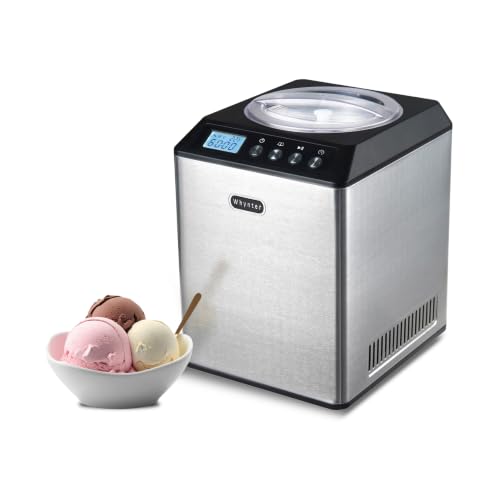
The Whynter ICM-201SB delivers the same 2.1-quart automatic compressor capacity as its sibling above, but in an upright format that trades counter width for height. That shape matters in real kitchens: a tall, narrow footprint can slot into the dead corner beside a stand mixer or at the end of a run of cabinets where a wide, low machine simply will not fit. The verified listing title confirms the same LCD display and timer arrangement, so you are choosing a shape, not compromising on the automatic experience.
Strengths
- Upright footprint fits narrow counter runs that reject wider compressor machines
- Full 2.1-quart capacity for family-size and party-size batches
- LCD display and timer support consistent, repeatable batch timing
Trade-offs
- Height needs checking against low wall cabinets before you commit to a spot
- Still a premium-tier, heavy appliance despite the space-friendlier shape
- Two similar Whynter models in one lineup can confuse — confirm the upright format on the listing
Key specs (verified)
- Capacity: 2.1 Qt (Amazon title)
- Format: Upright design (Amazon title)
- Freezing method: Built-in compressor — no pre-freezing (Amazon title)
- Controls: LCD display and timer (Amazon title)
Think of the ICM-201SB as the problem-solver of this list. Most compressor machines assume you have a generous, open counter; this one assumes you do not, and that assumption matches a lot of apartments and older kitchens with short counter runs broken up by sinks and stoves. The upright profile also makes the canister opening easier to work at when you are adding mix-ins mid-churn, because you are reaching down into the machine rather than across it. Performance expectations should mirror the ICM-200LS: steady compressor freezing, no pre-planning, and texture that holds up across back-to-back batches. Choose between the two Whynters purely on which shape your kitchen absorbs better.
Best for: space-tight kitchens that still want full-size automatic capacity. / Not suited for: under-cabinet spots with very low clearance.
Check the Whynter ICM-201SB on Amazon — check price on Amazon

Cuisinart Automatic Ice Cream Maker, No Pre-Freezing, 1-Qt, Freeze Ease — Best Compact Automatic
Not every automatic machine has to be a countertop monument. This compact Cuisinart — the listing title literally leads with the words Automatic and No Pre-Freezing — shrinks the compressor concept to a 1-quart format aimed at couples, small households and anyone whose freezer-bowl machine gathers dust because the planning never happens. One quart is roughly two generous dessert sittings or four modest scoops, which for many households is exactly the right amount of fresh ice cream to have in the freezer at once.
Strengths
- Smallest automatic, no-pre-freeze option here — realistic for apartments and small counters
- 1-quart batches keep portions fresh instead of lingering for weeks
- Cuisinart’s Freeze Ease approach targets simple, low-fuss operation
Trade-offs
- 1-quart yield is too small for parties without multiple sequential batches
- Newer model line, so long-term ownership patterns are less established than the ICE-100’s
- Compact automatics still cost more than larger freezer-bowl machines — you pay for the compressor, not the size
Key specs (verified)
- Capacity: 1 Qt (Amazon title)
- Freezing method: No pre-freezing — Freeze Ease technology (Amazon title)
- Styles: Ice cream and frozen yogurt (Amazon title)
The honest question with any 1-quart machine is whether small equals limited, and here it mostly equals focused. Small batches freeze faster and churn up with a particularly smooth texture, and they invite experimentation: a risky new flavour costs you a quart of base, not two. For a household of one or two, that is a feature disguised as a limitation. Where this Cuisinart earns its place over simply buying a freezer-bowl model is the same as everywhere in this guide — spontaneity. The base goes in when you decide, not the day before. If you regularly serve six people dessert, skip up the list to the Whynters; if you serve two, this is the automatic that fits your life and your counter.
Best for: couples and small households wanting automatic convenience without the bulk. / Not suited for: regular entertainers or large families.
Check the Cuisinart Freeze Ease 1-Qt on Amazon — check price on Amazon

Whynter ICM-220SSY Ice Cream Maker & Yogurt 2 Qt Compressor — Best for Ice Cream and Yogurt
The Whynter ICM-220SSY adds a second job to the automatic formula: alongside 2-quart compressor ice cream making, the verified listing title confirms a yogurt function, making this the pick for households that ferment as happily as they freeze. If your kitchen already cycles between homemade yogurt weeks and ice cream weekends, one appliance covering both rhythms is a genuinely practical consolidation rather than a gimmick, and the LCD digital display and timer keep both processes on a predictable schedule.
Strengths
- Dual ice cream and yogurt role replaces two separate appliances for the right household
- Full 2-quart compressor capacity with no pre-freezing for either freezing or batch planning
- LCD display and timer suit the long, set-and-forget cycles yogurt making requires
Trade-offs
- You pay for a second function you may never use if yogurt is not part of your routine
- Large, heavy compressor footprint, like the other full-size Whynters here
- Multi-function machines ask you to learn two workflows instead of one
Key specs (verified)
- Capacity: 2 Qt (Amazon title)
- Freezing method: Built-in compressor — no pre-freezing (Amazon title)
- Functions: Ice cream maker and yogurt function (Amazon title)
- Controls: LCD digital display and timer (Amazon title)
Combination appliances usually disappoint at both jobs; the reason this one makes the list is that the two jobs share the same core skill — precise, patient temperature control over hours. A compressor that can hold a freezing curve can also hold the gentle warmth yogurt cultures want, and Whynter leans into that overlap rather than bolting on a novelty mode. Practically, the ICM-220SSY suits the meal-prep household: yogurt on Sunday for the week’s breakfasts, a churn on Friday for the weekend. If that sentence does not describe you at all, the single-purpose ICM-200LS is the cleaner buy. If it does, this is the most efficient use of counter space in the entire guide.
Best for: households that make both yogurt and ice cream regularly. / Not suited for: ice-cream-only buyers who would rather pay for capacity than a second function.
Check the Whynter ICM-220SSY on Amazon — check price on Amazon
Comparison Table
| Pick | Badge | Key spec | Best for |
|---|---|---|---|
| Cuisinart ICE-100 | Best Overall Automatic | 1.5 Qt (from Amazon title) | households that want true automatic, no-planning-ahead ice cream most weeks. |
| Whynter ICM-200LS | Best for Bigger Batches | 2.1 Qt (Amazon title) | bigger households and entertainers who regularly churn for a crowd. |
| Breville Smart Scoop | Best Premium Automatic | Breville BCI600XL Smart Scoop (Amazon title) | enthusiasts who churn varied recipes and want automatic consistency control. |
| Whynter ICM-201SB | Best Upright Design | 2.1 Qt (Amazon title) | space-tight kitchens that still want full-size automatic capacity. |
| Cuisinart Freeze Ease 1-Qt | Best Compact Automatic | 1 Qt (Amazon title) | couples and small households wanting automatic convenience without the bulk. |
| Whynter ICM-220SSY | Best for Ice Cream and Yogurt | 2 Qt (Amazon title) | households that make both yogurt and ice cream regularly. |
Read the table as a matching exercise, not a league ranking. The compact Cuisinart Freeze Ease is not a worse Whynter; it is a machine aimed at a household of two, and it will make that household happier than a 2.1-quart unit that dominates their counter. Likewise the Breville’s premium only converts into value if you actually vary your recipes. Capacity, footprint and how often you churn — in that order — should drive the choice.
How to Choose an Automatic Ice Cream Maker
Start with capacity, not features. A quart of finished ice cream is roughly four modest servings. Households of one or two who eat ice cream as an occasional treat are well served by a 1 to 1.5-quart machine, and they gain faster freeze times and smaller storage as a bonus. Families and entertainers should look at 2 quarts and above, because a too-small machine does not just serve less — it tempts you into overfilling, and overfilled bases churn badly and freeze unevenly. Every machine in this guide states its capacity in its verified title, so use those figures as your first filter.
Understand what the compressor buys you. The premium over a freezer-bowl machine purchases three things: spontaneity, consistency and repeatability. Spontaneity, because no component needs pre-chilling. Consistency, because a compressor holds temperature instead of slowly losing the cold battle a thawing bowl fights. Repeatability, because you can run a second batch immediately — for a dinner party with two flavours, or for fixing a first batch that came out too sweet by churning a corrected second one the same evening.
Value timers and displays more than novelty modes. The most common automatic-machine mistake is leaving a finished batch sitting in the canister, where residual compressor cold firms it past the ideal point. A timer with an audible finish, confirmed on several picks here, is quiet protection against that. Extra programmes are worthwhile when they map to things you genuinely make — gelato, sorbet, yogurt — and decorative when they do not.
Measure the machine’s home before ordering. Compressor units are the heaviest appliances in the home ice cream world. Note the footprint, the height against your wall cabinets, and whether the spot has ventilation clearance, because refrigeration hardware breathes. The upright Whynter in this guide exists precisely because width, not capacity, is the binding constraint in many kitchens.
Freezer-Bowl vs Compressor: An Honest Word
Because the word automatic gets stretched in marketing, it is worth stating plainly what this guide excluded and why you might still want it. Freezer-bowl machines are lighter, simpler and sit in a far friendlier budget tier; for planned, occasional churning they make excellent ice cream. Freeze-and-process systems that work on pre-frozen pints suit single servings and protein-heavy recipes. Neither is automatic in the freeze-it-for-you sense. If your honest pattern is a churn every few months with a day’s notice, save the premium. If your pattern is wanting ice cream tonight, repeatedly, the compressor is not a luxury — it is the entire point.
How to Use an Automatic Ice Cream Maker, Batch by Batch
Step 1: Chill your base. Automatic does not mean the machine enjoys fighting a warm base. Refrigerate cooked custard bases until fully cold — ideally several hours — so the compressor spends its effort freezing, not cooling, and the finished texture stays dense and smooth.
Step 2: Fill with headroom. Ice cream expands as it incorporates air. Fill the canister to the maker’s guidance and never to the brim; an overfilled batch climbs the paddle, freezes unevenly and can strain the drive. When in doubt, split a big recipe into two runs — an automatic machine makes that painless.
Step 3: Add mix-ins late. Chocolate chips, cookie pieces, nuts and swirls go in during the final minutes, once the base holds soft peaks. Added at the start, they sink, freeze into rocks or get pulverised by an hour of churning.
Step 4: Judge doneness by texture, not the clock. Finished churn should look like thick soft-serve. Pull it there, transfer to a shallow lidded container, press a layer of wrap or parchment directly on the surface, and harden it in the coldest part of the freezer for a few hours for scoopable firmness.
Step 5: Clean promptly. Dairy residue souring in a canister seam is the fastest way to flavour the next batch. Wash the canister, lid and paddle in warm soapy water as soon as the ice cream is transferred, dry thoroughly, and wipe the base unit — never immerse a compressor housing.
Getting Better Texture From Any Automatic Machine
Three levers matter more than any recipe book. Sugar balance controls softness: too little and the scoop is icy, too much and it never firms. Fat controls richness and slows ice-crystal growth, which is why skimmed bases taste thin no matter how good the machine is. And a small addition of alcohol in adult recipes lowers the freezing point for a softer scoop — use a spoonful, not a glug, or the batch may never set. Master those three and a mid-list machine will outperform a flagship fed careless bases.
Common Buying Mistakes
Buying a freezer-bowl machine believing it is automatic. Read listings literally: if any component needs pre-freezing, the machine is not automatic in the sense this guide uses, whatever the headline claims.
Oversizing for a household of two. A half-empty 2.1-quart canister is counter space spent on air. Match capacity to your real serving pattern, and remember sequential batches are free with a compressor.
Ignoring the counter audition. Compressor machines are heavy and tall. Buyers routinely discover the perfect machine does not fit under their cabinets. Measure first; consider the upright format if width is your constraint.
Judging by the first batch. A warm base, an overfill or a missed timer cue will make any machine look ordinary. Give a new automatic three properly chilled, correctly filled batches before forming a verdict.
Storing ice cream in the canister. The canister is a churner, not a tub. Leaving finished ice cream in it invites over-firming and off-flavours; transfer to a dedicated container every time.
Ownership: Storage, Care and Keeping a Compressor Healthy
An automatic ice cream maker is closer to a small refrigerator than to a blender, and it rewards the same kind of care. Keep it upright in storage and in use; compressor systems circulate refrigerant and oil, and manufacturers of this category generally advise letting a machine that has been transported or tipped rest upright before running it, so the internals settle. If you have just moved house or carried the machine up from a basement at an angle, patience before the first churn is cheap insurance.
Ventilation is the second rule. The compressor sheds heat while it freezes your base, and a machine pushed tight against a wall or boxed in by other appliances works harder and churns slower. Leave breathing room around the vents, and never run the machine inside a closed cabinet. The third rule is dryness: wipe splashes off the housing promptly, keep the canister rim clean so the lid seals evenly, and make sure every removable part is fully dry before reassembly, because trapped moisture in a cold canister becomes frost, and frost becomes texture problems in the next batch.
Long-term, the paddle and canister take the wear. Avoid metal utensils inside the canister, wash with soft sponges, and inspect the paddle drive connection occasionally for dried base build-up, which is the usual cause of new noises in an older machine. Treat the unit this way and there is very little to go wrong: no belts to tension, no bowls to replace when a freeze cycle cracks them, and no consumables beyond the ingredients themselves.
A Simple Framework for Bases That Churn Well
Most disappointing batches are decided before the machine is switched on. A dependable vanilla custard framework looks like this in structure — adapt proportions to your own trusted recipe: a dairy base of milk and cream, egg yolks for body if you cook custards, sugar for sweetness and softness, a pinch of salt to lift flavour, and vanilla added after cooking so its aromatics survive. Cook gently until the base coats a spoon, chill it completely, then churn. That single framework, properly chilled, is the benchmark batch to make first in any new machine, because it separates machine performance from recipe experimentation.
From that benchmark, change one variable at a time. Swap part of the dairy for fruit puree and you are in sorbet and sherbet territory, where sugar balance matters even more because fruit brings its own water. Reduce the cream and raise the milk, churn more slowly in style if your machine allows, and you approach gelato’s dense character. Add cultured yogurt as the base and sweeten carefully, and frozen yogurt follows. Keeping notes — base temperature, churn observations, finished texture after hardening — sounds fussy for dessert, but three noted batches will teach you more about your specific machine than any manual, because every compressor holds a slightly different cold.
One practical warning: ingredients that seem harmless can sabotage freezing. Large amounts of alcohol, very high sugar syrups folded in too early, and warm mix-ins all delay or prevent setting. Add liqueurs by the spoonful, swirl syrups at the end, and let inclusions cool before they meet the base.
Troubleshooting: Soft, Icy or Slow Batches
Problem: the batch stays soft and soupy. Work through the likely causes in order: the base went in warm; the canister was overfilled so the paddle could not work; the recipe’s sugar or alcohol content is suppressing freezing; or the machine lacks ventilation and is fighting its own heat. Fix the first three and most soft batches disappear.
Problem: the texture is icy or grainy. Ice crystals grow when freezing is slow or when a finished batch melts and refreezes. Chill bases fully, harden finished ice cream fast in a shallow container, store it at the back of the freezer rather than in the door, and serve within a reasonable window instead of keeping a tub for months.
Problem: the machine sounds strained. A batch that has churned past soft-serve into near-solid will labour any drive. Stop at soft-serve, transfer, and let the freezer do the hardening — that division of labour is how the category is designed to work, and forcing the churn longer only wears the mechanism.
Problem: flavours taste faintly of the last batch. Dairy fat carries flavour. A thorough hot soapy wash of canister, lid and paddle, followed by complete drying, solves it; a lingering savoury smell usually means residue hiding in the lid seam, so take the lid apart as far as its design allows.
Who Should Skip an Automatic Machine Entirely
Honesty about fit matters as much as any pick above. Skip the whole category if your household eats ice cream a handful of times a year and is happy planning a day ahead — a freezer-bowl machine or even a good hand-cranked bucket will serve those occasions for a fraction of the commitment, and the counter space you save is real. Skip it if your kitchen genuinely has no permanent counter run to offer, because a compressor machine stored in a garage is a machine that gets used twice and then sold. And skip it if what you actually crave is the single-serving, freeze-a-pint format popularised by pint-processing systems; those solve a different problem — portion-controlled, mix-in-heavy small batches — and an automatic churner will feel cumbersome by comparison.
Conversely, the strongest signal that an automatic belongs in your kitchen is a freezer bowl sitting unfrozen right now. That small, common failure is not laziness; it is a workflow mismatch, and it is exactly what the compressor premium eliminates. Buyers who recognise themselves in that sentence almost never regret the upgrade, because the machine converts intention into dessert on the same evening, every time.
Finally, think about the household’s dessert economy. Families who buy premium pints weekly are spending at a rate where a compressor machine’s ingredient costs — cream, milk, sugar, eggs, fruit — compare favourably very quickly, even before counting the quality difference of a base you seasoned yourself. That arithmetic, plus the spontaneity, is the real case for the category.
One more practical consideration before the recommendations: noise and time shape whether a machine gets used on weeknights. Compressor units hum at roughly small-appliance volume and a batch occupies the counter for the length of a churn, so households with open-plan living may prefer to run batches during dinner preparation rather than during a film. None of the picks here is unusually loud for the category, but the habit point stands — an automatic fits life best when its cycle slots into cooking time you already spend in the kitchen, which is another reason the permanent counter home matters so much.
Final Recommendation
For most households, the Cuisinart ICE-100 is the automatic to buy: true no-pre-freeze freedom, a sensible 1.5-quart size and a workflow simple enough to become a habit. If you regularly churn for a group, step up to the Whynter ICM-200LS or its upright sibling the Whynter ICM-201SB depending on your counter shape. Recipe experimenters should look at the Breville Smart Scoop, small households at the Cuisinart Freeze Ease 1-Qt, and yogurt-making households at the Whynter ICM-220SSY. Whichever you choose, check price on Amazon on the day you order, and confirm the model code on the listing.
Exploring the wider category? See Best Affordable Ice Cream Makers, Best Affordable Home Ice Cream Makers, Best Affordable Ice Makers and Best 15 Ice Makers for the freezer-bowl and countertop ice alternatives this guide deliberately set aside.
Keep the scoop in warm water between servings, work quickly once a tub leaves the freezer, and return leftovers promptly with the surface wrap replaced — small habits like these protect texture far more reliably than any storage gadget, and they cost nothing at all to adopt from the very first batch onward.
Related guides
Frequently Asked Questions
Do automatic ice cream makers really need no pre-freezing?
Yes — that is the defining trait of the compressor machines in this guide. The refrigeration is built in, so neither a bowl nor a canister needs hours in your freezer first. If a listing mentions pre-freezing any part, it is a freezer-bowl machine, not a true automatic.
How long does a batch take in an automatic machine?
Exact times vary by base temperature, recipe and machine, so treat any single figure cautiously. What is consistent is the workflow: a properly chilled base churns to soft-serve texture in one unattended cycle, and the machine can start a second batch immediately afterwards.
Is a bigger capacity always better?
No. Capacity should match servings. A 1-quart machine suits one or two people and freezes small batches quickly; a 2.1-quart machine suits families and parties. Oversized machines waste counter space and tempt overfilling when run half-empty habits form — match the canister to your household.
Can automatic machines make gelato, sorbet and frozen yogurt?
Yes. All three are churned frozen bases, and several picks here name those styles in their verified titles. Denser, lower-air results suit gelato; fruit-based sorbets benefit from the steady cold a compressor holds. One pick, the Whynter ICM-220SSY, additionally carries a dedicated yogurt-making function.
How do I stop homemade ice cream going icy?
Chill the base thoroughly before churning, keep sugar and fat in balance, avoid overfilling, and harden the finished batch quickly in a shallow container with wrap pressed on the surface. Most iciness is a base or storage problem, not a machine problem.
Where should an automatic ice cream maker live?
On the counter, if you can spare the spot. These are heavy appliances with refrigeration hardware; a permanent home with ventilation clearance means you will actually use it, which is the whole argument for buying an automatic in the first place.